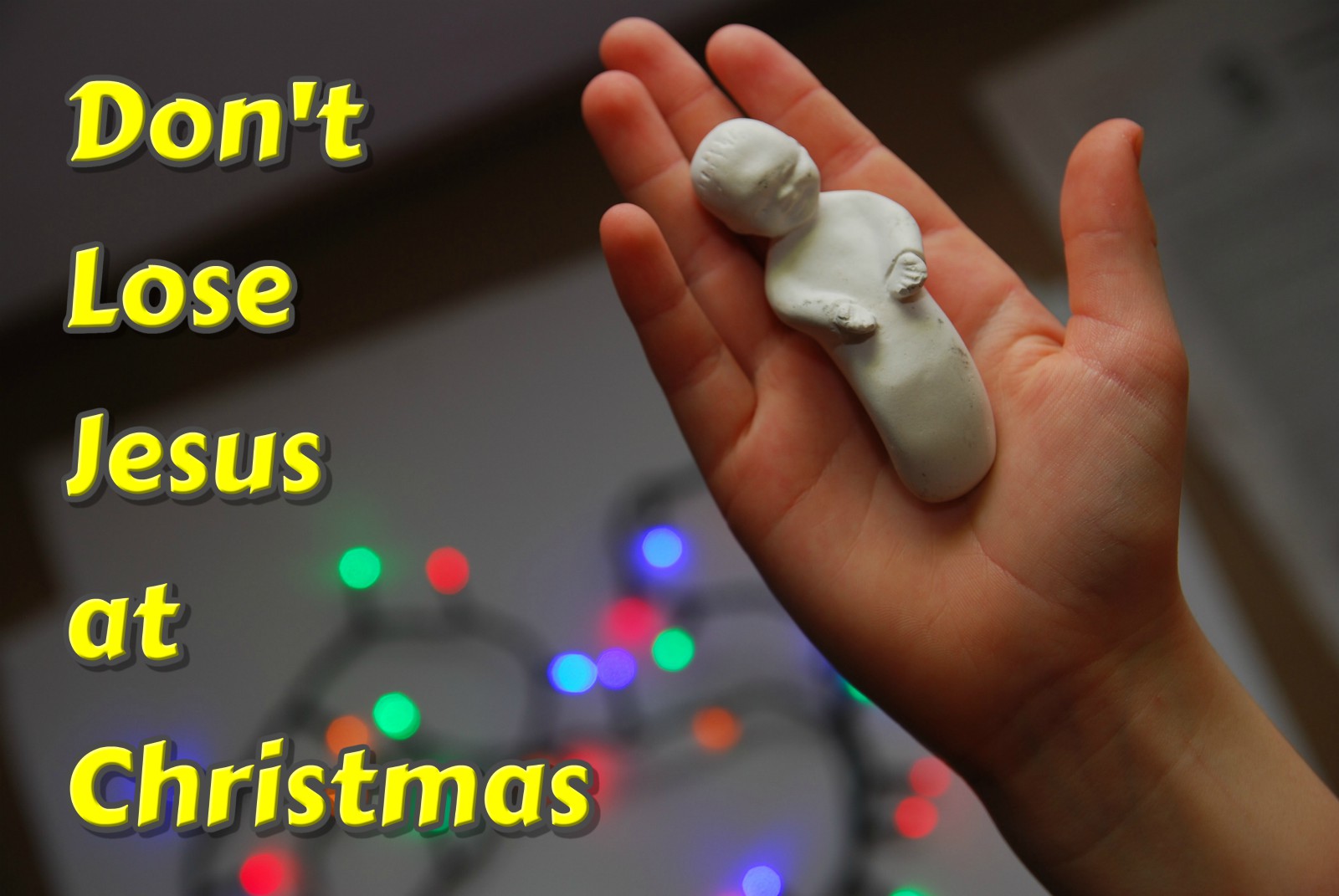
Don’t Lose Jesus at Christmas

If this were a normal year, churches and some schools would be busy preparing for the annual nativity play. Old curtains tied with rope, shiny cardboard crowns, gold-wrapped empty boxes and white sheets with tinsel. If this were a normal year, some groups would be keeping it simple, while others would be driving the event to a whole new level. If this were a normal year, some groups would see guests filing into their seats, only to realize behind the stage that Jessica forgot to bring her doll to be Jesus. This is no normal year.

What happens if you lose Jesus? In a normal year it would mean a parent driving home like he was being chased by the Police (hoping he doesn’t get chased by the Police). This is no normal year. So what does it mean if you lose Jesus, not just from a nativity play, but from Christianity itself?

Some preachers preach with Jesus eerily absent. Their sermons tend to drift towards moral lectures and the policing of church and society. Nobody in the world really cares what we think of its failures, and to be honest, we in the church don’t find this kind of preaching that helpful either.

Some evangelists lose sight of Jesus, too. Their presentations end up offering some sort of moral-change gospel – which is no gospel at all. You have been bad, judgment is coming, God can help you fix yourself . . . uh? The Gospel?

Some Christians accidentally drop Jesus as well. Our personal spirituality gets marked by a distant God, and we then become very “fallen human” again. Everything becomes about me. I must try harder, be more disciplined, behavioural in my focus. Bible reading will tend to focus on “walk worthy,” but my eyes will miss the truths underlying these exhortations.

In John 5, Jesus rebukes the religious elite for being diligent Bible men but at the same time, for ignoring him. They knew their Hebrew Bibles, but they missed how God revealed himself throughout those sacred books. They missed how his call to them was not primarily behavioural, but a call to faith – trusting not only the promises, but also the Promiser who walked amongst them on so many occasions. They had read their Bibles with self-glorifying lenses in their reading spectacles and so had lost sight of the person revealed throughout. Lose him and the relationship becomes a religion.

When we lose Jesus from Christianity, we lose any real sense of relationship with God. We become self-glorifying and we become vigilantes policing those around us. There may be no nativity play to worry about this year, but think about the bigger danger – the danger that we drift from a Christ-at-the-centre Christianity in our personal spirituality, in our evangelism, in our preaching.

Don’t Preach a Christmassy Christmas

It is easy to preach Christmas in a Christmassy way. You know, quaint and familiar cliches that smell a lot like an other-worldly fairy tale. It will have beautiful scenes and an eclectic array of two-dimensional characters. And our listeners will guess where the message is going: kindness to others, unity amidst division, celestial sentiments of goodwill and a few references to eating too much.

The first Christmas was no fairy tale. So we should not preach Christmas to satisfy the nostalgic yearnings of a weary public. Nor should we sprint past the stable to get to a post-Christmas presentation of the Gospel in order to satisfy the more robust preaching critics from pew four.

The birth of Jesus occurred in a context of great confusion and tension. Jesus entered this world to change things. And if we can enter that world, we might better grasp the hope for our world today.

Just think of all that swirled for the characters that first Christmas:

The shepherds were social outcasts who received one of the greatest visions in human history. They were stunned. And they needed the angel to stir them to leave their sheep and dare to follow up on the heavenly announcement. If the angel hadn’t deliberately mentioned the manger, and therefore, the poor surroundings of the newborn king, they would have probably stayed in the fields impressed by their vision.

The Magi were trusting in obscure information passed down to them and what they saw in the night sky. Prophecies from foreign documents, long and dangerous travel, no guarantee of fruit from their journey. We can only imagine how bizarre it must have seemed to them (as well as how bizarre they felt as they arrived at their destination!)

Mary and Joseph got their life-changing information from Gabriel – it was truly momentous news, but so much was left unsaid. What would they say to others? How would they explain this? Would they even be able to live in their home town? How would family react? Who would trust Joseph’s word in business now? Lots of questions about the little stuff of real life.

But as they all lived that first Christmas, God did give them what they needed. They heard or discovered God’s kindness, God’s faithfulness, God’s timing, God’s plan to deliver people from their sins, even what God would look like if he came in human flesh to be with us!

As we preach Christmas this Christmas, let’s not sound too Christmassy. Instead, let’s invite people back into that world, so that they can discover how Jesus came into our world, for real people, with real issues, real fears, real doubts, and real questions. Let’s stand next to an unnamed shepherd or Joseph, not knowing what the next years will bring, but knowing that God has cared enough to do something about it! Life was complex before 2020. They didn’t used to live two-dimensional cartoon lives. Preach the real Christmas, and give real hope, this Christmas.

Home for Christmas?

There is something poignant and powerful about the word “home” at Christmas. Maybe this year it will be even more so. With government imposed lockdowns and this year’s coronavirus making life complicated, we may not be able to be home for Christmas. Or we may not be able to be together, at home, for Christmas. For some this is true every year – there are empty places at Christmas.

The Christmas story as it is told usually includes some reference to the wonder of God the Son leaving his heavenly home to come down to earth. His welcome? Not a stunning palace and well dressed attendants. No, humble shepherds, gathered around an animal feeding trough. There wasn’t even place in the inn, so it all happened in a lowly stable.

At the risk of stomping on your nativity set, can I point out that reality may be even better than folklore? What actually happened is slightly different than what we tend to hear each year. Luke 2 tells us that Mary “gave birth to her firstborn son and wrapped him in swaddling cloths and laid him in a manger, because there was no place for them in the inn.

What was it really like? The “inn” was not a reference to a public inn as in the story of the Good Samaritan, an Israeli motel offering rough accommodation for traveling Jews. Rather the word used by Luke refers to the guest room attached to the back or the top of a single room family home. Joseph, with his family heritage would have received a welcome in the little city of David. And we do a disservice to Middle Eastern folks if we think young pregnant Mary wouldn’t have been looked after.

They didn’t get the guest room, because other visitors were already there. Instead they were probably brought into the single room residence of this humble family in Bethlehem. At the front end of the room there would have been a drop down to the area where the animals would be kept at night (for the animal’s security and for their central heating benefits). The sheep would have a wooden or stone manger, the family cow and the donkey would eat from the trough cut into the floor at the end of the human living space. It isn’t probably what we would choose, but it has a certain charm, nonetheless.

This was typical of the homes then, and culturally this would have been the situation. Perhaps not quite the quaint stable, but what a gripping image! The Messiah wasn’t born in a palace, but in a humble home.

Incidentally, the reference to the manger would have been important in the message of the angels to motivate the shepherds to come for their visit. After all, why would they leave their fields to go looking for a baby with a heavenly fanfare announcing his birth? Maybe if they knew he would be in a humble home like their own? Furthermore, if he was actually born in a stable, the shepherds would have insisted on a transfer to their humble homes – again, Middle Eastern hospitality! The young family didn’t even get the guest room, but the special little one came in the family home, with the women of the home helping Mary, then the men coming in to gaze in wonder at the new boy.

Maybe this is a good year to make something of the stable correction. Maybe this year we should help people to understand that the stable image may be humble, but it probably isn’t accurate. And actually, the living room of a poor peasant family is just as humble. We may not be able to gather people together in our homes this Christmas, but we know that Jesus would come into a home like ours. He was born into a more humble home that first Christmas!

Christ by highest heav’n adored, Christ the everlasting Lord!
Late in time behold Him come, Offspring of a Virgin’s womb
Veiled in flesh the Godhead see, Hail the incarnate Deity
Pleased as man with man to dwell, Jesus, our Emmanuel
Hark! The herald angels sing, “Glory to the newborn King!”

Christmas is a time when our thoughts turn toward home. What a truly glorious thought, that Christ left his home to come and be born in a humble human home. Pleased as man with man to dwell, Jesus, our Emmanuel. Our God, with us!

Preaching Christmas at Christmas

Even though 2020 is a unique year, Christmas is still an amazing opportunity to preach to people who normally don’t come to church. Maybe you are meeting, or maybe you are preaching online. But how do you make the most of preaching Christmas at Christmas?

1. Pray lots – there is a massive spiritual battle going on and the enemy wants to keep people looking at anything except the truth of the gospel. As Christmas approaches, he will also try to keep preachers distracted from the wonder of the gospel too. Pray lots, and keep your eyes on Christ!

2. Preach fact – it may seem like a Christmas card cartoon myth, but it is not. Luke launched his gospel with a declaration of the trustworthiness of his message. Let’s follow his lead. Look for any opportunity to underline that the Christmas story actually, literally, historically, physically happened.

3. Correct carefully – in your quest for historical truth, be careful not to over-correct every detail. A critical spirit never communicates well. Jesus wasn’t born in a cattle shed, Mary was not transitioning to hard labour as she arrived in Bethlehem, and the Magi could well have arrived that night after all. Be careful with correcting long-held beliefs, and be careful with your tone when you do correct.

4. Celebrate sensitively – this season comes with its own hype, and we may be tempted to breathe a sigh of nostalgic familiarity as we celebrate another Christmas. But remember that Christmas is bittersweet for many people. There are empty chairs at the table, and Christmas tends to underline the deep ache. Take a moment in your message, or in a prayer, to recognize the difficulties as well as the joys of the season.

5. Proclaim the good news – Christmas is not primarily about sentimentality and pleas for peace. Primarily, it is vertical and not just horizontal. Jesus came into this world to bring us back to God. Don’t miss the moment and just preach a nice message. Be sure to proclaim the best news!

6. Undermine assumptions – People who don’t normally come to church have assumptions (actually, many who do come to church regularly still have some of them too!) This is a great opportunity to undermine some of these assumptions. There is a historical reality to the Incarnation. God’s character is very different than people tend to assume. People think they know what God is like, and what God wants from them. Christmas is a great opportunity to move people from “malevolent majesty” notions of God, to the manger where God’s humility bursts onto our scene with the humble cries of a newborn.

7. Worship personally – as I mentioned the other day, don’t lose the wonder of this season. If you don’t feel it, why will your listeners? Spend some time with God. Let him warm your heart up to the season again. Then go preach Christmas this Christmas!

Christmas Expectations

Christmas is a strange time of year. And this year, Christmas will feel strange too. Maybe you are meeting. Maybe you are just meeting online. Maybe you are meeting but can’t sing. Whether you are preaching to a live congregation, or the lens of a camera, it is time to preach the Christmas message!

1. Listeners have some expectations of the message that should be met.  People are coming (or watching) with some expectations of Christmas. They expect to hear the story of Christmas in some form. They expect to hear references to Christians celebrating Christmas. They may well be expecting some personal warmth, and maybe this year especially, some reassurance that not everything has changed.

2. Listeners have some expectations of the message that should be shattered.  They may well expect the message to be antiquated, almost fairy-tale like and safe.  What an opportunity for your listeners to be surprised that the Bible is actually interesting, and profoundly relevant, and disarmingly engaging. Don’t just comfort them with nostalgic Christmas catchphrases. Introduce every listener to a heightened sense that God intended Christmas to be uniquely relevant to them.

Let’s pray for one another as we preach the Christmas message this month!

Christmas Wonder

One of the greatest dangers we face in ministry is losing the wonder of what we speak about. The demands of ministry are always high, and this year, maybe even higher. There are the expectations of people, the burden of creativity (only two pairs of Gospel chapters to preach from!), the pastoral concerns that don’t lessen in the dark days of December, extra responsibilities and expectations at home, and so on. How easy it is to lose the wonder of Christmas!

I don’t want to try to prescribe how to keep the wonder of it all this Christmas. I just want to suggest that we do. What will it take? Time with family – proper time? Extra guarded time alone with God? Is there music that triggers your awe at the Incarnation? Or a good book? Whatever it takes.

As we head into this unusual Christmas season, there are definitely pressures building on us. Let’s look to be captured by the grace of God as he chose to step into our messy world. Let’s look to be gripped by the hope held out in the Christmas story for a dark hurting world full of sinners – sinners ruled by sinners, threatened by death, worried about issues local and global (true then as it is true now!) Let’s look to be stirred afresh by the history-hinge of the Incarnation.

Ponder the first Christmas in all its gritty reality. Ponder the Incarnation in all its theological wonder. Ponder the questions raised for the first characters as they watched it unfold. Ponder the answers given to any willing to probe the truths of biblical revelation. Ponder the journey Jesus took from Bethlehem to the Cross. Ponder the everlasting nature of Christ taking on flesh. Ponder the hope that we have of seeing him one day for ourselves. Ponder. Ignite the wonder. Whatever it takes.

Book Launch Video!

Now that The Little Him Book is officially launched, here is a video interview to introduce the book. As before, any help in getting the word out about this book is really appreciated. I am hoping that people will get creative with giving this as a Christmas present this year … after all we have experienced in 2020, we all need to get our eyes back onto Jesus!

And here are some brief video endorsements too:

In the UK/Europe, please go to http://is.gd/himbook

In the USA, please go to http://10ofthose.com/mead

8 Benefits of Effective Transitions

It is easy to put a lot of energy into explaining the passage, applying the message, adding interesting illustrations, and so on. But what about the transitions? These little moments can be treated as automatic, but by neglecting them we miss a vital part of sermonic effectiveness.

What potential benefits do the transitions have as tools in our preaching arsenal?

  1. Clarity of Sermon Structure – You may have a very clear, balanced and organised outline, but without good transitions, your listeners won’t know! The transition is the cleared air that allows for the structure of the message to be clear. And when the structure is clear, the listeners get all the benefit of organised thought.
  2. At Pace: Breathing Space – After a few minutes of your preaching point, especially if it has been growing in intensity or pace, the transition allows everyone to take a breath. Some preachers may be ponderous, but others like to charge ahead at full steam. Listeners may appreciate energy and enthusiasm, but they also love to take a breath.
  3. Slower? Evidence of Progress – If your style is more ponderous, don’t underestimate the value of giving listeners a sense of progress. Maybe you tell them at the start that you have three points . . . the transition and its focus on moving to the next point may be exactly what some listeners need to hang in there!
  4. Re-entry Points for Listeners – Whatever your pace, listeners do get lost during the progression of a sermon. Someone drops something, a phone buzzes, a thought occurs, a helper from the childcare taps a shoulder, a siren passes . . . and people lose track of the message. The transition is a great moment to mention the main idea, review progress, and invite listeners back into the message.
  5. Restatement of Main Idea – Any opportunity to reinforce the main idea is worth considering. A handful of transitions in a message are as good a set of opportunities as you could ask for!
  6. Change of Pace – Sometimes you have a point that takes a fair amount of background or explanation, but the message needs to speed up. The transition allows for a deliberate change of pace and injection of momentum.
  7. Review of Message – As a message progresses the transitions allow you to review what has been said so far. This can really help the listeners to be ready for the later points and conclusion of the message.
  8. The Next Point – Maybe this is the most obvious benefit of all, but I have saved it for last. A transition allows you to take your listeners from your previous point into your next. It is like having a passenger behind you on a motorcycle. Take the turn too quickly and you lose them. Slow down, transition well, and they come right along with you into the next point!

Transitions are underrated. Focus on them and your preaching will improve!

10 Reasons You Can’t Cancel Christmas

With everything that is swirling around in this turbulent winter, there are lots of rumours about Christmas 2020 being cancelled, curtailed, or at least more complicated.  Maybe you are trying to work out how to do church without the normal December schedule of carol services and special events. Maybe you are ordering all your presents online for the first time, or just wondering if you will be able to spend time with loved ones at all this year.

Even if Christmas could be cancelled, the Incarnation cannot.  And that is a reason to rejoice, whatever our circumstances.

Here are ten implications of the Incarnation – ten realities that cannot be cancelled, but must be celebrated in 2020 just as in every other year:

1. Revelation.  As the Christmas story draws to a close in Luke 2, we see Mary and Joseph bringing Jesus into the temple courts, where they encountered Simeon.  He took Jesus into his arms and declared that he was now ready to die, for he had seen God’s salvation, “a light for revelation to the Gentiles…” (Luke 2:29-32) Because Jesus had come, Simeon was ready to go.  Nothing could top that moment.  Let’s pray that the wonder of the revealing of God’s saving person and plan would shine bright in our hearts this winter.  We have Jesus; what more do we need?

2. Response.  Walking through Luke’s narrative will show us many realities to celebrate as we think about the Incarnation.  In Luke 1:13 we see Zechariah stunned at the sight of the angel standing beside the altar of incense in the temple:  “Your prayer has been heard…”  Maybe this was a prayer from years earlier, maybe even decades had passed since he had prayed about having a son, but God is a God who hears prayer and responds to it.  Let’s pray in the midst of dark times, confident that God hears prayer and responds to it.  That first Christmas demonstrates to us that God hears, God cares, and God is more than able to respond.

3. Invasion.  Zechariah was stunned to hear that his wife would be giving birth (a miracle!), and that their boy would have a key role to play in God’s plan (greater still!), because he would prepare the way for the Lord himself (the greatest news!!).  After centuries of silence from heaven, now this!  Not just an angelic visit.  Not just a miracle birth.  But the moment when the Lord himself would invade this world (see Luke 1:17).  Let’s pray that we would not miss the significance of the hinge of history – the moment when God the Son stepped into this world on his great eternal rescue mission!

4. Reign.  After Zechariah we see young Mary, startled by the angel bringing her the glorious notification.  In the midst of all he told her, we read these words: “the Lord God will give to him the throne . . . and of his kingdom there will be no end.” (Luke 1:32-33) The Son of God wasn’t just touching down for a brief incursion.  This invasion would lead to a kingdom, a kingdom that, unlike human governments, would not be temporary.  Let’s pray with confidence that our King is on the throne, and will be on the throne, forever.  The story of human empires rising and falling will conclude with one perfect human reigning over a kingdom that will never fall!

5. Union.  Mary was perplexed, but the angel soon explained that she, a human, would be overshadowed by the power of the Most High and so her child would be both human and divine.  She would give birth to the Son of God (Luke 1:35).  This is the middle link in a glorious chain – first the union of God with God (the Trinity), then the union of God with man in man (the Incarnation), which makes possible our glorious union of humanity with God in Christ (Union with Christ).  Let’s pray that we would live in the light of these three great unions – the blazing light of Christian truth in a dark and broken world.

6. Recognition.  Mary celebrated the wonder of God’s mercy toward her and to all who fear him in her famous song.  He who is mighty “had looked on the humble estate of his servant” (Luke 1:48). God is so high, and yet he recognises the realities of the smallest and weakest of his people.  Let’s pray in light of Mary’s celebration, because God recognizes the vulnerability we feel and the humility of our circumstances.

7. Remembrance.  Mary finished her song celebrating the big picture.  Long ago, God made promises to Abraham and the Patriarchs.  Thousands of years later, God kept his promises (Luke 1:55).  Our God is a God who makes promises and keeps them.  Let’s pray with confidence that God has a plan that he is working out in our world, and nothing will stop him from keeping his promises.

8. Redemption.  After John was born, Zechariah emerged from months of enforced silence to celebrate this great moment in salvation history.  He launched his song of celebration with “Blessed be the Lord God of Israel, for he has visited and redeemed his people…” (Luke 1:68) The invasion of God the Son into this world to set up his kingdom would involve a daring rescue mission.  He had to redeem his people, enslaved and trapped in this sin-stained dungeon of death.  Let’s praise God every day for the way he redeemed us, buying us back from death and bringing us to himself!

9. Illumination.  Zechariah’s final words in his great prophecy speak of the tender mercy of God that gives sunrise from on high – in this dark world, we so need the light that Christmas brought into our world.  We sit in darkness and the shadow of death, but the Incarnation gives light (Luke 1:78-79).  The world feels darker in 2020 than it has for many years, but let us pray that the light brought by the Incarnation would shine in our hearts and through us into a dark and dying world.

10. Peace.  As we step into the familiar territory of chapter 2, we find those shepherds sitting in the dark field as the angels burst into song praising God, “Glory to God in the highest, and on earth peace among those with whom he is pleased!”  So much has changed this year.  But nothing has changed.  God is worthy of all glory, and the peace that broke into our world back then is still just as real today, as we continue to live in anticipation of the total peace that only Jesus’ reign on Earth will bring.  Let’s pray that our hearts would be peaceful this winter, and that God would be glorified by more and more people coming to know what it means to be those with whom he is pleased!

______________________________________________

Pleased to Dwell introduces the glorious biblical truth of the Incarnation.