5 Aspects of Natural Delivery

What makes for effective delivery in preaching? Gone are the days of appreciating the diction and power of a voice fit for the radio, or the grand gesturing and stage presence of yesteryear. Today effective delivery has to be natural.

People want to listen to preachers that are genuine, honest and real. People resist the polished sales patter of a car salesperson, the reading of a script in a phone conversation, or the phony demeanor of an average stage performer. People definitely do not appreciate the ranting and pontificating of old school preaching.

So how can a preacher be natural in delivery? A deep breath and determination to relax doesn’t cut it. Here are five aspects of natural delivery that might take some work:

1. Natural eye contact feels unnatural. It is almost impossible to overstate the value of eye contact in spoken communications. You would not buy from someone who wouldn’t look you in the eye. Our natural tendency will be to find security in our notes and when we dare to lift our heads out of our notes we will naturally look anywhere but the eyes of those who are judging us. It feels unnatural to learn to linger long enough to make meaningful eye contact with someone in the congregation, and then move on to make meaningful eye contact with someone else. It may only take a second or two, or sometimes it takes a few more, but it is worth it. (And the opportunity will only increase when our note-reliance decreases!)

2. Natural sized gestures feel unnatural: size of gesture. If you plan your gestures you will probably look like a puppet. I am not advocating for planned gestures at all. But it does take some work to make gestures appear natural to our congregation. Generally speaking, the bigger the congregation, the bigger the gesture. A little gesture in a conversation (or preaching to a camera) will look ridiculous from seven rows back in a large crowd.

3. Natural gestures feel unnatural: direction of progression. Logically we think from left to right (in our culture). So the past is logically to our left, and time moves towards the right. Gesture with that logic to a congregation and it just won’t feel natural to them. They will interpret, maybe subconsciously, but there is a slight jarring effect. Learn to present from right to left as your reference moves from past to future, or from your first point to your later points, and your listeners won’t skip a beat.

4. Natural explanation can feel unnatural. In a conversation you can often say something once and assume it has been heard, registered and even imagined. Not so with a group. It is not about their individual capacity to comprehend, it is about the distracting effect of being in a group setting. For concepts to formulate in their consciousness, a group of people typically will need more repetition and restatement. Don’t fire off a concept and march on. Make sure you give it the words, and the time, needed for the concept to be heard, registered and grasped. Don’t hurl an illustration past your listeners. Do what it takes for the image to project on their internal screens with clarity.

5. Natural delivery takes unnatural attention. If you just do what you naturally do, how do you know how you come across? It takes effort to pray about your life and your delivery co-existing in a natural and spiritually healthy congruence. It takes effort to ask for specific feedback from a variety of listeners, prompting them to be really honest, so that you can actually know how effective your delivery is. It takes effort to get yourself preaching on video and take stock of your presentation.

I am not saying we should perform. I am saying that it takes some effort to communicate naturally and effectively. There is probably something for every one of us to improve. Just taking a deep breath and trying to relax will not make you communicate well (although it may help a bit).

Some comedians are hilarious on stage and then angry drunks in the dressing room. Are you the same you in conversation after church? Are you the same you when you close the front door at home? Performance is unsustainable. At the same time, effective communication is worth some conscious and prayerful attention.

______________________________________________

Here is a resource you might enjoy:
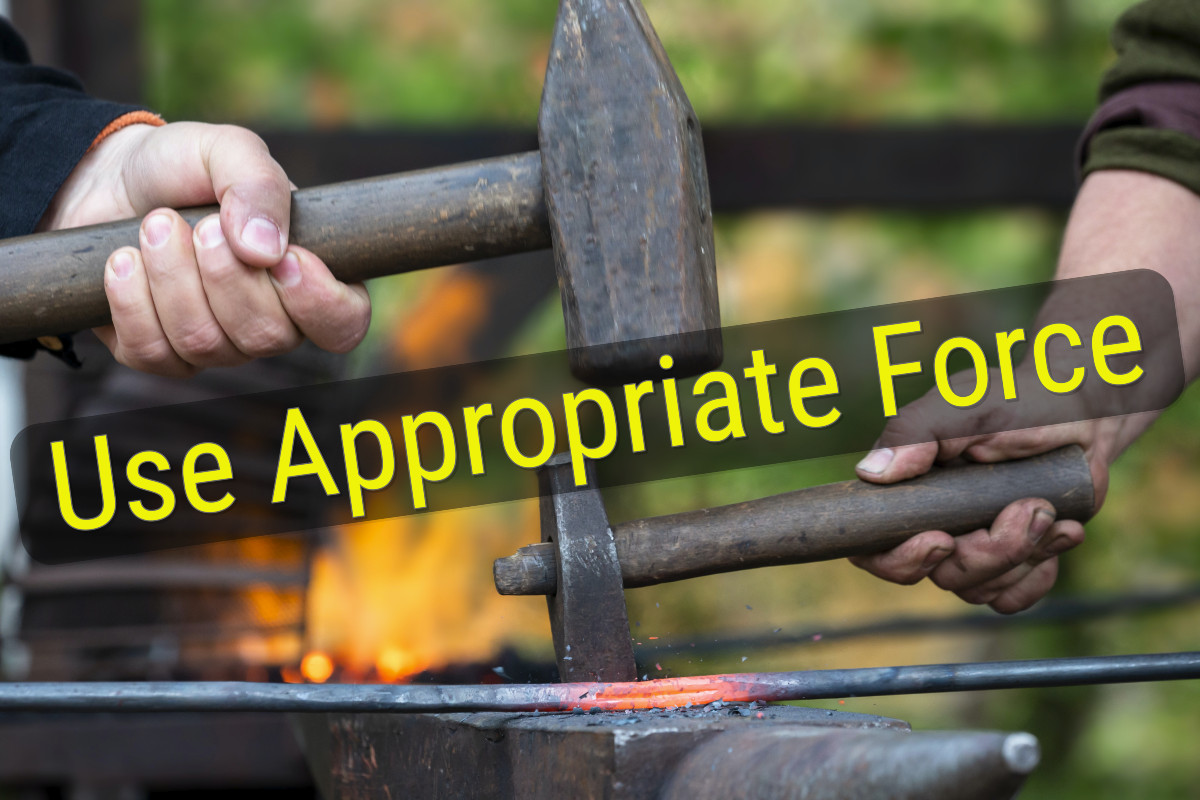
Use Appropriate Force

Tapping a nail into a wall with a sledgehammer, or pulling out a tooth with a tractor, would probably be considered an excessive use of force. I remember hearing about someone trying to loosen a wheel-nut on his car with a blast from a shotgun (he did get injured!) When we preach, we should aim to use appropriate force for each goal we are trying to achieve. Excessive force can really backfire in the pulpit. Here are some examples:

1. Overstated introduction. Your message is unlikely to solve every problem on the planet, so don’t over-egg the introduction. One of my teachers used to say that you shouldn’t roll out a cannon, only to fire a pea. This doesn’t mean that your introduction should be weak or full of supposedly humble disclaimers. Whatever you are preaching, create a thirst for the message and the passage, a thirst that the message can then quench. Promising too much can really backfire when what you do give feels like a disappointment.

2. Overpowered illustration. It is good to include content that will help to engage your listeners and enlighten them during your message. But if your personal story or powerful anecdote is too much, then it will backfire. Make sure your illustrations drive the main idea forwards, not overtake it and bury it in their dust. Even if the story is all true, and it happened to you, and it is relevant . . . it may be worth holding it back rather than letting it bury your message.

3. Over-the-top wording. We live in an age of extreme claims. Social media is full of absolute and total statements, as well as increasingly shocking headlines serving as clickbait. Be careful not to bring that tendency into your preaching. You have 20, 30 or even 40 minutes, not just 280 characters. Shocking a congregation, or describing something or someone in extreme terms, will be tempting. Don’t do it. Speak carefully and precisely so that people can sense that you are trustworthy with your words.

4. Over-relevant application. If you are a visiting speaker you can often hide behind your lack of personal knowledge of the local situation. But if this is your church, and these are your flock, then you need to be careful. A passage may sit up nicely for an application about divorce, financial integrity, or whatever. Yet if your congregation has a known marital breakdown, or a director under review for embezzlement, or whatever, then it may be better not to be quite so relevant with what you say on Sunday.

5. Overblown humor. It is not a sin to say something funny while preaching. But if you have to try too hard to get a response, then you are trying too hard. Don’t do it.

6. Over-pressured persuasion. There is a place for persuasion in the pulpit. But there are ways of pressuring people to respond to the Gospel, or to an application, that are excessive and unhelpful. Trust God to do the life changing as you seek to faithfully and effectively herald God’s Word. When their response becomes contingent on your pressure techniques – in wording, in tone, in manipulative practices – then your force is excessive and it will backfire.

Where else in a sermon can you apply too much force to get the job done?

10 Sermons to Eliminate

I came across a list of surrogate sermons by a Dwight Stevenson. This is a list worth reviewing. I used his titles and added my own descriptions. If you spot any of these in your ministry, maybe it is time for a spring clean!

1. Aesthetic artifact – an overly ornate work of art that is aiming to be a blessing to behold for generations to come, but not particularly targeted towards these listeners today.

2. Moralistic harangue – a sermon intended to merely exhort or punish our people because of their failure to live a certain way. People do appreciate this kind of sermon as a form of surrogate suffering. Like medicine, “it is a fine way of paying for sin without repenting of it.”

3. Museum lecture – a sermon that aims to be interesting and informative, tends to be dull and boring and is usually quite irrelevant.

4. Palliative prescription – a pendulum swing away from the moralistic harangue is the trap of cheap grace, easy assurance, repentance free pardon and most of all, superficial pain-relief.

5. Palace propaganda – a sermon that caters exclusively to the whims and preferences of the given church. Their ears itch and the preacher loves to scratch. Another church down the road may be hearing the exact opposite message (different socio-economic class, race, political leaning, etc.)

6. Theological lecture – a sermon that promotes a system of theology more than the message of the biblical text, and that elevates transformation by education in a surrogate seminary classroom. Of course our theology matters and preaching should be shaping it, but when preaching becomes a hand maid to our promotion of dogma, something has gone awry.

7. Argumentation and debate – a sermon that would fit in the courtroom is not necessarily helpful in the church. It is always tempting to set our sights on a theological position (or person, or book!), or a moral concern (or political issue, current event, etc.), and to go on the attack in a way that is not actually helpful for the people listening. If our preaching never challenges anything, we have a problem, because the Bible certainly does. But if our preaching breeds only counterattack, controversy and division, we have become Christ’s lawyers rather than his witnesses.

8. Eulogy – this is a platitude-ridden sugar festival of non-answers to real life realities. It may sound very spiritual, but is it more syrup than substance? Does it actually come from the text? Does it actually land in real life?

9. Ecclesiastical commercial – a sermon that feels like a message from the sponsor, and the sponsor happens to be the churches other programs. Promote them outside the sermon as a general practice.

10. Monologue and soliloquy – a sermon motivated by the preacher’s delight in hearing his own voice. There is no real concern for the reaction or the impact in the lives of the listeners. The motivation is self-concerned.

The Bible does not merely give a starting point, or illustrative material, or a stamp of approval.  The Bible has to be in charge of the message – its main idea, its flow of thought, its relevance, its goals.

4 Questions for Your Sermon Outline

You have worked in the text, and worked on the message. You have a main idea, and an outline. Now take the opportunity to evaluate the outline.

Remember, the outline is for you, not for the listeners. You are not an educator seeking to transmit an outline to their notes or their memory. You are a preacher and the outline is an overview of your strategy for communicating the biblical idea relevantly to the hearts of your listeners.

Here are four questions to interrogate your outline and strengthen your sermon:

1. Does this message have unity? Considering all the elements – the points or movements – is the whole idea covered, supported and developed? Is the whole biblical text sufficiently covered in the message? Do the points of your message cohere? Is anything missing, or is anything present that doesn’t seem to fit?

2. Does the message order make sense? The elements of your outline should advance in a logical order. Typically, although not always, this will be the order of the text.

3. Do the sections of the outline feel proportional? It is tempting to just look for a rough balance in the number of verses covered by each point, but that is a bit lazy. You really need to know the passage well to answer this question. Do the points of the sermon carry the freight proportional to their relative weight in the passage? And from the listener perspective, will each point feel like an achievable step in the progression of the sermon?

4. Does the sermon progress? Each point should generate forward movement. Listeners don’t feel comfortable circling forever, or going backwards, or standing still. The order has to make sense. The progress has to be felt.

The outline is an important overview of your sermon. Personally I wouldn’t generally suggest it is helpful to give the outline to your listeners, or even to take it with you into the pulpit. However, it is important in your preparation to be able to evaluate the message before you progress to preaching it through.

6 Questions About Illustrations – part 2

Yesterday I gave four questions to get us thinking purposefully about what we are doing with an illustration and where we are getting it from.

Here are two more questions that we need to consider:

5. Even if it is a good illustration, is it self-destructive? You might have a great idea for an illustration, but beware of some that self-destruct. Here are some to watch out for:

  • The Overpowering Illustration. If the emotional impact is too great, then people won’t hear the point, or even the sermon. (Details of your car crash, your surgery, your pet dog’s death, etc.)
  • The Morally Questionable Illustration. If the morality of your illustration raises concerns, then people won’t hear your point, or even the sermon. (It doesn’t have to be sinful to trigger this outcome – referencing some movies, or hobbies, etc., might trigger a “sin!” reflex in some of your listeners.)
  • The Complicated to Explain Illustration. If the backstory or complexity is such that it takes too much effort, then people might forget your actual point. (Many movie illustrations trigger this outcome – unless literally everyone knows the film, or the set-up can be really swift, it may be worth looking for something else.)
  • The Tribal Illustration. If the story elevates a sports team where the listeners may be tribal (some don’t like that team), or where some listeners are tired of sports illustrations, or if you push a political perspective or person (and some aren’t onboard with your perspective), then people will likely remember their reaction to this rather than the point you were making.

6. Are you missing the value of the non-illustration? Sometimes we can be so in the habit of finding illustrations for our preaching that we forget the value of the non-illustration. I don’t mean speaking in a monotonous complicated and academic lecture. I mean recognizing that sometimes the explanation of the context of a passage, or the presentation of the passage itself, can be so vivid and engaging that it feels like you are illustrating when actually you are not. Narratives tend to offer us the potential for powerful storytelling. Poetry tends to offer vivid imagery. Even the epistles sometimes offer illustrations built into the passage. Don’t rush to your illustration file before checking if the text can engage the listeners with a vivid presentation and a sense of resonating relevance.

Illustrating a sermon is not easy, but hopefully these questions might help. What else would you add?

6 Questions About Illustrations

Good preachers make illustration look effortless, but for most of us it can be a real struggle. Here are a few questions that I find helpful:

1. What’s the purpose of your illustration? Too many preachers default to simply adding in illustrations because there hasn’t been one for a few paragraphs, or because they think they should. It works much better to define your purpose. At this point in the message will your listeners be needing explanation to clarify the point you are making? Or will they need support to prove the point? Or perhaps application to picture themselves applying the point? Generally it is better to identify what you are trying to achieve and you will probably achieve it more successfully. Explain, prove, apply . . . or perhaps give a break in the intensity to allow them to re-group. Decide what is needed and then you are more likely to find it.

2. Are you relying on their knowledge, or does it touch their experience? People will always connect more with what they have experienced than what they know. People are more likely to remember cross-country running at school than have experience of running in the Olympics. They know what it feels like to get stuck in traffic, but probably not what it feels like to step out of a spacecraft. Instead of going for the more exotic, consider if more mundane might connect better.

3.  Have they experienced it, or are they simply having to hear about yours? The best illustrative material tends to be experienced by both speaker and listener. It is easy for you to describe and easy for them to imagine. If this isn’t possible, then consider whether you can do the learning and speak of what they know personally, rather than always asking them to imagine what you have experienced personally. It won’t always be possible, but worth the effort when you can.

4. Are you falling into the laziest and weakest forms of illustration? There are plenty of illustrations that fall outside your experience and knowledge, and their experience and knowledge. The illustration anthologies are full of them. Obscure anecdotes and clever quotes from yesteryear. Wartime speeches, heroic moments, distant pithy quotes. Generally speaking these will seem far more effective on paper than they do in actual preaching. At the very least, can I suggest that if you love this kind of illustration then at least try to balance these with something more immediate and normal? (You may love your 1950’s football stories, or WWI trench poetry, but your listeners may not be so enthused.)

It takes work to illustrate well. Sometimes we have to go with something weaker than we’d prefer. That is preaching. But let’s try to do the best we can. (And tomorrow I will share the final two questions…)

Discernment Danger

You have probably heard the old adage: “bank staff learn to identify counterfeit money by handling the real thing.”

I suspect we have a growing problem today. Actually, several.

1. Too many of us don’t think counterfeit money exists. Actually, I am not thinking about money. I am referring to ideas and agendas. Too many of us are shockingly naive. We have a vague notion that there is sin in the world, but still we assume that nobody could have ulterior motives as they deal in words (at least, not ones that are not immediately obvious to me). If you question the standard media or cultural narrative on any issue then you run the risk of being dismissed for believing conspiracy theories or being classified as a bigot or nutcase. Hold on, assuming the media or culture has no motivation to push anti-God, anti-Christian, or anti-truth agendas is about as crazy as suggesting nobody has any motivation to make or use counterfeit money! This world is full of lies and it cannot be the job of Facebook or Twitter to guide us into all truth.

2. Too many of us spend too much time handling “funny money.” Again, I am not thinking about money. I am referring to social media, mainstream media, Hollywood/entertainment media, news, etc. If we believe it is all neutral and trustworthy, we will become eerily unaware when our values are molded into the shape of this world, rather than being transformed by the renewing of our minds. How easily we can give hours each day, tens of hours each week, to a cultural indoctrination program that we don’t really believe exists. Is it time to take stock and stop feeling so impervious and maybe even being so arrogant?

3. Too many of us spend too little time handling the real thing. You might prefer this post to be about handling money, but that is not at all what I am writing about! I suspect that one of the big problems in our world today is that too many of us who know God and the truth of His Word are too distracted by the communications of this world to really soak in God’s Word. What this world needs is not primarily for us to be constantly active on social media, thoroughly conversant with every news story or knowledgeable about every movie (all of these may have some value, of course). What this world needs is men and women who are strangely soaked in God’s Word, “divines” if you will.

I know which of these three points has convicted me. Which is on target for you? If you aren’t sure, start with number 1.

We Are Not Performers

Whenever we preach we will be tempted to perform – our flesh will see to it. We know it is not supposed to be a performance, and we may feel strongly opposed to any notion of entertainment, but still the temptation is always there.

We do not preach to fill time. We preach to stir people and see lives being transformed by God. And we will notice how dull presentation has less impact than enthusiastic, or passionate presentation. In fact, we may notice quite a number of things that seem to make a difference, and before we know it, performance can sneak into our ministry.

Here are three ways to protect the pulpit from you . . . I mean, three ways to avoid performing:

1. Let preparation marinade. Last minute preparation can lead to pre-sermon desperation. In that state we may start to believe that certain strategies and tactics are our only hope. (Last minute preparation is sometimes necessary, but how quickly we forget that God understands that and is so gloriously gracious!) As much as possible, give your preparation time to soak in. Generally plan your schedule so that you are not living in the desperation zone. Let your messages, and even your series, soak in so that they become part of who you are. Then instead of “lines through an actor” it has more opportunity to be “truth through personality.” Preach what you truly believe, not what you only latterly found or formulated.

2. Avoid the natural presenter’s fallacy. I just made up that label, but what do I mean? I mean the idea that if I prepare less then my presentation will come across more naturally. Fallacy. Prepare less and you will come across unprepared. Not preparing on purpose is a path that leads to meandering introductions, illogical transitions, incomplete thoughts, unhelpful illustrations, mistakes in explanation, missed objections, circling and looking for a landing spot, etc. Put in the work: craft your message, sweat during preparation, wrestle, pray, think, think more and talk it through with others. That kind of work does not lead to performance, it leads to better preaching. In fact, good preparation should lead to more genuine, from the heart, textually solid and sensitively targeted preaching.

3. Pray as if this matters. Over time we can grow really complacent. I’ve done this before and I can do it again. Really? Stop the “bless my sermon” prayers and pray as if you are actually reliant on God. Wrestle with God who is at work in you. Persist in wrestling for those who will be listening. There is a great spiritual battle raging around you and around them. Don’t step into the pulpit to fight a battle you have not first heavily engaged, and even won, in the prayer closet.

What would you add?

Spiritual Warfare and Pulpit Ministry

Spiritual warfare is a subject that stirs opposite responses. At one extreme we can become paranoid and give Satan credit for every little difficulty, whether the forces of evil were involved or not. At the other extreme we can easily become complacent and act as if the enemy is impotent around someone such as me. Both extremes are unhelpful.

If there is any arena in which spiritual warfare may be a factor, surely it will be in relation to pulpit ministry. The enemy would love to disrupt or damage the proclamation of God’s Word, the presentation of the Gospel, or the encouragement of believers. The worship of God really does get under the enemy’s skin.

So what tactics does the enemy use against us preachers? Here are a few to prayerfully consider:

  1. Pride. Visible, respected, influential . . . pride is an ever present trap for the preacher. Without fanfare it slips in, we start to believe our self-fanfare and before you know it, we live with a painful lack of dependency on God.
  2. Temptation. During preparation, perhaps during interactions at church, perhaps the day after. Waves of temptation can feel relentless. Pride, lust, anger, discouragement, etc.
  3. Distraction. Not every interruption is an overt spiritual attack, but it is amazing how often we can face a pastoral or family crisis at the most inopportune moment.
  4. Accusations. It doesn’t take much in the way of accusation or lies from the enemy to wear down our heaven-high prayers and lofty ambitions for a sermon.

What attacks do you recognize to be spiritual in nature? When do you often feel attacked?

New Year Resolute

Every New Year up to now seems to be the same.  People launch into new habits and patterns to try and bring about the changes they want to see in their lives. “This year will be different in what I eat, how I exercise, when I read my Bible, and so on.”  The New Year means new resolutions and it quickly becomes like every other year.

Maybe this New Year feels different.  COVID-19 and all kinds of political and cultural turmoil have launched us into a period of uncertainty that, for many of us, feels like uncharted territory.  This year will be different irrespective of what snack we avoid, what exercise regime we try, or what Bible reading plan we commit to follow.  This New Year we need to remember what is unchanging, so it can anchor us for the year ahead.

I would encourage you to spend some time with God and your Bible.  Make a list.  You could call it “Certainties in 2021.”  Or maybe “New Year’s Unchanged Truths.”  Or perhaps “Facts: 2021.”  Instead of a list of flawed resolutions, how about a list of Facts Resolute?

Here are a few facts that remain wonderfully unchanged, and you are welcome to add your own:

1. His Character – As you read the Bible you see not only an unfolding history, but also the heart of God being revealed.  His generosity in creation.  His power in deliverance.  His faithfulness in history.  His love in redemption.  His righteousness in judgment.  His character is there to be seen in one story after another, one era after another, one empire after another.  God’s character has always been a fountain of goodness in a dark and messy world.  That has not changed.

2. His Position – As you read the Bible it is clear that God is on the throne, even though that has been continually challenged by the forces of evil and sinful humanity.  Whatever 2021 may hold, it will not hold a threat to God’s rule. God is ultimately in charge.  There have been many times that humanity could not see that truth from down here, but nevertheless, it remains solidly true.

3. His Promises – As you read the Bible you will find threads of promise weaving their way through the epic stories of Israel and the Church.  Sometimes generations pass without a hint of fulfilment.  Sometimes threats loom large and the promises look to be trampled under the feet of invading armies.  Sometimes heaven seems shut off and silent.  But consistently God has, and God will, fulfil His promises.  That has not changed one bit. 

4. His Plan – As you read the Bible it becomes clear that God has a plan.  On one page you might see the rise and fall of empires, one after another, until God’s kingdom comes to establish something radically different and better.  On another page you might see God’s plan quietly working itself out as a young Moabite widow chooses to cling closely to her elderly widowed mother-in-law.  God has a plan that is both global and personal, yet always unthwarted.

5. His Presence – As you read the Bible you find that God’s heart is to draw close to His people.  He walked in the garden with Adam.  He met with His people.  His glorious presence dwelt in a tent in the midst of His people.  Then there was the temple.  Later, little Jesus was carried into the temple.  Now we are the temple.  One day we will be in a place that needs no sun because God’s dwelling will be with us.  His presence with His people has always been, and forever will be, a key feature of God’s great story.  2021 is part of that story.

6. His Purposes – As you read the Bible it becomes clear that God’s people often don’t know what is going on.  God can declare His plans and sometimes He does, but so often we are invited to walk by faith rather than by sight.  We are to trust His character and His purposes even when everything seems to drive us in the opposite direction.  We know He wants us to walk in step with His Spirit in purity and by faith, looking to offer Jesus to a dying world and seeking to build up His Church, provoking one another to love and good deeds.  Those purposes have not changed.

7. His Timing – As you read the Bible you will find that God is as much God over the end of the story as He is over details in the story.  We can trust Him with the timing of our own death, or the timing of the Son’s return.  We don’t have any certainty that we will even see the end of 2021, but we know that we will see Christ one day.  In a world of disease, death, disaster, and destruction, we can live with the certainty that death will not be the end of our story.  It will just be a doorway.  And if we do not fear even death, then there is no limit to what God can do in and through us in this next year.

New Year’s Resolutions are all about me and my circumstances.  That is why they feel so flimsy and generally achieve so little.  Let’s instead be New Year Resolute – confident in the things that never change, even if the world all around us, local or global, should spiral into chaos.  Some things remain unchanged, certain, absolute . . . and they are all things about our God!