Here is an interview I did on Evangelical Focus . . .
Religion

Love Your Church
 To be an effective preacher you need to love your local church. It is not enough to love the church in general. Even if your ministry takes you to other places, still it is healthy to love your local church. (I know that it is not our church or my church, it is Christ’s, but let’s go with this terminology for the sake of this post.)
It is the people in your own local church who know you, who pray for you, who know your family and care for them. It is the people in your own local church who will sense when something is not right in your life. It is these people who will speak the truth to you, even when you don’t want to hear it.
Of course, there are complexities. The local church can become an antagonistic environment. It can become both a source and a threat to your livelihood. Receiving a salary from your local church means that you can be fired, or opposed, or any number of other challenges. Nevertheless, it is important to love your local church.
It is not enough to love the church in general. It is unwise and ungodly to love the income, the respect you get, or the power you develop. It is possible to use your local church position to get power or respect both within that church, and more widely. We have to be wary of using the church instead of loving it.
So we need to love our local church. Why? Because God loves it. This is the local expression of the Bride of Christ and God is at work there. This is the local gathering of believers that need not only your gifting, your time, your contibutions and your energy, they also and preeminently need your love. You can work fifty or sixty hours per week, preach and lead multiple meetings, visit people in their homes or in the hospital, give of your time, gifting and energy, but if you do not have love you have nothing.
Maybe it is really obvious. Or maybe this has become your greatest challenge in ministry. Maybe you are feeling loved and encouraged, or maybe you are feeling beaten up and ready to quit. Whatever the circumstance, it is vital to look to Christ and to love your local church.
Podcast: The Heart of the Evangelist
 It was a pleasure to chat with Glen Scrivener recently and he has posted that conversation as a podcast here. I appreciate Glen’s ministry and encourage you to take a look around his websites, as well as on Youtube.
10 Pointers for Preaching a Touchy Issue
 Sometimes we have to preach something that is potentially controversial or that may not go down too well. Here are ten pointers to help when that is necessary.
1. Know yourself. Some preachers like to ruffle others all the time. Other preachers never ruffle anyone. Know your default and beware if you are at either extreme.
2. Be so biblical the argument is with the Bible, not with you. It is tempting to make polemic statements, but there is much greater authority if you present a solid biblical case.
3. Look for ways to deconstruct first so that the Bible answer is needed. On the other hand, it is tempting to blast with the Bible, but it is better to show the need for the biblical case before presenting it.
4. Use story to get past defenses. When a subject is potentially hard to take, take a lesson from Nathan’s approach to King David. He was able to present painfully personal conviction without a defensive reaction through the telling of a compelling story. Remember that effective use of narrative can bring down the defenses of your listeners.
5. Love the people. When you bark at them, they sense you don’t love them. Then the issue will not be your content.
6. Build connections. Jesus had some tough things to say to several of the seven churches in Revelation 2-3. He did not jump straight into rebuke. He built that on a foundation of “I know you!” This can be relational, or it can be manipulative. That probably depends on your motivation.
7. Drip feed whenever possible. Does the issue have to be hit head-on this Sunday? As someone wisely said about preaching in general, ‘we tend to overestimate what we can achieve in one message, but underestimate what will be achieved through five years of biblical preaching.’
8. Understand why they are where they are. It is relatively easy to go after an issue, but to be effective in this pursuit we have to understand why people are where they are.
9. Don’t do everything from the pulpit. A lot of issues in the church are complex, but we can easily fall into thinking that our only output is from the pulpit. Could you gain more traction in a one-on-one conversation?
10. Pray. The most important in the place of final emphasis. There is a lot that can be done outside of preaching – conversation, interaction, etc. But the greatest element of any change will come not from our confrontation of it, but from our expressed absolute dependence on God to bring about the change.
Here are some other 10 Pointer posts for you to check out:
Younger Preachers / Older Preachers
Seminary Trained Preachers / No Formal Training Preachers
Why We Pray
 The church is the greatest news story, even though it is never reported. Lives are changed, peoples are united, society is helped, and preaching is at the heart of all of it. But preaching is not inherently powerful.
The church is not a society generated by, united through, and stirred to give of itself by human social engineering. It is possible to produce something by the skill of natural man as we exhort, encourage, celebrate and direct from the front. But ultimately preaching is not the true story because the church is not about sales technique, social engineering, or motivational speech.
The true church is supernatural and therefore the true story of the church is the story of God at work. God opens blind hearts to see the glory of the gospel of Jesus Christ. God unites believers as the Spirit unites their spirits with Christ and with each other. God’s love spills over from churches that are loved by Him so that His love can make a mark in society through social care and moral influence.
Preaching the Word of God is at the heart of the life of the church, but preaching in and of itself is not powerful. And that is why we pray.
The Story of 3 Great Unions
Union with Christ is becoming a fashionable term in church world. Some are recognizing the significance of the term, seeing it as the framework in which all of salvation theology makes sense. Others are using it because others are using it.
Yet the term is used in a variety of ways. Some will speak of an ecstatic union where the human soul ascends into some sort of beyond revelation intersection with an unspeaking God. Others will use union with Christ as a label for the legal position achieved by the atonement wherein the sinful soul is counted free and just through association with Christ. Still others will speak of a true union where the believer is truly united by the Holy Spirit to Christ in a marital relationship.
While the term may be used in these three different ways with varying levels of merit, there are actually three unions we should ponder biblically:
1. The union of God with God. The Bible gives us a glorious glimpse into the Trinity, the perfect union of Father and Son by the Spirit that overflows in creation. When the Fall follows we naturally ask what will this God do?
(The Promise – This God promises to defeat sin and death, to send a deliverer who is the Son, and ultimately to achieve a marriage-like connection with humanity.)
2. The union of God and man in Jesus. God sending His Son is the great hinge of history. The Son of God remained fully God, while becoming fully man. This perfect union of God and man in the person of Jesus means that he is fully God, fully man, fully one, forever. In this person we see humanity rescued and drawn to God at the cross of Calvary.
(The Promise fulfilled – God said He would deal with sin and death, and He did. So now we can experience the first phase of the fulfillment plan:)
3. The union of God and man in the Spirit. The Son of God didn’t just become one of us to die for us, He also became one of us to enable us to be united to Him in a spiritual marriage. Now we can taste something of the wonder of being made one Spirit by the Spirit – one with Christ. One day this spiritual marriage will be consummated at the end of human history!
When we preach, let’s not fall into a mere status presentation of the Gospel, nor a hypothetical ideal version of ecstatic union with God. Instead let’s keep front and centre this glorious progress of three unions that tell the wonderful story of God’s great plan.
 Since this post made much of the theological theme of Union with Christ, I thought I’d take the opportunity to push your attention towards the growing resources available at Union. Please be sure to take a look at UnionTheology.org for some great resources, as well as Union School of Theology if you are considering pursuing further education.
Rigor and Response
 Last week I had the opportunity to interview John Piper. At one point we were talking about the preacher’s emotional response to the text. I appreciated John Piper’s perspective on this.
Gordon Fee, as well as others, have pointed out that we don’t want the people in our churches having devotional engagement with the Bible that is not exegetically on target. And that our people don’t need preachers who are exegetical without being devotional as they study the Bible. All true biblical interpretation should be devotional as well as exegetical.
But John Piper’s perspective was helpful to me. Absolutely, the preacher should have their heart stirred in the study. However, he said, there will be times when the exegetical rigor is not heart-stirring. You may be wrestling with technicalities in the Greek construction of a sentence for a couple of hours. You may be wading through technical commentaries weighing up interpretive options. The exegetical rigor may not be heart-stirring during the process, but the fruit of it had better be heart-stirring!
Do we make sure we are not transitioning into message preparation until we are not only thinking clearly of the passage, but also feeling deeply moved by it?
Preaching and Politics
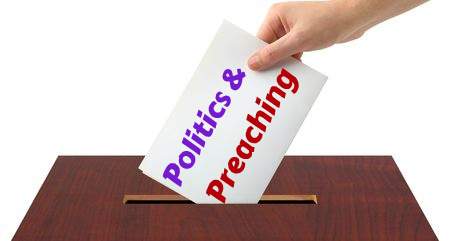 Should the preacher be influential when it comes to politics? The USA is coming to the end of the presidential primaries and moving towards the most controversial presidential election ever. The UK is fast approaching a long-awaited referendum on EU membership. Other countries are facing equally significant decisions. Should the preacher be influential in these things? I believe the answer is yes, we should. But how?
How we are influential is a very important question. And it is a complicated question. Here are 4 of the ways that preachers handle politics and the pulpit . . .
1. No mention of politics. Some preachers will avoid reference to politics in their preaching and keep the focus on the good news of Jesus. This does not, and should not mean that they have no political influence. It does mean that the influence will be more subtle and indirect.
2. Standing on ethical/moral issues without being party political. Some preachers will overtly take stands on certain issues, but without becoming party promoters. They might sound like they affiliate with one party for an issue like the sanctity of life, and then sound like they affiliate with another party on an issue like social justice and care for refugees.
3. Jump on the bandwagon and preach to the choir. Some preachers will go with the majority party in their audience. Some churches will want preachers to sound very conservative, while other subcultures lean much more to the left. How easy it is to be fashionable in these things. So some preachers will effectively jump on the bandwagon and end up preaching to the choir, fearful of displeasing the perceived majority. One danger, of course, is that the few dissenters who listen may struggle to hear what really matters and feel unnecessarily alienated.
4. Use position of influence to push an overt political agenda. Some preachers seem to think that their political influence is a primary calling. They won’t just tow the expected party line, as in #3 above, but will seek to push and change the opinion of others. God has given them influence, and they feel their calling is to shape opinion for the good of society.
In a year like this one, I believe we should prayerfully think through several issues regarding politics and our preaching:
A. We are to influence society, but the greatest influence will not be the outcome of the next vote. Yes Christians matter in society, yes we should be voting, yes we should be informed, and yes, these decisions matter. But our calling has eternal ramifications, not just four-year cyclical implications. Don’t confuse political decisions with the far greater influence that knowing Christ will bring to our society one person at a time. Our hope is not in any party, but in Christ.
B. People need hope, not bitterness, if things turn out differently than expected. Whether we have nailed our colours to the mast or not, we will need to pastorally point people to Christ once results are in. Don’t be so politically invested that you then become a beacon of bitterness for your hurting political subculture (or triumphalist if things go as you hoped!)
C. Could we be placing trip hazards on the path to Jesus? This is huge. In our church we say we don’t want anything to get in the way of people meeting Jesus. How about in yours? If they hear the rhetoric they are getting all week in the media when they step into church, could that not be a huge trip hazard that keeps people from Christ? Do we want to see all coming to Christ, or just those that agree with us politically?
D. Is there a difference between preaching and social media? Just to finish, here’s a caveat. I have chosen to generally avoid being political in my use of social media, but I fully respect the rights of others to use social media differently. Our preaching and our social media proclamations don’t have to match. Maybe you choose to avoid overt party politics in the pulpit, but choose to tweet and share articles that you think will be helpful in forthcoming elections and referenda. Obviously it is worth prayerfully pondering the points above, but by all means seek to influence in the way that you feel is appropriate.
May God give every one of us wisdom to know what to say and when to say it. May we be known in heaven for influencing eternity on our knees, and shaping culture for good, but never for simply soapboxing with temporal blinders on. May we have real wisdom in how we vote, and how we care for the souls of voters too.
7 Preacher Landmines
 In the path of the preacher there are many landmines – hidden explosives that can do untold damage to your ministry. Whether you’ve been preaching for a couple of years or for half a century, why not take some time to prayerfully work through this list? If you are on a team why not work through these together and pray for each other? Maybe you could ask your spouse if they sniff any whiff of these in your life?
1. Pride – Preaching involves influence, position, recognition, and respect, not to mention criticism, attack and hurt. Whether it goes well, or not, preachers are always going to need to navigate pride in their ministry. This can start to manifest in many ways, but any preacher who claims no temptation to pride is probably on the brink of disaster.
2. Prayerlessness – Remember the trepidation when you first entered the pulpit? That is probably long since gone, but has prayer gradually slipped away too? Prayer in preparation, prayer in anticipation of preaching, prayer for those who will hear, prayer for yourself, prayer for other preachers in town, prayer should be central in any preaching ministry, but often it silently slips away as we move on in ministry.
3. Laziness – With experience comes learning and proficiency. Maybe it doesn’t take as much preparation and you know your stuff much better now. So do you preach in some way at the level of years ago and use the spare capacity for self indulgence, or does the benefit of experience and learning lift your ministry to greater heights now?
4. Bitterness – Over the years you will be rejected, attacked, criticised, lied about, and repeatedly disappointed. Have you pushed anger inside toward others for what they’ve done and said? Have you pushed anger inside toward God for not answering prayers as you hoped He would? Bitterness is never obvious in the mirror, but it tends to ooze out so others can smell it. Eventually it will blow.
5. Fatigue – Giving yourself away to others in preaching and pastoral ministry, combined with financial limitations, family struggles, and perhaps poor health can leave you wiped out. Admit it if it is true.
6. Lust – Are you fatigued and vulnerable? Are you successful and vulnerable? Are you struggling in your marriage and vulnerable? Are you lonely and vulnerable? Are you complacent and vulnerable? Somehow you are vulnerable.
7. Fear – Maybe there is a fear lingering in you . . . fear of failure, fear of exposure for your inadequacy or sin, fear of rejection, fear of man, fear of finishing.
What would you add to the list? What landmines have you trodden on, or seen blow up for others?

