Perishing the Thought of Performing

Most people almost perish at the thought of public speaking.  As only the statisticians can say, most people would choose death over public speaking (a good twisting of a statistic).  But for those of us who preach, presumably we aren’t petrified of public speaking any more.  Perhaps instead our fear might be turned toward performing.

As a preacher we study an ancient text, determine its main idea and its contemporary relevance, then design a message to communicate both the meaning and the relevance to the congregation who will sit before us on Sunday morning. Our goal is not to fill time, but to see people marked by God’s Word and to see lives transformed. If we’re honest, there are ways to generate some sort of response. It is not out of our reach to spin a story a certain way in order to turn the emotions of our listeners, or ask a rhetorical question that we know will poke a nerve of guilt in them. So how are we to avoid stepping up to the pulpit and treating it like a stage?

1. Give preparation time to soak. Last minute preparation will lead to last minute desperation wherein “preaching tactics” will seem like our only hope. We must be diligent to begin the study and thinking process early enough for a message or a series to soak in before we must pour out. Even if all we can do is to start reading and making some notes ahead of time, it is worth it. Performance is lines through an actor, but preaching is truth through personality (Phillips Brooks succinct definition). Allow time for the preparation to become a part of who you are so that you preach something you truly believe and know deep down, because it has already deeply marked you.

2. Prepare more, not less. In the quest for “natural” delivery, it may be tempting to prepare less. The hope is that what comes out will be less of a performance and more “from the heart.” The reality is that unprepared preaching will often lean heavily on our own abilities. It is better to craft, to sweat, to wrestle, to pray, to think and to think some more. As I have written before, in an ideal world it is best to write out a manuscript in full and edit it closely and prayerfully. All that extra work will result not in performance, but genuine preaching “from the heart” as well as “from the text” – choosing to do minimal work will compromise both the text and your heart, leaving only any performance skills you may have.

3. Pray. Not just a “bless this effort” prayer, but real prayer. Personal wrestling with the God who is at work in you first. Persistent wrestling for those who will receive the message. There is a great spiritual battle raging around you and around them. Let us not fight in the pulpit a battle we have not first heavily engaged in the closet.

Add to FacebookAdd to DiggAdd to Del.icio.usAdd to StumbleuponAdd to RedditAdd to BlinklistAdd to TwitterAdd to TechnoratiAdd to Yahoo BuzzAdd to Newsvine

Exegesis and Application

I’ve recently been reading student responses to Fee and Stuart’s book How to Read the Bible for All Its Worth.  This is a rare book, a hermeneutics book that has sold massive numbers.  If you haven’t read it, you probably should.  That doesn’t mean it is perfect though, there may be much in it that you might quibble with (it may be the willingness to take positions on issues that makes the book such a bestseller).  One point that struck me as I looked at it again is the unfortunate decision to define hermeneutics as the follow on step after exegesis.  I know I’m not the only one that doesn’t see these terms as sequential steps in a process.  (They even acknowledge this is not the normal use of the term.)

I would agree with their definition of exegesis as “the careful, systematic study of the Scripture to discover the original, intended meaning.”  But surely the following step, thinking about the significance and potential impact of the passage in contemporary terms should be called application?  And hermeneutics?  Well, that refers to the guidelines that enable both exegesis and application to be done effectively.

This is especially important for preachers (and then, by extension, to all believers).  As I wrote on here some years ago:

The difference between a true expository sermon and an interesting biblical lecture is often the speaker’s awareness of sermonic purpose. As Bryan Chappell wrote (Christ-Centered Preaching, p52) “Without the ‘so what?’ we preach to a ‘who cares?’” In his own way Haddon Robinson has put it like this, “Preaching can be like delivering a baby, or like delivering a missile – in one your goal is to just get it out, but in the other your goal is to hit the target!”

Perhaps the problem goes deeper though. While it is true that we must think through the purpose for a sermon before preaching it, there seems to be an issue at an earlier stage in the process. Are we saying that it is possible to study a passage, but not follow through and consider its application? Hermeneutical purists argue about whether application is a part of the hermeneutical process.Yet as preachers our concern is not academic wrangling, but bringing the Word of God into the lives of His people, by the power of His Spirit, to see His purposes worked out. May we never fall into the trap of studying a passage, determining the author’s intended meaning, but failing to consider the contemporary application of that passage in our own lives.

Perhaps a lack of application in the pulpit is the fruit of a lack of application in personal study. The implications are frightening.

Add to FacebookAdd to DiggAdd to Del.icio.usAdd to StumbleuponAdd to RedditAdd to BlinklistAdd to TwitterAdd to TechnoratiAdd to Yahoo BuzzAdd to Newsvine

The Power of God

Easter is a time for reflection, for prayer, for worship.  This is true for us first and foremost as the redeemed, but also for us as preachers.  What is it we preach?  We preach a message of foolishness to the wise, and a message of weakness to the power-hungry.  We preach not with clever trickery or manipulation, but with faithful representation of the wisdom and power of God.

Let us be sure to bow at the cross this Easter as preachers committed to preaching the crucified and risen Christ.  We won’t tickle ears. We won’t manipulate responses.  We won’t generate numbers.  We won’t entertain.  We won’t preach to please people who are not passionate about pleasing God.  We won’t preach in the power of our own gifting, or enthusiasm, or natural abilities.  We won’t preach to impress.  We won’t preach to earn money.  We won’t preach to fill time.  We won’t preach because we feel we should, we will preach because we know we must.

We won’t preach to affirm people in their independence from God, nor to give hints for successful living, nor to recite historical fact alone.  We won’t preach myth, or helpful tales with gentle morals, or strongly worded messages of morality.  We won’t preach watered down niceties, nor implore people to try harder, nor settle for human level transformation.

We will preach the Word of God, we will preach fact.  We will preach as those who know how little we bring to the salvation question, as those who know what an honour it is to represent God’s Word inspired and incarnate, as those who live in the shadow of the cross, and as those who live transformed by the Risen Christ.

We are not ashamed of the gospel, because it is the power of God for everyone who believes.  So we bow before a God who would give everything on a horrifying Roman cross, and rise empowered by the Risen Christ to preach Him: Christ crucified, Christ risen, Christ alone.

Add to FacebookAdd to DiggAdd to Del.icio.usAdd to StumbleuponAdd to RedditAdd to BlinklistAdd to TwitterAdd to TechnoratiAdd to Yahoo BuzzAdd to Newsvine

The Friday Finish for the Feedback Fiesta

Since we’ve been thinking feedback all week, why not finish the week with one more post?  We’ve thought about questions to ask others, we’ve pondered the value of feedback others offer unasked, and we’ve thought about some key ingredients in the unrequested feedback of greater significance.  The week can’t end without a couple more nudges that I’ve made before.  You can improve your preaching by engaging in your own feedback too!

1. Prayerful Evaluation. Ask God what He thought of your message.  Process in His presence.  He cares more about your preaching than you do, and I’m sure He’d be glad to be your main preaching coach.  We can be so quick to pray about a sermon before we preach it, but say almost nothing afterwards.  Almost as if we want God’s help to do our thing well.  What about saying thank you?  What about asking Him what was going on in your own heart?  What about asking Him to nudge you in better directions?  What about processing the feedback received in His presence?

2. Audio Evaluation. I tend to listen through my messages as I prepare them for the archive.  I get to spot the bits that didn’t come across so clearly, or the moments when pause could have been better used, or the moments when my description was lacking in colour, or whatever.  It is worth listening to yourself because you are the only person who knows what you were planning to say after all the study and preparation.

3. Video Evaluation. I mention this periodically, but it’s worth the nudge.  If you watch yourself preach on video, it will improve your preaching.  Don’t need to do it every week.  But now and then.  You will spot things nobody has yet had the guts to mention to you!  You will realize that you are actually looking at your notes 72% of the time.  You will spot that you aren’t smiling as much as you think you are.  You will see some very effective gesturing (as well as some backward gestures).  You will be glad you did it.  Promise.

Add to FacebookAdd to DiggAdd to Del.icio.usAdd to StumbleuponAdd to RedditAdd to BlinklistAdd to TwitterAdd to TechnoratiAdd to Yahoo BuzzAdd to Newsvine

Opaque or Lens?

Opacity is worthy of our consideration.  The contrast between being opaque and being a lens was suggested last week in conversation.  That is, does the preacher act as a lens through which I see Christ, or as an opaque presenter through which I see little?  It may be hard to quantify, but as listeners I think we know the difference.

When the opaque preacher preaches, we receive information and ideas, maybe even illustrations and anecdotes, perhaps applications, and even apparently effective delivery.  Technically the sermon might tick all the standard boxes.  Faithful to the text, relevant to the audience, clear in presentation.  But obviously not clear in the sense we mean in this post.  Because for all the good that’s there, the sermon event feels opaque.

So what is it that turns the opaque preaching into a lens through which the person of Christ is seen, through which the grace of God can shine into our lives?  I suspect it isn’t primarily about technique, since great preparation and delivery skill can still lead to opaque messages.  Perhaps it’s something along the lines of …

A sermon will act as a lens to the extent that the preacher relationally engages both God and the listeners as true personalities.

That could be better stated, but it will do for now (comment freely and offer better statements!)

1. If God is viewed as a distant, unknowable, cold deity who has left us with a set of data encoded in an anthology we call the Bible, then the preacher won’t engage Him.  But if God is known personally, through the Word, through prayer, through a living and vital and covenantally loyal love relationship; and if God is an active participant in the life of the preacher; and if the preacher genuinely loves and likes God . . . then we may be onto something special for preaching.

2. If the listeners are viewed as an amorphous group of punters who have chosen to attend a presentation in which they (the seated ranks of unknowns) get to hear me (the preacher), then the preacher won’t engage them effectively.  But if the people matter, and are cared for and prayed for and are important to the preacher (even if he is visiting), and if he seems to not only care enough to give tough medicine, but loves enough to make it palatable, and likes enough to smile . . . then we may be onto something special for preaching.

Opaque or lens?

Add to FacebookAdd to DiggAdd to Del.icio.usAdd to StumbleuponAdd to RedditAdd to BlinklistAdd to TwitterAdd to TechnoratiAdd to Yahoo BuzzAdd to Newsvine

Letter from the Tax Office

I enjoyed a good conversation about preaching yesterday.  Here’s a thought.  2 hypothetical situations:

Situation 1 – I have received a letter from the tax office stating that a Mr Jones is going to be hearing from the bailiffs if he doesn’t pay his tax bill within five days.  I figure out that Mr Jones lives six doors down from me.  Out of courtesy I take the letter to him and hand it over.

Situation 2 – I have a close friend who works in the tax office who lets me know that a mutual friend of ours, who happens to live next door, is long overdue on a tax payment and needs to respond immediately.  I go next door and explain the situation carefully and clearly to Mr Smith, making sure he understands the gravity of the situation.

Which situation will offer the more compelling communication.  Obviously the second one.  Why?  Because in the first I know neither the person in the tax office, nor the recipient.  In the second one I know and like both of them.

Question: when you preach, which situation fits you? Ignore any tax and duty typology here – that’s not my point.  As a communicator do I take data from the study of a written document and present that clearly to others?  That is, do I handle a 2-D document in a manner that is relationally disconnected?  Or do I have a heart-level connection with both the Author of that document, and the listeners of my message?

Many preachers and pastors are alert to the importance of knowing and loving the people to whom they preach. Humans can sense when someone cares, or even when someone likes them.  Have you heard a preacher that didn’t seem to like you?  I have recently and it left me stone cold.  A good shepherd really loves his sheep.  A good under-shepherd will too.

Fewer preachers seem to be alert to the importance of the heart connection in the other side of the preaching mix. That is, do you as a preacher know not only the text, but do you know and love and like the God who inspired it?

This makes a massive difference, but is rarely addressed in the preaching books.  Massive difference.  If you are not compelled and captivated by the One whose Word you preach, then why should your listeners be marked by its presentation?  Your love for them alone is inadequate.  It will carry things a decent distance, but it will fall short.  The connection, ultimately, has to be between them and Him.  Relational coldness between you and them, or you and Him, will short-circuit the whole loop.

Add to FacebookAdd to DiggAdd to Del.icio.usAdd to StumbleuponAdd to RedditAdd to BlinklistAdd to TwitterAdd to TechnoratiAdd to Yahoo BuzzAdd to Newsvine

An Officious Calling

David Gordon’s list of four failing approaches to preaching includes the category of “Introspection.”  Let’s hear some highlights (pp83-84):

Some of the neo-Puritans have apparently determined that the purpose and essence of Christian preaching is to persuade people that they do not, in fact, believe. …This brand of preaching constantly suggests that if a person does not always love attending church, always look forward to reading the Bible, or family worship, or prayer, then the person is probably not a believer.  To the outsider, it appears patently curious to take an opportunity to promote faith as an opportunity to declare its nonexistence.

Since the sermon mentions Christ only in passing (if at all), the sermon says nothing about the adequacy of Christ as Redeemer, and therefore does nothing nourish or build faith in him.  So true unbelievers are given nothing that might make believers of them, and many true believers are persuaded that they are not believers, and the consolations of Christian faith are taken from them.

It is absolutely debilitating to be told again and again that one does not have faith when one knows perfectly well that one does have faith, albeit weak and imperfect.

It is really hard to see any positive that comes from this kind of preaching.  The bruised reed and smoldering wick do seem to get broken and snuffed out.  The dead in sin are hardly offered life when the love of God is not offered as the vivifying affection.  Even the self-righteous are only reinforced in their misbelief since they will always assume this message is for someone else.

The self-righteous like it too much; for them, religion makes them feel good about themselves, because it allows them to view themselves as the good guys and others as the bad guys – they love to hear the minister scold the bad guys each week.  And sadly, the temperament of some ministers is simply officious. Scolding others is their life calling.

So, what can we suggest to preachers who find themselves being described in this post?  I suppose the only solution is to fling yourself at the foot of the cross, read the Word for yourself and see your own brokenness and need.  If you see brokenness in yourself, surely you see the need for others to be tended, to be cared for, to be shepherded, to be encouraged.  If you see no brokenness in yourself, then perhaps you need the very gospel you are convinced nobody else really believes.

Add to FacebookAdd to DiggAdd to Del.icio.usAdd to StumbleuponAdd to RedditAdd to BlinklistAdd to TwitterAdd to TechnoratiAdd to Yahoo BuzzAdd to Newsvine

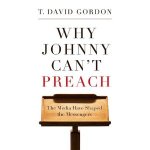
Review: Why Johnny Can’t Preach, by T.David Gordon

It’s a short book,108 pages, but it packs quite a punch.  T.David Gordon wrote Why Johnny Can’t Preach during a year of treatment for cancer.  Given only a 25% chance of survival, he found his focus clear and the desire to compromise his message absent.  The book is hard-hitting, but I found the tone entirely appropriate and not harsh despite the subject matter.

The writer is a media ecologist – that is, one who studies the effects of the change of media forms on the culture.  Taking his title from two books in the 1960’s on the growing inability of students to read and write, this book focuses on why the present state of preaching is so dire.

The first part of the book sets out his evidence for his claim that preaching is ordinarily poor.  While admitting freely that his first line of evidence is merely anecdotal, I found the presentation of evidence hard to argue with (not that I’m inclined to argue since my experience largely reflects the author’s).  Yet Gordon’s evidence is not merely subjective.  He goes to some pains to make clear that there are some objective measures of sermon quality that can be used to identify problem preaching.  It is too common to hear “that is just your opinion” if a sermon is ever questioned or critiqued.

The author’s argument culminates with the almost total absence of the annual review, not missing in any other profession, but indicative that all sides know there is an issue.  Gordon doesn’t blame seminaries for this state of affairs.  In his perspective they haven’t changed, but the calibre of incoming student certainly has.  What has changed?  Because of the change in media forms, Johnny is no longer able to read, nor write, nor discern the significant, and hence he can’t preach either.

True preaching requires close examination and study of a quality text, something non-readers have no experience of today.  People don’t study classical languages.  They don’t read literature.  They aren’t equipped to really study a text.   People read for content, but don’t learn to look at how a text communicates.

True preaching requires careful composition.  But people don’t write letters anymore.  They talk on the phone. Instead of careful composition, we live in a day of easy and cheap talk.

True preaching requires a sensibility of the significant.  But the only way to watch hours of television is to turn off such sensibility, so most do.

A once-common sensibility (close reading of texts) is now uncommon, and a once-common activity (composition) is now comparatively rare.  A once-common daily occurrence (face-to-face communication allowing us to “read” the unstated feelings of another) has been replaced by telephone conversation in which visual feedback is absent.  A once-common sensibility, the capacity to distinguish the significant from the insignificant, is becoming rare.  For a minister today to preach a basic average sermon by early-twentieth-century standards would require a lifestyle that is significantly countercultural.

The book is not solely concerned with capacity to study and compose.  The fourth chapter looks at the content of sermons and gives a fine rebuttal of four contemporary approaches – moralism, how-to, introspection and “so-called culture wars” . . . helpful content that I will come back to in other posts.

At certain points I would suggest that the author’s view of Christian preaching is a little narrow.  There is more to an inherently relational faith than merely submitting our will to God’s will.  Perhaps the Bible text, if read carefully, might present the heart of God such that our hearts might be changed in response.

Nevertheless, even taken on the author’s terms, the book’s message is important and needs to be considered.  All of us live in a fast-paced world that simply doesn’t allow for careful reading of God’s heart in His Word.  Perhaps it is time we were more counter-cultural in order to be able to read the text well.

Thankfully, T. David Gordon is still alive and serving the church through his teaching and writing.  We should be grateful for this little gem of a book.  Buy this book, perhaps even pass on a copy to someone else!

(If you are in the UK, click here to buy.)

Add to FacebookAdd to DiggAdd to Del.icio.usAdd to StumbleuponAdd to RedditAdd to BlinklistAdd to TwitterAdd to TechnoratiAdd to Yahoo BuzzAdd to Newsvine