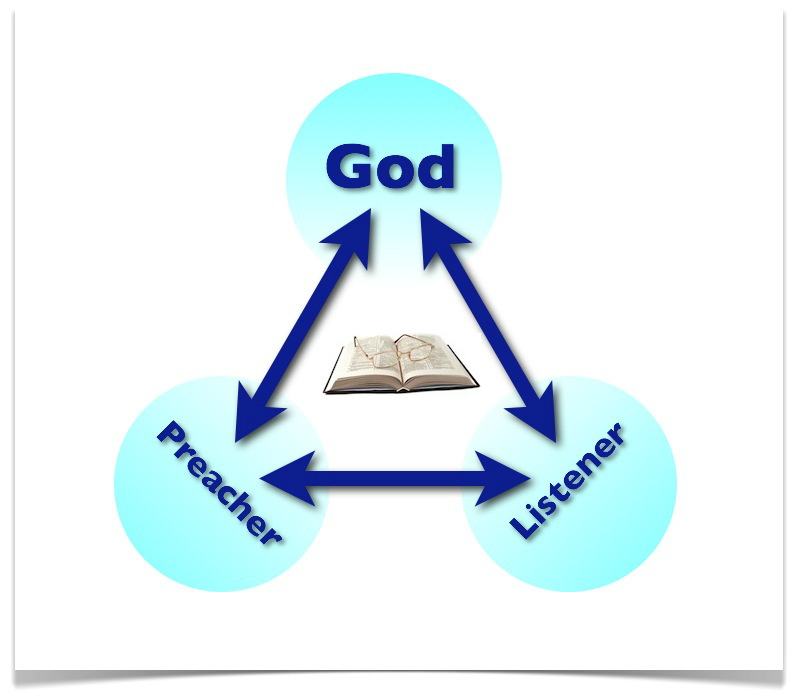
The Preaching Triangle – Omissions 1 and 2

Yesterday I suggested that every participant matters in the preaching triangle.  What happens when we leave one out?

1. God.  The goal of all biblical ministry in the church is to know the God who reveals His heart in His Word.  The Spirit who inspired the biblical authors also empowers the biblical communicator to point to the Son, that through Him, the Father might be known.  God is at work in both the preacher and the listeners, and both need to be responsive to Him.

And when we somehow leave God out?  Then we have an informed presentation, or a human-level exhortation, or a religious performance for a distant deity, but we do not have Christian biblical ministry.

2. Preacher.  God has chosen to use inadequate communicators to enable others to hear His Word and respond.  We also form a connection with the listeners (either good or bad) and communicate with our lives as well as with our words.  Effective communication involves the heart to heart connection of the preacher with the listener, as well as both with God.  This means that as well as the verbal content (the words), the preacher must also effectively communicate by means of the vocal and visual elements (use of voice, plus posture, gesture, expression and movement).

And when we downplay the role of the preacher?  Then we lose the incarnational nature of God’s self-revelation, we lose the privilege of hearing God’s Word spoken with power.  We might be able to affirm a strange view of “reliance on God” (based on a hope that He might work around us and despite us), but we do not have incarnational or effective Christian biblical ministry.

Why would someone leave out either of these participants in their approach to preaching?  I suppose a view that God is distant and disconnected, or excessive confidence in one’s own intellectual ability might lead to the first omission.  A highly “spiritual” view of God’s work despite the preacher, combined with a potentially confused view of humility might lead to the second omission.

Tomorrow I’ll consider the implications of leaving out the other two…

Add to FacebookAdd to DiggAdd to Del.icio.usAdd to StumbleuponAdd to RedditAdd to BlinklistAdd to TwitterAdd to TechnoratiAdd to Yahoo BuzzAdd to NewsvineLike This!

The Preaching Triangle – Introduction

Preaching is not about performance, nor ritual.  It is a communication event.  Like most things, how you understand it flows out of how you view God.

If you see God as a distant power broker, a singularity focused exclusively on his own self-absorption, that will influence the way you preach.  I suspect you’ll be torn between making much of Him because you should, and making much of self because that is the logical conclusion of being made in His image.  The Bible will function as a code of instruction to decipher and disseminate that others might know how to satisfy the distant One.

But if you see God as the eternal fellowship of the trinity who is always others-centred, so that His love has reached out to us to bring us into fellowship with Him by His grace, then that will also influence the way you preach.  And it seems to me that preaching will consequently be a much more relationally-charged event.

In the next days I’d like to probe the notion of preaching being essentially about three relationships, between three ‘participants,’ centred around the inspired Word of God.  The participants are all required:

1. God.  Without whom preaching is an exercise in human performance.  I wonder whether we might sometimes tip our hat to the importance of God’s role in our preaching, but then pray and preach as if our dependence is only token?  Truly, apart from me, you can do nothing.  Surely preaching without God’s involvement is an exercise in abject futility?  But what does it mean for God to be involved?  Just that we pray to Him?  If we pray to Him and then preach about Him, is that enough?  What if Christianity is much more participatively relational than we have realized?

2. Listener.  Without whom preaching makes no sense, since it is not about us or our desire to impress God with our rituals and performance.  Again, I wonder if our preaching is genuinely marked by an awareness of those to whom we preach?  More than that, do we really consider the connection between us and those to whom we preach?  It is easy to tip our hat to the importance of knowing the listener, but then preach as if they are a generic gathering of folks.  But the listeners matter precisely because of the kind of God that we have.  He knows, He loves, He cares.  Consequently He expects those preaching His Word to also know, love and care.

3. Preacher.  Without whom the conversation would be about something other than preaching, but really, does the preacher matter?  I say yes.  There is a vital role for the preacher precisely because of the kind of God that we have.  He is a communicator, He cares, He incarnates.  Consequently He values the human speaker, who also should care, who in some way is an enfleshed presentation of the Word.

All three participants matter greatly in the preaching triangle.  Tomorrow I’d like to drill down a bit more on why each one matters, before we then start to probe the relationships in this triangle.

Add to FacebookAdd to DiggAdd to Del.icio.usAdd to StumbleuponAdd to RedditAdd to BlinklistAdd to TwitterAdd to TechnoratiAdd to Yahoo BuzzAdd to NewsvineLike This!

Saturday Short Thought: Luther, Law, Preaching and Popes

This week I’ve been writing about the power of our words as preachers.  Not only can we re-present the Scriptures as we explain and apply, but we can undo the Scriptures as we carelessly overqualify, say too much, or say that which is unhelpful.

They say driving a car is like having a 1.5 tonne bullet with the trigger under our right foot.  What, then, is preaching a sermon?

This week I read through The Freedom of a Christian by Luther.  Yesterday I started reading a book that has become an “I don’t want to put this down” kind of book.  I won’t tell you what it is yet, I’ll reveal it on the Books page once other commitments allow me time to finish it.  But here’s a taster on the this issue of the sermon:

Luther was astonished how many Christian theologies accepted the basic scheme of the law and its morality (opinio legis), but had nothing worthwhile to say about Christ. . . .

Luther is the Great Misunderstood. How could he become so contorted into the form of modern Protestantism? One might reasonably take recourse in Luther’s assumption that the devil was on the prowl ready to pounce on anyone preaching the gospel. The picture of freedom that developed by the nineteenth century has very little to do with Luther’s own theology. On the face of it, Luther’s proposal was not of “reform” nor was it modest, though it was excruciatingly simple: it was to replace the papacy with a sermon: “Christ’s merit is not acquired through our work of pennies, but through faith by grace, without any money and merit – not by the authority of the pope, but rather by preaching a sermon, that is, God’s Word.”

Down comes Christendom, with a word! Preaching is democratized, not in the sense of emerging from the people but of being available to them all equally – in an instant, rich and poor, male and female, circumcised and uncircumcised, German and Italian.  With this the pinnacle of power lay not in Rome or with kings, but at the point of the delivery of a sermon.

(pp3, 8, of ?)

Add to FacebookAdd to DiggAdd to Del.icio.usAdd to StumbleuponAdd to RedditAdd to BlinklistAdd to TwitterAdd to TechnoratiAdd to Yahoo BuzzAdd to NewsvineLike This!

Saturday Short Thought: Fresh Over Abundance from a Can

This week the blog has been pondering issues of recycling sermonic materials and also recycling other peoples’ materials.  Meanwhile we’ve welcomed a healthy baby daughter into our home and we are both thankful to our gracious Lord and very tired!  So just a short thought to finish off the week.

I understand the challenge faced by many preachers with other work commitments and family priorities.  I understand the feeling that some express, namely, that without borrowing the outlines and sermons of other preachers from the internet, they would never be able to preach a sermon on a Sunday.

Just as we close the week out, I’d like to offer an encouragement.  Even if you are limited for time and feel unable to do the work of fully developing a sermon for your listeners, consider not taking the short-cut of outline borrowing or sermon lifting.  Even if you are only able to develop what feels like an inadequate sermon for Sunday, try it anyway (how about next week?)

I suspect your listeners would prefer to feed on the real food of your Bible study in preparation than the canned contents of some internet repository.  Your intro may be weak, your conclusion may be unsophisticated, your illustrations may be lacking, your outline may be undeveloped and your main idea might be just plain, well, plain.

But if your heart has engaged with God’s in prayer for theirs, and you have spent time with the Lord pondering how to present this text with relevance emphasised, then your listeners will be better fed than if you offer a sophisticated super-sermon that is not your own.

When we have guests, it is always hard to serve less than an adundant feast.  But the truth is, visitors would rather have home cooked food than an abundant but canned meal.

You will also find that with regular practice, the process becomes more manageable, even on a very limited time budget.  Let’s go for fresh over canned, for the sake of souls: both ours and our listeners’.

Add to FacebookAdd to DiggAdd to Del.icio.usAdd to StumbleuponAdd to RedditAdd to BlinklistAdd to TwitterAdd to TechnoratiAdd to Yahoo BuzzAdd to NewsvineLike This!

Eco-Preaching: Recycling and Plagiarism

We live in an age of unprecedented access to information.  Cut and Paste was a hassle until a few years ago.  Now there is endless resource online just sitting there ready to be plagiarized.  At the same time, preachers face the pressure of busy lives.  And then there’s the pressure to live up to the impressive and often carefully edited sermons of the superstar preachers that everyone can listen to all week.  It’s a recipe for plagiarism.

There’s plenty on this subject online already, so I’ll just offer a few thoughts on recycling content that is not our own:

1. As ministers of God’s Word, we should have higher standards than academics and journalists (and they can lose their jobs over it).  Sadly, some act as if everything is fair game for cutting, pasting and preaching as if it is personal work.

2. Oral communication doesn’t require, and cannot support, the tedious footnoting needed in academic work.  But it does need integrity.  If I’m quoting the words of someone else, I mustn’t give the sense that they are my own.  Last Sunday, for several reasons, I quoted “a great figure from church history” (and was fully prepared for people to ask who that was after the message).

3. Appropriately using a well-turned phrase or a helpful illustration as part of a message that is unequivocally yours is not the same thing as lifting a whole outline or sermon and preaching it as if it were your own.  The latter is stealing intellectual property, it is deceitful toward your listeners, and it is cheating both yourself and others due to your lack of time in prayerful biblical preparation.

4. First person illustrations from someone else should not be shared in the first person.  If it didn’t happen to you, and you give the impression that it did, you are lying.

5. Inasmuch as I’ve tried to be clear here, we need wisdom since there is so much that is unclear in this issue.  May our wisdom be thoroughly shaped by the good character of the God we represent as we preach!

Add to FacebookAdd to DiggAdd to Del.icio.usAdd to StumbleuponAdd to RedditAdd to BlinklistAdd to TwitterAdd to TechnoratiAdd to Yahoo BuzzAdd to NewsvineLike This!

Eco-Preaching: 5 Dangers of Recycling Sermons

Yesterday I offered five potential benefits of recycling sermons.  Now let’s consider five dangers:

1. Personal stagnation.  John Wesley is widely credited with saying “Once in seven years I burn all my sermons; for it is a shame if I cannot write better sermons now than I did seven years ago.”  (Apparently, though, he was quoting another preacher, and disagreeing with him.  We need to be careful when we recycle quotes!)  But there is a validity to the sentiment expressed by whoever it was.  If I always recycle the same message, I am missing out on all the growth of personal, devotional, spiritual biblical study and application, as well as the blessing of praying through new messages (since repetition of “successful” messages could lead to complacency and trust in the message rather than God).

2. Ministry burnout.  Too much recycling can lead to a dangerous equation.  An increase in activity (if I recycle I can preach in every possible gap in the schedule), combined with a decrease in personal feeding (since I can recycle in the wrong way without any time in God’s Word or presence), will lead toward burnout.  Easy to be a firework in ministry.

3. Preaching thin.  I mentioned this in passing the other day.  When I prepare over several days and then preach a message, the message is much more than the outline or notes I record at the time.  It is actually more than even the message I record and have on record as an audio file.  There is also all the wealth of exegetical study, the supporting biblical content that didn’t make it into the message, but was fresh in my heart at the time of preaching.  Returning to that message in the future means returning to a skeleton of the original.  I am in danger of preaching “thin” – without the wealth of supporting materials.

4. Loss of attention.  If the listeners get the sense that this is old material, rather than being a message from God for them, today, in particular, then the level of attention invariably drops.  They will be subconsciously tempted to evaluate your performance, rather than listening for God’s message to their hearts.  If it is recycled, it must be prayerfully re-prepared for them – don’t dump leftovers from the fridge, serve them with care!  I know the various stories of “I’ll repeat the message until you act on it!” – but the truth is that it is much easier to be bold in an anecdote.

5. Loss of integrity.  If the content you are recycling is not your own, then you lose integrity.  More on plagiarism tomorrow!

Add to FacebookAdd to DiggAdd to Del.icio.usAdd to StumbleuponAdd to RedditAdd to BlinklistAdd to TwitterAdd to TechnoratiAdd to Yahoo BuzzAdd to NewsvineLike This!

Why I’m Not Rushing to Two-Person Preaching – Part 2

If our churches follow cultural trends, which they tend to, does this mean we are facing the prospect of “sanctified banter preaching?” After all, it seems like everywhere we look in the media, there are now two presenters, two DJ’s, two hosts. So do we have to consider having two preachers simul-preaching? I suspect not…

I remember sitting at a big Christian convention where three speakers rotated through the morning session in soundbites. The blessing of hearing one was only frustrated by the ranting of another, it felt bitty and unprepared. But what if it were done well?

I’m not convinced. There are venues where it could work and it could work well. But I’d lean more toward it in a teaching situation than in a preaching situation.

As with some powerpoint/media intensive preachers, I get the sense that the preparation would be radically changed. Instead of time spent with God in prayer, the powerpointer sometimes seems to spend hours in mouse-clicking creativity. Actually, (in many cases they seem to end up not spending enough time with God, or in preparing the powerpoint fully, but that is another issue.)

So the collaborationist preaching pair might spend hours in scripting transitions and dialogue, hopefully without the tacky banter that seems so plastic on some TV shows, yet not have anywhere near the depth of time spent in God’s presence.

The change in preparation would mean a potential loss of profundity. There is something about a preacher spending time with God in the text praying for the people, and then coming to speak to the people. I would love to hear this done by a pair of preachers who have really pursued God, His Word, His heart for these people, etc.

I fear that profundity would disappear if the 2-person preaching were seen as a contemporary solution to a contemporary problem (like the acetate and the powerpoint were also seen as ways to fix poor preaching in recent years).

Somehow the core has to be kept in place, and done well. Then there may be benefits to supplemental approaches like this. I’m not opposed, I’m just not convinced.

Add to FacebookAdd to DiggAdd to Del.icio.usAdd to StumbleuponAdd to RedditAdd to BlinklistAdd to TwitterAdd to TechnoratiAdd to Yahoo BuzzAdd to NewsvineLike This!

Saturday Short Thought: Taught by the Spirit (with Reeves Quote)

Here’s a concern I feel needs to be addressed as the week comes to an end:

“When we just prayerfully look at the Bible text, then the Spirit can direct us and teach us.” (Implication: if you look at “the words of humans,” such as in commentaries, then you will not hear God’s Spirit.)

I stumbled across the same notion in a conversation this week.  “You went to Bible school, but I’ve been taught by the Holy Spirit.”  But?  Just because one claims to only be taught by the Spirit, this does not mean one has received more training from the Spirit.

Whether we are talking about use of commentaries or the privilege of “formal” study, let’s not make this false step of restricting where God’s Spirit can work.  This is similar to the nonsensical idea that the Spirit works when we don’t prepare a message, but is absent if we do prepare.

We absolutely need God’s Spirit at work in us as we prepare to preach, both in respect to understanding the Bible text, and in terms of sensitively applying it to those who will listen.  As one person put it this week, “Hearing how God has spoken to the community over the ages about the text will only give the Spirit more chance to speak, not less.”

Not only does the Spirit want to work in our biblical study, and in our ministry, but in light of yesterday’s book review, he most certainly wants to work in our hearts too.  What does he want to do there?  Let me finish with a quote from Reeves’ new book (p73):

My new life began when the Spirit first opened my eyes and won my heart to Christ. Then, for the first time, I began to enjoy and love Christ as the Father has always done. And through Christ, for the first time, I began to enjoy and love the Father as the Son has always done. That was how it started, and that is how the new life goes on: by revealing the beauty, love, glory and kindness of Christ to me, the Spirit kindles in me an ever deeper and more sincere love for God. And as he stirs me to think ever more on Christ, he makes me more and more God-like: less self-obsessed and more Christ-obsessed.

Add to FacebookAdd to DiggAdd to Del.icio.usAdd to StumbleuponAdd to RedditAdd to BlinklistAdd to TwitterAdd to TechnoratiAdd to Yahoo BuzzAdd to NewsvineLike This!

___________________________________________

Next week: Two-Person Preaching?