Insightful Incidentals – part 2

Yesterday I suggested that some preaching points pursued from minor details in a text can be well off-target.  But does this mean we are constrained to a rigid main point only approach?  Generally this wouldn’t hurt most preachers, but let’s say for argument’s sake that you are very conscientious on preaching the main idea in a text . . . are there some guidelines for commenting on the less central details?

1. Make sure you’ve understood how the detail relates to the whole before you say anything else about it.  

Biblical narrative tends to be sparse in nature.  Papyrus was expensive and the writer’s were sober.  They didn’t waste words.  So if a detail is present, assume the detail is important to the specific goal of the passage.  Rather than rushing into an easy preaching point, be sure to make sense of the detail in the whole passage, and the whole passage in light of the detail.  Once you know how it is working here, then maybe it bears some passing interest in its own right.

2. Make sure any comment you make concerning the detail is rooted in its context.

Plucking a phrase or sentence out of context to say something it doesn’t say . . . well that is the arena of the cults.  Let’s not subtly prepare our people for the cults by modelling cult-like Bible handling in the pulpit (or they might go for it on their doorstep!)  A text is saying something.  You can’t legitimately say anything from a passage, be sure to say the passage’s something.  Context will always be the key to correctly interpreting the meaning of a detail.  If it doesn’t mean what you want to say, be patient until the passage does say that.  Perhaps even select a preaching passage accordingly, but be committed to saying what the text is actually saying.  Never force.

3. Make certain any passing applicational point is rooted biblically.

There may be a place for a passing application point, but be sure the application is genuinely biblical.  Many a moralistic point has been made that is more preacher’s culture or personal preference than biblical teaching.  Many are committed to the idea of comparing scripture with scripture during the interpretation phase of biblical study.  I think more would do well to compare scripture with scripture in anticipation of making their applications.  I think Haddon Robinson said a few times that there is more heresy per square inch in the field of application than in any other aspect of preaching.

More could be said on all this, what would you add, or clarify?

Insightful Incidentals?

Whatever passage you are preaching, there will be opportunity to make passing comments about relatively minor details.  Of course, all Scripture is God-breathed and there is no such thing as a non-essential word in the Bible.  But a high commitment to verbal plenary inspiration (i.e. the words are inspired, all of them), does not mean every word can become a preaching point on a whim.

So what sort of insightful incidental comments are best left unsaid altogether?  Tomorrow I’ll address the potentially appropriate ones, but for now, just the baddies:

1. Distracting moralisms – For example, the preacher is working through the story of Zaccheus’ encounter with Jesus.  The setup is finished, Jesus has just called Zac down from the tree and there is an interim comment before the big scene in his house.  The interim comment is about the crowds grumbling.  Cue preacher going off on a gentle tirade about grumbling and how bad that is for a church.  A couple of wilderness quotes, the threat of excessive quail dinners and then the diversion is over, back to Zac’s dinner table.  Oops.  And then some.  This story has nothing to do with whether people should grumble or not.  Actually, if the preacher had observed more closely, it would have become clear that the comment by Luke is not wasted at all.  The crowds grumbled at Jesus!  Here is the key point in the story, the moment when Jesus diverts anger onto himself to free up sinner Zac.  By looking for a moralistic application point, the preacher has missed the transformational gold of grace in action.  Chances are, after missing that, the same preacher might go on to make Zac’s proclamation of distribution into part of his salvation negotiations, rather than the pure response that it actually is.

2. Errant critiques – For example, the preacher is working through the story of the blind man healed in two stages.  In this case he hadn’t given any attention to the preceding content in Mark 6-8, which is so critical to understanding this unique story.  Getting to the end of the passage, his eyes are drawn by the red ink of Jesus’ words in verse 26.  “Do not enter the village.”  Voila!  Preaching point.  We don’t do follow-up these days!  We need to learn from Jesus.  Jesus didn’t just heal, he also gave instruction.  Don’t go back into the world.  Just follow me.  Etc. Etc.  Meanwhile the more astute listeners have their eyes on the text wondering how the preacher missed the first half of the verse.  Did Jesus ask this blind man to follow him?  Or did he actually send him to his home?  It is perilous to be looking for preaching points, rather than really reading the passage to understand it.

3. Personal soapboxes – I’m out of words, but you know what I mean.  The slightest hint in a passage and off goes the preacher on a personal crusade.

So easy to preach in vague connection to a text.  So much safer and better to preach the message of the text.

Saturday Short Thought: Seeker Sensitive Preaching

For the past two weeks I have been blogging my way through what I think might be the ten biggest big ideas in the Bible.  I’m sure there are others that should be included.

And I’m sure there are some that shouldn’t.  I’ve watched a discussion on a forum where people have been posting their own lists in response to my suggesting there might be eight to ten such macro thoughts.  One or two suggestions have seemed to be off-track.  My concern is not to wrangle over debates between one theological camp versus another.  My concern is that the God of the Bible be represented well when we preach the Bible.

I suppose I could call this seeker sensitive preaching.  That is, is our preaching sensitive to the great seeker, the one who came to seek and to save the lost?  He is passionate in His seeking, as evidenced in His Passion.  Surely it must grieve Him when our preaching misrepresents His character, His nature, His concern, His desire, His goal.

I don’t know if you have pondered what you might include in a list of 8-10 biggest big ideas in the Bible.  But if you do come up with a list, let me suggest you review it in light of this question – do those big thoughts represent accurately the character of the God who reveals Himself in His Word?

The same question should be asked of any sermon.  When we preach we are not just explaining an ancient text, nor even just declaring a faith tradition passed down to us: we are representing the living God.  Let’s be sure we represent Him well.

Add to FacebookAdd to DiggAdd to Del.icio.usAdd to StumbleuponAdd to RedditAdd to BlinklistAdd to TwitterAdd to TechnoratiAdd to Yahoo BuzzAdd to NewsvineLike This!

Biggest Big Ideas – 10. Christ

We’ve covered a lot of ground in nine posts.  A lot of threads weave through the canon.  The resulting tapestry is stunning and breathtaking, but we can’t help ourselves, our gaze goes from the whole to the who…the one who reveals God to us, the Son.

10. The centerpiece of God’s great Word is His Word, His Son, our Lord, the Christ, the deliverer called Jesus, from Nazareth.

The epic adventures of God’s chosen people take more than a few posts to tell.  In various times, in different ways, God spoke to them.  But in these last days He has spoken to us in a son!  Can we ever get beyond the wonder of Jesus of Nazareth?  Fully God, fully man, fully one.

His arrival should not have been a surprise.  God predicted and announced His coming, as if the enemy were so unequal that even with press releases and pronouncements, his terror attacks would amount to nothing.  More than that, God showed His Immanuel-ness all the way through.

God is the kind of God who would choose to walk on two legs with His creation in the garden.  But what of an unholy people, surely they could not see His face and live?  He is the kind of God who would meet with such as Abraham, and Jacob, and Manoah, and let them live.  He is the kind of God who would dwell in tents near His special people, meeting face to face with Moses.

And so the communication of the Father became flesh and pitched his tent among us, so that we beheld his glory!  No one has ever seen the Father, but if only we could request just a glimpse?  If you have seen me, Jesus would announce, you have seen the Father.

So he spoke to a gathering of the biblically trained elite, and also to a pair of hurting disciples on a road trip.  To both he made it clear that the Scriptures speak of Him – by prediction, by appearance, by certain types, by fulfilled themes.  Their hearts burned within.  Two, in delight at the One who came for them.  The others, in anger for the love of God was not in them.  The Christ stirs hearts, he can leave none in some hypothetical neutral apathy.

The glory of God’s grace and faithfulness manifest in the flesh of a carpenter from Nazareth.  Can anything good come from there?  He was the solution to sin, the revelation of God, the forever bond between divine and human, the one who is coming, the one to be worshipped, the one who is friend, who is brother, who is bridegroom.

The greatest theme in the Bible is not our sin, our faith, our redemption or our obedience.  It cannot be primarily about us, and yet wonder of wonders, it is about the One who became one of us.  The incarnation, the step us-ward, the path cross-ward, the indignity of humiliation at the hands of those created in His image.  Can anything good come out of Nazareth?  Oh yes, the only One who is good came to there, and from there.

The foundation stone and centerpiece and capstone of every good idea, promise, purpose and revelation is the Word made flesh, the ultimate revelation of the Father, His beloved Son.

Add to FacebookAdd to DiggAdd to Del.icio.usAdd to StumbleuponAdd to RedditAdd to BlinklistAdd to TwitterAdd to TechnoratiAdd to Yahoo BuzzAdd to NewsvineLike This!

Biggest Big Ideas – 9. Hope

I started this series last week with the note that Haddon Robinson had suggested that the Bible weaves together about ten bigger big ideas.  I’m offering my list, feel encouraged to read the Scriptures and write your own.  We’ve pondered our triune God, His creation, our fall into sin, His grace, our faith, His great work of redemption, resulting in our unity, the spreading giving goodness of God’s plan and now we have two left.  The Bible is saturated with this theme:

9.  A fallen world is a place of despair, yet sin cannot win against our great God, so His people always have hope.

From the very beginning God’s book is a book of hope, because God’s people have a God worth trusting.  Even in the very moment of rebellion, in the sentencing phase of the first ever trial, God gave not punishment, but promise.  The seed of the woman is the hope of a fallen humanity.

Eve thought she had him in the joy of a son born.  The generations passed, but God is not slow in keeping His promise.  The promised one was coming in the line of Shem, of Abraham, of Isaac, of Jacob, of Judah, of Jesse, of David – of the unlikely, of the unholy, of the ordinary people in the line of an extraordinary promise.

The prophets told of the coming servant who would suffer, the coming King who would reign.  Generations ticked by, but for those with hearts aligned with God’s, hope only grew stronger.  Each father potentially in the line and gazing into his little Jewish boy’s face would wonder.  Finally it was a step-Dad’s little boy, a tiny bundle of life that he carried into the temple courts to be gazed on by two sets of faithful hope-filled aged eyes.

Now we live in light of His coming, and yet we look forward.  Almost every book of the New Testament speaks of the future return of our Christ, the groom coming to take us home to the Father’s house prepared for us.  We live in the shadows between two great spotlights, the appearing of the grace of God, and the appearing of the glory of our great God and Saviour Jesus Christ.  That is our blessed hope.

Some suggest such a hope is a crutch for the weak, or an anesthetic for the hurting.  The truth is we are so weak we need more than a crutch, but this hope does not dull our senses.  It enlivens us to live this life with hearts beating after His, with eyes to see His faithful loyal love, with ears to hear His word that stirs faith.  Hope transforms the darkest vale of tears, not by a temporary fix, but with the perspective of His forever plan.

The hope of the people of God is not a hope restricted to manageable circumstances or changeable situations.  It is a hope that holds in the face of hellish opposition.  It is a hope that stirs when death seems to own valley of the shadow in which we walk.  It is a hope that steps forward to pay even the greatest price, knowing that it is not we that stand on a slippery slope.

This earth has nothing we desire besides Him.  So we live on this earth gripped by the hope that only a good God would offer.

And we will not be disappointed.  We wait, we live and we die still anticipating a city whose maker and builder is God.  We hail home and do not shrink back, as those looking forward to the homecoming of those bought and washed in precious blood, a community with no trace of sin and its effects.

Yet our hope is not really the city with its perfect architecture and untarnished building materials.  They are as asphalt compared to the real glory of that city.  For our hope is not merely the place, nor even the privilege of participating in the gathering of the rescued people, our hope is the Person himself in whose presence we will know the fullness of joy – we will be forever with the Lord!

The hope God gives has always gone beyond the where, to the who.

God, who has called you into fellowship with His Son Jesus Christ our Lord, is faithful.

Add to FacebookAdd to DiggAdd to Del.icio.usAdd to StumbleuponAdd to RedditAdd to BlinklistAdd to TwitterAdd to TechnoratiAdd to Yahoo BuzzAdd to NewsvineLike This!

Biggest Big Ideas – 8. Spreading Goodness

I suspect there is something of a story even in the sequence of big thematic ideas I am pondering in this series.  God, creation, sin, grace, faith, redemption, community, and building on last time:

8. God’s character is marked by a certain spreading goodness that moves outwards to us and to all nations, rather than the self-oriented glory grab we might expect.

It is strange that we have expectations of God.  If it weren’t for His self-revelation we would know nothing.  Yet somehow we can easily assume we know quite a lot, even apart from the Bible.  So we take the speculative notions of the classical Greek theologians and voila, a bank of knowledge about the supreme being.

If we would just listen to the Bible we would surely hear something different.

God is not a self-oriented glory hunter.  He is not some sort of power-obsessed despot creating and playing for his own amusement.  Even though a god made in our image would be self-concerned, the God of the Bible is anything but.

There is no more glorious glimpse into the eternal experience of God than the Son’s prayer in which we discover that the Father and Son are completely concerned with the other, not with self.  There is glory, but it is a far more glorious glory, the glory of a loving giving kind, the biblical God kind.  And even the prayer is a prayer for others to share in that eternal experience!

It is the outward moving motivation of God’s love that makes sense of creation rather than non-creation.  It is the spreading goodness of God that makes sense of mercy triumphing over judgment.  It is the overflowing and giving character of God that makes sense of His missionary mindset – in the sending of His Son, in the Son’s sending of His followers, and in His going with us.

It is the revealing, speaking, good God of Isaiah that wants witnesses to get to the ends of the earth, and His Son, His ultimate revelation, speaking to His followers with a commission in the same language.

So God’s character is reflected throughout the canon of Scripture.  God is a giving God, a going God, a to the ends of the earth kind of a God.  There is nothing grabby about this deity, other alternatives should be set aside in response to the great theme of God’s spreading goodness.

We may have consumed a diet of divinity teaching from the world, or even in the church, that somehow hasn’t felt quite consistent with the Bible.  We need to preach His Word so that others can taste and see that the Lord is good.

Add to FacebookAdd to DiggAdd to Del.icio.usAdd to StumbleuponAdd to RedditAdd to BlinklistAdd to TwitterAdd to TechnoratiAdd to Yahoo BuzzAdd to NewsvineLike This!

Biggest Big Ideas – 7. Community

Woven through the warp and woof of Scripture’s great landscape are themes so glorious and rich that we can barely put them into words.  I’m trying.  What are the ten big ideas of the Bible?  God, creation, sin, grace, faith, redemption.  Where next?  I suppose it is obvious if we pause to consider what kind of God we have:

7. The glorious tri-unity of God reaches out to both create community, and to draw us into the community of His love.

God’s passion for beautiful unity in diversity brings the unlikely into unexplainable unity to reflect the good and pleasant bond of God’s fellowship.

In the very beginning, the conversation of God led to the creation of two creatures made in His image.  Male and female.  United to each other and to God by His Spirit.  Diversity, yet beautiful other-centred unity.  The image of God.  A wedding to start the story, but nothing like the wedding that will end it.

Sin drove distance like a wedge into the Edenic marriage, and the relationship with God.  The apparent freedom of self-love is a destructive prison of competition, fear, hatred, as well as the deafening silence and dark terror of living as the dead, alone in the coffin of our self-defined worlds.

So God has continually moved toward His creation, promising to create community beyond our wildest dreams.  He promised to bless all families through one man’s seed.  He promised to establish a kingdom of righteousness, even though his holy nation resisted the privilege of priesthood.

He is now calling out a bride for the Son He loves – the church, a temple of stones united in one God-inhabited structure of worship, a body of diverse yet valued parts united under one head, a bride of diverse peoples bound together by the captivating love of the beloved and longing for His return.

As God brought together Jew and Gentile into one body, His multi-coloured wisdom has quite literally been presented to a watching world and spiritual realm.  Where else can there be true unity between people long divided?  Where else can a world be taken aback by the mutual love of people so different and naturally opposed?  (Consequently where else is racism, or hatred, or political power-mongering, or falsity so unspeakably hideous?)

Unity among God’s people is not just a pragmatic idea – a means by which we can avoid losing energy for our greater mission of reaching the world.  Unity among God’s people is our greatest testimony in reaching the world.  Our unity speaks of His character and nature.  Our disunity screams a lie about God to a watching world.

So we long for the day when all the tribes of Israel and all the tribes and tongues and nations and languages of the church will reflect God’s unity and diversity in our eternal reflections on His worthiness around the throne and the Lamb.  This will be no cacophony.  This will be the most harmonious symphony of voices, of languages, of stories, of peoples…of one people, united in the world of God’s love.

There are not a few passages that address issues of unity among God’s people – from narratives of brotherly disunity to psalms celebrating the refreshing nature of brotherly unity.  From Jesus’ foundational instruction of squabbling disciples, to epistles extolling the glorious potential implicit in the gospel applied.

Let’s not preach unity as some pragmatic ideal for the sake of some other goal.  Let’s not preach unity as independent creatures tolerating each other.  Let’s recognize that God’s passion for unity flows from who He is, and what He’s making us to be.

Add to FacebookAdd to DiggAdd to Del.icio.usAdd to StumbleuponAdd to RedditAdd to BlinklistAdd to TwitterAdd to TechnoratiAdd to Yahoo BuzzAdd to NewsvineLike This!

Biggest Big Ideas – 6. Redemption

I’ve been blogging through ten of the biggest big ideas in the Bible.  Somehow every passage seems to touch on at least a few of these.  So far we’ve pondered God, creation, sin, grace and faith.  Today’s idea brings so much together, but may we never take it for granted:

6. In God’s great plan of redemption He brings home straying adulterous hearts into the fullness of His forever family.

The story of the Bible is the story of the redemption of humanity, but this doesn’t make it a story about us.  Primarily it is the story of God.

It is His promised grace that overcomes fatal sin.  It is His faithfulness to His word.  It is His self-revelation, His becoming flesh and His sacrifice that does what we could never do.  In the end it will be His bride presented to Him by His Father, and His kingdom presented to His Father.  The redemption story is God’s story, and it reflects God’s character throughout.

The salvation offered to humanity is a gift beyond compare.  Doctrines weave together into the richest tapestry, like the glorious righteousness in which we are clothed, and ultimately transformed.  What are the beautiful threads?

Justification speaks of the transformative conquering of sin and guilt in the gracious and righteous declaration of a hideous price fully paid.  Reconciliation speaks of the broken relationship restored to more than it ever could have been without the redemption story.  Adoption speaks of the gracious inclusion into the inheritance and provision of the divine family.  New birth speaks of the spiritual life transforming the dead heart into a living, beating reflection of the heart of our Abba.  Cleansing speaks of the inside-out purging of impurity.  Sanctification speaks of a precious and careful ownership.  Glorification speaks of magnificence yet unseen in the loving embrace of a giving God.

As you would expect of a triune God, the imagery of redemption’s story is saturated in relational colours.  Like a lost son we are arrested by a stunning display of our loving Father’s self-humiliating grace.  Like a straying harlot wife we are melted and won by our groom’s persistent love.  Like an enemy wishing Him dead, we are made His friends by His laying down of His life.

The problem of sin is so profound, and the solution so beyond the creature, that the whole of creation groans in anticipation of the redemption of the pinnacle of creation.  Yet how creation will sing when made new in the final answer to the question of rebellion.  Is there better life to be found apart from God?  Is there life at all?  No.  He is the life giver, and what lengths He has gone to in order to give us life!

Eternal life in the joy filled family of the truly life-giving God.

So when we preach a passage in the Bible, we preach a snapshot from the family album that tells the tremendous tale of God’s great love story.  Hallelujah, what a Saviour!

Add to FacebookAdd to DiggAdd to Del.icio.usAdd to StumbleuponAdd to RedditAdd to BlinklistAdd to TwitterAdd to TechnoratiAdd to Yahoo BuzzAdd to NewsvineLike This!

10 Biggest Big Ideas – 1. God

Every passage has a unique main idea.  But are there thousands of completely different main ideas in the Bible?  Haddon Robinson said several times that there are basically variations on roughly ten big Big Ideas in the Bible.  We students kept trying to get a list out of him, but to no avail.

So I’ve decided to suggest my own ten.  As you read through the Bible you may come up with a different list, but I suspect these macro main ideas are recognizable to all who are reading the Scriptures.

1. Everything is defined in relation to the triune God whose relational nature overflows into all that He has made.

The Bible doesn’t argue for the existence of some generic divine being, but assumes the existence of the one true God.  He is a God who exists in the loving communion of Father and Son and Spirit.   God is not only inherently good, His loving bond is the very measure of goodness.

It is out of this relationship that creation comes, the unrequired but unsurprising act of a loving and giving God.  Creation reflects His creative artistry, His generous power, and His delight in blending diversity in beautiful unity.  Even creation in its present corruption demonstrates the pervasive power of relationship.

Yet creation is not all God gives to enable us to know Him.  His nature and character is revealed definitively by the Son who always reveals the unseen Father to us, and His Spirit who points us to the Son.  Both the Son and the Spirit are given into a fallen world in an act of deep generosity.

It is out of God’s nature that the whole human story makes sense.  Created as loving responders, humanity has a wondrous capacity for love and joy and delight and response.  Equally, as true heart-driven beings, humans have an equally profound capacity for hate and grief and sadness and diverted affection.

It is not possible to make sense of creation without seeing it in the context of God’s goodness and the profound impact of creaturely rebellion.  It is not possible to make sense of any human without seeing him or her in the context of their relationships, especially the pre-eminent relationship with God himself.

Not only is every aspect of creation, and every human, defined by their response to God, so is every event only understood in light of God’s role.  So every narrative in Scripture is primarily a narrative about God, even when He is not mentioned.  Every character is either trusting Him or not.

Consequently every biblical sermon has to be, above all else, a sermon about God.  Technically this is called Theocentric preaching.  The term doesn’t matter.  God does. And not just any God, or even some assumed generic God of human speculation, it must be the triune, covenant making and keeping, self-giving God who is love.

Let’s be sure to preach every passage with a profound prayerful awareness of the God whose Scripture it is.

Add to FacebookAdd to DiggAdd to Del.icio.usAdd to StumbleuponAdd to RedditAdd to BlinklistAdd to TwitterAdd to TechnoratiAdd to Yahoo BuzzAdd to NewsvineLike This!

Saturday Short Thought: Glorious Gospel

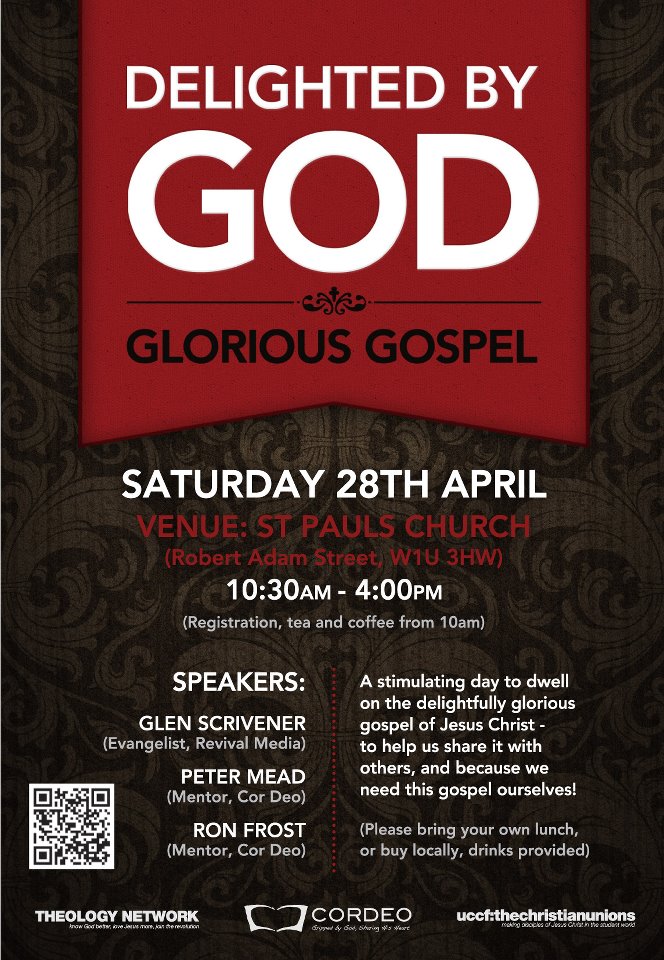
In a little while I’m heading to London to speak at a Cor Deo Delighted by God conference.  Our subtitle for the day is Glorious Gospel.  I am excited to hear the other sessions and to ponder together just how glorious the gospel really is.

What it comes down to, I suppose, is how glorious our God is, and what kind of gospel He has given us.  Too often the presentation of the gospel I hear is less than glorious.

It seems like a negotiation between a willing sinner and a reticent God.  The sinner is willing to say some words in order to gain a significant package of benefits.  And God is open to some sort of a contractual deal, but really is essentially resistant without the intervention of a kind lawyer working for us.

This is such a corruption of the truth.  God’s initiative is critical, and the extent to which He has gone to overcome the resistance of the human heart is stunning.  And as for the language of contracts, let’s dump that in the grip of His fatherly embrace!

The gospel is wondrously glorious, but it’s the kind of glory that involves His being high and lifted up, in absolute self-giving humiliation.

Let’s be sure we don’t preach a watered down, or petty, or negotiated gospel.

PS We’d really appreciate your prayers for today’s conference to go well!

_______________________

Next Week: The 10 Biggest Big Ideas

In the classroom Haddon Robinson said more than once that there are basically eight to ten big big ideas in the Bible.  He never gave us a list, but I’ll offer mine starting on Monday.  What would you include?