Preach To The Heart, Then Put Feet On It

It is a constant temptation for preachers. In fact, it is a feature of some streams of preaching. To preach at the level of behavioral change. You take a biblical story, draw out a moral (or several) from it, usually at the level of the characters’ ethics. Then preach a moralized version of the passage. The Bible is more than a book of moral case studies. Preaching should go to the level of God (theocentric) rather than just humanity (anthropocentric). Yet the message must also be relevantly addressed to a human audience.

People are heart driven creatures, so preach deeper than the mind and will. Of course we are called to inform peoples’ minds and exhort the will. Yet our preaching will always fall short if we don’t address the heart, the values, the desires, the passions, the feelings and the attitudes of our listeners. Whenever possible, target your message at the hearts of your listeners.

Heart level preaching is not merely conceptual, put some feet on it too. It is easy to preach at the level of attitudes or values and end up with a very conceptual and abstract message. It is important to try and earth that preaching in the every day world of your listeners. What does that mean when they watch the news on the TV? What will that look like when that person starts to flirt with them? What should they do when the temptation comes? Preach to the heart, but then help them visualize successful application of that preaching. They may agree with you and desire to change, so help them see what that will involve by putting feet on your heart-level preaching.

Images in Preaching, Not Always a Challenge

One thing we all want to avoid is preaching in a way that resembles a lecture more than a living, vivid, full color message.  Somehow we want our preaching to fizz and bubble, rather than lying soggy and lifeless in the pulpit.  One thing we need to give attention to is vivid imagery.

When preaching a poetic passage . . .  such as a psalm, the writer will usually give us some very helpful images.  Why go hunting for new images when the psalm provides a resting child, restless hours fretting in bed, climbing the mountain toward Jerusalem, entering the city gates in procession, etc.  We need to work on relevance and be sure to handle the imagery appropriately, but handle it, it is right in the passage.  It would be a shame to waste the head-start we are given.

When preaching a narrative passage . . .  such as a parable or event, then the passage itself is an image.  Too often I’ve heard preachers at pains to explain the story, but the preaching lacks zing because they forget to actually tell the story.  Don’t dissect a story to death, allow it to live in front of people and let them observe its power.  Be sure to explain and apply, of course, but don’t fail to let the vividness slip by in your preparation.

When preaching a discourse passage . . . such as an epistolary paragraph, then you may have extra work on your hands.  Often the passage will be very effective and logical explanation, or even direct application.  But it may be so direct that it lacks imagery.  This will not be the case in most of James, but is often true in parts of Paul.  Just because it is prose and perhaps plain in presentation, do not fail to look for images that will help the truth stick in the hearts and minds of your listeners.  If the images aren’t in the text, then find them elsewhere.  But don’t preach image-free, that’s a real waste of an opportunity.

How to End the Sermon Series

You are preaching through a book, perhaps an epistle, and you come toward the end.  How will you finish the series?  There are several options available, none of which is always the best route to take:

1. Summarize the “end matter” in a sermon.  You preach the last obvious preaching section and include a summary of the final verses in the book.  So for example, in 2nd Timothy, you might preach 4:6-8, but then summarize the content of verses 9 and following.  The strength of this approach is that it avoids dragging out a series unnecessarily.  The weakness is that you may miss the richness of those final verses, including verses 16-18.

2. Preach the “end matter” as the final sermon.  There are two reasons to always consider this.  First because of a conviction that all Scripture is God-breathed and useful.  Second because it will stretch you as a preacher to wrestle with how to preach sometimes seemingly miscellaneous verses (although whether any are truly “miscellaneous” is open to debate).  If a sermon would truly feel like a stretch, then it is probably better to not pursue this option.  However, it would be a shame to miss such passages and verses as Romans 16:17-27; 1Cor.16:22; 2Cor.13:11-14; Gal.6:11-18, etc.

3. Preach a review sermon at the end of the series.  Instead of finishing with a small part of a book, take the opportunity to review the whole book in one messages. We would be naïve to assume that listeners pull all the pieces together during a series.  Consider preaching the whole thing, making sure to show how those final verses bring the book to a point of closure.  Consider creative preaching options for such a sermon, with first-person being an obvious candidate.

Change Takes Time

Perhaps you are one preacher among several in a church.  Perhaps other ministers in the church hold a different view of preaching.  Maybe the congregation has differing expectations.  What can you do if others don’t share your commitment to expository preaching?

Accept that change takes time.  Take stock of the situation and thank God for the influence you do have.  If you ever preach, then use that opportunity to be an example.  Be an example by inviting input in response to your preaching, so that others may ask for your input in respect to theirs.  Share books and resources that will point others to the importance of expository preaching.  9 Marks by Mark Dever is a helpful book because it is not so pointed; as well as preaching he addresses eight other marks of a healthy church.

There are lots of things that can be done, but the process is usually slow.  Above all else there are two things to remember.  First of all, grace should season your attitude, your speech, your interactions.  Second, and last only for emphasis.  Pray.  Churches and people change, but not due to our cleverness.  We leave a mark on a situation as we pray fervently for God to work His will.  May all our churches increase in their commitment and responsiveness to true expository preaching – not because we are fans of any particular form of preaching, but because God is our goal, and expository preaching is the best approach to His Word.

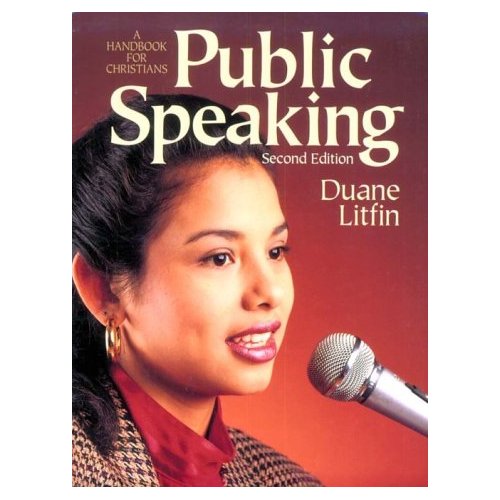
Review: Public Speaking: A Handbook for Christians, 2d ed., by Duane Litfin

litfin.jpg

This is a college text focusing on speech communication, rather than homiletics. The main reason it may be worth reading is because it is built on the Haddon Robinson “Big Idea” preaching model. Robinson’s influence is evident throughout, not only conceptually, but also in specifics.

Since Litfin’s work is not primarily focused on preaching, he is able to challenge the reader to produce latently Christian communication in a variety of fields, a challenge perhaps we in ministry need to hear. Litfin does well to show what an audience centered communication approach looks like, including the factors that make for easier listening (such as concrete, familiar, suspenseful, interesting, humorous and life-related elements). The introduction of other elements of communication such as proxemics, paralanguage and so on add a dimension perhaps weak or lacking in many preaching texts.

Litfin’s emphasis on the importance and function of the idea reinforce Robinson’s work, but the text also goes beyond Robinson to mention other approaches to speech formulation.

Litfin’s final chapter addresses the issue of preparing a Bible message. This chapter provides a helpful and relatively succinct summary of the process of homiletics (at least in reference to preparation). Litfin’s seven steps largely parallel Robinson’s, except for introducing audience need earlier in the process. Introducing audience need prior to writing the speech idea – the same stance taken on this site, seems like the correct order if the Big Idea is to be stated with relevance to the audience.

This book is a useful book for reinforcing and amplifying some aspects of Robinson’s work. For a speech com class, this is a great text. For preachers? It is helpful if you feel the need for help to fully grasp Robinson’s work. Not a preaching text, but not a bad source of supplemental reading.

First Person: An Extra Challenge

Sometimes preaching a passage in first person is the best and most effective way of communicating it.  Preaching in character allows you to engage the story in a more vivid and engaging manner.  Yet preaching first person sermons well is by no means easy.  You have to do all the work of Bible study and designing the message as for a normal sermon, but you also have to do more . . . more research, more planning, more details.  Two brief thoughts to add in to the planning process:

1. Remember that you are presenting the history, but need to preach the theology of the text.  For example, if you are preaching a narrative from the Gospels, you should preach the narrative in light of one of the written records.  I say this as opposed to preaching a composite blend of multiple accounts, to preach the event itself.  So if your narrative is found in all three synoptic Gospels, then be aware of all three (so as not to present a historical error in your story-telling), but make sure your idea, purpose and emphasis come from one of them.  The historical event was revelation, but the written account is inspired.

2. Remember to find ways to provide the evidence to support the idea of your sermon, and your interpretation of the text.  In normal preaching this is more simple, you merely decide how much of your textual study should be demonstrated and in what way.  If your understanding of the passage is influenced by the term the writer chose to use, then you can demonstrate that.  But when preaching first person, you usually can’t refer to the text in this way.  Do not therefore simply tell the story without letting your study show.  Show it in other ways.  For example, in Mark 4:35-41 you discover that the term “rebuked” is significant in understanding the story as Mark presents it, as is the use of “be still” in Mark’s gospel.  When preaching in character you cannot simply explain how these terms point to Mark’s intent in his presentation of the story.  But they can still show.  For example, speaking as a disciple, “You should have seen Him!  It wasn’t just that He spoke to the storm, it was also the way He did it.  As I thought back on it after, playing that moment over and over in my mind, I realized where I’d seen Him speak like that before.  It was when . . .” (then describe briefly the earlier incidents in Mark 1 and 3).  You can’t refer to chapter and verse, but you can refer to the stories in such a way as to highlight the significance.  And again, “The words He used, ‘be still!’ – He’d said that before . . .”  In first person it takes creativity to support your interpretation of the text, and it will be an indirect approach.  But you must do it, otherwise you run the risk of telling a story, but not preaching a text.

Take the Time

Some things take time.  This is true in all areas of life, and it is especially true in preaching.  Ideas take time to form in the minds of your listeners.  Description takes time to take effect.  Applications take time to visualize. 

We must avoid the temptation to rush through a sermon in order to cram in as much “content” as possible.  It is better to communicate one thing well, than three things poorly.  So before preaching a sermon, ruthlessly cut anything that does not serve and support the big idea.

Just because a clear image comes into your mind as you read a text, do not assume others see it clearly or at all.  Take time to describe what the text is referring to, not only so people have the facts, but so they can see it in their minds.  Careful and vivid, specific and focused description will eventually lead to an image emerging in the shadows of their minds.  This will take some time.  If you are preaching about Paul’s thorn in the flesh, take the time to help people enter into the reality of a thorn in the flesh.  If you are preaching a story with a terrifying storm, do what it takes for people not only to know about bad storms, but see the waves in their minds, to feel their hearts racing and their breathing become shallow.

Take the time to help people visualize themselves applying the message in their own lives.  Great Bible study worked into a great message can easily miss the target because the application is left vague and brief.  You can tell people to trust Jesus, and if you do they will nod and maybe even say “Amen!”  But what will that look like in real life tomorrow?  Wednesday morning at work?  Thursday evening at home?  Friday night when their daughter is not home and the curfew time has passed?  Take the time to describe application in glorious technicolor . . . because as you are describing, gradually an image will form, and they will know how the message, the idea, the text can change them, and by God’s power, it will.

Layers of Complexity

Sometimes a passage may prove more complex than it initially appears.  This is almost always the case with stories in the Gospels.  Usually Christians tend to view each story as a distinct unit that can be pulled out from the context in which it is placed.  In reality, each story or account in a Gospel is carefully woven together with others for a purpose.  For example, the stilling of the storm in Mark 4 is placed after, and linked to, the first part of the chapter where Jesus is teaching about the kingdom using parables.  However, in Matthew the account is in a series of miracle stories, quite separate from those same parables (which appear later).  While someone might suggest this indicates that what comes before and after is irrelevant to the interpretation of the passage, in fact the opposite is true.  The stories themselves, just like words, seem to get their meaning not only from within themselves, but also from the company they keep.

So while a story may appear simple to understand, as you study it in its context you often find that considering it in its context will clarify its meaning and purpose.  Then as you consider the context and flow of thought more, the interpretation may become more involved and complex.  As a preacher your first priority is to do everything you can to understand the passage. 

Once you’ve done all that you can to understand the passage, you then have to form the sermon.  The temptation will be to dump every element of your study into the sermon.  Don’t.  What is necessary and helpful?  What must be explained, what can simply be stated, what parts of your presentation need proof?  How much time do you have to support what you say?  Sometimes you will discover that your understanding of a passage has multiple layers of complexity, stretching out through layer after layer of other stories and accounts within the gospel.  Be thankful for the back-up support you have, but only give as much as is necessary and as much as your listeners can handle.  They may be fine with one layer of context, but overwhelmed if you present five layers.  Know the passage fully, but also know what your listeners need and are able to take onboard!

How Do Ideas Develop?

If communication is all about ideas, which it is, then what happens to those ideas? Haddon Robinson regularly states that there are only three things that you can do to develop an idea. You can explain it. You can prove it. Or you can apply it. There is nothing else that can be done to develop an idea.

* In a biblical passage, what is the author doing? Is he explaining/clarifying, is he proving/convincing, or is he applying/exhorting? It is helpful in Bible study to discern what the author is actually doing as his thought develops.

* As you preach the passage, what does your audience need? Do they need explanation? Do they need to be convinced? Do they need to consider application?

* You do not have to do just what the passage does. It could be that a passage spends no time explaining a concept, but your listeners need that extra explanation. We must know our listeners and their needs as well as possible in order to communicate effectively.

* There is a logical progression to the three developmental options. Generally explanation precedes proof/convincing, and both proceed application. The progression is important to note, even though this does not require us to therefore be rigid in our preaching. We do not need to always follow a formula of stating, explaining, proving, applying, etc. This can be both tedious and unnecessary. But it is important to understand the three options, and to think through what is necessary at each stage of each sermon.

Review: Power in the Pulpit, by Jerry Vines & Jim Shaddix

Subtitle: How to Prepare and Deliver Expository Sermons

vinesshaddix.jpg

Power in the Pulpit is a lengthy three-section textbook.  At times it may feel like the goal in writing was exhaustive explanation, rather than reasonable length.  Although not in the same league as Robinson or Sunukjian, the book is worth reading.  It is especially targeted at the minister preaching every Sunday.

The first section deals with the preparation for exposition.  The task of preaching is defined with a lengthy support for exposition as the ideal philosophy of preaching.  The foundation for preaching is seen in the word of God and worship of God, fundamental pre-requisites for preaching, along with the less well supported concepts of the call of God and anointing.  Finally, the preparation of the preacher is set out through the idea of being a healthy, hard-working individual who is a good steward of heart, mind, body and schedule. 

The second section is somewhat unsatisfying.  The process of exposition is set out at length, but seemingly without original contribution.  The analysis of the text is presented well, followed by the process of theme unification.  In fact, the sections on the central idea, the proposition and the purpose, are all effective (albeit tedious at points).  There is a bombastic attack on the new homiletic when the structure section begins (this makes the book read like a college text rather than a seminary text – proving a point cheaply using straw men, rather than engaging fairly with different views).  Then the structure section gets into concepts like the keyword method.  This section begins well but seems to get weighed down in detail and dogmatism by this stage. 

The writers rightly urge the preacher to be not only biblical, but also relevant.  So the preacher should observe culture and learn about people, they should particularly be concerned with how the message is relevant to their specific audience.  The section ends with strength as the authors provide helpful discussion of invitations at the end of messages (detail often overlooked in preaching texts).

The third part of the book deals with the presentation of the message.  After development comes delivery.  Here the book comes into its own with detailed suggestions on how to communicate the thoughts of the message in a way that will engage and communicate with the audience.  Here audience awareness is critical –level of education, type of vocabulary, manner of delivery and so on.  In order to make the connection necessary with the audience, it is helpful to use visualization for the sake of more vivid communication.  Part of this is visualization of the audience.  Thus, the preacher who better knows his audience will be better prepared.

The book ends with a strong call for preaching from the heart.  It is this personal connection, delivery of passion, of soul, of self, that magnifies the effect of communication on the recipients.  Helpful appendices at the end deal with relaxation, breathing and voice.

This book certainly covers a lot of ground.  Perhaps its greatest strength comes in its exhaustive dealing with delivery.  It is certain chapters, such as on the voice, that will prove a useful resource.