Lack of Application? Not Just A Pulpit Problem.

A follow-up thought to yesterday’s post. The difference between a true expository sermon and an interesting biblical lecture is often the speaker’s awareness of sermonic purpose. As Bryan Chappell wrote (Christ-Centered Preaching, p52) “Without the ‘so what?’ we preach to a ‘who cares?’” In his own way Haddon Robinson has put it like this, “Preaching can be like delivering a baby, or like delivering a missile – in one your goal is to just get it out, but in the other your goal is to hit the target!”

Perhaps the problem goes deeper though. While it is true that we must think through the purpose for a sermon before preaching it, there seems to be an issue at an earlier stage in the process. Are we saying that it is possible to study a passage, but not follow through and consider its application? Hermeneutical purists argue about whether application is a part of the hermeneutical process. Yet as preachers our concern is not academic wrangling, but bringing the Word of God into the lives of His people, by the power of His Spirit, to see His purposes worked out. May we never fall into the trap of studying a passage, determining the author’s intended meaning, but failing to consider the contemporary application of that passage in our own lives.

Perhaps a lack of application in the pulpit is the fruit of a lack of application in personal study. The implications are frightening.

Expository Preaching is More Than a Commentary

In Christ-Centered Preaching (p55), Bryan Chappell makes the following distinction:

“Expository preaching is not a captioned survey of a passage. By this I mean the typical: ‘1. Saul’s Contention, 2. Saul’s Conversion, 3. Saul’s Commission’ (Acts 9:1-19). In my own circles I think I have heard more sermons of this type than any other. They sound very biblical because they are based on a passage of Scripture. But their basic failure is that they tend to be descriptive rather than pastoral. They lack a clear goal or practical application. The congregation may be left without any true insights as to what the passage is really about, and without having received any clear teaching about God or themselves.”

He is so right. My circles also yield many messages of this type. If you look at tomorrow’s notes and discover you have a message like this, what can you do? Well, with just 24 hours to go, probably not too much. Try to change the points from captions to full sentences that state the idea of that section. Try to change those sentences from historical statements to contemporary applicational points. Or just preach what you have and pray for God to use it anyway.

However, before you start next week’s message, there are things you can do. First of all, remember that your goal is not to present a vocal commentary, but a message where God’s Word is vital and relevant to the lives of your listeners. Take the time to evaluate the listeners as well as the passage. Make clear notes for yourself on the purpose of your message. Seek to integrate relevance and application throughout the message, not only at the level of “illustrations,” but right in the points themselves. Make the points full sentences. Preach to transform lives, trusting the Holy Spirit to do the transforming, but not “despite” your message.

Repent of the faulty idea that merely getting biblical information into peoples’ heads, perhaps with a brief vague application in the conclusion, is enough. To preach an expository message, seek to bring the truth of the Word and the lives of your listeners into an encounter. It is about real life, not vague application. It is about the heart, not just the head.

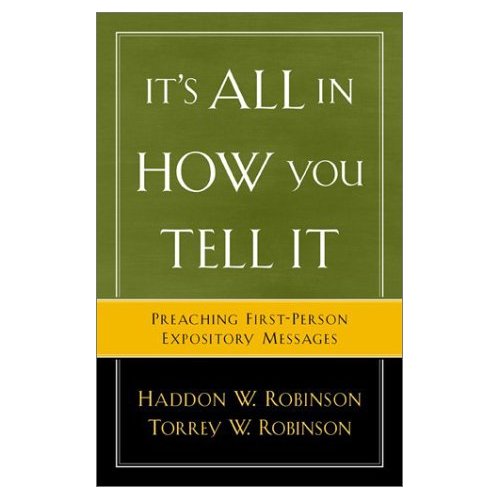
Review: It’s All in How You Tell It, by Haddon and Torrey Robinson

Subtitle: Preaching First-Person Expository Messages.

rob1stpers.jpg

This book, by Robinson and son, has a clear target. The sleek and well prepared script of the book flies effortlessly to hit that target. Unhindered by extraneous information, disconnected asides or time-consuming tangents, the book achieves its purpose. Preaching first-person expository messages.

The first major thrust of the book is to convince the reader of the efficacy of first-person preaching. Like a stealth bomber that flies in undetected by the defensive radar systems of modern believers, this kind of message can hit the heart like no other. By thinking through the audience and strategically designing the message, the preacher may be more effective using sanctified stealth than throwing traditional telegraphed torpedoes at them. People love a story. God’s Word is overflowing with them. So why do we tend to dissect a story and make it a lecture, leaking power at every stage in the process?

The book goes on to describe the process. Since this is expository preaching, it begins with massive amounts of study – of the text, of the character, of the setting. A key decision is what stance the character should use in light of the text and the audience. Are they with us, are we with them, do they know the listeners are there, etc? Then comes the well-worked big idea, definition of clear purpose, followed by structure, flow and the meat on the bones of the message. The process of preparing a first-person message is described essentially as a simplified Robinson process, with the additional step of character stance. The purpose of a message is not to perform (preacher-centered), but to effectively bring the big idea of a text home to the hearts and lives of the specific listeners that will hear it (Bible and audience centered).

There is a helpful section dealing with specific aspects of delivery such as movement, delivery, costume and so on. Obvious hindrances are overcome in the final chapter. One important lesson brought out in this section deals with the issue of sanctified imagination. As a preacher it is possible to easily assume people can tell the difference between fact and added detail. Assumptions are dangerous. A colorful illustrative detail can be misleading for an unaware audience.

The book ends with seven example sermons showing different approaches, different character stances and so on. Both Matthewson’s and Edward’s, as well as the Robinsons’ Herod sermons left an impression, even just in print. I would have liked to experience the effect of these sermons in person.

This book will leave you with one question. Why don’t you use first-person preaching more often?

And When You Think You Know Them . . .

As a preacher it is important to know who you are preaching to.  This takes work.  Often the focus of this work is on building relationships and getting into their world.  Conversations are priceless, counseling matters much, visiting homes and workplaces is all helpful, reading what they read, and entering into their world.  However, sometimes it is helpful to create an opportunity for them to enter your world.  Specifically I am referring to pre-sermon interaction with some of your congregation.  This could take the form of a sermon group that you meet with regularly.  I know some preachers who do this and value it highly.  Even without taking that step, it is possible to benefit from a one-off meeting.

Last year I preached a single message on the subject of euthanasia.  I invited a group of about ten people to come together to discuss the subject in the week before I preached it.  That meeting was very enlightening and critical in my preparation.  The discussion was not primarily concerned with my learning about the subject, but my learning about how people think of the subject.  I wanted their input on how the message could be handled effectively.

I had my pre-conceived commitment to sensitivity reinforced by the real-life experiences of those in the group.  My sensitive approach would now be more personal.  However, I had my pre-conceived ideas of Christian convictions shattered by the discussion.  After that evening I had to rework significant elements of the message.  The over-riding sense from some of the group was a view typical in this culture, that it is not possible to be caring for people and strong on the issue at the same time.  Therefore, in order to be sensitive, I should not take a strong stance on the issue.  That misconception became the foundation of my message – that God’s Word calls us to care for people and at the same time to stand against injustice, precisely because God is a God of immense compassion and uncompromising moral clarity.  My hour with those friends became a critical force driving my message not only toward sensitivity, but also to a more theological level. 

It is easy to assume that Christians think a certain way.  They probably don’t.  Getting some together to talk about the subject is a simple way to find that out!

Take Seven Steps to a Sermon, No Less

As you know, on the right hand menu of this site I have seven stages of preparation for a sermon.  The order is somewhat significant.  There is a general order there, although aspects of stage 7 – sermon details, could be written at various points in the process.  The number is not significant, I could easily adjust it to nine or more.  However, the number is significant.  Let me explain.

It would be possible to go through the first three stages and then present a message of biblical truth.  Some who espouse “expository preaching” do just this.  By adding in stage 4, purpose, it would be possible to also present biblical demands on peoples’ lives.  Again, some do this and only this.  The final three stages allow you to present biblical truth and biblical demands in a way that is relevant, persuasive and effectively communicated.

Expository preaching, by definition, includes not only accurate interpretation and proclamation of the text, but also effective communication with the listeners present.  To achieve both sides of the equation, all seven stages are necessary in the preparation process.

Who You Preach To – Part Two.

Ramesh Richard presents a helpful angle on the variety of people listening to any sermon. He presents three attitudes that will be present at various times in a message. “An expositional ministry,” he writes, “allows you to put a weekly dent in their apathy, passivity, ignorance, or hostility to equip them for godliness and service.” So the three attitudes that we must be aware of and communicate with?

1. The I Don’t Cares! These are not hostile, they just don’t feel they should be there at all. They are there out of a sense of duty to friends or family, or habitual routine. For this attitude the need raised at the beginning of the message is critical. Without it, they are free to continue their inner stance of not caring.

2. The I Don’t Knows! They lack the background awareness that others may have regarding God, the Bible, Christianity and church life. These people need good biblical content clearly explained.

3. The I Don’t Believes! These people are doubtful about the truth of what is said, or the applicability of it to real life. They are likely to test what is said with questions such as, “Is this truth coherent?” or “Is the sermon consistent?” or “Is this truth practical?” and especially, “Will this work?” For this attitude you must demonstrate a coherent consistency as well as practical applicability.

These attitudes may come and go during the same sermon, sometimes within the same person. Before preaching, evaluate your sermon and adjust its design to overcome the potential pitfalls for these attitudes. Is a clear and valuable need raised? Is there sufficient accessible explanation? Is the message relevant and practical? We preach not to get our study into the public domain, but to see the lives, the hearts, the attitudes of our listeners changed by exposure to God’s Word.

Who Are You Preaching To?

Preaching can be considered a relatively simple equation. You try to get the biblical message to the people sitting in the pews. Yet we so easily give all our effort to one half of that equation. We may study the passage for hours, but give little or no thought to the listeners. So next Sunday, who will you be preaching to? Lewis Smedes looked out at his church one Sunday morning and saw this:

“A man and woman, sitting board-straight, smiling on cue at every piece of funny piety, are hating each other for letting romance in their marriage collapse on a tiring treadmill of tasteless, but always tidy, tedium.

A widow, whispering her Amens to every promise of divine providence, is frightened to death because the unkillable beast of inflation is devouring her savings.

A father, the congregational model of parental firmness, is fuming in the suspicion of his own fatherly failure because he cannot stomach, much less understand, the furious antics of his slightly crazy son.

An attractive young woman in the front pew is absolutely paralyzed, sure she has breast cancer.

A middle-aged fellow who, with his new Mercedes, is an obvious Christian success story, is wondering when he will ever have the guts to tell his boss to take his lousy job and shove it.

A submissive wife of one of the elders is terrified because she is being pushed to face up to her closet alcoholism.

Ordinary people, all of them, and there are a lot more where they came from.”

Lewis Smedes, “Preaching to Ordinary People,” Leadership 4, no.4 (1983): 116.

On This You Cannot Work Too Hard

Pastoral ministry and family life rarely yield the full quota of hours we would like to perfectly prepare each sermon.  However, there are some elements of a sermon that don’t do well with a short-cut approach.  Time spent on this aspect of the sermon is always time well spent.

Clarity.  It doesn’t come by accident.  The only thing that is clear when you don’t spend time on clarity is that you didn’t spend time on clarity.  It takes work to think yourself clear and then more work to preach in a clear manner. 

However, it is tempting to bypass this aspect of sermon preparation.  This is because everything seems so clear to you, the preacher.  You have spent hours in the text (hopefully).  You have wrestled with understanding the passage and then forming a sermon.  Yet for the clarity to come through, you have to pay close attention to matters of clarity.

I have been both a student and a teacher in preaching classes.  The students know that they need to communicate a clear big idea.  They know that the class will be asked for the big idea once their sermon is over.  Consequently the smart students “work the system” by stating and reiterating their big idea seemingly to an extreme level.  Then when the prof asks the class what the big idea was, there is usually a pause, followed by three or four different ideas.  The preacher sits there with a puzzled look.  “I thought I was being clear!”  If prepped students looking for the idea can’t spot it, what about a congregation who may not even know what a big idea is?  They’ll come up with something, but if you are not clear, then it will not be what you intended.

So before you preach your next sermon, do a review for clarity.  Is the big idea clear?  Does the sermon flow in a clear manner?  Are the transitions clear?  Are you using vocabulary people will understand?  Be clear, be clear, be clear.  If you’re not clear, then what are you achieving?

Story Basics

Much of the Bible comes to us in story form. We should as familiar with the basic ingredients of a story as we are with riding a bicycle or driving our car. Sadly, many preachers are not. Rather than quickly dissecting a story into preachable points, take the time to review the basic ingredients. How does this story work? Consider:

1. The Setting. Where does it begin and end? What is its written context? What is the historical, geographical and cultural setting?

2. The Plot. What is the background information provided? Then what is the crisis, complication, tension point? As the tension rises, where is the resolution or climax of the tension? Then finally how does the story conclude? Is the plot simple or complex? Does it have a second complication and a second climax? Is the story left unresolved? Why?

3. The Characters. Who is major and who is minor in the story? What clues are there to help you picture the characters? Is there direct description? What do they do? What are they called? What do they say?

4. The Narrator. Every story has a story teller, but he is usually very inconspicuous. What is the perspective of the narrator? Does the narrator make any overt comments in the story? Are there brief moments of explanation or helpful asides?

Basic stuff, but we are not harmed by reviewing it again.

Hearing Is Not Like Reading

The difference between writing for the eye and writing for the ear is often overlooked by preachers.  We tend to be book people – we may have studied formally for more years than many others, then our work requires us to keep on reading diligently.  Perhaps we even write books and articles for others to read.  All this means we too easily write for the eye by default, even when we write our sermons.  But our sermons are not for the eye.  They are designed to be heard.  People can’t go back and re-read what we just said, nor pause for thought when a particular sentence strikes a chord.  Consequently, we need to be careful to prepare sermons that work for the ear.  Various techniques will help our listeners.  Here’s an important one:

Restatement – It is not repetition (saying the same thing again, like a parrot), it is restatement (immediately saying the same thing with different words).  Repetition can sound like you think the people listening are stupid (although sometimes it is appropriate to simply repeat what you just said).  Restatement gives the listener time to take in what you are saying.  It’s useful to use with the big idea, with references to the structure of the message, with major points, etc.  When people are reading a book, they can go back and look at an important sentence to make sure they understood it.  When they are listening they can’t go back, so you need to do this for them through restatement.  Practice saying something and then saying it again in other words.  Train yourself to state your point, but then to restate it in different terms.