I was asked by long-time fellow blogger John Brand if he could interview me about the subject of preaching. Here it is:
John’s site is www.preachersonpreaching.net (or here for the Facebook page).
I was asked by long-time fellow blogger John Brand if he could interview me about the subject of preaching. Here it is:
John’s site is www.preachersonpreaching.net (or here for the Facebook page).
The genealogy in Matthew 1:1-17 points to the fulfilment of the promises to Abraham and David. It also gets the reader thinking about the troubled reputation of several women in earlier days. In Matthew 1:18-25, we see another couple troubled by apparent sexual sin.
Joseph’s Gracious Plan (vv18-19)
Couples married young, and this young couple had their lives before them. The young carpenter and his younger bride-to-be. But then the ultimate slap in the face: Joseph discovers that Mary is expecting a child. It is not hard to imagine the shattered dreams, repulsive images, and emotional turmoil that Joseph endured.

Not only did this crisis mean their forthcoming wedding was a sham, but Joseph also now faced the shame of suspicion. The obvious pathway forward was to save face for himself by publically disgracing her and distancing himself. If he could be sufficiently indignant and distance himself, then maybe his honour could be saved. But Joseph did not choose the obvious path.
Public disgrace for Mary might have meant some sort of public execution by stoning, but even without that, public disgrace is too painful to describe in a shame and honour society. Joseph chose an incredibly gracious option: he would divorce her, and he would do so quietly. What would people say about him? The cloud of suspicion would linger, but Joseph looked out for the best interests of the girl whom he thought had sinned. Joseph’s selflessness is worthy of reflection, not least because we know what he didn’t – the identity of the baby inside her!
God’s Greater Plan (vv20-21)
During the agonizing turmoil of Joseph’s deliberation, new information was introduced. Perhaps he tossed and turned on his bed. The thoughts, the images, the options, the consequences. But the troubled young man must have slept, for an angel of the Lord appeared in a dream.
He was told not to fear taking Mary into his home. He was told that the baby was in her from the Holy Spirit. He was told to name the boy Jesus. And he was told why.
Jesus. The Hebrew name Joshua. Yeshua in Aramaic. However we might pronounce it, this was a name of significance. Actually, it was not unusual. There were lots of little Jesuses running around the neighbourhood for it was one of the most common boys’ names in Palestine at that time. But the angel didn’t just give the name choice, he also gave the reason. This boy would live up to His name – He would save people from their sins.
God’s Great Plan Predicted (vv22-23)
Matthew adds some theological commentary for the sake of the reader. Going back to Isaiah 7:14, Matthew quotes the prophet’s anticipation of a virgin giving birth to a special child with a special name. Ahaz may have been a king with all sorts of issues, but God was not out of touch with his struggling people. In fact, an unmarried woman was soon to give birth to a son of significance, and the significance was God’s presence with the people.
What was true in Ahaz’s day proved to be infinitely truer still with Mary. She was a virgin, unmarried, but with child. This time it was not a matter of sequencing prediction and then fulfilment by normal means. This time she truly bore a miracle child, a child whose significance could not be greater. Immanuel – God with us!
So what would Joseph do? Seems obvious: obey the angel. But not so fast. So he had insider information concerning the child inside her. The boy Jesus was to save the people from their sins and He would be God with us, Immanuel. All very well and perhaps worthy of some Christmas carols, but what about Joseph and Mary?
You can imagine his thinking. Two men come into his carpenter’s shop and request a bid on a certain job. Joseph tells them a price. They look impressed but concerned. Joseph adds a comment about how they could trust his word. Little boy Jesus runs in and starts playing with some wood blocks. They look at the child and whisper to each other. Joseph hears a snippet of a comment about an angel in a dream. They laugh and press him further for assurance on whether he can follow through on his bid. Joseph knows what they are thinking. They leave and go looking for another carpenter, one they can trust.
The stigma of the sinful reputation would linger for years. It could cost them on so many levels. How would he provide for them? How would Mary cope with the dagger comments in the market? How long until the child sensed what everyone thought? It wasn’t that nobody sinned in Nazareth, that was all too common. But when a couple perceived to be different turns out to be the same as everyone else, well, they don’t get treated the same as everyone else. And what about family? What would they say? Family, friends, work, and just about every aspect of life would be stained by the reputation of sinful infidelity.
Joseph’s Immediate Obedience (vv24-25)
Matthew leaves us with no doubt what kind of man Joseph was. He had been kind to Mary, even when he thought she had been unfaithful. And now he proved faithful to God when the days ahead looked so uncertain.
He took Mary into his home, thereby offering the protection and security she needed. A quick wedding was the best thing for all involved. Then he had no marital union with her until after she had the boy. And Joseph named the boy Jesus.
Three times Matthew points to the name of the child. Indeed, the significance of the birth story here is wrapped up in that name. Everyone thought they saw just a normal couple getting married in a hurry for the ‘normal’ reason and later giving birth to a son with a common name. But this was not normal in any way.
How could they face the uncertainties, the knowing looks, the suspicious smiles from family members, or worse, the rejection that may come their way? They could face the stigma of sin because this child was Jesus, the One who would save His people from their sin. This child was Immanuel, God with us.
___________________
This post is adapted from chapter 9, Pleased to Dwell: A Biblical Introduction to the Incarnation (Christian Focus, 2014), 83-87.
Join us on a journey to Christmas this December. A new video every day walking through Pleased to Dwell (follow along with the book, or just the videos).
So last time we started this list of 12 points of advice to preachers from John Wesley. Let’s keep going!
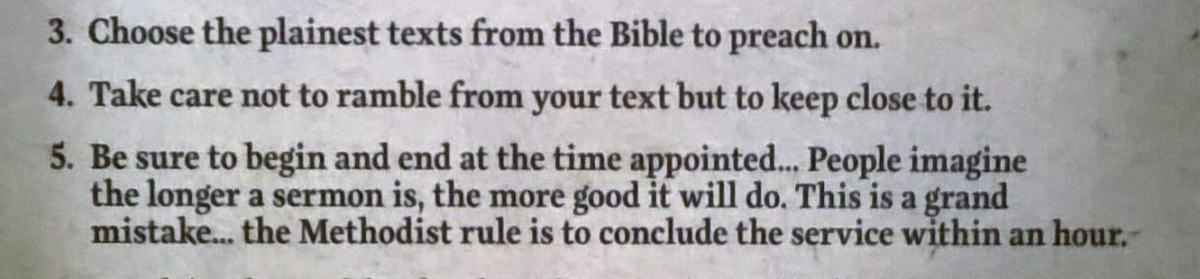
3. Choose the plainest texts from the Bible to preach on. Again, if I were purely speaking to non-believers then I would completely concur. However, in a typical church setting, we will be speaking to both Christians and non-Christians. A steady diet of the same evangelistically oriented passages will lead to some malnourishment among God’s people. I think it is good to help our churches experience the full breadth and scope of God’s Word. You might preach more from the New Testament than the Old, but if they never hear the Old Testament preached, why would they read it? And if they don’t read it, what a vast vista of theological truth is lost. Different types of text are also important for the health of the church.
So on the one hand, I would agree that every passage has a redemptive force that should be brought out because believers never move beyond the need to hear the gospel being applied to their lives. On the other hand, while every passage is useful, not every passage is equally useful on every occasion. Don’t be stubbornly preaching through Jeremiah when people are coming for a Christmas Carol Service. Bottom line? Be selective and choose what you are going to preach appropriately for the listeners and the occasion, but in a church choose from the whole Bible because people need more than your favourite five passages.
4. Take care not to ramble from your text but to keep close to it. Can I just say I agree and move on? Of course not, otherwise this would be a “Quote” rather than a “Blog!” It is quite remarkable how little weight the Bible passage will have in some sermons. Some will leave it behind to ramble into excessive personal anecdotes and humorous illustrations. Others will leave it behind to ramble into theological presentations that resemble explosions in a concordance factory! (Hyper cross-referencing is very common in some circles!) Few seem to recognize that this passage is uniquely powerful and should not be missed by superficial coverage in the sermon. Your church may not be back in that passage for several years. Keep close to it, do it justice, allow time for clarity to emerge and its impact to be felt.
5. Be sure to begin and end at the time appointed… People imagine the longer a sermon is, the more good it will do. This is a grand mistake… the Methodist rule is to conclude the service within an hour. Several points in this one. Let’s go one-by-one – (1) begin and end on time. I understand that different cultures have different expectations in terms of time. But the point still applies. Abide by the expectations of the culture. Once we break the general expectation, then we distract attention from the sermon. If we go 10 minutes over, parents are concerned about children in kids’ groups, volunteers in kids’ groups start to lose their joy in serving, and others are concerned about their plans, their lift home, etc. Generally speaking, stick to time. Seems fairly simple.
(2) Longer is not necessarily better. Again, agreed. Haddon Robinson was captivated by how some preachers preach for ten minutes and it feels like an hour, while others preach for an hour and it feels like ten minutes. Length tends to become the key focus when too little attention is given to clear, engaging and relevant content and delivery. Generally speaking, longer sermons could be sharpened into shorter sermons. But shorter is not automatically better either. Some things take time. Just as an illustration might be lost in two sentences, but really capture hearts in two minutes, in the same way, a sermon can be technically precise in a shorter timeframe, but more vivid and engaging with enough time given to let the listeners’ imagination flourish. There is no right length of sermon. It depends on preacher’s skill; listener’s background, expectations and focus; and the occasion too.
(3) Service length should be less than one hour. That feels quite arbitrary and culturally bound. I imagine that didn’t translate effectively in some other global contexts! But, service length should be considered for the sake of church attendees, as well as their perception of service length for potential guests they might invite in the future.
Ok, let’s leave it there for this time.
Definition matters massively. One person might say, “professional preachers are the problem!” Then another person might say, “amateur preachers are the problem!” And both might be right. It all depends on what they mean by what they say.
1. “Professional” can be referring to very different issues. What image does the term “professional” bring to mind? You might think of a person’s skill, or how they handle their communications with customers, or their manner in person, or their motivation for what they do. That is already four variations of potential meaning for the term “professional.” Perhaps an electrician is called to solve a problem in your house. They might be a real professional in their work (positive – they knew exactly what to do), their invoice was very professional looking (positive – good communications), their conversation and manner in conversation might have been a bit professional (negative – cold or aloof communications), and their reason for working may have seemed too professional (negative – it was all about the money).
2. “Amateur” can be referring to very different issues, too. What image does the term “amateur” bring to mind? You might think in the same categories as before. Perhaps the electrician was amateur in their work (negative – they did not know what to do), their invoice looked very amateur (negative – sloppy communication), their conversation might convey the enthusiasm of an amateur (positive – they love what they do), and their reason for work may have been the best side of an amateur (positive – they do it for the love of their craft).
3. In terms of skill, be professional. I don’t want someone showing “amateurish” skill levels when they fix my car, cut my hair, or operate on me. Skill is good. In reality, some of the most skilled people in the world may not be paid for what they do, while some who are paid should not be allowed anywhere near your car, your scalp or a scalpel. So actually, pay is irrelevant. The point is about skill. So as a preacher, it does not matter to this point whether you are paid to preach or not. In terms of skill, be as professional as possible. Read, learn, study, grow. Be a good steward of the ministry opportunity God has given you.
4. In respect to motivation, be amateur. When someone’s vocation has been “professionalised” then their motivation becomes suspect. This is why a nationally known car exhaust company may not be trusted (did they do more work than was needed in order to get more of my money?) Or why it is a problem if your medical practitioner is incentivized by drug companies to prescribe treatments to as many people as possible (whether they need the treatment or not!) In this respect, skill is not the issue. The point is about motivation. A highly skilled mechanic who rips off the customer is not to be celebrated. A brilliant clinician who risks lives to increase their income should be prosecuted. So as a preacher, your skill level (in this point) is not my concern. In terms of motivation, be as amateur as possible. Love God, love people, and love your craft. Be driven by the privilege of getting to speak God’s Word to people for their benefit.
5. And in the area of interpersonal communication, be genuine. I have underlined issues of skill and motivation, but interpersonal communication is also part of the package. Coming across as too professional can be problematic, even when you are not preaching. Coming across as an amateur might be an issue too. Instead, how about we settle on the need to be genuine? It does not resolve all the complexity of conversational dynamics, but it does leave us with two clear points to finish.
6. As a preacher, let’s do what we do as well as we can. If that means being professional in some sense, so be it. We certainly don’t want to be amateurish.
7. As a preacher, let’s do what we do with heartfelt motivation. If that means being amateurs in some sense, so be it. We certainly don’t want to be professionalised.
The definition of labels is important. This is an example worth pondering as far as preaching is concerned and how we might view our ministry. We should preach as professionals in the sense of “to the best of our ability” and as amateurs in the sense of “with the passion of a captured heart.” We should not preach as professionals in the sense of “relying on our own ability,” or “just for money,” nor as amateurs in the sense of “to a poor standard.”
It is also an example to keep in mind in a world where labels so easily get applied as a pejorative, and the mud sticks because people don’t question what is really meant.
______________________________________
In the next week or so I will be completing my short video collection through the Psalms. Please do check it out and share with any who may find it helpful as a reference, or better yet, as a companion through the Psalms in 2023!
This might seem like a really obvious thing to say, but I think it needs to be said. We have to really work hard in order to really know a passage before we preach it.
It is very easy to assume we know a passage. It is very hard to recognize how much we don’t know. But learning to think clearly about your own thinking is a critical skill for the preacher.

Here are some thoughts to consider:
1. Knowing a passage involves more than knowing some highlights or landmarks in it. After reading a passage and spending some time in study, you may be able to identify some key features of the passage. You might be able to say that there is the truth in verse 3, and the truth in verse 5 and then the conclusion in verse 9. Do you know the passage? No, you are aware of some highlights in the passage.
2. Knowing a passage involves more than being able to launch preaching points from phrases in it. You might feel ready to preach because verse 3 mentions justification (and you have some things to say about justification), and then verse 5 mentions hope (and you have a nice illustration you want to share about hope), etc. Are you ready to preach the passage if you have some good preaching points ready to launch? No.
3. Knowing a passage involves more than being able to talk about each phrase with theological truth. But what if your preaching content is not illustrations, but rich theological truths? Maybe you have a whole theology of justification that you can launch in verse 3, and then you can make a presentation on sanctification because of a key word that appears later in the passage? Surely if it is rich theological truth, then you are ready to preach? No. Not if the passage is not saying what you are planning to say. Just because wind appears in John 3 does not mean that I should preach about God’s view of changing weather patterns from it.
4. Knowing a passage involves more than reading some commentaries about the passage. It is not a bad idea to have some conversation partners in your study. Other live humans can be super helpful. As can published ones. But even if I can quote from impressive commentaries, it does not mean that I really understand the passage yet. By all means use the best resources you can access, but remember the goal is still for you to understand the passage, not just to have studied things written about it.
5. Knowing a passage involves understanding the details as they work together in a coherent whole. This is where many preachers seem to stumble. They do reasonably well with the details. They speak theological truth. They associate that truth with the wording in the passage. But if they don’t recognize how the details are working together in the passage, they don’t know the passage. Remember, your goal is not to study a passage in order to find a sermon. Your first goal is to study it in order to understand it.
6. Knowing a passage involves understanding the flow of thought in the passage, with an awareness of context. A passage sits in a book, as part of the whole. If you don’t understand how the passage works in the book, how can you really grasp what the passage itself means? So we need to study each passage in its whole book, as well as whole Bible, context. The point is, each passage was written to communicate something specific, and we need to figure that out. Our job is not to generate meaning by creativity, but to find meaning by dogged humble persistence.
7. Knowing a passage means being able to explain it so that the original author would affirm your grasp of its essential meaning. That sounds like a bold goal. It is. That is why we can’t just study until we feel a message emerging. As preachers we can generate messages out of nothing. But God has given us something very specific. And unless we grow in our confidence that it is possible to communicate the essential meaning of a passage to a level where the original author would affirm our explanation, then we will not put in the work necessary to be ready to preach.
Implication? The big implication of this post is simple. Don’t be so confident that you know the meaning of a passage. Study more. Study longer. Study humble. Study persistently. Make it your goal to know the passage better than you ever have before, to be able to handle questions about specific aspects of the passage, and be willing to explain the meaning of the text even to the original author himself…and then start thinking about how you will preach it!
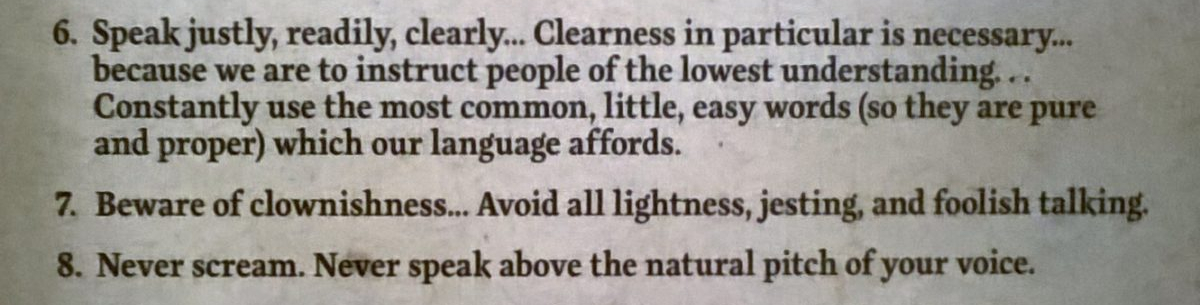


 Biblical Preaching