The Thirties – Part 8 (Points to Ponder)

In this series, I have considered ACG’s book, Inside Germany.  Published in 1939, it is a fascinating account of the Nazi takeover of Germany that brought the world to the brink of disaster.  In light of reading that book and reflecting on our own times, what are some takeaway points to consider as preachers?

1. Only one message can change hearts.  It is not a political message nor driven by headlines in the newspapers or social media.  It is the message of the Gospel, and it comes from the Bible.  We must preach the gospel as loud and clear as possible in tumultuous times.  It may be that the turbulent times stir previously comfortable hearts to a new level of openness.  When those moments come, we must offer Jesus to a needy world. 

2. Only saying one thing can be a sign of weakness.  I know that our ministry is to preach the Gospel.  However, we also have some clauses in our job description that relate to being people of the truth.  In an age of disinformation, misinformation, malinformation, etc., we must speak the truth.  In an age of censorship, controlled media narratives, and the silencing of independent thinking, we need to promote informed and free thought.  Suppose our default position in public speech is to hide behind what is culturally acceptable.  For now, we can quote Bible verses because it is still safe to do so.  Why do we think we will later become bold clarions of truth when the societal pressure to conform becomes so much greater once tyranny takes a tighter grip on our throats?

3. We need to grow in discernment.  Too many are proclaiming a media-shaped worldview with some Bible verses attached.  There is probably a church in your town that is already fully there – sounding like their pulpit is a marginally more religious version of a BBC TV presenter.  God has not called us to offer insipid commentary on society with the odd tip of the hat to contemporary ideology.  We were called to think and proclaim biblically.  So read the Bible, then read the culture through the lens of the Bible (and not vice versa). 

We wouldn’t only read theology books from one agenda-driven publishing house, so don’t read society simply through the lens of the mainstream media’s agreed narrative.  Neither should we only read society through just one or two social media voices.  Let’s look for trustworthy sources.  That doesn’t mean checking to see if they are on the BBC, even if it once did.  Censorship should be a red flag to any thinker.  Look for who is being paid and who is losing their livelihood.  Look for who stands to gain and who is being silenced.  Let’s look for multiple trustworthy sources of information and set an example of being informed, thoughtful, and biblical in our discernment.

4. Have the courage to speak when silence is easier.  Can I be candid?  There have been times during recent years when I have found that many Christian leaders seem to be hiding behind the mantra of only preaching the Gospel.  It is easy to quote John 3:16 on social media.  But how many churches have gone along with the media narrative every step of the way, only to wonder later why they didn’t question more?  The easy choice today can mean I have reduced my credibility in a year or two.

5. What is our territory?  We have to be careful with politicised issues.  But don’t fall for the simplistic idea that every political matter is off-limits to us.  Last week, I was in a room where some people were asked what it was like to live under Soviet rule.  One answered about how they could not trust anyone.  Another spoke about never showing gladness outwardly.  Then an older man said, “We can never explain to our children what it was like because it was a spirit.”  There was a spiritual reality behind Communist rule.  There was an evil spirituality in Nazi rule too.  And if there is a “spirit of the age” at work in the ideological agenda of our day, then we cannot say that preachers should stay quiet.  Politics may be largely off-limits, but speaking God’s truth in the midst of a spiritual battle certainly is our territory.

6. Having courage does not negate the need for gentleness.  Sometimes, people hear a call for courage as a call for bombastic shouting.  Not at all.  We represent Christ, and we need to convey the nature of his character, as well as truth, in society.  But we should not underestimate what can be achieved in this world with gentle forcefulness.  (See my post on Solzhenitsyn’s “Live Not By Lies” from January.)

7. Pray and pray boldly.  As well as saying little to challenge the media narrative, it is also easy to pray as if that media narrative dictates reality.  God can do immeasurably beyond all that we ask or imagine.  In our private and public prayers, let us boldly pray for God to bring down those who exalt themselves, for God to expose those whose plans are for evil rather than good, and for God to break open hearts that seem so solidified against him.  The Third Reich was supposedly going to last a thousand years, but it was done in twelve.  Many prayed for that.  The impregnable Iron Curtain was brought down in my younger years.  Many prayed for that too.  And so it is with every variation of Communism, globalism, or religious takeover. Let’s pray that God would bring it down so that more can be spared the suffering and freely come to know him.

The Thirties – Part 1 (A Seismic Shift)

At the height of restrictions during the times of Covid, I made a comment to a friend.  His response has stayed with me.  My comment made a specific comparison of a contemporary trend with 1930s Germany.  He immediately reacted and told me that we should never make such a comparison because it implied that the motives of certain influential people were as evil as Hitler himself.  I find censorship to be a huge red flag, and I felt like my thought process was being shut down.  A few years later, whether the situation warranted my comment is still up for discussion.  Perhaps, over time, we will know.  But my interest in 1930s Germany has continued.

What did they know?  And significantly, how did they respond during an era of multiplying warning flags?

Recently, I discovered Inside Germany, a book written by Albert C. Grzesinksi [herein ACG] – a member of the Social Democratic Party who helped to found the German Republic after the First World War.  Intriguingly, he published the book in 1939 without the benefit of hindsight.  After six years of the Third Reich, he wrote without knowing what would unfold in the next six years. The horrors of Nazi Germany during the Second World War, especially the “Final Solution” to the “Jewish problem,” were eventually revealed to the world.  But what about before the war?  How did the German Republic become the Third Reich?  How did so many accept such a rapid transition from liberal democracy to tyrannical evil?  It is a fascinating read.  And maybe, a century later, there could be lessons for us as we pray for our world, influence Christians and lead churches in a time of potentially tectonic political shifts.

The German Republic was quite an achievement after the devastation of the Great War of 1914-18.  On the 31st of July, 1919, the National Assembly in Weimer “gave the German people a constitution that was one of the most liberal, progressive and inspiring documents in the history of the world.  On the 23rd of March, 1933, the parliament of the same republic passed an empowering act which concentrated all powers in the hands of Hitler, and which wrote finis to German democracy and the liberal republic.” (p357)  Strikingly,  ACG wrote, “Those two dates . . . mark Germany’s road to Golgotha, the road to the crucifixion of the German people under the Nazi swastika.” (ibid.)

It would be easy to assume that Germany, after WWI, simply rebuilt itself, leading to WWII.  Not so.  The Germany of 1919 had to be radically changed to become the Third Reich of 1933 and following. “Seemingly by a stroke of the pen, political liberties were achieved which not even the boldest optimists and democratic dreamers of Germany had dared to envision. Germany became a state of, by and for the people; a democratic fatherland dedicated to the needs and aspirations of the working masses.” (p358)  And it is that seismic shift from liberal democracy to totalitarian tyranny that intrigues me.  How can that happen so quickly?  And, if you will indulge a series of posts about Nazi Germany, I’d like to ponder what it might mean for how we preach and influence both church and society in our tumultuous times?

7 Defining Moments in Your Sermon – Part Two

As we work through this list of seven defining moments in the sermon, we have so far thought only about the unseen preparation of all involved and the first impressions before the sermon really starts.  Now let’s consider two that are part of the introduction to the message:

3. The motivation to listen – Most sermons will have the same elements: a beginning, a middle, an end, a Bible passage explained and applied, and some illustrative material to help communicate.  Now, all of these standard elements can be better or worse.  But they tend to be present.  However, the motivation to listen is by no means guaranteed.  It is not guaranteed from the listener’s side, and it is not guaranteed in the details of the sermon.  How could it be missed?  Easily.  Too many preachers assume that their listeners are interested in Elijah’s encounter with a widow or Paul’s answer to the church’s question.  And too many introductions offer something less than motivation. 

We can easily settle for familiarity or interest.  Familiarity introductions are the ones that refer to something we all experience – you know, going upstairs and forgetting what you went up to get.  Everyone smiles and relaxes a bit.  Then, the message continues as if that connection is enough.  Or interest introductions are the ones that raise eyebrows with an interesting tidbit – you know, that it is impossible to lick your own elbow.  Some knew that, some didn’t, some try it, etc.  And the message moves on.  Familiarity introductions and interesting introductions are probably better than just launching into 1 Kings 19 and its background, but better by far would be an introduction that makes listeners want to hear what is coming. 

Inasmuch as you are able, motivate listeners to listen.  Robinson used to talk about surfacing a need in your listeners that the passage would then be able to address.  Use your introduction to grab their attention, convince them that they need what this passage is going to show them, and win their hearts to be open to you as you lead them into the passage.

4. The overview – At the end of the introduction, it is easy to skip the overview.  Generally, you should not skip it.  Give people a sense of the shape of the message.  We are going to see the problem described, and then the solution.  Or Paul gives three truths that we will look at together.  Or the passage comes to us in two chunks, verses 1-5 and verses 6-9.  Or we will see the transformation we need is coming, the triumph over death is certain, and the therefore that changes how we live – the transformation, the triumph, and the therefore.  The overview can be detailed or a very high-level glimpse, but if it is missing, the listeners are slightly in the dark as to where the message is headed.  If your message is an inductive shape, then make sure the question that is going to be answered is clear: what is the critical ingredient that we need if we are to have a ministry like the master?

Feel free to comment about introductions – what works well?  What do you hear that doesn’t connect or help the listener?  Introductions are critical to the effectiveness of a sermon.  Next time, we will look at two more defining moments in the sermon.

7 Defining Moments in Your Sermon

As you preach, there are numerous defining moments.  That is, pivotal decisions or moments that will multiply the impact of the sermon.  The whole sermon matters, of course.  You can’t expect one great line to do great work when it is packaged in fluff.  But while you work on the whole sermon, remember that there are some defining moments that could make or break it.

1. The unseen preparation (yours and theirs!) – Whatever happens during the sermon itself is really just the final part of a process.  There has been a whole lot of unseen preparation before the moment of delivery.  Of course, there have been the ups and downs of sermon preparation for you, the preacher.  The prayer, the study, the wrestling with word choices, the hunting for illustrative material, the interruptions, the storm, and the calm inside you and in your study.  The journey to the pulpit may have been arduous, or somehow serene, but hopefully God has been at work in you before he will work through you. And I am only describing the last few days, but God has been at work for years.  However, the sermon is not just about the preacher.  How has God been stirring the listeners?  Providential circumstances, carefully timed conversations, quiet questions inside, or overwhelming challenges without.  It is not unusual for a sermon to touch a nerve that was only sensitized in the preceding days.  “How did the preacher know that about me?”  Often, the preacher didn’t.  But someone did.  It is helpful to remember that a lifetime of preparation is brought into the sermon from all sides, and only God can be aware of that, let alone influential in it!

2. The first moments of the introduction – It is hard to overstate the importance of the first moments.  I don’t mean the introduction.  I mean the first impressions.  Do you seem comfortable, or nervous, or indifferent, or agitated?  Will listeners get the sense that you have something to say that is worth their focus and time to listen?  Will people who have never heard you before feel welcomed and engaged?  Will regular listeners sense that you are well prepared, or will they get the sense that you are somehow “off” this week?  Remember, humans are wired relationally.  When you sit at a table in a restaurant, you know whether you like the server before you have a chance to evaluate your first interaction.  Sometime, watch a video of yourself.  Watch up until your first word.  Prayerfully and conversationally evaluate (that is, ask God what he thinks, and ask someone else what they notice – don’t just trust your own perspective).  Then watch the first couple of sentences, and evaluate again. 

We will continue this list of defining moments in your sermon next time, but feel warmly invited to comment with any that are on your mind!

7 Defining Moments in Your Sermon Preparation – Part Four

There are multiple defining moments in the sermon preparation process. We have thought about starting the process, shifting from passage study to message formation, becoming conscious of who will be listening, and the unplanned interruptions that seem to prevent a smooth preparation. There is one more defining moment left. It is one to add if it doesn’t happen naturally:

7. The realization of insufficiency.  You want to be a good steward of your opportunity to preach.  You desire to give your best, both in terms of exegetical rigour, and pastoral sensitivity in sermon crafting.  And perhaps the process has allowed better than normal focus, with more clear hours for preparation than you expected.  Maybe nothing broke at home, no hospital visits were necessary, and everything was unusually peaceful and supportive along the way.  Will you go into preaching feeling confident in your preparation, your skill, and your work of sermonic art?  I hope not.  When we feel we have “the best of sermons” then we tend to discover the false promise of self-sufficiency.  If God has not brought you to humble dependency through a log jam, or through an interruption, or through years of preaching experience, then it is totally acceptable to bring yourself to the place of total dependency.  Some combination of “apart from you, I can do nothing” prayer content along with a flat-on-your-face prayer posture is highly appropriate.  One of my teachers always prayed that he had a stick but needed God to come through as he threw it on the ground.  You want to be the most prepared preacher possible, but you must preach with a profound sense of your dependence on God.

What other defining moments do you recognize in your sermon preparation process?

Okay, here is a bonus one as I reflect on the list:

Bonus: The recognition of the coherence of the passage. Thinking back to the study of the passage, it is critical to arrive at the recognition that the passage holds together. It is easy to skip past this once you start to see some points that will preach. But actually, for your message to feel coherent, you need to recognise that the passage is also coherent. What unifies it? How does it hold together? How do the points and details relate to each other? Assume the Bible writer was not jumbled or scattered in his thinking, and keep thinking until you can see how it is a single unit of thought.

7 Defining Moments in Your Sermon Preparation – Part Two

While the whole preparation process will shape your message, some defining moments will fundamentally change the outcome of the process. We started with two related to starting preparation. Now let’s think about two that tie into the transition between passage study and message formation:

3. The decision to transition from passage study to message formation.  The first half of the preparation process focuses on understanding the passage.  The second half involves formulating and writing a message.  The shift between these two phases is critically important.  If you shift too early, then you will be working on the message without really grasping the meaning of the passage.  If you shift too late, then you will have plenty of exegetical insight to share, but little time to craft a message that lands in real life.  Do you tend to fall in one direction or the other?  It is hard to see a lack of understanding in the mirror – we all tend to think we have a good grip on a passage when it may only be a superficial sense of the meaning.  Or you may be in a rut of sharing exegetical nuggets without crafting a message that is shaped to speak into real life.  And some, sad to say, neither know the joy of being gripped by a passage, nor the pleasure of crafting a sermon that hits home – they just use a passage as a launch point for some standard favourite content.  If that could be you, then it may be time for some candid conversations with some listeners, and for radical surgery on your ministry.  It will be worth it.

4. The realization of who will be listening.  At one level, this moment is fairly straightforward, as long as it happens.  That is to say, after studying the passage to understand the author’s meaning as accurately as possible, then you consciously introduce your listeners into your thinking as you move to crafting the sermon for their benefit.  You don’t want to be thinking too much about your listeners when you are studying the passage, because your concern is the original audience of the text.  Neither do you want to not be thinking about your listeners when shaping the message, because your concern has to be for them as the audience of the sermon.  That moment of introducing conscious consideration of your listeners should be a standard point in the process every time (and essentially the same moment as number 3 above).  But then there will be some sermon-specific moments in this category too.  You might realise how the message could hit very close to home for someone in your congregation.  You might be told that a certain person is going to be present.  You might be at church when someone walks in that you were not expecting (and you realise your message requires some tweaking for their sake – either to be more accessible, less provocative, or whatever.)

As this list continues to build, what defining moments do you recognize in your sermon preparation?

7 Defining Moments in Your Sermon Preparation

As you prepare your sermon, there are numerous defining moments.  That is to say, pivotal decisions that will impact the essential nature of the sermon.  The whole process is important, and every little detail of your preparation will build the character of the message.  But the defining moments will fundamentally change the outcome of your process.  Therefore, it is helpful to be especially aware of these key points in the process.

Here are seven defining moments in your sermon preparation:

1. The choosing of the passage.  If we genuinely believe in expository preaching, then the choice of passage will always be a key moment in our preparation.  Why?  Because that passage will be the boss of the message.  We cannot say whatever we want using any passage.  Some preachers do.  We must not.  If it is a series from a book, then the moment will primarily be the selection of the series, although the length of the next section to be covered will also matter.  If it is a one-off message, then the choice of the passage matters for the content of the sermon.  And also the timing of that choice will matter for how much time we can give to the preparation.  Some preachers make a good choice, but they make it so late that the preparation is adversely impacted by lack of time. 

2. The decision to start preparing.  If you have a tendency to procrastinate, and many of us do, then deciding to start preparing is important.  If your routine is established and it works well, then this may not be a key point for you.  However, if you find that life often presses in and the week is often eaten up before you even start the process, then this point is for you.  Decide to start early.  Just the first step.  For me, that means pasting the passage into a document and starting to recognize the shape of the passage.  Once you have started, even if only just, then the brain starts to collect and sort exegetical information, and the heart starts to bow to the truth of the text.  Some helpfully choose to get started, even if only just, more than a week before preaching.  Some even take some time to get started on every series, and even every passage, months before the time comes to preach.

In the next post we will continue the list of seven defining moments in the preparation of a sermon.

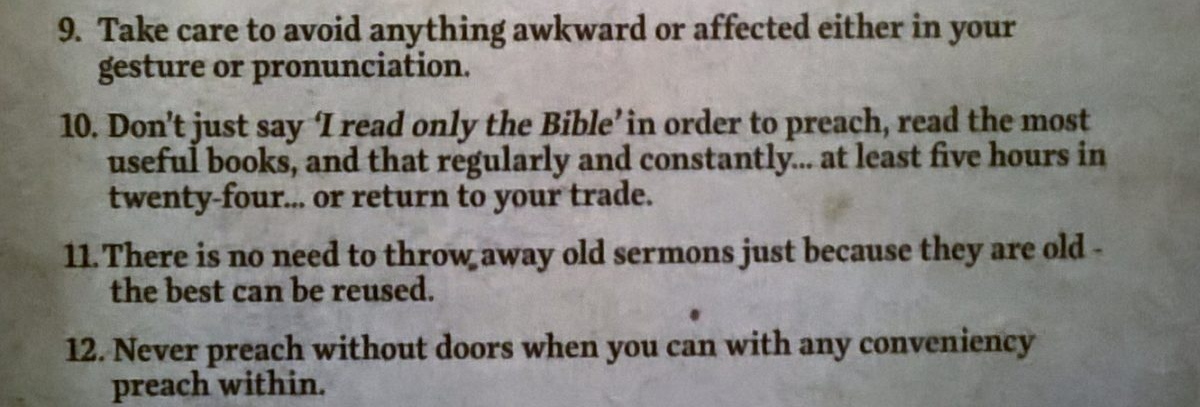
John Wesley’s Advice – Part 4

The final part of the list of John Wesley’s advice to preachers.  Points 1-2, and 3-5, and 6-8 are already covered.

9. Take care to avoid anything awkward or affected either in your gesture or pronunciation.  It is interesting to see this from Wesley.  I tend to think of affected pronunciation as being related to vocal projection in vast unamplified venues – a concern that we no longer have.  But that would not be the only reason for it.  There is the awkwardness that comes from feeling self-conscious, or from attempts to be theatrical, or from a learned “pulpit voice” that attempts to sound more “hallowed.”  To connect with coal miners on Hanham Mount in the 18th century, or normal people anywhere today, it is better to communicate naturally and authentically.  Nobody likes listening to an actor.  Actually, the reason real actors are so good at what they do is that they convey that natural communication as someone they are not.  As preachers, our only goal is to convey natural communication as someone who we are!

10. Don’t just say ‘I read only the Bible’ in order to preach, read the most useful books, and that regularly and constantly… at least five hours in twenty-four… or return to your trade.  Can I be brief on this one?  I don’t know, but I suspect he wouldn’t include social media surfing in that at least five-hour goal.  Once we limit this to book reading, then it does feel like a big ask for many today.  Perhaps we should take this away and ponder it.  Are we neglectful of our calling, responsibility and opportunity to not give ourselves to as much reading as we should?  (And if you are a “lay preacher” – you can determine the appropriate goal for your circumstance.) 

11. There is no need to throw away old sermons just because they are old – the best can be reused.  I agree.  I would add that when reusing a sermon, it is helpful to spend some time refreshing it and making sure that it is current in your heart and not just present in your notes.

12. Never preach without doors when you can with any conveniency preach within.  This is the advice that probably needs the most pondering.  For Wesley, his move to preaching outdoors was radical and had huge implications for his church relationships.  But once he got known for it, it is intriguing to think about this advice.  Maybe the point for us is not so much about whether we preach indoors or outside.  Perhaps the point is to not allow anything we do to become a gimmick.  Don’t get known for something and then keep working that thing to the detriment of what really matters.  Be a preacher of the Word.  End of.  Once you get known for a specific type of sermon, a particular location(!), a specific type of biblical text, or even a specific subject, then you have to reckon with this point of advice from John Wesley.  What does this mean for you and me?  Maybe nothing at the moment, but it is a good one to prayerfully ponder.

There we go!  All done.  I have enjoyed thinking through these brief thoughts.  I hope that has been helpful for you, too.

Running on Fumes

When a car has very little fuel in the tank, we say it is running on fumes.  It is moving forward, but warning signs indicate the vehicle is in trouble.  It won’t go very far unless something changes.  And the something is simple – it needs fuel.

The same thing happens with Christians too.  They give the impression of keeping on spiritually, engaging with the church, and so on.  But there are warning signs, and they won’t go very far unless something changes.  Again, the something that needs to change is relatively simple – they need fuel. Simply being around Christians and using Christian language is not enough. Without a vital personal relationship with Christ, they are merely running on the fumes of Christianity.

Warning Signs – In a car, you have warning lights on the dashboard to alert you to an issue before it becomes a problem.  If you proceed far enough, the engine will start to sputter and make unusual noises.  What are the warning signs when a Christian is running on the fumes of Christianity?

  1. Loss of Joy – There are many reasons for a loss of joy, so do not assume that the spiritual tank is always empty when joy fades.  However, any warning light is a reason to investigate.  Indeed, when someone’s tank lacks the fuel needed, delight in the things of God and church life will only come in fits and starts.  The classic biblical example is Martha in Luke 10:38-42 – she was doing the right thing, but the joy was gone.
  2. Alternate Fuels – Is work or a hobby suddenly becoming more significant?  Are they starting to find motivation and purpose in something other than Christ in a way that was not true earlier in their Christian journey?  Alternative fuels are attractive because someone struggling will see the alternative as more readily accessible and the goals more attainable.
  3. Blaming the Church – It is very rare to hear someone drifting from church life and being honest, “Oh, I am staying away because I am not fuelling my soul, and so I feel awkward being around other Christians right now.”  It is much easier to talk about how the church does not meet their needs, and they don’t fit, the programs are not helpful, the other people don’t like them, etc.  Not every person being critical of the church is in a bad place personally, but many are.
  4. Verbal Paper Cuts – Sometimes it is not the full force explosions that hurt, but the subtle paper cuts.  Someone in a low place spiritually will often make little paper cuts with their words.  Little bits of gossip.  Little criticisms.  Little digs.  Maybe nothing significant enough to confront or challenge, but enough to leave you feeling that sting of an open wound when they walk away.
  5. Emotional Outbursts – Sometimes, things do come out in full force explosions.  And, like a cornered animal, someone feeling spiritually empty can lash out and attack rather than admit their need and open themselves up to help from others.

Emergency Measures – What do you do when someone is running on empty and about to run out of fuel and grind to a halt? 

  1. Re-Fuel – To be blunt, they need to be in the Word of God and allow Him to minister to them.  But they may struggle to feed themselves if they have let their tank get too low.  Perhaps a friend can help them get into the Word and start back into a healthy pattern. 
  2. Recognize the Emergency – How often do we pridefully persist on our path, ignoring all the warning signs?  Many a stranded motorist thought they could go a little farther before stopping for fuel.  Part of solving the problem will be humbly admitting the problem.  As long as pride continues to stir excuses and explanations, the fuel cap remains in place.  They must humbly acknowledge how they have allowed themselves to drift, how they have arrogantly felt they did not need to be in the Word personally, or how another sin has built a blockage between them and God.  Whether that is a giant skeleton in the closet or the “respectable” sin of personal pride, confession will be like a doorway to help for the struggling believer.
  3. Reach out for Help – These are in the reverse order.  We need to be fuelled again, but often that won’t happen until the nature of the problem is recognized, and often that is hard to achieve without first calling out for help from another.  If you see the warning signs in a friend, encourage them to face the reality of their situation.  If you are desperate, you could point them to this post and ask if it resonates with them because you are concerned.  If you see warning signs in yourself, then get a friend immediately.  We tend to think that a renewed effort in my quiet times, or perhaps some alternative, will fix the issue.  A thimble of fuel won’t get you too far.  Call a friend and walk through it with someone. 

_________________________________________________________

Check out a Psalm from this week for your encouragement: