Good preachers make illustration look effortless, but for most of us it can be a real struggle. Here are a few questions that I find helpful:
1. What’s the purpose of your illustration? Too many preachers default to simply adding in illustrations because there hasn’t been one for a few paragraphs, or because they think they should. It works much better to define your purpose. At this point in the message will your listeners be needing explanation to clarify the point you are making? Or will they need support to prove the point? Or perhaps application to picture themselves applying the point? Generally it is better to identify what you are trying to achieve and you will probably achieve it more successfully. Explain, prove, apply . . . or perhaps give a break in the intensity to allow them to re-group. Decide what is needed and then you are more likely to find it.

2. Are you relying on their knowledge, or does it touch their experience? People will always connect more with what they have experienced than what they know. People are more likely to remember cross-country running at school than have experience of running in the Olympics. They know what it feels like to get stuck in traffic, but probably not what it feels like to step out of a spacecraft. Instead of going for the more exotic, consider if more mundane might connect better.
3. Have they experienced it, or are they simply having to hear about yours? The best illustrative material tends to be experienced by both speaker and listener. It is easy for you to describe and easy for them to imagine. If this isn’t possible, then consider whether you can do the learning and speak of what they know personally, rather than always asking them to imagine what you have experienced personally. It won’t always be possible, but worth the effort when you can.
4. Are you falling into the laziest and weakest forms of illustration? There are plenty of illustrations that fall outside your experience and knowledge, and their experience and knowledge. The illustration anthologies are full of them. Obscure anecdotes and clever quotes from yesteryear. Wartime speeches, heroic moments, distant pithy quotes. Generally speaking these will seem far more effective on paper than they do in actual preaching. At the very least, can I suggest that if you love this kind of illustration then at least try to balance these with something more immediate and normal? (You may love your 1950’s football stories, or WWI trench poetry, but your listeners may not be so enthused.)
It takes work to illustrate well. Sometimes we have to go with something weaker than we’d prefer. That is preaching. But let’s try to do the best we can. (And tomorrow I will share the final two questions…)


 So a lot of people endorse Haddon Robinson’s Biblical Preaching but seem to miss the prize jewel in the book – the Big Idea. They may use the language, but many miss the point. We’ve thought about the Big Idea in terms of communication, and in terms of biblical studies. One more:


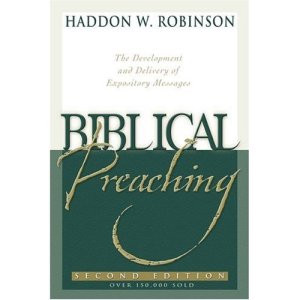 Over the past few years I’ve come across quite a number of people who talk about preaching and recommend Haddon Robinson’s book, but don’t really understand Robinson’s teaching on the subject. It seems that some people are impressed with aspects of the book, Biblical Preaching, but don’t really grasp some of the core teaching of it. In particular, the nature and power of the Big Idea in preaching. Today I’d like to focus on communication, but will continue the series tomorrow in respect to biblical studies, then finish with a focus on the Spirit of God. Do we really get the Big Idea?
 Biblical Preaching