Developing Layered Story Sensivity

WeavingYesterday I suggested that we shouldn’t be plucking stories and presenting little life lessons.  So what to do?  I pushed the idea of seeing little story accounts in the context of the bigger sweep of stories in that section, and then seeing that section in light of the bigger story of the book, and the book in light of the biggest story of the whole Bible.  Yes, but how?

1. Read the big sweep, then repeat.  It is very hard to grasp the big picture of the Bible without reading large chunks of it.  Simply digging deep into the meaning of a sentence will not give the big picture awareness that the Bible invites.  Even checking commentaries and reference tools will only offer a limited awareness of the sweeping sense of Scriptures.  While some commentaries are becoming more alert to the structuring and flow of a book, nothing can replace the benefits of knowing the big picture for yourself.

2. Look for the links between smaller narratives.  Develop a sensitivity for links and contrasts offered by the biblical writer.  Check the little theme of laughter ribboned through Genesis 17-21, and it isn’t simply Sarah and Isaac.  Look at the relative locations of Jacob to his family either side of the wrestling match.  The Bible is fairly sparse on detail compared to modern fiction writers, but what is there is there on purpose.

3. Ask why stories are neighbours.  Why does the story of Abraham with Gentile Abimelech come after the story of Lot being dragged out of Gentile Sodom, which is really a story about Abraham watching God’s justice and promise in action?  Without becoming dogmatic based on the limited links you might recognize, do probe the flow of the text and ask good questions.  Don’t only probe within a text.  Think about the contrasts and comparison points between Joseph in Genesis 37 & 39 and Judah in Genesis 38 . . . leaving the land, garments, goats, compromise, etc.

4. Don’t focus on little life lessons, look for how the text reinforces bigger realities.  Life isn’t ultimately about how we do business, or how we do wrestling, or how we do temptation, or how we do sojourning.  Life is primarily about how we relate to the one true God who makes promises and keeps them, who is involved in life yet sometimes apparently distant, etc.  Preach about God and living in response to His self-revelation.  Don’t just tip your hat to God and focus on how we can be more like a Bible character in our quest to live essentially independent lives of obedience to divinely inspired example (stretched to make preaching points).

Layered Story Sensitivity

WeavingWe are trained as children to pluck out Bible stories and learn a lesson.  Let’s try to fix that as adults.

You know the routine.  You select a story, such as Abraham and Isaac on the mountains of Moriah.  You tell the story.  You offer a lesson…be willing to obey God whatever He asks.  Job done.  And the children go away thinking that that is how to handle the Bible.  Pluck the story, point to a life lesson.

Then as adults we can easily do the same thing.  You select a story, such as Jacob wrestling with the stranger at night.  You tell the story.  You offer a lesson…or maybe several (adults can cope with more): three top tips for handling complex threats.  (I’m making this up, although it is true that preaching this way doesn’t require much time.)  Be careful what situations you put yourself in.  The dark is dangerous.  Fight hard because God doesn’t let anything happen to you that you can’t cope with.  (Forget that last one, it is problematic on so many levels!)

God did not give us a compendium of life lessons dressed up as character stories.  The Bible writers were masterful in crafting the historical accounts into literary masterpieces.  The brevity of individual stories woven together into epics of grand proportions.  So what to do?

1. Study stories in the context of the bigger stories.  Abraham and Isaac heading to the mountains of Moriah is the climax of a twelve chapter, decades long faith journey for Abraham and God.  It wasn’t a random test coming out of nowhere.  It was a heartbreaking and confusing test in the context of a story that had stretched as long as many of us live on earth.  Promise, travel, gradual response, family separation, land assignment, further travel, false starts, wrong-headed plans, bizarre marital failures, repeated promises, eventual faith, later covenant sign, divine protection over the marriage and very late promise fulfillment.

2. Study bigger stories in the context of the bigger stories.  So don’t just make sense of Jacob’s wrestling in the context of Jacob’s bigger story, see it as part of the sweeping story from Abraham’s promise down through the generations.  Jacob was a deceiver, as was Laban, and the threat of Esau was massive . . . but was God a deceiver?  Could He be taken at His word?  Was Jacob’s big issue really his problematic relatives?  Or was it himself and his own view of God?

3. Study bigger stories in the context of the biggest story.  While this shouldn’t override the passage and completely change its meaning from what it could have originally meant, we have to be sensitive to the whole Bible epic of God’s dealings with humanity.

Tomorrow I’ll poke at this issue from another angle.

Why Bible Reading is Down – Part 2

BookYesterday we pondered two issues raised by Peter Enns’ article.  First, that people read the Bible in fragments, and second, that people read it a-historically.  Here is the third finding he lists:

3. Bible reading is down because people read it in isolation

Too true.  When did the “personal devotions” approach to Bible reading become the only legitimate approach to Bible reading?  I am very excited to embark on another season of Cor Deo next week . . . six months of studying God’s Word and pursuing God’s heart with a group of friends passionate to know God more.  I wouldn’t trade that for anything.  Perhaps you need to pray about finding someone with whom to enjoy the Bible.  Not to drown it in dull fill in the blank questions.  Not to discuss it at length until one person’s theological hobby-horses send the other to sleep.  But open-hearted delight-filled enjoyment of discovering God together.  And that is not about hunting for applications as the first order of business, but about pursuing the God who has first loved us.

Enns finishes his article by suggesting we should “read big, read real, read together.”  I agree.  Might I add that we should “read big, engage historically informed imagination and chase the personal God.”

To see Enns helpful post, click here.

I can’t help but think there may be some other important factors too.  Let me list a few and see if you would add any:

4. Bible reading is down because some preachers don’t motivate reading by their own lack of enthusiasm for enjoying Scripture (hard to be infectious if you don’t have the disease)

5. Bible reading is down because some preachers don’t expect people to actually read the Bible (and people will live down to that kind of expectation)

6. Bible reading is down because technology and instant communications is changing the way this generation engages with any books

7. Bible reading is down because preachers with an over-emphasis on application and utility has reduced the appetite for chasing God Himself (a self-focused engagement with Scripture will always diminish appetite for a revelation that works in the opposite direction)

What would you add?  And just to complete a bit of a messy post, how about a brief counterpoint too?

I wonder if Bible reading really is down?  Generally I would accept the assertion.  But among a lot of people I meet, there is a great passion for Bible reading.  These kinds of studies are always open to spin in respect to who is in the sample.  I had a conversation recently with someone asserting that the under-30’s are leaving the evangelical church in unprecedented droves. I pointed out that I don’t know any under-30’s who love Jesus who are leaving the church, and perhaps the stats may actually be pointing to nominal church-goers?  It is hard, statistically, to measure true faith.

Why Bible Reading is Down

BookI was interested to see an article by Peter Enns  exploring why Bible reading is down in churches today.  Biblica did some research and offered three conclusions.  Let me share their findings with my own thoughts here:

1. Bible reading is down because people read it in fragments

They point to the perennial problem of prooftexting.  The problem here goes both ways.  First, despite the proliferation of prooftexting in seemingly all types of Christian literature, as an approach it fails to live up to implicit promise.  People like to think that there are nuggets and bite-sized nibbles can satisfy the need for wisdom and instruction, but reality does not support this.  People need more than “a verse for this” and “a verse for that.”

Which leads to the second issue here.  Not only does prooftexting fall short, but it also steals the experience of seeing the bigger picture, the sweeping thoughts, the epic narratives and the heart-stirring poems of Scripture.  I often ponder the fact that the Bible men and women who I most aspire to be like are not those with a ready quiver full of pithy proof-texts, but those who know the God of the Bible because they are washed in the Bible as a whole, book by book.

2. Bible reading is down because people read it a-historically

The article points to Biblica’s approach to reordering the books in the canon.  This is interesting and I sometimes read through the Old Testament using the Jewish TNK order, or mix up the NT books into a different logical sequence.  I would push our thoughts in another direction than canon, however.  I think too many readers are reading Bible books looking for something to jump out to them today, as if the Bible were written as a relatively poor repository of ancient wisdom for future listeners to sift through and glean the lasting nuggets.

How much better the Bible becomes when we read it to find the God who revealed Himself to the original writers/readers, and who continues to reveal Himself through those books today, when understood in their own contexts.  Studying the historical setting of an epistle or a prophet can be a profound experience.  I remember reading the introduction to a weighty commentary on Isaiah – the introduction set me on fire for studying the Bible!  I would recommend reading something like Paul Maier’s “Flames of Rome” to enter into the historical context more, and then see if the epistles still feel so flat afterwards.

Tomorrow we will look at the third reason given . . .

Case Study: Isaiah 40

grasshopperI just posted a summary of a message on Isaiah 40 on the Cor Deo site.  If you haven’t seen it, let me share a few thoughts here first.  In simplistic terms, the section preached focuses on the greatness of God and the graciousness of God.  I think there are two easy mistakes to make here.

1. To focus purely on the greatness (since that is the focus of vv12-26, the majority of the text).  I think this can lead to an impressive presentation of theology, but a weak message in terms of what is needed.  Not only by listeners today, but also in respect to the original intent of the passage in light of the first verse – to offer comfort.

2. To simple offer two paradoxical truths.  Two things about God.  He is great.  He is gracious.  Two points.  And potentially, two messages.  Simply balancing the two sets of truths is better than mistake number 1, but it is still not engaging with the text in terms of what the author was trying to achieve.

As you read the summary you won’t see all the illustrations and applications made in my preaching of it, but you will get a sense of the flow of the message.  In particular, you should see how I addressed the greatness and graciousness issue.

One further thought.  I think it is important to see the flow of a text.  I have heard this passage preached, actually, I think I have preached this passage, as a selection of theological truths to pluck and present.  It makes for a lot of positive feedback, but I don’t think this approach really honours the text God inspired Isaiah to record.

Enough for now, here’s the link to the post: Not Comforted by God’s Greatness?

Blog Review of 2013

DogBinoculars2It has been a quieter year on the blog as I have had to scale back the writing in recent months.  Launching a new church has certainly taken time and energy, but what a privilege it is to be involved in such a project.  Meanwhile, back at the blog:

Most popular posts, in reverse order:

Preaching Doxologies and also Preaching [Insert Word] Jesus, came in just behind  The Preacher’s Clock: Procrastination?  Preparation  & Anticipation.  Writing about Bible Reading usually gets a stir.

A single post about Reading and Preaching seemed to get a big reaction for a stand alone post.  The first in the Three Common Mistakes series proved the most provocative –  Genesis.  In second place came a mini-series called Dangerous Immunization  Part 2, along with a series on the dangers of Exemplar Preaching – Exemplar ChristiExemplar Homo-BiblicasExemplar Persona Illustrations and Legitimate Exemplar Preaching.

The top series of 2013 was the Preaching Myths series back in the summer:  #1 – Pew Trust  #2 – Cool Preaching  #3 – Acid and Bleach    #4 – Non-Gospel Preaching  #5 – Short Talk Required  #6 – Evaluation Verboten  #7 – Sawn-Off Concordance  #8 – Delivery Equals Circus

Some of my favourites:

I enjoyed pondering and writing the following posts and want to mention them now – Why God Still Works Through Poor Preaching and Losing our Youth by Dangerous Superficiality, which is closely tied to Static vs Dynamic Position Principle.  I wish churches would use testimonies, but not without a guide along the lines of Ten Top Testimony Tips.  I enjoyed the work that went into the Repentance Word Study in Acts.

I think my favourite series was How to Preach Less than Christian – Part 1  Part 2  Part 3  Part 4

Highest Impact Books:

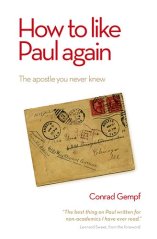
I was able to review some stunning books this year.  Here are four not to miss.  Probably the best biography I’ve read is Jonathan Edwards, A Life by George Marsden.  A must read for people preaching the Gospels is Pontius Pilate by Paul Maier.  I recently wrote on a great little book on the Apostle Paul’s writings – How to Like Paul Again, by Conrad Gempf.  And for anyone involved in church work, take a look at Deep and Wide, by Andy Stanley.  (I enjoyed writing a film review on Les Mis too Click here to go there.)

Thanks for visiting the blog this year.  I hope that 2014 will be a good year for the blog, and an even better year for all our preaching!

Book Review: How to Like Paul Again, by Conrad Gempf

41eLcj9NQOLThe front cover of this book (published by Authentic, 2013) has a snippet of an endorsement that states, “The best thing on Paul written for non-academics I have ever read.”  I agree, although I can’t list a whole lot of other books on Paul written for non-academics, to be honest.

Gempf is engaging and witty, his style draws you in and keeps you hooked.  His concern is that Paul has gotten a bad rap and so people judge him without knowing him.  I don’t have a negative view of Paul at all, but by the end of this book I liked him and his letters even more than when I started.

This book is like a crash course in hermeneutics, but a genuinely enjoyable course . . . the kind taught by a master teacher who so captures your attention that you don’t realise it is a course in hermeneutics.  Each chapter builds on what has gone before and Gempf seems to enjoy a Paul-like rhetorical conversation with his readers.

His method is to select three epistles and work with each one for a few chapters.  He starts with Galatians, then moves onto 1 Corinthians.  He contrasts the two.  Different audiences, different letters.  A church in need of 1 Corinthians could be harmed by a slap-dash misapplication of Galatians, and vice versa.  I loved the letter to the Galatians from the other side – a helpful feature of a section that gives a clear sense of the danger churches today face in respect to the Law and Christian spirituality.

Throughout the author is convincing the reader of the importance of understanding what it meant back then before pondering what it might mean for us today.  A wonderful dose of healthy hermeneutical teaching in a book that reads more like a good novel or biography than a biblical studies text book.

After Galatians and 1 Corinthians, I did put the book down.  Busy schedule and a family Christmas.  And, to be honest, I thought Philemon might be a weak end to a great book.  I was wrong.  Philemon was a great place to add another set of dimensions to Paul and his apostolic writing.

This is a great book for new Christians and long-term preachers alike.  Maybe you went to Bible school and have preached through Paul’s letters many times.  I still think you should read this book.  It is refreshing and it will stir your appreciation for the epistles again.

Perhaps your Christmas presents were wonderful, but lacked a gripping book.  Why not buy yourself a late gift.  In fact, buy two or three because you will be thinking of people to whom you must give a copy.  Thanks Conrad, a wonderful book!

To order this book in the UK, click here.

Read Your Bible in 2014? Part 2

BookIt has been a couple of years since I suggested that the famous reading plan of a certain famous Christian was not a good idea.  (If you want to see that post, click here.)  That plan, and many that have copied it, involves reading a small handful of chapters each day.  The chapters are from different places in the canon.  I know some people swear by this approach, but I am unconvinced.  Here’s why:

1. Why treat the Bible chapters as vitamin pills rather than part of a coherent feast?  Why pursue “balance” with a passion, but sacrifice the divine design?  God gave us books, not an assortment of random chapters.

2. Why choose to not read chapters in their context?  Esther is hard to put down, so is Ephesians, and Hebrews always grips me, and there are over 60 other books, most of which are an awesome read in flow.  Why take a bit of one meal and then a bite of another?

3. Why miss out on the delight of noise-free reading?  For the first minutes of our Bible reading, perhaps 10-15, we have a mental noise in the background: things to do, don’t forget this, remember that, what about…  Once that clears, we zero in and enjoy what we are reading.  Read for ten minutes and you will be ready to stop.  Read for 30-40 and you will struggle to put it down.  Most reading plans cater to 10-12 minute reading loads.  So you could struggle year after year with these disciplined approaches, but absolutely thrive on the simple approach of reading a decent chunk in flow.  Really?  People who struggle to read the Bible through in a year may find it easier and more enjoyable to read it 2 or 3 times in a year?  Yes.

4. Why take a checklist approach to the most important relationship?  I don’t have to force myself to read sports news, or eat three meals a day, and certainly don’t require a checklist to remember to interact with my wife each day.  I don’t tend to be impressed with reticent disciplined Bible readers.  But those who delight in God tend to be people who devour the Bible.  That may look like discipline, love usually does, but discipline is not the way to get there.

Perhaps it is worth pondering how to encourage people by enthusiastic invitation, rather than by affirming the “difficulty” and “trudgery” of “getting through the Bible” in a year or three.  Here is a link to my friend Ron’s article on Bible reading – as “Bible presenters” lets be sure to be genuine Bible enthusiasts that do more than try to fire up the so-called disciplined wills of our listeners!

Read Your Bible in 2014?

BookTwo years ago I wrote a post that seemed to polarize readers.  I suggested that the famous reading plan of a certain famous Christian was not a good idea.  If you want to see that post, click here.  Let me offer some thoughts on this as we head toward a new year and probably a fair few resolutions for preachers and non-preachers alike.

I am a huge fan of getting people to read the Bible.  While there are numerous ways to walk devotionally with our God, every other option surely must be undergirded and shot through with exposure to the Bible – God’s primary means of self-revelation and input into our lives.

If a reading plan is the only way to motivate someone, fine, so be it.  But I am concerned whenever I sense a lack of motivation in myself or in others.  I think that too often we treat a lack of motivation as a normal emotional problem to be overcome by diligence, accountability and determination.

I would suggest that we treat a lack of motivation as a flashing light on the dashboard of our lives.  When the oil light flashes I don’t obey it and choose not to drive the car.  Equally I don’t disregard it and press on.  I address the issue.  Same with a lack of motivation for Bible reading . . . don’t simply obey it, nor ignore it, but address it.  The best way I have found is to talk to God about that lack of motivation.  Be honest.  Out loud.  Tell him what is more attractive to you than His self-revelation.  That should prove to be convicting and bring us back in humility with a brokenness and renewed, albeit weak, hunger to hear from Him that we might respond as we should.

The best motivation for Bible reading is a hunger to know God more.  Therefore the best motivator for stirring others to read their Bibles is to know God more and be infectious with it.  When you are captured by a person, others will want to know Him too.  This is a far cry from language of diligence and discipline and so on.

I don’t ask my friends to hold me accountable to pretend to love my wife and listen to her.  I may ask them to point out if they see me rationalizing a drift from healthy relationships though.  Same with the Bible reading.  I don’t need someone to crack the whip to make me do it, but I am wide open to hearing from a friend that I seem touchy or less excited about God than is normal.

So next time I will come back to the reading plan issue and share some thoughts.  None of this is intended to stir up the hornets nest again, just to stir our thinking as we head toward a New Year and probably a lot of renewed motivation to be consistent in Bible reading . . .