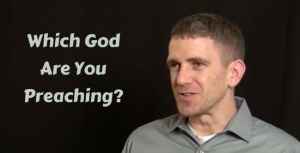
Here’s a 3-minute clip where I raise the issue of different God-options in Christianity. So much more could be said, but this is a start! Click on the image to go to the video at the FOCLonline.org site.
Earlier this year we looked at 10 pointers for planning a preaching calendar. Let’s zero in and think about planning a series.
1. Keep track of your series. Having a record of what you have preached through as a church in the last years is very helpful in determining what to preach in the coming year. If you have a record then you can see parts of the Bible that have lacked attention, for instance.
2. Make Bible books your default go to for a series. There will be reasons to go to something different than a Bible book, but defaulting to a book is good practice for generating a healthy diet. When I say book, I don’t mean necessarily exhausting a book – you could take a chunk in one series, and then return for another series at another time.
3. Be aware of the church calendar. A great series in Ezekiel will not feel so great the week before Christmas. Be aware of Christmas and Easter, as well as other significant seasons in your context. Plan series accordingly.
4. Seek to offer variety in biblical genre. A series in a Gospel will feel different than a series in an Epistle. Old Testament history will be different again, as would a series in the Psalms or a Prophet. Try to vary the genre throughout the year so that you are not overloading the diet with one part of the Scriptures only.
5. Plan values-based series periodically. With a steady diet of Bible book exposition, you then have the luxury of sometimes taking two or three weeks to zero in on a specific value the church has, or to address a specific need in the church. This series may be topically selected, as in, pick the best passages to achieve your goal (but then be sure to actually preach those passages!)
6. Schedule buffer weeks. When one series is followed immediately by another, there is no margin in the church calendar. Plan a spare week between series because things will come up. Sometimes you will have to shift the series back a week, or maybe extend it to adjust from your original plans. Buffers reduce stress in preaching schedules.
7. Plan your series with sensitivity to evangelistic events or guest Sundays. If you know you will get guests at Easter, make the new series that starts the next week an attractive one to draw them back to church. That is much better than continuing an interrupted series that doesn’t sound appealing to newcomers.
8. Vary the length of your series. Make some of them 4-6 weeks, and maybe some 8-10 weeks. Typically don’t go longer than that as they will inevitably get interrupted and start to feel protracted. It does not matter how long Lloyd-Jones took to preach through Romans – it is not a competition and you are not him.
9. Vary the length of chunks within a series. Don’t make a series monotonous by making every chunk the same length. Why not include an overview at the mid-point, the beginning and/or at the end? Why not sometimes cover a larger section and sometime dwell longer in a couple of verses? Andy Stanley rightly says that a lot of sermons would make a great series. Don’t rush, but instead plan with enough room to linger in passages and benefit.
10. Be creative. As well as mixing the genre, varying the length of series and chunks within a series, you can also be creative on type of series: sometimes track a character (eg. Abraham’s faith journey in Genesis), or a theme (eg. the glory theme in John). Be creative in presentation – think about visual “theme branding” to give a sense of cohesion to the series. Be creative in what goes on around the series – perhaps a Q&A session would be helpful, or maybe an associated small group study, or maybe watching a movie based on that Bible book, or whatever. Build a great series, and build great things around the series.
Well planned and well preached series can drive the life-changing impact of Bible books deep into the DNA of a local church!
__________________________________
Other 10 Pointers posts to check out: Evangelistic Preaching, Special Occasion Preaching, Preaching Easter, Untrained Preachers, Seminary Trained Preachers, Preaching Teams, Older Preachers and Younger Preachers.
Michael Ots is an evangelist who regularly speaks at events in universities across Europe. His first book, What Kind of God? is translated into Russian, Serbian, Romanian and Spanish. To find out more, please visit www.motsy.org
_____________________________________
‘Man is a crumpled piece of paper in the rain whose only liberation is death’ – this was the conclusion of the existentialist philosopher Jean Paul Sartre. Most of us would not share his bleak conclusion about humanity. However, his was the logical conclusion to come to if at the end of the day we live in a materialistic universe where there is nothing more than matter. The scientist Francis Crick said ‘You, your joys and sorrows, memories, ambitions, sense of personal identity and free will, are in fact no more than the massive assembly of nerve cells… Who you are is noting but a load of neurons.’
The problem with such views…
View original post 164 more words
Recently I was getting my hair cut and the radio was playing in the background. Bizarrely there was a phone-in on the radio with an expert in building cracks. Since I had no option but to listen, I listened in as callers explained the nature of cracks appearing on various walls in buildings that they own and the expert responding with, “that is not serious, ignore it” or, “you need to get that fixed or your building will collapse!”
It made me think about the cracks that we sense in our relationships. It is so easy for a crack to develop between two people. Maybe it is with your spouse or a close friend. Maybe it is with a co-worker in the church, or a fellow church member. Whatever the relationship, cracks are serious.
In Colossians 3, Paul recognizes the challenge of maintaining harmonious relationships in the church and offers the vital recipe for dealing with the cracks that will inevitably form between people. After listing several other Christlike characteristics in verse 12, he comes to patience and pauses to develop the thought. “…bearing with one another and, if one has a complaint against another, forgiving each other, as the Lord has forgiven you, so you also must forgive.”
Most issues between people can be dealt with by Colossians 3:13. Bear with, forgive. But it is important that we do that. Too easily we can leave the cracks to spread and to grow wider.
I really appreciated Andy Stanley’s teaching related to this. He explained how we all have expectations of one another, but what should we do when there is a gap between our experience and our expectation? We expect someone to do A, but they instead do B. There is a gap. Andy Stanley teaches that we are to fill the gap with trust. We can assume that there is something we don’t know and that the person is trustworthy. However, there will be times when we cannot fill the gap with trust. Then what? Simple. Then we need to approach them.
One of two things will happen when we approach someone over a gap between our expectations and experience. When we go and assure them that we want to trust them, but there is this gap… Either they will be able to fill us in with the information we are missing, thus re-establishing the trust in the relationship. Or they will be given the opportunity to own their sin and they will ask us for forgiveness. Either way, the relationship is honoured and Christ is pleased.
So what do we do when we sense a crack developing in a relationship? We are to forgive first, then either we can bear with, or we need to approach and proactively address the situation. Notice that forgiveness is not dependent on the other person apologizing to us. Forgiveness takes only one person. If there is a breakdown in the relationship then it will take two people to reconcile, but we should forgive before we ever approach the other person. It is vital to do this so that our manner and tone can be genuinely humble and loving, rather than confrontational and touchy.
So this leaves some non-options. There are several things we must not do when cracks appear in a relationship. We may be tempted to do all four of these, but we must not, or the cracks will only spread further or grow wider.
1. Leave it. We cannot simply leave it. Ignoring cracks in relationships will not cause them to go away. These things do not self-heal. Some cultures are very committed to avoiding any conflict, but this can simply compound the problem and create a bigger mess once addressing the issues becomes unavoidable.
2. Label them. It is always tempting to label other people. “He is touchy. She is weird. They are sensitive.” But if the crack in the relationship has not been addressed, then this is a label based on incomplete information. We like to think we know enough to make such judgments, but we don’t, and we are usurping God’s role as the all-knowing One!
3. Retreat. Not only is it tempting to leave the issue alone, it is also tempting to retreat from the other person. We can avoid people without even consciously planning to do so. Our self-protection radar beeps quietly and we can navigate life without meaningful or awkward contact, but it is awkward, because the relationship is cracked.
4. Report. How very easy it is to spread the label we’ve applied to others. Gossip occurs when our communication about someone reduces the esteem others have for that person. Do not go there. Learn to sense gossip and stop it in its tracks. When someone starts to cross the line with you, you can ask them, “have you spoken with them about this?” or “do they know you are sharing this with me?” Gossip is aggressive crack multiplication in the local church.
So how is it possible to proactively address cracks and pursue harmony in the body of Christ? Colossians 3:12-17 gives several critical pointers for us.
First, we won’t achieve this by looking to ourselves and determining to do better in this. We must first look to Christ. The whole letter points us in Christ’s direction, see 1:15-23, or 3:1-4. In fact, look at how verse 12 begins: we are God’s chosen ones, holy and dearly loved – our gaze needs to be on Christ and our union with Him, not on ourselves and our determination to do good.
Second, we have the peace of Christ at work in our midst like a referee with a whistle. Verse 15 in its context is not about a private guidance mechanism. It is all about how the Spirit works to promote unity amongst believers. When we say something unhelpful, or when a crack develops, God is at work with a gentle whistle to highlight the issue to us. Let’s pray for a growing sensitivity to that refereeing of our relationships.
Third, the word of Christ dwelling in us will feed our healthy mutual interactions – verse 16 underlines our need for this.
Fourth, gratitude will be a wonderful gel in group dynamics. Three times Paul points to the need for gratitude amongst the believers.
So keeping our gaze fixed on Christ, with His Word very much at home in our hearts, with the Spirit’s whistle gently nudging us when cracks develop, we can gratefully pursue a proactive unity and harmony. Always forgiving, usually bearing with, and sometimes approaching when necessary, we can be part of a harmonious group of believers whose Christlike corporate culture create a Christlike impact in a world desperate for authentic and loving community.
Viv Thomas is the Associate International Director of OM International, and Hon. Teaching Pastor at St Paul’s Hammersmith. He has authored Future Leader, Second Choice, Paper Boys, The Spectacular Ordinary Life and The Spectacular Ordinary Organisation. His next book, Wisdom Road, will be published in December 2015. For more information on Viv’s ministry click here, or for OM, click here. I have known and worked with Viv for many years and have appreciated his heart and his input. In this post Viv offer three foundational questions we should be pondering.
_____________________________________________________
Phileena Heuertz suggests some questions that help us get to the core of what is going on in our lives. I suggest that we let them rumble through our minds and conversations listening to the voice of the Spirit as we go.
Who are you?
This is the identity question. It is not always easy to answer…
View original post 327 more words
Dave currently serves on the staff team for Grace Church Exeter, but is pursuing a next step into pastoral ministry elsewhere in 2016. He’s married with three young sons. He previously spent 11 years on the staff team of the UCCF, as a Christian Union Staff Worker and then as Team Leader for the South West. He’s edited three volumes of sermons by puritans Richard Sibbes and Jeremiah Burroughs in addition to many years of blogging at thebluefish.org. As Foundations is being released, I am thankful to Dave for this guest post on what it means to be human.
______________________________________________________
“The depths which were previously located in the cosmos, the enchanted world, are now more readily placed within.” Taylor, p540.
In his enormous book A Secular Age Charles Taylor is examining the shift that has occured over the past 500 years from a world in which it was…
View original post 510 more words