Eco-Preaching: Recycled Sermons Must Be Refreshed

I don’t believe a preacher should pull out an old sermon and just preach it, unless the invitation to preach was five seconds before the sermon slot.  Any longer notice and the preacher should be prayerfully refreshing the message.

Undoubtedly, a recycled sermon takes less preparation time than a sermon from scratch on a passage previously never preached.  But my suggestion, if you are preparing to re-preach an old sermon, would be to follow a process along these lines:

1. Prayerfully consider the text itself before looking at the old notes or outline.  Even if you only have time for a brief engagement with the text, there needs to be a freshness about your approach to it, even if the end result remains the same in terms of message outline and details (since the passage does communicate something specific, and that, at one level, does not change).  Be sure to feel the impact of the text on your heart as you pray through it.

2. Prayerfully consider the specifics of this occasion before looking at the old notes or outline.  It is good to get a clear image of who the message will be preached to on this occasion.  What are their circumstances, what are their needs?

3. Prayerfully walk through the whole passage preparation process as you reconsider the previously preached sermon (or ideally, your old exegetical notes).  Why are you selecting this text?  What are the pertinent elements of exegesis that should drive your understanding of this text?  What do you now think was the author’s purpose in writing this text?  Is that main idea still the best summary you can make of this text?  You may find that your interim growth and biblical studies have changed your level of understanding so that you start tweaking your old passage or study notes.  If you only look at the end product (outline, notes, etc.) then you are preaching without the richness of the exegesis that didn’t make it into the notes, but was fresh on your heart.

4. Prayerfully walk through the message preparation process as you reconsider the old sermon.  What is your message purpose this time, this congregation, this occasion?  Can you improve the message idea to fit this particular preaching event, or to better reflect the text’s idea?  Is your old outline the most effective idea delivery strategy?  Do the details of introduction, conclusion and “illustrative materials” fit?  You may well find that the message also changes in some ways.

5. If at all possible, prayerfully preach it through out loud.  Listeners can spot a stale notes-dependent presentation.  Just because it looks ok on paper, does not mean it can be preached with freshness from your heart and mouth.  Run through it and prayerfully “own it” again.

This may seem like a lot of work, but actually I could do this process in less than a couple of hours (plus the run through of step 5).  This is a lot less time than a full sermon from scratch, and as we’ll see tomorrow, time saving is not the only benefit.

Add to FacebookAdd to DiggAdd to Del.icio.usAdd to StumbleuponAdd to RedditAdd to BlinklistAdd to TwitterAdd to TechnoratiAdd to Yahoo BuzzAdd to NewsvineLike This!

Eco-Preaching: Ever Old, Always New

This week I’d like to go green and consider the notion of recycling sermons. We’ll touch on different aspects of this broad subject over the next few days (although there may be a quiet day or two as we have a baby imminently joining the family!)  To get us started, two fundamental thoughts:

Ever Old – Every sermon we preach is made of recycled materials.  All of us are standing on the shoulders of the giants who’ve gone before us (and sadly some are standing on the shoulders of non-giants too).  If I stop to think about it, as I prepare a message, I am in the debt of so many people, and I never have new source material.

Ever Old Influences: As I think about yesterday’s two messages, there are too many influences to name.  My mind scans over the preachers I have heard over the years, the professors at seminary who taught me how to handle the Bible, who taught through those particular books in survey or exegesis courses, who taught me the languages, who taught me homiletics and theology and pastoral ministry, etc.  I think of the conversation partners I turned to in the form of commentaries, and the footnotes attest to some of those that influenced them.  I could go on, but you see my point.  I’ve preached hundreds of messages, probably into the thousands, and it would be a bit self-aggrandizing to suggest that I have generated more than a few truly original thoughts.

Ever Old Material: While I pulled out a few illustrative elements for yesterday (and didn’t look them up in an anthology of distant impersonal illustrations), the bulk of the material was the Word of God.We must be ever wary of the temptation to think our thoughts, be they original or probably not, are somehow better source material than the ever living Word of God!  Yesterday in the course of my preaching I returned to texts that I’ve preached in this church in the past year, and without apology.  We need to hear God’s Word.

Always New – Every sermon we preach is new.  The text of Scripture doesn’t change, but everything else does.  The preacher can never stand still.  Either the preacher has grown, or the preacher has stagnated and changed negatively, but life never stands still.  Two congregations can never be the same in constituents or their circumstances, even if it is the same church.  The situation is always fresh.  Different preacher, different listeners, different occasion, different set of needs.  I suppose, in theory, I could preach the same text in the same church once a month for the next several years and never preach an identical sermon.

Tomorrow we’ll probe a bit beyond this foundational level as we seek to be good stewards of a preaching ministry.

Add to FacebookAdd to DiggAdd to Del.icio.usAdd to StumbleuponAdd to RedditAdd to BlinklistAdd to TwitterAdd to TechnoratiAdd to Yahoo BuzzAdd to NewsvineLike This!

Saturday Short Thought: Concluding Chronicles and Biblical Theology

Over the past three weeks I have been preaching a series in 2Chronicles 26-36, which is effectively the end of the Hebrew canon (in the typical Jewish ordering of books), and the conclusion of the backwards looking summary of the Old Testament.  Because my wife is expecting any day, I am uncertain of being able to preach tomorrow, and so made sure I finished the series last week.  But I now have (potentially) another two messages in the series tomorrow since the baby seems to be comfortable where it is.

This leaves me in the nice position of being finished with the series, yet not finished.  My plan is to allow an aspect of Biblical theology to put the finishing touches on the series.  Let me explain.

One of the big themes in the last chapters of Chronicles is that of the devotion of the kings to the Lord.  Some were, some weren’t.  And the biggest manifestation in pre-exile Israel lay in the issue of overt idolatry.  As the book ends, hope dawns with Cyrus’ decree that the temple should be rebuilt.  Perhaps God’s promise to David will be fulfilled after all?

So in the progression of revelation, we move to a post-exilic Israel where overt idolatry was never a feature again.  Historically we see this determination for purity in books like Ezra and Nehemiah, but canonically, the next step from Chronicles is Matthew.  It’s a new world in Israel in Jesus’ day.  No physical idols.  But no idols?

Jesus addresses the issue of the less tangible idolatry of his day in the Sermon on the Mount.  And the beauty of this is that Matthew 6 speaks so directly to our, typically non-physical idol, cultural setting.  In post-exilic Israel, as in the modern Western world, money has become the “ba’al” for many.  Yet the issue of our devotion to God remains paramount.  Who is bigger in our eyes?  The false god, indeed the replacement god of financial security, or the true God who really cares?

So maybe I will get to preach Matthew 6 tomorrow to finish the Chronicles series.  Maybe I’ll get to push further into the New Testament and consider other areas of covert idolatry facing believers today.  Or maybe I won’t!

___________________________________________

Next Week?  Eco-Preaching: Recycling Sermons

Be Quick to Look, Slow to Decide

This week we began another season of Cor Deo – a small group of people longing to know God more and grow closer to Him.  We had some great discussions, studied some wonderful passages and enjoyed getting to know each other.  One discussion moment was the highlight of the week for me.  A passage was raised and considered.  The more we looked at it, the more it opened up for us.

Here’s the thing.  If we had looked at just the particular verse, even a good few minutes of studying it wouldn’t have been enough.  We had to look at the surrounding context.  By the end of our time in that passage, my own view of it had changed significantly.  But we could have easily misunderstood the verse, even with our initial reading the context.

As we look at any passage in the Bible, we must be quick to look and slow to decide.

Quick to look at context – This is not the same as looking quickly at context. What is going on before and after the passage? What is the tone of the section? What is the flow of the section? In the case of the verse we were considering, it began an apparently new section in the epistle, but we had to go back and see what came before or we would have misunderstood it.
Quick to look at connectives – The flow of the text depends, in part, on the author’s use of “for” and “therefore” and “so” and “and”, etc.  Little words that make a big difference.  In this case I continued to ponder the passage after others were off into broader context, and looking at the connectives I started to ponder the structure.

Quick to look at syntax – What was the structure of that paragraph?  What is the dominant thought and what is subordinate/supportive?  Phrase by phrase, how does it work?

Slow to decide – Without the extra looking and being open to learning about the flow and structure of the immediate context, our target verse would have been essentially misunderstood.  Every one of us had an automatic sense about the verse, but careful observation proved that our sense was wrong.  I am so glad for that reminder of the importance of being quick to look, but slow to decide.  I’d hate to have preached it the way that seemed obvious from first reading, when in fact the whole tone of the text is almost a polar opposite!

Add to FacebookAdd to DiggAdd to Del.icio.usAdd to StumbleuponAdd to RedditAdd to BlinklistAdd to TwitterAdd to TechnoratiAdd to Yahoo BuzzAdd to NewsvineLike This!

Stuck in the Mud

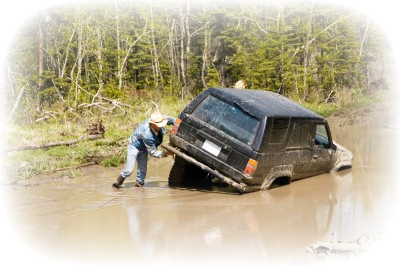
Some sermons seem to get stuck.

Some that I preach.  Some that others preach.  The sermon is moving along well, perhaps moving at a decent pace through a text, engaging and interesting, then suddenly, the sermon seems to go into thick mud.  Suddenly the momentum is lost and the experience for preacher and listener alike changes significantly.

Why does this happen?  The message is following the standard guidelines for sermons.  The text is being explained, the relevance is being emphasized, illustrative material is helping listeners see the message clearly, etc.  But momentum drains away and progress becomes elusive and there is a struggle on for the next ten to fifteen minutes as the sermon simply seems to stand still.

I was observing this recently from the listener’s side.  It seemed that at a certain point in the journey through the message, the momentum stopped and we felt like we were spinning our wheels.  Restatement.  Repetition.  Illustration.  Repetition.  Illustration.  But no progress.

Have you experienced this phenomena?  What would you suggest to avoid it happening?  I’d suggest we look at the outline or manuscript and prayerfully evaluate it for progress and momentum, as well as for content and clarity.  While a third illustration under the same point may compound the clarity, it might also feel like an anchor keeping the sermon from arriving at its destination.

I’d also suggest prayerfully preaching through a sermon to experience it through your own ears.  Sometimes sermons look perfect on paper, but in reality simply don’t “come out well.”

One more suggestion – when it happens, take the time to evaluate why it happened and try to learn from you (or someone else’s) mistake.  The tendency is to flee the scene of what feels like a sermonic flop, but perhaps there is more to learn there than when a sermon’s momentum was faultless.

How do you make sure your message keeps moving?

Add to FacebookAdd to DiggAdd to Del.icio.usAdd to StumbleuponAdd to RedditAdd to BlinklistAdd to TwitterAdd to TechnoratiAdd to Yahoo BuzzAdd to NewsvineLike This!

Why I’m Not Rushing to Two-Person Preaching – Part 2

If our churches follow cultural trends, which they tend to, does this mean we are facing the prospect of “sanctified banter preaching?” After all, it seems like everywhere we look in the media, there are now two presenters, two DJ’s, two hosts. So do we have to consider having two preachers simul-preaching? I suspect not…

I remember sitting at a big Christian convention where three speakers rotated through the morning session in soundbites. The blessing of hearing one was only frustrated by the ranting of another, it felt bitty and unprepared. But what if it were done well?

I’m not convinced. There are venues where it could work and it could work well. But I’d lean more toward it in a teaching situation than in a preaching situation.

As with some powerpoint/media intensive preachers, I get the sense that the preparation would be radically changed. Instead of time spent with God in prayer, the powerpointer sometimes seems to spend hours in mouse-clicking creativity. Actually, (in many cases they seem to end up not spending enough time with God, or in preparing the powerpoint fully, but that is another issue.)

So the collaborationist preaching pair might spend hours in scripting transitions and dialogue, hopefully without the tacky banter that seems so plastic on some TV shows, yet not have anywhere near the depth of time spent in God’s presence.

The change in preparation would mean a potential loss of profundity. There is something about a preacher spending time with God in the text praying for the people, and then coming to speak to the people. I would love to hear this done by a pair of preachers who have really pursued God, His Word, His heart for these people, etc.

I fear that profundity would disappear if the 2-person preaching were seen as a contemporary solution to a contemporary problem (like the acetate and the powerpoint were also seen as ways to fix poor preaching in recent years).

Somehow the core has to be kept in place, and done well. Then there may be benefits to supplemental approaches like this. I’m not opposed, I’m just not convinced.

Add to FacebookAdd to DiggAdd to Del.icio.usAdd to StumbleuponAdd to RedditAdd to BlinklistAdd to TwitterAdd to TechnoratiAdd to Yahoo BuzzAdd to NewsvineLike This!

Why I Am Not Rushing to Two-Person Preaching

Whether we admit it or not, our churches are shaped by our culture.  When overhead projectors became the thing in business meetings, so suddenly preachers wondered how Wesley had survived without acetates.  Then preachers pondered the problems Spurgeon must have faced without powerpoint and projectors.

As well as technological influence, there are others too.  How regularly do we hear and see another “study” indicating people have shockingly short attention spans so we should keep our messages to less than 35 seconds?  It’s amazing how these “studies” seem to selectively focus on the criteria that make the point of the person writing – not exactly solid science in many cases.

So here’s one that surely must be coming . . . two-person preaching.  If I think back to the TV I saw in the 1980’s, I tend to think of individuals – film reviews?  Barry Norman sat in a black chair and looking at the camera.  Satire?  Clive James on his own with the occasional guest.  Now everything is done in pairs.  Presenters have their sidekicks for painfully choreographed repartee in some cases, or side-splinting banter in others.  Radio shows rely on the bouncing back and forth between DJs, and if one DJ is dominant, the other acts as a foil.  So should we expect to see more 2-person preaching?

There are positives that come to mind here.  Some of the best educational experience I had involved two professors co-teaching contemporaneously.  In Cor Deo we have deliberately adopted a two-mentor teaching model, and I delight in the advantages of that approach.  It offers the benefit of added perspective in discussion environments.  It offers the possibility of variation in voice and presentation.  It offers a tangible relational approach that fits for an inherently relational faith.

But when it comes to preaching, there are also negatives.  And I’ll share my thoughts on this tomorrow.  I’d love to hear other perspectives on this . . .

Add to FacebookAdd to DiggAdd to Del.icio.usAdd to StumbleuponAdd to RedditAdd to BlinklistAdd to TwitterAdd to TechnoratiAdd to Yahoo BuzzAdd to NewsvineLike This!

Saturday Short Thought: Taught by the Spirit (with Reeves Quote)

Here’s a concern I feel needs to be addressed as the week comes to an end:

“When we just prayerfully look at the Bible text, then the Spirit can direct us and teach us.” (Implication: if you look at “the words of humans,” such as in commentaries, then you will not hear God’s Spirit.)

I stumbled across the same notion in a conversation this week.  “You went to Bible school, but I’ve been taught by the Holy Spirit.”  But?  Just because one claims to only be taught by the Spirit, this does not mean one has received more training from the Spirit.

Whether we are talking about use of commentaries or the privilege of “formal” study, let’s not make this false step of restricting where God’s Spirit can work.  This is similar to the nonsensical idea that the Spirit works when we don’t prepare a message, but is absent if we do prepare.

We absolutely need God’s Spirit at work in us as we prepare to preach, both in respect to understanding the Bible text, and in terms of sensitively applying it to those who will listen.  As one person put it this week, “Hearing how God has spoken to the community over the ages about the text will only give the Spirit more chance to speak, not less.”

Not only does the Spirit want to work in our biblical study, and in our ministry, but in light of yesterday’s book review, he most certainly wants to work in our hearts too.  What does he want to do there?  Let me finish with a quote from Reeves’ new book (p73):

My new life began when the Spirit first opened my eyes and won my heart to Christ. Then, for the first time, I began to enjoy and love Christ as the Father has always done. And through Christ, for the first time, I began to enjoy and love the Father as the Son has always done. That was how it started, and that is how the new life goes on: by revealing the beauty, love, glory and kindness of Christ to me, the Spirit kindles in me an ever deeper and more sincere love for God. And as he stirs me to think ever more on Christ, he makes me more and more God-like: less self-obsessed and more Christ-obsessed.

Add to FacebookAdd to DiggAdd to Del.icio.usAdd to StumbleuponAdd to RedditAdd to BlinklistAdd to TwitterAdd to TechnoratiAdd to Yahoo BuzzAdd to NewsvineLike This!

___________________________________________

Next week: Two-Person Preaching?

Review: The Good God, by Mike Reeves

Whatever else we may be or do, we present God to others.  We present God in our preaching of the Bible, and we present God as we live our lives.  A critical question, then, has to be this: which God do we present?

Mike Reeves’ new book, The Good God, from Paternoster, is exactly what the doctor ordered for the church today.  And not one of those miserable doctors that prescribes some yucky fluid in a plastic bottle.  I mean one of those doctors that suggests a break in the sun and a feast of good food to help you feel better from all that ails you.  The church today needs to bask in the sun and feast on the truth offered so gloriously and accessibly in this little book.

Mike introduces the reader to the God who is loving, giving, overflowing, relational.  With his light and accessible manner, Mike shares a profound taster of just how good God is.  Clearly Mike loves God and it shows throughout.  Some books on the Trinity can come across as a technical manual of heresies to avoid.  Others as an exercise in premeditated obfuscation.  This little book sizzles with energy, addresses the issues with clear insight rather than excessive technicality, and stirs the reader’s heart to worship, to delight, and sometimes even to laugh in sheer joy.

Mike’s biblical references scattered throughout don’t come across as a defensive attempt to prove a point, nor as a theological citation method that distracts the reader.  Rather they subconsciously stir the reader to want to get back into the Bible and see this good God afresh.  As you’d expect from a Reeves book, there are also enjoyable windows into church history as key voices from folks famous, and not so, pop up to share a thought along the way.

The book is shaped, well, um, trinitarianly.  An introductory chapter invites the reader into the pre-creation love relationship that is the Trinity.  Then the book looks at creation, redemption and the Christian life (as in, Father, Son, Spirit, although brick walls can’t be built between the roles of each in each chapter).  The book closes with a chapter that asks who among the gods is like you, O LORD?  I won’t give away the end of the book by sharing Mike’s answer, but I know if you start, you’ll want to read to the end anyway!

I will say this though, the advance of anti-theist “new atheism” gets a clear response in the final chapter.  Oh, and for one final twist, just when you feel like there’s nothing left to add, he also addresses three of the big issues that Christians sometimes throw out in opposition to an emphasis on God’s loving relationality. Superb.

This book is a must read and a must share.  As you read it you will think of others you wish would read it – from atheists to strident single-author-reading Christians. But most of all, I think you will be thankful that you read it. I am genuinely excited about how God will use this book in the years ahead!

To pre-order your copy in the UK, click here or the book image above.  Note – the book will be released in the USA later in 2012 by IVP under the title, Delighting in the Trinity: An Introduction to the Christian Faith.

Add to FacebookAdd to DiggAdd to Del.icio.usAdd to StumbleuponAdd to RedditAdd to BlinklistAdd to TwitterAdd to TechnoratiAdd to Yahoo BuzzAdd to NewsvineLike This!