10 Biggest Big Ideas – 3. Sin

The 10 biggest ideas in the Bible?  We’ve considered God and His creation.  Now we need to probe the problem.

3. Our profound capacity for love has been perverted into a self-love that drives a charade of independent divine status, in mockery of and in sickening rebellion against the loving leadership of our good God.

Within three biblical chapters God’s perfect creation is corrupted to the core.  It is corrupted from the core.  And the story of God’s resolution to our relational rebellion takes the whole canon to fully resolve, leaving only two chapters for the briefest glimpse of a post-fall new creation.  This is the great tension in the grandest of meta-narratives.

Lovingly created for relational interdependence and trusting dependence, the human race is marred by love perverted and trust destroyed.  The manifestation of the fall, the fruit, if you will, was in the eating of the forbidden fruit.  Yet the core of the event was at the level of the heart, not merely a matter of rule-breaking.  The corruption was caused by a love turned inwards, by a rebellious spurning of God’s right to rule in love, and by a fatal distrust of His good Word.

A God-given capacity to love another, delight in another, live for another, trust in another and give to another was twisted, perverted and corrupted.  It became the horrific reorientation of the power of divine love into a love of divine power – shamefully manifesting in a love for self, delight in self, living for self, trusting in self and giving to self.

Now the god of a human heart is the perceived good of that same human heart.  Instead of lovingly trusting a loving and trustworthy self-giving God, the default wiring of humanity is to hate and despise Him, performing the charade of god-hood as if that is really about self-concern, independence and power.  Even the pathetic performance shows a profound corruption of God’s true nature.

Believing the lie, we present a lie.  Every person a theologian by birth, and every person profoundly wrong.  God is not self-concerned and power-obsessed – it’s not just the “who is God?” question we answer so badly, but also the “what is God like?” question.

Sin re-orients the heart, taints the mind and manifests in broken behavior.  Some shake their fist at heaven in acts of overt rebellion, demonstrating the horrific and grotesque nature of sin by the evil that they do.  Others shake their fist at heaven in an act of apparent goodness, diligently demonstrating their ability to do good in a self-loving independence from the God who alone is good.   Even righteous deeds are as filthy rags.  Whatever is of independent un-faith is sin.

Sin is the tension in every biblical narrative, and every personal narrative.  It isn’t a question about whether we can do good, or whether we can be empowered to do good.  It is a question about what or who can ever recapture our hearts and draw our incurved souls from addiction to self, to gaze on the truly lovely, the genuinely loving and the profoundly trustworthy God who made us for participation in His love.

So as we preach the Bible we must never miss the fallen condition focus of every passage, the context of sin in which every text swims.  Neither must we offer any sense of instruction for independent goodness, for that was the root of the issue.  Sin is pervasive and profound, and God’s solution is glorious beyond words.  Yet we preach.  We preach . . . you finish the sentence: “we preach . . . and Him . . . .”

Add to FacebookAdd to DiggAdd to Del.icio.usAdd to StumbleuponAdd to RedditAdd to BlinklistAdd to TwitterAdd to TechnoratiAdd to Yahoo BuzzAdd to NewsvineLike This!

10 Biggest Big Ideas – 2. Creation

I am slowly offering what I think might be the ten biggest ideas in the Bible.  I encourage you to write your own list, the process is a real joy.  Yesterday I wrote about God and His self-giving goodness.  I need to develop one aspect from that post:

2. Even in its current corrupted state, God’s creation reflects God’s heart and nature.

Those who start with a generic God born of human speculation will tend to emphasize the power of God.  Often this truth grows so loud that other truths are drowned out.  Yet the God of the Bible doesn’t seem as passionate about His own power as some might suggest.  He is all-powerful, of course, but that is defined and driven by the loving relationality of the unity of the three – Father, Son and Spirit.

The giving and overflowing love of the Three-in-One speaks a word, and an abundantly diverse and beautifully united creation into existence.  His eternal power is seen in the stunning reflection of His divine nature – with its vibrant, abundant, giving, creative, procreating, beauty.

Yet the beauty of creation is merely a stage for the most powerful beauty of all – the wonder of loving relationship.  Creation is the stage for the relationships of creatures made in the image of a relational God.  So every field, every mountain, every sunset, every vista, is a delight best experienced alongside another with whom God’s creation might be enjoyed.

We live in a broken, corrupted and perverted creation.  Even through the death and the brokenness, we still see overwhelming beauty – from the abiding grandeur of the milky way, to the unique features of an individual leaf.  Yet it is not only the lingering beauty that captivates, it is also the smothered whisper of what could be and should be.

The greatest pain is not that felt in a dying body, or that of a marred creation, but the deepest agony of broken relationship.  Sadly we may experience the worst of fallenness in our bodies, or see the most grotesque disfigurement of creation, but every human inherently feels the deepest agony of all in the context of broken relationships: with friends, with family, with God.

Creation stirs us, yet creation itself groans.  It groans to be the stage of what could be and should be, and by God’s grace and power, one day will be.

The Bible repeatedly returns to the relationship of creation to God – He made it, He owns it, He stamped it with His imprimatur, and He will pour out life to overcome death.  Our hope is the new creation, the stage for a greater joy than could ever have been known in Eden.

So we preach a Bible that is earthed, quite literally.  Both the past stories, our present experience, and our shared future hope, is well earthed in a world that reflects more about God than we usually even begin to notice.  One day we will.

Add to FacebookAdd to DiggAdd to Del.icio.usAdd to StumbleuponAdd to RedditAdd to BlinklistAdd to TwitterAdd to TechnoratiAdd to Yahoo BuzzAdd to NewsvineLike This!

10 Biggest Big Ideas – 1. God

Every passage has a unique main idea.  But are there thousands of completely different main ideas in the Bible?  Haddon Robinson said several times that there are basically variations on roughly ten big Big Ideas in the Bible.  We students kept trying to get a list out of him, but to no avail.

So I’ve decided to suggest my own ten.  As you read through the Bible you may come up with a different list, but I suspect these macro main ideas are recognizable to all who are reading the Scriptures.

1. Everything is defined in relation to the triune God whose relational nature overflows into all that He has made.

The Bible doesn’t argue for the existence of some generic divine being, but assumes the existence of the one true God.  He is a God who exists in the loving communion of Father and Son and Spirit.   God is not only inherently good, His loving bond is the very measure of goodness.

It is out of this relationship that creation comes, the unrequired but unsurprising act of a loving and giving God.  Creation reflects His creative artistry, His generous power, and His delight in blending diversity in beautiful unity.  Even creation in its present corruption demonstrates the pervasive power of relationship.

Yet creation is not all God gives to enable us to know Him.  His nature and character is revealed definitively by the Son who always reveals the unseen Father to us, and His Spirit who points us to the Son.  Both the Son and the Spirit are given into a fallen world in an act of deep generosity.

It is out of God’s nature that the whole human story makes sense.  Created as loving responders, humanity has a wondrous capacity for love and joy and delight and response.  Equally, as true heart-driven beings, humans have an equally profound capacity for hate and grief and sadness and diverted affection.

It is not possible to make sense of creation without seeing it in the context of God’s goodness and the profound impact of creaturely rebellion.  It is not possible to make sense of any human without seeing him or her in the context of their relationships, especially the pre-eminent relationship with God himself.

Not only is every aspect of creation, and every human, defined by their response to God, so is every event only understood in light of God’s role.  So every narrative in Scripture is primarily a narrative about God, even when He is not mentioned.  Every character is either trusting Him or not.

Consequently every biblical sermon has to be, above all else, a sermon about God.  Technically this is called Theocentric preaching.  The term doesn’t matter.  God does. And not just any God, or even some assumed generic God of human speculation, it must be the triune, covenant making and keeping, self-giving God who is love.

Let’s be sure to preach every passage with a profound prayerful awareness of the God whose Scripture it is.

Add to FacebookAdd to DiggAdd to Del.icio.usAdd to StumbleuponAdd to RedditAdd to BlinklistAdd to TwitterAdd to TechnoratiAdd to Yahoo BuzzAdd to NewsvineLike This!

Saturday Short Thought: Glorious Gospel

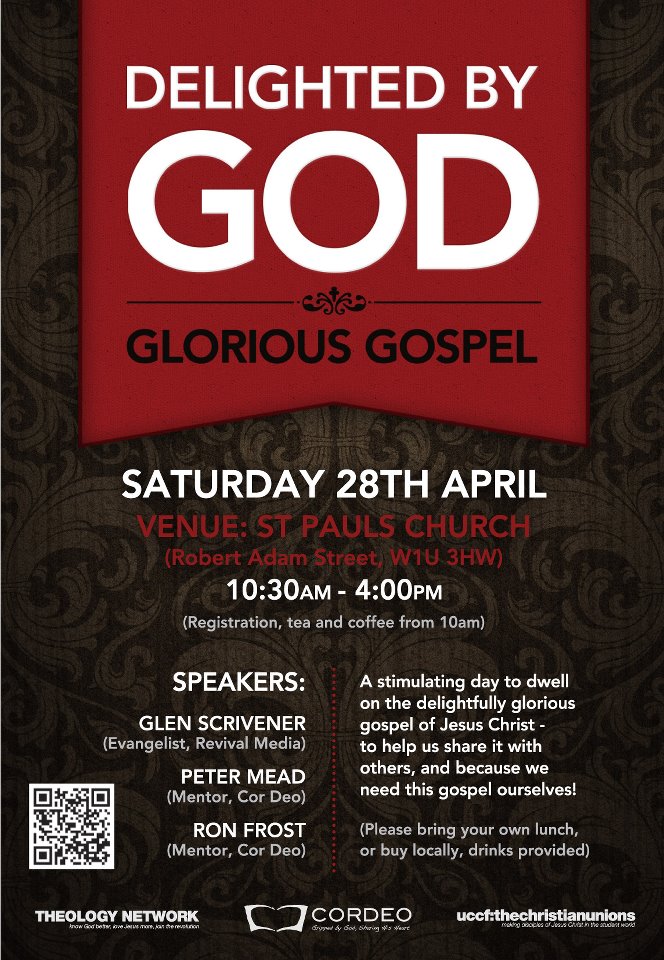
In a little while I’m heading to London to speak at a Cor Deo Delighted by God conference.  Our subtitle for the day is Glorious Gospel.  I am excited to hear the other sessions and to ponder together just how glorious the gospel really is.

What it comes down to, I suppose, is how glorious our God is, and what kind of gospel He has given us.  Too often the presentation of the gospel I hear is less than glorious.

It seems like a negotiation between a willing sinner and a reticent God.  The sinner is willing to say some words in order to gain a significant package of benefits.  And God is open to some sort of a contractual deal, but really is essentially resistant without the intervention of a kind lawyer working for us.

This is such a corruption of the truth.  God’s initiative is critical, and the extent to which He has gone to overcome the resistance of the human heart is stunning.  And as for the language of contracts, let’s dump that in the grip of His fatherly embrace!

The gospel is wondrously glorious, but it’s the kind of glory that involves His being high and lifted up, in absolute self-giving humiliation.

Let’s be sure we don’t preach a watered down, or petty, or negotiated gospel.

PS We’d really appreciate your prayers for today’s conference to go well!

_______________________

Next Week: The 10 Biggest Big Ideas

In the classroom Haddon Robinson said more than once that there are basically eight to ten big big ideas in the Bible.  He never gave us a list, but I’ll offer mine starting on Monday.  What would you include?

15 Ways to Improve Clarity

This week I’ve been writing about the doctrine of Biblical clarity – the fact that the Bible may be understood.  This is a cause for great rejoicing.  Imagine for a moment that the Bible was absolutely impregnable.  Anyway, one of the points I made the other day was that preachers are representing a God who made His book understandable, so we should model a passion for clarity in our communication.

Let’s have a rapid-fire list of factors that influence our clarity in preaching.  I’ll start, you finish:

1. Voice. If it isn’t loud enough, and distinct enough, it isn’t clear enough.

2. Vocab.  Don’t try to impress, try to communicate.  Jargon doesn’t help, good word choice does.

3. Preaching Text.  If you stay in your text as much as possible, it should be easier to follow.

4. Structure. A memorable outline remembers itself, there’s no need to be clever, be clear.

5. Main Idea. One controlling, dominant thought, distilled from the passage is critical for clarity.

6. Unity. Let every element of the message serve the main idea, nothing extraneous.

7. Order. Take the most straightforward path through the message, so others can follow.

8. Transitions. Slow down through the turns or you’ll lose the passengers.

9. Pace. Sometimes you really need to take the foot off the pedal to keep people with you.

10. Visual Consistency.  Keep your gestures and scene “locations” consistent to reinforce well.

11. Verbal Consistency.  Let key terms rain down through the message, don’t be a thesaurus. 

12. Restatement. Restate key sentences in different words, less patronising, but helps clarity.

13. Illustrative Relevance.  Be sure illustrative materials have clear connection to the message.

14. Flashback and Preview.  Whenever appropriate, review and preview at transitions.

15. Pray.  Pray for message clarity during preparation, God cares about this!

That’s a start, what would you add?

Add to FacebookAdd to DiggAdd to Del.icio.usAdd to StumbleuponAdd to RedditAdd to BlinklistAdd to TwitterAdd to TechnoratiAdd to Yahoo BuzzAdd to NewsvineLike This!

Clarity: More Than Thinking

Yesterday I offered three implications of the doctrine of Biblical clarity for us as preachers.  Since the Bible is written by a master communicator who made sure it could be understood, therefore we need to work hard at understanding, we should help others know it can be understood, and we should strive to be clear in our own preaching.

There’s one more issue that I wanted to add to the list.  This might be the one we need to ponder more than the others.  Clarity is not really about intellectual capacity.  The brightest scholars can make the biggest mess with interpreting Biblical texts.  The simplest Christian can profoundly understand God’s Word.

Intellect is a blessing, but it is not a requirement.  Formal training is a privilege, but it is not the definitive necessity.  Reference resources are helps, but they are not preconditions for understanding.  We have to grasp the fact that understanding communication is not an exclusively brain-defined exercise – our brain, or anyone else’s.

Dr B may be a very intelligent individual.  Mr S may never have finished school and struggle to read.  But which of these two is most likely to understand the nuances of Mrs S’s communication?  Probably the husband who loves her.

4. Preachers have to both recognize and model that understanding is not primarily a matter of intellectual capacity or formal training, but alignment of heart by the Spirit.  We can so easily purvey the notion that scholarship and intellect are pre-eminent distinctives of effective biblical study.  The Word of God makes wise the simple.  But there is a profound spiritual and relational aspect to understanding the Bible.

Notice how Jesus speaks of the role of the soil in the parable of the good soils (Matthew 13, Mark 4, Luke 8).  In his explanation the repeated issue is their hearing.  He continues on in Mark and Luke to speak of a lamp under a jar, then returning immediately to the issue of hearing.  He warns them, “Take care then how you hear, for the one who has, more will be given, and from the one who has not, even what he thinks that he has will be taken away.”  

So how is the good soil defined?  In Matthew it is the one who hears and understands.  In Mark, it is those who hear and accept. In Luke, it is those who hear the word, holding it fast in an honest and good heart.

As preachers we can easily give the impression that the issue is intellect.  It isn’t.  The real issue is the alignment of the heart, its responsiveness to the God whose word is being spoken.  It is more about Spirit enlivened relational capacity than genetically transferred intellectual capacity.  As preachers of God’s Word, we must both recognize and model that.

Add to FacebookAdd to DiggAdd to Del.icio.usAdd to StumbleuponAdd to RedditAdd to BlinklistAdd to TwitterAdd to TechnoratiAdd to Yahoo BuzzAdd to NewsvineLike This!

Bible Clarity and Preaching Clarity

The doctrine of the clarity of Scripture does not mean that the Bible is instantly clear, or equally clear to all, or fully clear to anyone.  What it does mean is that the Bible can be understood.

I’ve often made the passing remark in teaching settings that the authors of the Bible were neither drunk nor wasteful.  That is, they were coherent in their thoughts, and efficient in their writing.  They didn’t waste words or papyrus, they wrote in order to be understood by their intended audience.

But their is a greater Author involved too.  He is the master communicator and He made sure the Bible communicates exactly what He wants communicated, down to the very last word.  Praise God that He is a communicating God to the core of His triunity!  He is not a glory-hungry despot who communicates with impenetrable complexity in order to make us feel small!

This truth does not negate the necessary work involved in making sense of the Bible.  We do have to cross a significant historical, geographical, political, religious, cultural and linguistic divide.  It does take effort, and prayer, and time, to make sense of the Bible.  But no matter how tough some parts may be, it can be understood!

So what are some implications of the doctrine of biblical clarity for preachers?

1. Preachers have to work at understanding the Bible, there is no excuse for making up our own message (ab)using a passage.  When we preach our own message from a passage, we subtly give the impression that the text is not there to be understood, but abused.  Don’t be surprised when listeners copy our textual abuse patterns and come up with ideas we don’t like.

2. Preachers don’t have to make every detail instantly understandable to listeners, but we should be breeding confidence that study leads to understanding.  The doctrine of the clarity of Scripture does not imply that God is patronizing.  We don’t need to be, either.  Some parts are very tough, acknowledge this, don’t fudge.  There is much more that can be understood than is seemingly impregnable – help people see this.

3. Preachers are representing a God who made His book understandable, we should model a passion for clarity in our communication.  We don’t represent Him well when we make our message dense, impregnable or overly complex.

Tomorrow I will add one more aspect that is perhaps the most crucial of all.

Add to FacebookAdd to DiggAdd to Del.icio.usAdd to StumbleuponAdd to RedditAdd to BlinklistAdd to TwitterAdd to TechnoratiAdd to Yahoo BuzzAdd to NewsvineLike This!

Authority and Clarity

Two sibling doctrines.  One gets all the attention.  The other goes unmentioned.  Actually, one is the darling of preachers.  The other might well think we are out to get it.

Authority and clarity.

These two doctrines matter.  Authority speaks of whose Word the Bible is.  It speaks of how His Word got to us.  It speaks of why we must hear it and apply it.

Clarity speaks of whose Word the Bible is.  It speaks of how well His Word got to us.  It speaks of how we can grasp it and apply it.

Some speakers overtly present the process by which the Bible got into our hands: how God was involved in revelation, inspiration, transmission, canonization and even in translation.  Other speakers don’t get into specifics, but they keep on affirming that this is the Word of God.

Few speakers overtly present the clarity of Scripture: how God has communicated so well that His great book is able to be understood through diligent observation and interpretation, with prayerful reliance on His Spirit for illumination.  Many speakers don’t get into clarity at all, if anything, they keep on giving the impression that God’s Word is out of reach to the average person.

That is the issue.  While authority gets regular affirmation in the church, clarity is not only oft-ignored, but also oft-undermined.  How so?

How easy it is to give the impression that people need the preacher in order to make sense of the Scriptures.  How easy to undermine the listeners’ confidence that they have the necessary competence for reading and understanding the Bible.

I’m sorry to suggest this, but we need to ponder this issue: too many of us undermine the confidence of our listeners to take up and read.  Tolle lege, if you will.  Uh, I just demonstrated one way to do it…there’s nothing like an ancient language quotation to make normal people feel inadequate.  But I didn’t mean that.  Exactly.  That’s how it happens.

Here’s the bottom line for today.  The clarity of Scripture and our preaching.  It is not about whether our sermons are clear or not (let’s hope they are).  The issue is whether our listeners perceive themselves to be competent to pick up their Bibles and read.

That is a big part of our task.  That is why I think Clarity deserves a break.

Delighted by God: Glorious Gospel – London, next Saturday

Next Saturday I will be one of the speakers at the Delighted By God conference in London.  More importantly, Ron Frost and Glen Scrivener will also be speaking.  If you are within reach of London, it would be great to see you.  There is no charge for attending the event, although donations will be accepted to help with costs.

We will be considering the glorious nature of the gospel we proclaim – a great subject for preachers and non-preachers alike!  Please help spread the word – the facebook event can be found by click here.