Saturday Short Thought: Ajith Fernando on Technology & Theology in Preaching

This week I have been thinking out loud about technology and sermon preparation.

Later today I will be adding a book review of a book on biblical scholarship by Ben Witherington III.  Let me quote a brief segment that is relevant to our subject this week:  “We begin to believe we can find anything on the Internet if we are just computer and web savvy enough.  This is false.  You can waste a lot of time searching for things on the Internet, when what is needed is to travel to an actual library or consult with scholars in person.”  (Witherington, Is There a Doctor?, p85).

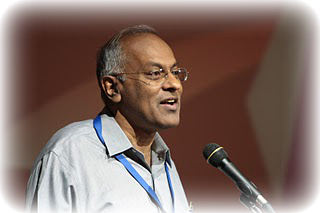
The LinkedIn preacher’s group has also had a bit of a discussion going on this subject – if you are on LinkedIn, please join the group.  I asked Ajith Fernando if I could quote his comment on this site, and he graciously agreed.  Ajith is the Teaching Director for YFC in Sri Lanka and is a regular expositor at well-known Christian conferences around the world.

Technology could be a help or a hindrance to good preaching. One of the biggest problems in the church is that our leaders are technicians when they should primarily be thinkers, theologians–that is, with everything they do coming from reflecting on the teaching of the Scriptures. For example, the great John Stott who was in every way a great theologian of the Christian life applied to contemporary life was not computer savvy. I use technology a lot. But I try to make it something that helps me do technical work (e.g. exegesis) faster and more efficiently than before so that I will be freed to give extra time for thinking, meditating, applying etc, etc.

Add to FacebookAdd to DiggAdd to Del.icio.usAdd to StumbleuponAdd to RedditAdd to BlinklistAdd to TwitterAdd to TechnoratiAdd to Yahoo BuzzAdd to NewsvineLike This!

The Downside of Technology and Sermon Prep

Sermon preparation does not require technology.  A Bible, maybe some paper and a pen, time and the Holy Spirit.  These seem to be the necessities (and it would be possible without the pen and paper, if necessary).  But this week I’ve been looking at various technological helps for sermon prep.  Undoubtedly all that has been mentioned has value and can be very helpful.  Yet it would be remiss to end the week without waving these four flags of caution:

Time – Using technology can undoubtedly save time.  Reorganizing a message using cut and paste is much quicker than rewriting the whole message.  Almost instant access to the right page in a commentary, or almost instant concordance searches are amazing innovations in our generation.  But technology can also sap time.  My mind immediately jumps to two, one of which I haven’t mentioned this week.  Social networking can be a massive time sapper.  So can preparing Powerpoint.  I haven’t mentioned Powerpoint because it is really a technology designed to help presentation, rather than preparation.  I will say this though – it is worth pondering whether the two or three hours (and more!) had been spent in improving the oral clarity of the message, would the message have been more compelling, gripping, clear, etc.?  In many cases, the answer is a definite yes in my opinion.  Anyway, I’ll leave powerpoint and similar for another series.

Distraction – Using technology offers instant access to so much, but it can also offer distraction from the task at hand.  I’m not saying we shouldn’t use computers (and alarm clocks, phones, etc.)  I am saying that we shouldn’t be naïve to the distraction that technology, especially the connected technologies online, can bring to our week.  Maybe it would be worth keeping an accurate time log to discover just how distracted you get in a typical week!

Booklessness – I mentioned this earlier in the week.  With all the benefits gained from online libraries and electronic books, etc., there does seem to be something lost when we don’t have a physical, tangible, real paper book on the desk before us.  It may be hard to explain, but there does seem to be something about actually looking at paper, rather than being gradually blinded by the screen.  There is something about actually retaining information, rather than merely being an expert in where to find it.

Prayerlessness – I pray when I’m working on the computer.  But not always.  Sometimes the combination of overwhelming information and the urgent though not always important needs, not to mention the noise of social media . . . well it can add up to seasons of prayerlessness.  Even if that season is an hour, it seems to me that that is too long.  If I weren’t using technology, would I be prayerless for an hour?  Our churches need preachers who are walking very closely with God, who pray, who read . . . people that used to be referred to as “divines.”  I don’t think it is just the label that has gone out of fashion.

Add to FacebookAdd to DiggAdd to Del.icio.usAdd to StumbleuponAdd to RedditAdd to BlinklistAdd to TwitterAdd to TechnoratiAdd to Yahoo BuzzAdd to NewsvineLike This!

Bible Software and Sermon Prep

This post isn’t a fair comparison of Bible software, but it is a suggestion that you look into the value of something beyond the free options.  I shared a free option on Monday, and others have followed in the comments.  If you are in a position to invest financially in software, then Bible software is well worth considering.

There are three “big boys” that I’ll mention.  Feel free to add your experience with any of these, or others you’d care to mention too.

 Available on PC and Mac, Logos offers an impressive array of content.  I’ll be honest, I’m still getting used to the pure Bible functions of Logos, as I have been a Bibleworks user for so long (and still reach for it on my netbook at times).  But it seems to me that Logos is improving and at least catching up in terms of exegetical function.  Where Logos seems to stand alone is in the array of commentaries and research materials you can get on it.  My suggestion is to prioritize the quality commentaries and resources so that they are the ones that you automatically go to when you are looking at a passage (i.e. there are plenty of resources on Logos that you shouldn’t feel bad about ignoring – it’s still worth the price for the quality ones!)

 In simplistic terms, if you want lots of books, go to Logos.  If you want to work with the text itself rather than commentaries, especially in the original languages, then Bibleworks is fantastic.  It is a PC based software (although some do run it on an emulator on the Mac, I haven’t gone down that route).  Truth is that Bibleworks is probably capable of much that you will never use.  I would say that people with any original language knowledge probably need something beyond the free options, and this is definitely one to consider for PC folks.  If you don’t use Greek and Hebrew, then Bibleworks will still prove very helpful, but you may find the cost prohibitive (as with all three).

 I can’t speak for this one as I haven’t gone there.  Accordance is the Mac based Bible software.  Users I know seem to delight in it, primarily for its intuitive Bible-handling interface, but it also has Logos-like collections of resources that can be added at a cost.  I suppose Accordance would argue: what is the point of emulating a PC on a Mac?  If you have a Mac, you know how it works, and so do the Accordance folks as they’ve always designed their software for this platform.

For many, these software options represent a luxury that is simply out of reach financially.  For that reason I am thankful that the gap between free and expensive is not as big a gulf as it would be in most purchases.  For those who have experience of any of these, I’m sure others would appreciate your comments.

Add to FacebookAdd to DiggAdd to Del.icio.usAdd to StumbleuponAdd to RedditAdd to BlinklistAdd to TwitterAdd to TechnoratiAdd to Yahoo BuzzAdd to NewsvineLike This!

Disconnected Technology and Sermon Prep

Yesterday I blogged about some of the ways we can be connected to others as we prepare a sermon.  Today let’s unplug the router and think about disconnected technology that may be helpful:

Word Processor – I suspect this is by far the most popular sermon prep tool.  Recording notes in our biblical study, cutting and pasting information in, typing out manuscript or outline, being able to format for fading eyes, etc.

Recording Equipment – While the word processor records through the input of our deftly moving fingers, there are other recording devices that can be useful.  I mentioned audio recording on smartphone apps yesterday, and the same would apply to any type of dictation device.  Sometimes you may not have, or be able to safely or efficiently use, a pen and paper.  And speaking of paper, every time I fly and look in those shopping catalogues in the sky, I’m always drawn to the scanner pens.  Scanning sections of a book to then transfer into the word processor, seems like a nifty gadget.  Anyone use one?  Worth it?

Bible Software – This is a big category, so I’ll post on this separately tomorrow.

Alarm Clock – Here’s a clever little piece of technology.  Some of my most productive hours are early, but without my alarm I often wouldn’t see them!  And for “bi-vocational” preachers, I suspect this is a must.

Square Scolls – Talking of all this newfangled gadgetry and advanced technology, let’s not forget one innovation that surpasses everything listed so far this week – the book.  There is a very real danger that preachers get caught up in contemporary technology and miss the powerful combination of some earlier advances in technology – the codex and the printing press.  What a privilege to own even a single book!  It is intriguing how technology is supposed to save time, yet sometimes it seems to create noise and squeeze out time from things that really matter.  Preach well this week, get your nose back in a book!

Add to FacebookAdd to DiggAdd to Del.icio.usAdd to StumbleuponAdd to RedditAdd to BlinklistAdd to TwitterAdd to TechnoratiAdd to Yahoo BuzzAdd to NewsvineLike This!

Connectional Technology and Sermon Prep

This week I am looking at the use of technology in sermon preparation.  Yesterday I shared three online research tools that I find helpful, but there’s more to “connected” technology than accessing articles and notes.  Here are a few more possibilities to consider:

Social Media – I see some real advantages and disadvantages to the use of social media like Facebook, Twitter and LinkedIn (if you are on any of these, please click the link and let’s connect there).  Sometimes asking a question on one of these sites can get a helpful response from folks in your network, which may be useful in sermon preparation.  I certainly don’t use this as much as some do.  I have seen the Facebook page associated with this site used a bit along these lines, and the LinkedIn group for Biblical Preachers is certainly growing as a helpful venue for pre-sermon discussion.  But if I’m honest, I see the main pro and con on a fairly simplistic level: good connections tend to post helpful links to resources that may be useful, but the noise generated by all social media can very easily become a significant distraction and time waster.

Quick Book Access – I don’t have a kindle or equivalent e-reader, but I do see one big advantage (apart from the benefits in travel) . . . instant access to a book. Generally, of course, it is better to be planning ahead and have what you need. But I’m sure I’m not alone in getting into situations where I suddenly realise a specific book would be really helpful and the clock is ticking.  A couple of times I have bought a book for access on a free Kindle app, just so that I can have instant access.  Luxury?  Absolutely.  But at the same time it is good to give our very best in sermon prep.

Note Taking – Smart phones can be just another source of noise and distraction, but they can be helpful too.  I’ve taken audio notes while out and about.  And I know some preachers delight in the free app Evernote, for example.  I think this does have good potential in terms of logging observations and illustration ideas, as well as capturing research information.

Telephone – Don’t miss the obvious!  Sometimes there’s nothing like getting on the phone to someone you trust and talking through your prep with them.  What can be achieved in twenty minutes in conversation with someone on your wavelength can sometimes break open a log jam in your thinking and save hours of low productivity preparation.

What other connectional technology do you find useful?

Add to FacebookAdd to DiggAdd to Del.icio.usAdd to StumbleuponAdd to RedditAdd to BlinklistAdd to TwitterAdd to TechnoratiAdd to Yahoo BuzzAdd to NewsvineLike This!

Online Research and Sermon Prep

This week I’ve decided to post about the use of technology in sermon preparation.  Searching for help with biblical study online can be hit and miss.  For most people it is mostly miss since they don’t know where they are looking.  Not every web-based resource is created equal.

Consequently people tend to end up looking at some blog from somebody pontificating without any credibility (not in every case, of course, but there are plenty of them out there).  Or you end up with free resources that lean on public domain materials, which may be ok, but often are very outdated and not the best place to be spending your energy.

Here are some sites I don’t think you should miss, and they are free.

net.bible.org – The NET Bible is an excellent translation that I hope will continue to gain in popularity.  I know some of the translators and have really enjoyed using this version in recent years.  Now the new online study environment is one not to miss.  The NET Bible, other versions too, as well as the excellent translators’ notes (explaining why they made the decisions they did with the text in a way that is accessible to non-original language scholars), plus Thomas Constable’s class notes (Bible exposition prof’s notes covering the whole Bible – while I might not agree with every detail, these are a solid resource that most people would have published years ago – I love it when people give away quality material!), plus numerous articles from experts like Dan Wallace (Greek Grammar Beyond the Basics, etc.)  You need to check this out.

Other Bible sites – it is worth looking at Biblia.com (especially if you have a Logos account, sign in and access more resources, but even without there is some helpful stuff there).  I’m sure the usual suspects will be mentioned in comments too.

www.biblicalstudies.org.uk – This resource is growing all the time.  A friend of mine has been plugging away at this for years (I’d love to see more people catch the vision and support him so he can do this even more efficiently).  There is a growing resource of pdf articles from theological journals and magazines on this site, as well as its sister sites related to theology and historical studies.  Obviously journal articles are of different quality, but all have been published.

www.theologynetwork.org – This is a great site associated with UCCF which provides written, audio and video resources.  Especially strong in areas of theology and historical theology, if you don’t have this site bookmarked you are missing out on a massive set of free resources.

There is so much online, but I’d suggest you get these three sites bookmarked and start there rather than simply googling the passage you are studying.

Add to FacebookAdd to DiggAdd to Del.icio.usAdd to StumbleuponAdd to RedditAdd to BlinklistAdd to TwitterAdd to TechnoratiAdd to Yahoo BuzzAdd to NewsvineLike This!

Let Man Not Separate Holy Spirit and Preaching Preparation

Yesterday I wrote about the error of separating devotional spirituality from exegetical rigour.  Skill in handling the Word should not be divorced from personal spirituality and our walk with the Lord.  There is a very direct correlation.  I’ll stay with this theme of not creating false separation with three more preaching and Holy Spirit related posts this week.

Today I’d like to address the myth that preparation for preaching somehow reduces the involvement of the Holy Spirit.  You may know people who suggest something along these lines – “Oh, I don’t want to get in the way of the Holy Spirit, you know, and lean on my own understanding.”  

It is a very real danger that prayerless preparation can cause us to lean fully on our own strength and to dismiss the work of the Spirit.

but

It is a very real danger that failing to prepare can cause us not to lean fully on the Holy Spirit, but rather on the random cocktail of energy stirred within by nervous tension and adrenaline, drawing on reserves of content that are neither fresh, nor suddenly “spiritual” due to our irresponsible and inconsistent view of ministry.  (I am not here addressing the situation where preparation was not possible due to sudden need or massively impeded preparation due to unforeseen family/pastoral crisis.)

so

the right approach must surely be prayerful, Spirit empowered preparation.

1. The Holy Spirit does not guarantee that our interpretations of a passage are infallible.  He will work with us as we show our whole-hearted, whole-mind, whole-strength love for the Lord as we study His Word to seek to truly make sense of it.

2. The Holy Spirit inspired the Word of God, and so is not insulted when we try our hardest to handle it well.  Surely the insult comes when we brandish it as if it were merely magic words to be thrown at people.

3. The Holy Spirit is also at work in the lives of the people to whom we will preach.  Surely it makes more sense to prayerfully prepare to preach to them, than it does to busy ourselves with other things and then suddenly claim Spirit empowerment in the moment of preaching.  He is working in them all week, why not let Him work in the preacher too in anticipation of that preaching moment?

4. The Holy Spirit normally works far more consistently and progressively in both the preacher and the listener, rather than the relatively rare “intuitive flash” (which in some cases might very well be explained by other causes, though not always, of course).

5. The Word that the Spirit Himself inspired includes the instruction to a local church based preacher to “make every effort” in teaching the Bible accurately (2Tim.2:15).  He hasn’t changed His mind.

Add to FacebookAdd to DiggAdd to Del.icio.usAdd to StumbleuponAdd to RedditAdd to BlinklistAdd to TwitterAdd to TechnoratiAdd to Yahoo BuzzAdd to NewsvineLike This!

Saturday “Short” Thought: And the Winner Is . . . ?

There is a discrepancy that I need to share with you.  This week, in a slightly relaxed pre-Christmas mode, I ran a couple of polls on the Facebook page and the LinkedIn group associated with this blog.  I asked, what do you wish you had more of in order to help improve your preaching.  Here are the results in reverse order . . .

In last place – further training in biblical studies (5%)

In fourth – more encouragement from listeners (10%)

In third – further training in preaching (19%)

In second – more fellowship with other preachers (24%)

And the winner – more time for preparation (43%)

Now I have done enough classes in quantitative analysis and statistics to know that this survey is bordering on meaningless, but in the spirit of bad statistics, let me make a couple of comments before I point out a big discrepancy for pondering over this festive season.

Comment on the winner – people responded to the survey by clicking on their most desperate felt need.  I suspected that time would be the greatest felt need because many of us wish we had more of it every single week!  This doesn’t mean that only ten percent of preachers need more encouragement from listeners.  I suspect that number would be higher if people could have voted for two or three options.

Another comment on the runner-up – it is interesting that quite a few folks expressed the desire for more fellowship with other preachers.  I suspect that the ministry of preaching is unnecessarily lonely in many churches.  Perhaps it is worth starting some sort of preacher’s gathering in your area, or better, in your church.  I have been so encouraged by the first two gatherings of a dozen preachers and interested parties in our church.

DISCREPANCY! I posted another poll in a larger group of Christians asking “What is the greatest weakness in the preaching you hear?”  The options available were lack of Bible, poor handling of the Bible, lack of clarity, lack of relevance, and poor presentation.  Issues of clarity and presentation came last, lack of Bible came third, lack of relevance second, but the runaway winner was poor handling of the Bible with 45%.  Combine that with lack of Bible for a total of 65% and two things jump out at me.

1. I’m breaking too many quantitative analysis rules to list.

2. Runaway greatest need in one poll (Bible handling), and distant last in perceived need among preachers (further training in Biblical studies) – could it be that preachers are generally over-confident in their ability to handle the text accurately and effectively?  I know some of the preachers who responded to the poll and don’t think this to be true of them, but in general, this strikes me as true: many preachers need more training in effective Bible handling.  I wonder if it would be worth picking up that book that might help over the next couple of weeks as we sit at home enjoying Christmas festivities?  That might be the best feast of them all!

_________________________________

Have a wonderful Christmas!

Preaching Proverbs 4: Sayings and Sermons

Yesterday I described two masterpieces of the art of preaching Proverbs (click here to see post).  Both the explanatory emphasis of the first and the applicational emphasis of the second affirmed the possibility of a full-length single saying sermon from the Proverbs.  What were some of the key features of these sermons?

1. Repetition.  In both cases the preachers repeated the main idea (the proverb) multiple times.  It never felt forced or tedious, but it did tattoo the truths on the hearts of those listening.  Proverbs are designed to be memorable.  While we don’t have the memorability of the original language to aid us, repetition certainly helped.

2. Memorability.  We don’t have sound-play in the wording like the Hebrew, but memorability can be achieved in other ways.  In the first example Haddon Robinson achieved memorability by pursuing visualization.  That is, through vivid description, the listeners could see what he described, and having seen it on the screen of their hearts, they wouldn’t forget.  In the second example, Gene Curtis achieved memorability by a different type of sound-play.  Not the sounds of the words, but the clever use of a repeated first line of a song.  Actually, this musical marker was so effective in flagging up the need for the proverb because he ended the mini-rendition by tweaking the tune into a melancholic minor key each time – a refrain introducing the main idea each time.

3. Non-linearity.  Neither sermon imposed what felt like a foreign sermon structure on the text.  There was no overt three point with sub-point presentation involved.  Both felt relaxed and slightly circular, yet on paper could have been defined using standard outlining, of course.  There wasn’t the urgency of a narrative, or the driving progression in logic of an epistle.  The structure seemed to fit the genre.

4. Application.  Both sermons were marked by specific, tangible, relevant and vivid application.  While the one placed greater emphasis on explanation, both felt absolutely preached to the listener, to mark the listener and to bring about transformation.  I’m sure many of us could manage it, but surely it must be wrong to turn a practical, vivid, life truth, into an academic curio.  It takes great intellect to make something simple and clear, but a lesser preacher can impress and confuse the listener.  Hey, was that a contemporary antithetical distich?  Nice.

Tomorrow I’ll finish the series . . .

Add to FacebookAdd to DiggAdd to Del.icio.usAdd to StumbleuponAdd to RedditAdd to BlinklistAdd to TwitterAdd to TechnoratiAdd to Yahoo BuzzAdd to Newsvine

Preaching Proverbs 3: Full-Length Single Saying Sermons

Jon provoked this series of posts by asking if it is possible to preach longer than five minutes on a proverb (particularly the two-line kind), without preaching topically through a whole subject.  I believe it is.  Not just in theory, but based on my experience as a listener.  Two, perhaps three messages stand out to me, that have been on a single two-line saying, and have warranted the full sermon length they were given.  So, two ways to pursue fully orbed Proverb preaching:

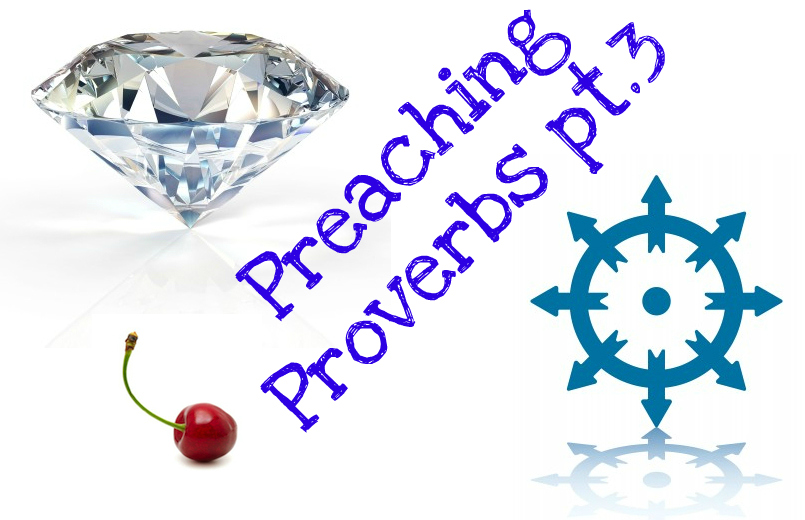
The Every Angle Jewel Explanation Approach.  The message I have in mind is one I head a few years back from Dr Haddon Robinson.  Seemed like a simple saying, until he started probing it.  Like a connoisseur of fine jewels, Robinson took up that little saying and methodically turned it in every direction, probing each facet to gradually determine the richness of the meaning of the proverb.  Technically he used carefully developed paragraphs of thought.  Experientially it was like sitting at the feet of a wise sage giving a guided tour of a fascinating thought.  In the process of explanation I learned about metallurgy, about Hebrew culture, about the language used, and most importantly, about myself as the light reflecting from that jewel shone into corners of my life.  There was no bony structure sticking out, or jerky transition into time for an application.  It was relaxed, it was measured, it was well-crafted, it was a message that marked me.

The Every Direction Intersection Application Approach.  Ok, so my label is almost as long as a proverb, but I’m not Solomon.  The message I have in mind is one I heard in seminary chapel over a decade ago.  Dr Gene Curtis preached a masterpiece of a sermon that still influences my ministry today.  A typical two liner.  A full length sermon.  A lot of marked listeners.  How did he do it?  He explained the proverb, which didn’t take long, but then he applied it.  Then he applied it again.  Then he applied it again.  Multiple situational applications, all driving home the same point, the main point of the proverb.  In this particular case he also used the first line of a children’s Sunday school song to reinforce the point and offer a musical memory marker along the way.  If you can imagine a busy intersection in the centre of a large city, a roundabout/rotary with multiple roads leading off it, that was his sermon.  He left the world of the Hebrew sage and entered the office of the pastor, the conversation of the spouse, the lap of the parent, the phone call of the friend, etc.  Each time showing the relevance of the proverb, each time reinforcing the same point, each time returning to the text and then heading off on a different exit point.  I would love to have preached a sermon so effective.

I was impressed recently with a sermon by Andy Stanley on a single proverb, which was excellent, but despite the impressive feats, perhaps it didn’t quite attain to the two I’ve described.  (Or perhaps it had the strengths of both!)

Add to FacebookAdd to DiggAdd to Del.icio.usAdd to StumbleuponAdd to RedditAdd to BlinklistAdd to TwitterAdd to TechnoratiAdd to Yahoo BuzzAdd to Newsvine