Review: Preacher, Can You Hear Us Listening? By Roger Van Harn

vanharnl.gif

I was surprised by this book.  I am not sure what I was expecting, but I was both blessed and challenged by it.  The focus of the book is on listening, both to God and to people, by the preacher and the congregation.  Perhaps the strongest lasting impression left is the notion of the preacher being a ‘pioneer listener’ – he who is one of the people, yet listens first to God’s word for the people.  The preacher listens to, with and for the people.

The book is structured using twelve questions.  The first sets up the opportunity to present a biblical theology of hearing/listening in the New Testament.  Then he moves through issues of the noise of a fallen world, the importance of the biblical text and gospel story, as well as contemporary culture to a final call for preachers to be listening to their people.

Chapters 2, 3, 5 and 6 are particularly strong as Van Harn addresses issues relating to Biblical interpretation and presentation.  Unfortunately chapter 4 breaks the sequence.  As he tries to show the importance of presenting the gospel behind every text he inadvertently does a good job of debunking the rather simplistic idea of the chapter.  His imagery of a smudged window is not comfortable to this reader.  Having criticized this chapter, I should reemphasize how effective those before and after were in their purposes.

As well as affirming the need to hear the story behind, and around, the text, it would have been nice to read a chapter affirming the need to hear the story in the text.

Van Harn effectively presents the need for listeners to see the connections between text and sermon, as well as sermon and life.  His presentation of the need for a helpful angle and proper distance is excellent.  He highlights the importance of the sermon in helping the community of believers interpret their culture, knowing when to say yes, no, or maybe to those things going on around them.

His presentation of the church as that which is one, holy, catholic and apostolic is interesting, but he is strangely quick to dismiss the distinction between the visible and invisible church.  The closing chapters perhaps lost the strength of the first half of the book, but still are worthy of your time.  Van Harn’s closing suggestion for hearing the congregation is simple and seemingly quite effective.

This is clearly a book written by a man who has given much thought to the generally neglected subject of listening.  I think we could all benefit from reading it, and hearing what he has to say.
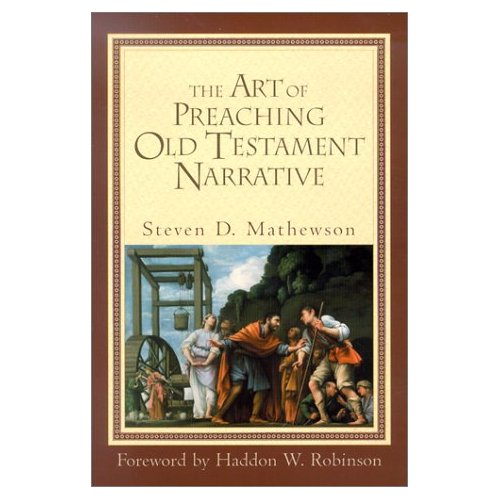
Review: The Art of Preaching Old Testament Narrative, by Steven D. Mathewson

mathewson.jpg

There are many preaching books, but only a handful I recommend wholeheartedly.  This is one of them.  Mathewson’s passion for the many narrative passages in the Old Testament is contagious.  His passion for the effective preaching of these passages is greatly needed today.  This is especially the case while significant preachers continue to view Old Testament narratives as primarily illustrative material, rather than preaching texts. 

Mathewson’s work is widely researched, with significant influences including Robert Alter’s The Art of Biblical Narrative and Haddon Robinson’s Biblical Preaching. 

The first of the three sections in the book is concerned with hermeneutics – how to move from the selection of a text to a focused central concept.  The second section is more focused on the homiletical process – how to move from the central concept to the sermon.  This section is strongly influenced by Robinson’s methodology and serves as a very helpful clarification on that method.  While Robinson’s book is succinct and well-written, Mathewson’s presentation of the ten-stage approach with a specific focus will help the reader understand Robinson’s methodology more fully.

Mathewson’s explanation of biblical narrative forms support his central idea of developing sermons using the flow of the story, rather than a forced and rigid analytical presentation. 

The third and final section of the book contains five example sermons from Mathewson, Donald Sunukjian, Paul Borden, Haddon Robinson and Alice Mathews.  These are helpful in a variety of ways, although no example sermon can ever be perfect.  There are also a couple of appendices – one on Hebrew plot analysis (for Hebrew trained preachers with a lot of time on their hands) and one on helpful commentaries.

There are many books on preaching, but I’ve yet to find one that can match Mathewson in terms of dealing with Old Testament narratives.  This book is worth buying, reading and considering carefully.  Having read this, you might also be inspired to read Robert Alter’s The Art of Biblical Narrative, if you have not done so already.  Two strong recommendations in one review – I would apologize to your bank balance, but these two books would be money well spent.

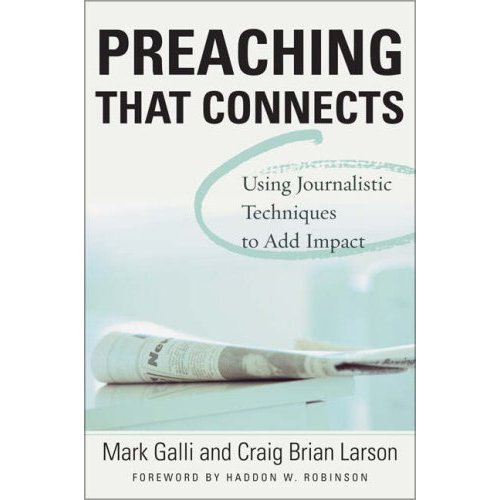
Review: Preaching that Connects, by Mark Galli and Craig Brian Larson

Subtitle: Using Journalistic Techniques to Add Impact

preachingthatconnects.jpg

Both authors are journalistic editors (Christianity Today and PreachingToday.com respectively). Both are also preachers. They wrote this book to show how the skills of journalism can help the effectiveness of preaching.

The book is short, but a worthwhile read. A dozen brief chapters deal with the following subjects: the motivation of effective communication, creativity, introductions, sermon structure, illustration, story telling, language style, and conclusions. The goal in journalism is effective and captivating communication. What preacher does not desire to be effective and captivating?

As the foreword suggests, this book might only take a couple of hours to read, but there is potentially a lifetime of benefit.

Review: The Passion Driven Sermon, by Jim Shaddix.

Subtitle – Changing the Way Pastors Preach and Congregations Listen

ShaddixPassion

This is a book with both strengths and weaknesses. To be honest, this is not a classic.

Jim Shaddix is a pastor and teacher of preaching at New Orleans Baptist Seminary. He co-authored Power in the Pulpit, a preaching manual, with Jerry Vines. This book, The Passion Driven Sermon, is not a manual, but a theology of preaching. In this book he wrestles with what preaching is, and what it should be.

The Passion Driven Sermon, according to Shaddix, should be a sermon driven by passion for the glory of God. His passion is evident throughout the book as he addresses issues relating to preaching and the Bible, preaching and the pastor’s role as shepherd, then preaching and the sermon.

There are some real strengths in this book. His style is uncompromising. The recurring idea throughout is that preaching should be filled with “God’s stuff” rather than just “good stuff.” The passion for God, for His glory and for His Word, is commendable. The repeated swipes at non-expository felt needs preaching is certainly needed in certain circles.

However, there are also real weaknesses in this book. Often the swipes taken at non-expository felt needs preaching swipe too broadly. The reader soon has the sense that any specific relevance to the daily life of the listener is a compromise that should be rejected.

Is it not possible to preach Christ and Him crucified, to preach theocentric and Biblical sermons, making clear the claim of Christ on the lives of the listener, but to do so with relevance and application? True expository preaching demands both Bible and relevance.

Pendulums swing far, often too far – but it is important to get the point of the swing. Shaddix’s book is a pendulum swing away from man-centered, unbiblical, rhetorically driven ear-scratching preaching. He swings too far and rejects too much, but we should hear his message anyway.

We do need the message of this book today, but I would be nervous if a preacher followed this book to the letter. After reading this, it would be healthy to read another book that places the importance of relevance in Biblical exposition back in its rightful place.

To be honest, at times it felt like Shaddix was in a bad mood when he wrote the book. Strengths and weaknesses, but not a classic.

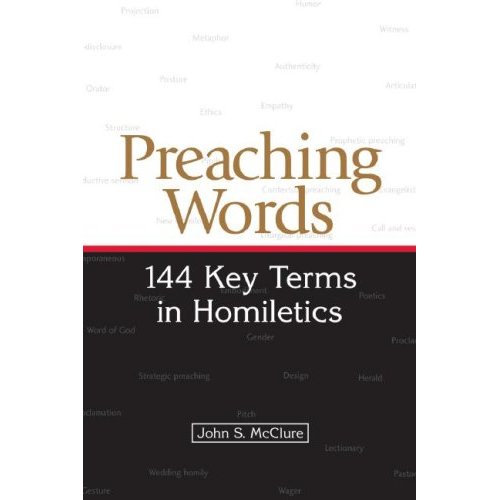
Review: Preaching Words: 144 Key Terms in Homiletics, by John S. McClure

144KeyTerms

This is not a dictionary, although the similarities are clear. 144 terms are stated and defined succinctly. Then explanation with quotes from key figures in the area follow in anything from one paragraph to four page explanations of the definition, and then a brief bibliography.

For the author, these terms make up the “building blocks of homiletics” (p.xii) However, the extent to which you resonate with his confidence will depend on your theological stance. The words chosen reflect the diversity of ‘key’ concerns in the broader realm of homiletics – from feminist preaching and gender, via deconstruction or Nommo, to kinesics and embodiment.

There is a good amount of helpful content mixed in to this volume, including some helpful summaries of various writer’s works. If your preaching library already includes several good texts on expository preaching, Biblical interpretation/hermeneutics and so on, then this book would offer a helpful introduction to homiletics beyond the more evangelical sphere. If you want an introduction to preaching, despite McClure’s confident introduction, this is not the book for you.

A collection of building blocks for preaching? No. When key blocks like “hermeneutics” do not even include the possibility of interpreting the Bible as we would affirm, a building constructed with this block would be at risk of crumbling under any weight. These are not building blocks, but windows – helpful and easy to see through, some of which open into areas of homiletical study many of us seldom consider, or even know exist.

This succinct book is very helpful, if you are looking for an introduction to homiletics in its broader forms. There is real benefit here, but look carefully, you would not want to fall through some of these windows.

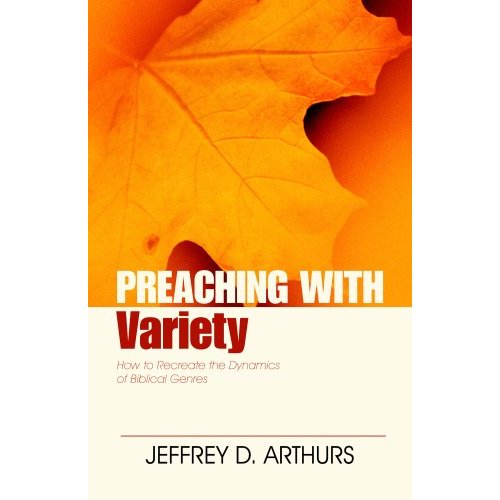
Review: Preaching with Variety, by Jeffrey Arthurs

Sub-title – How to Re-Create the Dynamics of Biblical Genres.

Arthurs Variety

I hope this book gets the recognition it deserves. This is a power-packed paperback that seeks to stimulate Biblical preachers in developing variety in their preaching through awareness of how the various Biblical genres function. Arthurs offers not only understanding of how the genres do what they do, but also many suggestions on how to reflect their diversity as we preach them.

Arthurs states, “I believe that a sermon’s content should explain and apply the Word of God as it is found in a biblical text, and a sermon’s form should unleash the impact of that text.” (p.13)

Arthurs is not arguing that the form of a text dictate the form of a sermon, even if that were possible. Rather he argues that genre sensitive preaching seeks to replicate the impact of the text. He affirms the great freedom in form available to preachers, and encourages that freedom by presenting the great variety found within the six major Biblical genres.

The first two chapters argue in favor of variety in preaching, firstly because God the master communicator uses such great variety in all His communication – not least in the diverse forms of literature used in His Word, and secondly because our listeners value variety.

The rest of the book deals with six Biblical literary forms: Psalms, Narrative, Parables, Proverbs, Epistles and Apocalyptic. In each case presenting an introduction to the genre, a helpful explanation of the rhetorical devices used to create their impact and numerous helpful suggestions on how to preach the different types of text. The result of these suggestions, if heeded, will be real variety in Biblical preaching.

Arthurs is as much concerned with rightly handling the Biblical forms as he is with prompting variety in preaching. He is urging effective understanding of the rhetorical function of Biblical genre, so that one’s preaching might also fizz with Biblical variety. This is not the definitive book on creative preaching, for there are others that suggest many exciting and bizarre possibilities. However this may well become a model book on interpreting Biblical genre (and in that divinely designed diversity is the shove we all need to vary our preaching!)

So I hope this book gets the recognition it deserves. Thomas Long’s brief paperback on literary forms has been rightly praised as a helpful introduction to the subject of genre studies with some help for the preacher. Arthur’s work may well replace Long’s, for it is a more complete introduction to more Biblical genres from a more definite evangelical stance, with much more in the way of practical suggestion for the preacher.

This book will help you say what the text says, and do what the text does!

(Peter has responded to a comment on this review) 

Review: Preaching and the Literary Forms of the Bible, by Thomas Long.

Long Literary Forms

Thomas Long provides a solid introduction to the literary forms of the Bible and how a preacher should interact with them. The book begins with a relatively brief consideration of reading different genre and the process of moving from text to sermon. Long emphasizes that the Word is to influence not only the what, but also the how, of preaching. In effect the preacher is to seek to grasp and replicate the total impact of a text on its reader.

Long then moves into the various literary forms of the Bible. His approach for studying each genre is helpful, although not a process for preparing a message. Firstly, the genre must be recognized. Then the rhetorical function of the text is observed, with a sensitivity toward the literary devices within the text. The text is then analyzed to determine how its impact on the reader is created. Finally, Long briefly considers how a sermon might create the same impact in today’s listener. These final thoughts in relation to sermon possibilities are at times a little brief.

Long considers five genre – psalms and proverbs are Old Testament specific. Narrative covers both Old and New Testament material. Parables and epistles deal with the rest of the New Testament coverage. Sadly prophetic and apocalyptic literature are missing. Throughout the study, Long’s repeated emphasis is that the rhetorical effect of the literature is to be recreated through preaching.

Long’s relatively short book is high on value. This review does not affirm every statement in the book, but does affirm its value for anyone concerned with Biblical Preaching. To only cover five “literary forms” and not deal with the prophetic and apocalyptic forms is unfortunate. However, what is included fits the purpose of the book and is effective in making the reader think through the implications of genre study for Biblical preaching.

Before buying this book, please read the review on Jeffrey Arthurs’ new book, Preaching with Variety.

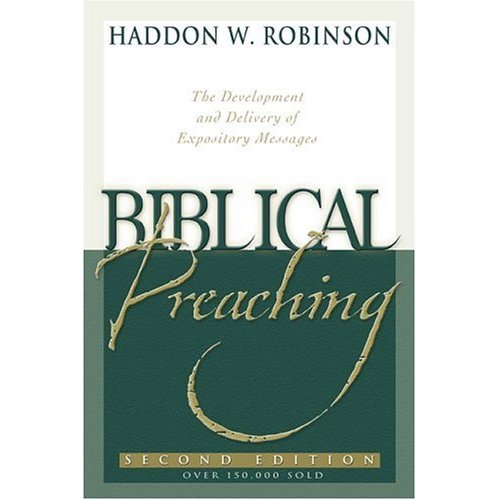
Review: Biblical Preaching, by Haddon Robinson (2nd ed.)

Biblical Preaching

In England this book is sold under the title of “Expository Preaching,” but if you get it online, I would go for the American title so you are sure to get the 2nd edition.

This is Robinson’s highly revered “how to” preaching textbook. He presents a ten-stage process of sermon preparation in his typically precise style. No word is wasted. In many respects numerous other books on preaching are building on this one, trying to offer some clarification or slight adjustment. That is certainly not true of all, but of many.

The emphasis throughout is on preaching a thoroughly Biblical message, through effective communication, in a way that is entirely relevant to the specific contemporary audience. The “Big Idea” is central to the philosophy and the procedure of preaching. So the ten steps move from understanding the text to the point of an accurate and clearly defined exegetical idea, through the process of developing the homiletical idea with clear purpose, to the practical matters of sermon shape and effective content. Although there are other books that deal in detail with issues of delivery, Robinson’s brief section on delivery is helpfully succinct.

I think it is fair to say that anyone interested in the subject of preaching should have this book. Robinson’s combination of Biblical commitment, expertise in communication theory, and renown as a teacher of preaching, effectively blend to make this a very effective book. It seems wrong to review another book before this one!