When Lies and Treachery Take Root – Part 1

I feel sorry for the last book in a collection.  While many may enjoy the first, and probably the next couple too, not all readers will complete a series.  This was certainly true in my case.  It is only now, with my last pair of children, that I have finally cracked open The Last Battle and journeyed back into Narnia one last time.  What I discovered felt like a commentary on devilish and despotic democracide.  I had to check the publication date.  Was this written in 2023?  Obviously not, for it treads on far too many sensibilities for our day!

However, The Last Battle, the final chronicle of Narnia, remains eerily relevant.  I am sure it was to its own day, a day of reflection on the atrocities of National Socialism (Nazi-ism) in Germany, and a day of growing suspicion of the murderous evil of International Socialism (Communism) in the East.  Like all great stories, The Last Battle remains eerily relevant today, too.  “Narnia faced its fiercest challenge,” the back cover explains, “not an invader from without but an enemy from within.”  Indeed, so often the greatest threat to society lies within its own ranks.  And that threat does not always come from the most intelligent enemies of the state.  Often the mind behind the evil is devilish, while the actors used are less than impressive.  His antagonism to all that is good lies behind the puppet leaders used to enact the sinister effort to transform a safe society into something so much more malevolent.

By the time we reach the third chapter of The Last Battle, we already know that a self-serving Ape and his hapless Donkey have stitched up a lion’s pelt for some nefarious purpose.  We also join King Tirian and his Unicorn, Jewel, as they discover that Aslan has returned and ordered the felling of the holy trees and the murder of their dryads.  Arriving at the newly cut gash in the Narnian landscape, they discover Calormenes who are mistreating a Narnian talking horse.  It is all too much and they kill the two foreigners in a fit of rage. 

Struck by their noble consciences, they determine to surrender their fate to the justice of Aslan.  Whereupon we encounter “The Ape in its glory.”

I know that this is not directly related to biblical studies or preaching. But if you will indulge me as I share a brief series of reflections on a prescient work of fiction, here are twenty-two eerie parallels to ponder – parallels between Narnia, C.S.Lewis’ day, and even perhaps, our own.

1. A crisis was created and used by the leader of the coup.  The felling of trees, the gash in the landscape, the sale of noble tree trunks to the Calormenes, the profound upset of Narnian peace – it was all created by the one who now used that same crisis to wrest control of the territory and to serve his heinous purposes.

2. Death is in the air.  In the first chapter Shift cunningly manipulates Puzzle with the notion that he “shall probably die” if he tries to fetch the lion pelt from the pool.  Puzzle retrieves it and is “almost tired to death.”  In the second chapter the dryad is killed, then two Calormenes.  This is a story of death after death so that by the end, all the characters are dead.  Multiple characters state that it would have been better to be dead than…, and later on, we see Cair Paravel “filled with dead Narnians.”  Death becomes an everyday conversation when societies are taken over by tyrannical forces.  Lewis may not have known how accurate his picture was in the Communist east.  We may not know all that is swirling in our world today, but it does feel like the subject of death is hanging in the air.

3. Everyone is saying the same thing.  The King is struck by the fact that “the Horse said it was by Aslan’s orders. The Rat said the same.  They all say Aslan is here.”  Even though he had been warned that this was a lie, everyone was repeating the same message.  There is a strange power in a common story.  It will grow its own legs and generate its own credibility.  Sometimes a coup will take over a land by force, but not always.  Sometimes it is by stealth and the subjects will carry the tale of their own downfall willingly as if what they say is true.

4. For those that see clearly, it was clearly a charade.  There in the clearing, at the peak of the hill, “there was a little hut like a stable, with a thatched roof.”  But for those who could not see clearly this charade became their focal point.  “On the grass in front of the door there sat an Ape.  Tirian and Jewel, who had been expecting to see Aslan and had heard nothing about an Ape yet, were very bewildered when they saw it.”  As readers we can see through the whole charade – don’t believe what he says, he is a fancy-dress ape with a dressed-up donkey prop!  It is frustrating when others cannot see what is plainly before them.

5. Tyrants always look silly.  When the Ape, chewing his supply of nuts, was handed the king’s sword with its belt, “he hung it around his own neck: it made him look sillier than ever.”  Did the German population wonder about the short, shouting Austrian tyrant?  Did the bigger moustache of Stalin command the respect he may have thought it should?  And what of the potential tyrants in our day?  If you look carefully, they always look silly.

6. Tyrants are always self-serving.  “Now listen to me, everyone.  The first thing I want to say is about nuts. . . . I want – I mean, Aslan wants – some more nuts.”  The squirrels had already given the Ape more than they could spare.  That’s the thing about tyrants: they take everything from the people and lavish luxuries on themselves.  Beachfront villas, fine foods, private jets.

Next time we will continue our list . . .

(Illustration by Pauline Baynes)
8 Reflections on Preaching Through 1 Peter

In our church, we have just completed an eight-week series in 1 Peter. Here are some brief reflections that may be helpful:

1. This epistle is relevant. I know that is not breaking news to you, but it bears underlining. 1 Peter speaks to people that felt like oppressed outsiders in the society in which they lived. It did then, and it does now.

2. Suffering may be necessary. We have lived through decades of relatively little suffering, but times seem to be changing. Suffering is not permanent, “now for a little while.” And suffering may be part of the plan, “if necessary.” In 1 Peter 1:6 we are introduced to the possibility that suffering is not the result of bad luck, but divine providence. As we come towards Easter we have the ultimate example of deliberate and planned suffering.

3. Biblical background helps. There is the situational background of the readers, forcibly moved from Rome and repatriated to these five regions of modern Turkey. There is the historical background of Peter’s life and experience. Keeping that in mind, as he would have done, is helpful to shine a light on his call to be prepared (3:15), to stay humble and to resist the devil (5:6-9), etc. Then there is the textual background of Peter’s biblical awareness as he wrote. For instance, the situation behind Psalm 34 seems to be shining a light on much of Peter’s writing in this epistle.

4. Difficult texts still have simple points. Preaching the end of 1 Peter 3 and the start of 1 Peter 4 is not easy territory to navigate. There is the timing, location and content of Jesus’ preaching in 3:19; then the reference to Noah in 3:20; followed by the awkward reference to baptism in 3:21. It is exegetical difficulty piled on exegetical difficulty. I chose to give some minutes to explain that complexity, but not before I emphasised the simple point of this section: Jesus suffered and Jesus was victorious. It helps to keep a clear picture in mind when trying to make sense of the complex.

5. The letter has a strong DNA. God’s pattern is for suffering now to be followed by glory later. It was true for Jesus, it was true for Peter’s readers then, and it is true for Peter’s readers now. Suffering and then glory: this idea works its way through the entire letter.

6. Variation can help a series work well. We had a team of preachers on this series. One of the messages was preached in first-person. It came in the middle of the series and really helped the series to not feel monotonous in style. Different preachers helped the series, although it was important to make sure we were preaching a coherent series.

7. Non-Suffering forms of Christianity lead to harm. We seem to live between two extremes. One is the fatalistic idea that disaster is coming no matter what. The other is the idealistic idea that we should always be healthy, and wealthy and travel in a private jet. What is the healthy middle ground? It is not a gentle form of health and wealth – that is, things should generally go well for us if we simply trust, pray and obey. Many Christians seem to want to live with their basic orientation towards good circumstances. No, the reality is that we live in a fallen world filled with suffering. So let’s turn from gentle forms of health and wealth, and let’s engage a fallen and sin-marred world with our hope reaching out beyond this suffering to the glory to come. Our hope is not in our experience but in the character of our good God and his plan.

8. 1 Peter should prepare us for difficulty, but stir us to trust! Every problem we face in this world is a problem that exists within creation. 1 Peter urges us to look beyond this realm to the eternal realities. We look outside of this realm to the God who is so much bigger, the God who cares for us. “The dog bit me,” ~ yes, but God is bigger. “But it was a big dog,” ~ so what, God is bigger. “But it was a lion,” ~ it doesn’t matter, God is bigger. “Actually it was a killer whale.” ~ Ok, but God is still bigger than any problem we can face in this realm. What’s more, he already came and suffered, and is now sitting in victory. So we can be humble, be watchful, and be hopeful. We get to stand in the true grace of God whatever may come our way.

There are plenty more thoughts generated by two months in 1 Peter. But hopefully this list is a motivational starter for now…

____________________________

I have a series of videos on 1 Peter 2:1-10 that focus on the interpretation phase of Bible study. You can find them in this playlist:

Studying the Bible

The first half of preparing a sermon is studying the biblical text.  More than that, a fundamental feature of the Christian life is feasting on God’s word.  We all need to be able to study the Bible and enjoy the great gift of God’s word to us.  So, how should we do it?

In this video, I give a brief overview of the Bible study process.  Let’s think of it in terms of three questions, or four stages:

1. Look – what does the text say?  We need to develop our observational skills to be able to see what is actually written in the text before us.  Too many of us are too good at feeling familiar with the text and therefore skipping ahead.  A lot of Bible-handling errors and heresies would be avoided if we slowed down to see what is actually there.  What does the text say?

2. Learn – what does the text mean?  Once we have looked carefully at the text, we will get to the point of determining what the text means.  That is, not what does it mean to me – this is not an exercise in modern art appreciation.  What was the author intending to communicate?  Learning what the text means requires me to travel back in my mind to the original author’s situation, and try to make sense of what he wrote, in context, for the sake of the original recipients.  I have to go back then before I can think about lasting implications for today.

3. Love/Live – what should the text stir? Bible study should never end “back then.”  God did not give us the Bible as a historical curiosity.  It should ultimately have an impact on my life today.  So what should it stir?  Since it is primarily a revelation of God’s heart, character and plan, it should stir my heart to love Him.  Bible study that does not lead to greater love for God has gone astray.  My heart should be stirred by the God I am discovering in my Bible study.  But it is not enough to have a stirred heart.  This is not about a mere emotional response.  The Bible is intended to exact transformation in my life.  And that transformation works from the inside to out.  So my heart is warmed to God, and then my life should bear fruit as I am not just a hearer, but a doer of God’s Word.  Good Bible study will stir my heart to worship, and it will stir transformation in every area of my life.

What does the text say?  What does the text mean?  What should the text stir?  This is the Bible study process.  It might seem cumbersome at first, but this can, and should, become second nature to us as Bible readers.  Make sure you see what is actually there.  Look closely.  Go back then before considering today.  Expect God to change you from the core of your being out to the most specific activities of your day. 

In the coming weeks, I will be breaking down these stages on YouTube.  There will be a series of videos on Look, then another on Learn, and another on Love/Live.  I will offer some in written form here, but to catch it all, be sure to subscribe to the channel on this link.

Say, “Father!”

When I was a child, we attended a small church in Bristol, England.  Outside was a low wall forming a small courtyard where people would gather after church.  Teenagers would laugh and chat while younger children would weave in and out, playing tag.  It was a happy bubble of fellowship and laughter.

One Sunday, a group of local teenagers was on the other side of the street.  One picked up a stone and threw it at the church, smashing a small window high above the door.  As the glass shattered, that safe bubble burst.  I immediately ran inside and went straight to my Dad.  As far as I could tell, he was the tallest and one of the strongest men on earth.  I felt fearful and threatened, so Dad was the one I wanted to be close to at that moment.

The idea of a loving and protective father is not just important for children.  It is also important for all Christians.  In one well-known Bible passage, Jesus uses four words that should influence our lives every day.

In Matthew 6, Jesus addresses the subjects of giving, praying, and fasting.  In all three cases, he urges his followers not to make a show of their religious practice but to do them in secret.  After all, God knows what happens in secret, and he is all that matters.  So with the subject of prayer, Jesus warns against being showy visually or in our vocabulary.  And then, he gives a model prayer in verses 9-13.

When you pray, say, “Our Father in heaven….”

Familiar words.  You can probably quote the prayer.  Maybe you have noticed how it starts with one address, asks two things regarding the Father, and then three things regarding the family.  Let’s ponder the “address” some more. “Our Father in heaven.”

Many things should be true of a father.  Let’s be simplistic.  On the one hand, a good father is supposed to be an authority figure with power and strength.  On the other hand, a good father is supposed to be loving, kind, and close.  That immense strength has to be under control for the good of those under his care.

A. Our Father on Earth – Sadly, we live in a world where so many Dads have done a poor job of impersonating our heavenly Father.  They have been missing, angry, drunk, and even abusive.  Many Dads resemble the devil more than they do God.  But even if we did have an honourable Dad or even a Christ-loving Dad, we probably all feel a lack in our hearts.  Whether that is a slight lack or a gaping wound, it only underlines how we were created for closeness with a father.  We long for a father who is powerful and strong so that we can feel safe and secure.  We long for a father who is loving and close so that we can feel held and happy.  Our father on earth may not have been what we needed, but what about our Father in heaven?

B. Our Father in Heaven – Jesus was on a mission.  It was not just a mission to rescue us from sin and bring us into a relationship with God.  It was also a mission to reveal God’s heart to us.  What is our Father in heaven like?

i. Authority & Power – When the stone bursts the safety bubble of life, we need a Father who is big and strong.  In Matthew 8:23-9:8, we read three stories that show us a glimpse of God’s authority and power.  Jesus rebuked the winds and the sea during a great storm, and they obeyed him.  Jesus commanded demons to leave the two demon-possessed men on the other side of the Sea of Galilee.  Jesus forgave and healed the paralytic.  Jesus demonstrated his divine authority over creation, the spiritual forces of evil, physical healing, and forgiveness.  At the end of this trio of stories, we read, “When the crowds saw it, they were afraid, and they glorified God, who had given such authority to men.” (To one man in particular! – see Matthew 9:8)

ii. Love & Closeness – When the bubble bursts and the glass rains down, we need a Father whose heart is towards us.  In Matthew 7:7-11, Jesus encouraged his followers to pray and ask because of God’s good heart.  Who gives a child a slice of slate to chew on when they ask for toast?  Who thinks a poisonous snake is a suitable alternative to a healthy protein and omega-3-laden fish for a hungry child?  We are fallen creatures in a fallen world, but we know how to give good gifts to our children.  So “how much more will your Father who is in heaven give good things to those who ask him!”

iii. Who is in Heaven – There is one moment in Matthew’s Gospel where heaven bursts onto the scene.  In Matthew 17:1-7, Jesus takes three disciples up on a mountain, and the curtains are pulled back.  Suddenly they see Jesus in his heavenly impressiveness, conversing with Moses and Elijah.  Peter panics and suggests a tent-building plan.  Then there is a bright cloud and a booming voice from heaven. “When the disciples heard this, they fell on their faces and were terrified.” Quite right.  It was terrifying.  But notice that Jesus was not on his face.  Why not?  Because he knew the voice and the heart of the one who spoke.  On that mountain, they got to experience God’s terrifying power and authority, but take note of what they heard!  “This is my beloved Son, with whom I am well pleased; listen to him.” (v. 5). Our Father in heaven is both terrifyingly powerful and wonderfully loving.  Jesus has made him known to us!  That is why it is crucial to be sure that he is not just The Father in Heaven, or even Jesus’ Father in Heaven, but Our Father in heaven.

C. And What About Us? – Whenever we think about prayer, we tend to start thinking in terms of a religious burden.  “We are a month into a New Year, and I should do better at praying.  I need to be more diligent, more purposeful, etc.”  Maybe there is another way to look at this. 

If God has all authority and power, then that means I can come to him as one who is frightened and weak.  If God is loving and close, then I can approach him as one who is childlike and weary.  I don’t need to impress him.  I can just come as I am, start with “Our Father in heaven…” and then pour out everything on my heart.  What a privilege!

_______________________________________

Please see the new series of videos for 2023 – Enjoying the Word . . . all about enjoying Bible reading and Bible study.

Bible Reading Basics – Part 2

If you have a good Bible reading and study plan that works well, that’s great.  But what if you don’t?  What if others don’t get on with your approach?  Well, for you, or for someone else, this video might be helpful.  It shares a reading and study approach that I believe has a lot to commend it. 

There is flexibility – you choose what time to give to it. 

There is motivation – you choose where to put your energy. 

There is potential – I’ve not found a plan that seems more likely to build solid Bible-shaped believers.

One of the challenges of Bible reading is maintaining momentum. There are a number of momentum killers, like long lists of names and unpronounceable places. What should we do?

One way to evaluate your Bible times is by checking in on what is happening in your mind and heart the rest of the time. What does it mean to meditate on God’s Word day and night? Check out this video for more:

The question that I hear more than any other is this, “what should I do when I don’t feel like reading my Bible?” It is an important question. We all need a decent answer that can help us when we inevitably get those days. Here is a video that may be helpful.

Please click here to subscribe to the YouTube channel – thanks!

Bible Reading Basics – Part 1

When you first open the Bible, it is an overwhelming tome, to say the least.  Over time we can start to find our way around the Bible, just like we can learn to find our way around a big city – one landmark at a time.  In fact, the Bible gives us a great example of such landmarks right at the start of an important chapter.

Why do so many believers lose their love of Bible reading before Valentine’s Day?  Could it be that they are trying to read and study simultaneously?  Have you ever found yourself struggling through Leviticus and taking very little in while longing to be in Philippians (and knowing you won’t be there anytime soon)?  Perhaps it is time to make a helpful separation.

The Bible speaks of delighting in the words of God.  Other Christians sometimes seem to sound so delighted by the word of God.  So why do some of us never seem to reach those heights?  Perhaps a simple suggestion relating to concentration might prove helpful.

John Wesley’s Advice – Part 4

The final part of the list of John Wesley’s advice to preachers.  Points 1-2, and 3-5, and 6-8 are already covered.

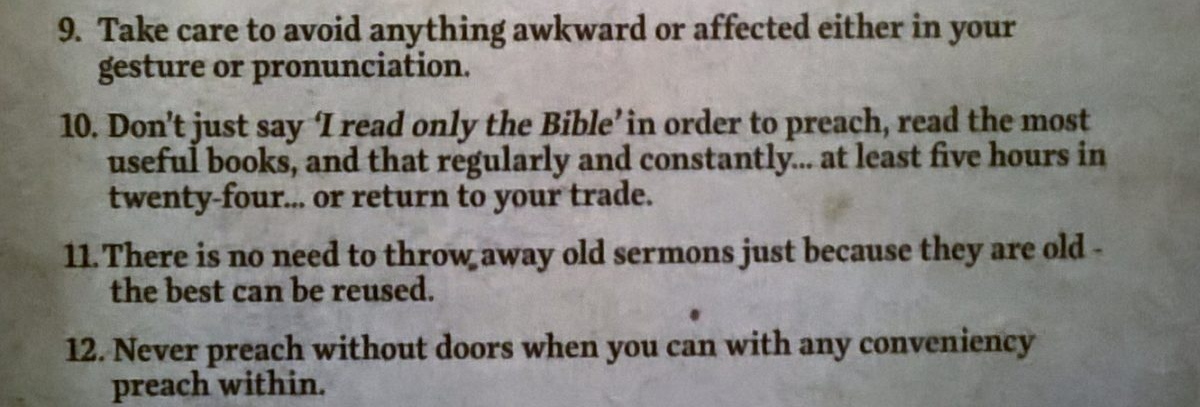
9. Take care to avoid anything awkward or affected either in your gesture or pronunciation.  It is interesting to see this from Wesley.  I tend to think of affected pronunciation as being related to vocal projection in vast unamplified venues – a concern that we no longer have.  But that would not be the only reason for it.  There is the awkwardness that comes from feeling self-conscious, or from attempts to be theatrical, or from a learned “pulpit voice” that attempts to sound more “hallowed.”  To connect with coal miners on Hanham Mount in the 18th century, or normal people anywhere today, it is better to communicate naturally and authentically.  Nobody likes listening to an actor.  Actually, the reason real actors are so good at what they do is that they convey that natural communication as someone they are not.  As preachers, our only goal is to convey natural communication as someone who we are!

10. Don’t just say ‘I read only the Bible’ in order to preach, read the most useful books, and that regularly and constantly… at least five hours in twenty-four… or return to your trade.  Can I be brief on this one?  I don’t know, but I suspect he wouldn’t include social media surfing in that at least five-hour goal.  Once we limit this to book reading, then it does feel like a big ask for many today.  Perhaps we should take this away and ponder it.  Are we neglectful of our calling, responsibility and opportunity to not give ourselves to as much reading as we should?  (And if you are a “lay preacher” – you can determine the appropriate goal for your circumstance.) 

11. There is no need to throw away old sermons just because they are old – the best can be reused.  I agree.  I would add that when reusing a sermon, it is helpful to spend some time refreshing it and making sure that it is current in your heart and not just present in your notes.

12. Never preach without doors when you can with any conveniency preach within.  This is the advice that probably needs the most pondering.  For Wesley, his move to preaching outdoors was radical and had huge implications for his church relationships.  But once he got known for it, it is intriguing to think about this advice.  Maybe the point for us is not so much about whether we preach indoors or outside.  Perhaps the point is to not allow anything we do to become a gimmick.  Don’t get known for something and then keep working that thing to the detriment of what really matters.  Be a preacher of the Word.  End of.  Once you get known for a specific type of sermon, a particular location(!), a specific type of biblical text, or even a specific subject, then you have to reckon with this point of advice from John Wesley.  What does this mean for you and me?  Maybe nothing at the moment, but it is a good one to prayerfully ponder.

There we go!  All done.  I have enjoyed thinking through these brief thoughts.  I hope that has been helpful for you, too.

John Wesley’s Advice – Part 3

Continuing our walk through twelve points of advice from John Wesley.  So far we’ve looked at numbers 1-2, and numbers 3-5.  Let’s move on…

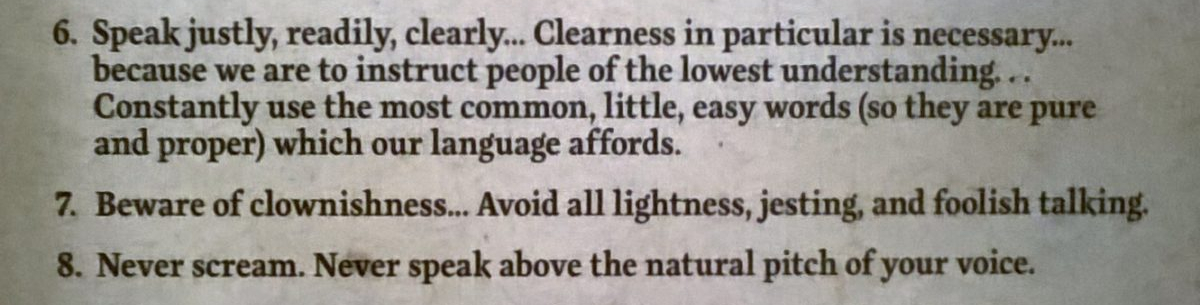
6. Speak justly, readily, clearly… Clearness in particular is necessary…because we are to instruct people of the lowest understanding… Constantly use the most common, little, easy words (so they are pure and proper) which our language affords.  Most of us are not preaching to uneducated miners like Wesley did, but don’t let out-of-date phrasing obscure the point he is making.  Our job as preachers is to communicate, not to show off.  If you don’t have a theological and grammatical terminology that is higher than your preaching vocabulary, then you are either aiming too high with your words, or you are too weak in your study.  Say the profound things that the Bible says.  And say those things in the simplest way possible.  Even if ten PhD’s walk into your church, you still need to preach so that people with the least understanding (by means of their education, church being an alien environment, English not being their first language, or whatever) will be able to understand what you are saying.  Be clear.  Simple.

7. Beware of clownishness… Avoid all lightness, jesting, and foolish talking.  Again, good advice.  There is a place for humour in preaching, but we do need to be very wary of entertaining or making the sermon about us.  I suspect that if we avoid jesting and foolish talk, as well as clownishness, then we are on safe ground.  We don’t have to come across as sombre in every moment, but we should speak as if we have a very important message to convey – which we do if we are preaching the text properly.  We need to be wary of inappropriate formality.  Just as wearing a tuxedo can feel out of place, so can a strange and affected formal tone or a presentational gravitas that is not consistent with our personality and natural demeanour.  In our fear of jesting, let’s not come across as unloving, lacking in warmth, or out of touch with the room.  

8. Never scream.  Never speak above the natural pitch of your voice.  This was probably a greater concern before amplification equipment.  Nevertheless, this point still applies.  There is a natural upper limit to your pitch, your power, and even your pace.  Don’t go above that level to achieve some kind of emphasis.  The screamer seldom communicates anything other than a loss of control.  In fact, it is good to consciously work on going down instead of up for emphasis.  Down in pitch.  Down in power.  Slow down the pace.  Emphasis sounds very natural in the opposite direction, but it takes unnatural work to develop the skill!  And even more foundationally, your emphasis and impact is not ultimately determined by your vocal delivery, but by God’s Spirit bringing conviction to your listeners.

Next time we will finish the list.

Is Biblical Interpretation Boring?

When Paul wrote to Timothy, the senior apostle urged the younger Timothy to do the work necessary to “rightly handle the word of truth.”  The implication is that it is possible to mishandle the word of truth.  You only need to listen to a few sermons online or visit a few churches to start your collection of scary examples! 

Nuanced technical caveats notwithstanding, it is essential to recognize that every passage says something specific.  Our job as we study is to determine, as best we can, what that something is.  That is to say that each passage has one accurate interpretation.  It cannot mean anything, and it does not mean everything.  It means something.

Once we determine that meaning, that one interpretation, we can then begin to evaluate the many potential applications of the passage.

Here is a video on this specific matter:

But if we are going to talk about the rules and principles of interpretation, then are we not embarking on a tedious task?  After all, who wants to memorize rules?

You could say the same thing about other processes too.  Learning to ride a bike feels tedious, but it opens a new world of adventures for a child.  Learning to drive a car safely can feel overwhelming, but it creates new freedom that is a wonderful blessing.  Learning anything will involve some rules or principles.  The real question is this: is it worth learning?

When we learn to handle the word of truth rightly, we start to see the richness God has put in our Bibles.  We get to understand his glorious message to us.  We get to enjoy the beauty of the divine revelation in all of its literary splendour.  We get to experience the life-change that comes from living a Bible-marked life.  The rules of interpretation sound dull, but they are a means to infinite treasure!  Boring is not the word; let’s try exciting instead!

Check out the video to see which Bible passage I use to introduce this point!

John Wesley’s Advice – Part 2

So last time we started this list of 12 points of advice to preachers from John Wesley.  Let’s keep going!

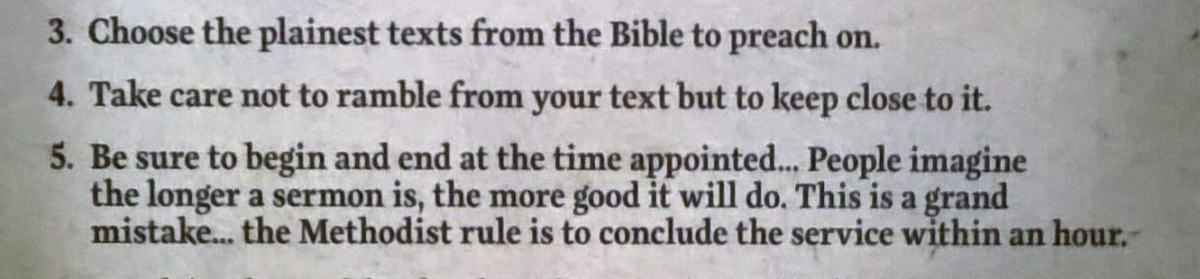
3. Choose the plainest texts from the Bible to preach on.  Again, if I were purely speaking to non-believers then I would completely concur.  However, in a typical church setting, we will be speaking to both Christians and non-Christians.  A steady diet of the same evangelistically oriented passages will lead to some malnourishment among God’s people.  I think it is good to help our churches experience the full breadth and scope of God’s Word.  You might preach more from the New Testament than the Old, but if they never hear the Old Testament preached, why would they read it?  And if they don’t read it, what a vast vista of theological truth is lost.  Different types of text are also important for the health of the church.

So on the one hand, I would agree that every passage has a redemptive force that should be brought out because believers never move beyond the need to hear the gospel being applied to their lives.  On the other hand, while every passage is useful, not every passage is equally useful on every occasion.  Don’t be stubbornly preaching through Jeremiah when people are coming for a Christmas Carol Service.  Bottom line?  Be selective and choose what you are going to preach appropriately for the listeners and the occasion, but in a church choose from the whole Bible because people need more than your favourite five passages.

4. Take care not to ramble from your text but to keep close to it.  Can I just say I agree and move on?  Of course not, otherwise this would be a “Quote” rather than a “Blog!”  It is quite remarkable how little weight the Bible passage will have in some sermons.  Some will leave it behind to ramble into excessive personal anecdotes and humorous illustrations.  Others will leave it behind to ramble into theological presentations that resemble explosions in a concordance factory! (Hyper cross-referencing is very common in some circles!)  Few seem to recognize that this passage is uniquely powerful and should not be missed by superficial coverage in the sermon.  Your church may not be back in that passage for several years.  Keep close to it, do it justice, allow time for clarity to emerge and its impact to be felt.

5. Be sure to begin and end at the time appointed… People imagine the longer a sermon is, the more good it will do. This is a grand mistake… the Methodist rule is to conclude the service within an hour.  Several points in this one.  Let’s go one-by-one – (1) begin and end on time.  I understand that different cultures have different expectations in terms of time.  But the point still applies.  Abide by the expectations of the culture.  Once we break the general expectation, then we distract attention from the sermon.  If we go 10 minutes over, parents are concerned about children in kids’ groups, volunteers in kids’ groups start to lose their joy in serving, and others are concerned about their plans, their lift home, etc.  Generally speaking, stick to time.  Seems fairly simple.

(2) Longer is not necessarily better.  Again, agreed.  Haddon Robinson was captivated by how some preachers preach for ten minutes and it feels like an hour, while others preach for an hour and it feels like ten minutes.  Length tends to become the key focus when too little attention is given to clear, engaging and relevant content and delivery.  Generally speaking, longer sermons could be sharpened into shorter sermons.  But shorter is not automatically better either.  Some things take time.  Just as an illustration might be lost in two sentences, but really capture hearts in two minutes, in the same way, a sermon can be technically precise in a shorter timeframe, but more vivid and engaging with enough time given to let the listeners’ imagination flourish.  There is no right length of sermon.  It depends on preacher’s skill; listener’s background, expectations and focus; and the occasion too.

(3) Service length should be less than one hour.  That feels quite arbitrary and culturally bound.  I imagine that didn’t translate effectively in some other global contexts!  But, service length should be considered for the sake of church attendees, as well as their perception of service length for potential guests they might invite in the future.

Ok, let’s leave it there for this time.