The Thirties – Part 3 (The Threats Identified)

In the last post, I noted a few parallels between the 1930s and our times.  But what about the threat itself?  The Nazi threat was totalitarian, oppressive, ideological and quasi-religious.  Since the fall of the Third Reich, the world has been more focused on Communism, supposedly coming from the opposite end of the political spectrum.  Also, on the expansion of militant religion, and latterly, activist agendas driven and funded by globalist ideologues.   While the media seems to scream “Nazi!” quite freely as an insult, there appears to be an eerie ignorance of where the threat lies for our society today.  What would be the cost in both freedom and lives if we continue to push in the direction of the utopian dreams being touted?

Interestingly, the ideologies swirling in the 1930s seem to come from both ends of the traditional political spectrum as people understand it. 

“Hardly had the republic been established, when the enemies started to attack in earnest.  From the left . . . the communists savagely pounded away at the people’s state and its institutions . . . fighting and belittling everything created by the republic. . . . Propelled by the insane belief in a world revolution, the communists caused millions of gold rubles to flow into Germany for the fight against the republic.” It is interesting to read how “time and again [the communists] joined forces with the Nationalists and Nazis in parliament.  They cast their vote against democratic government and, together with the Nazis, did immeasurable harm to the dignity of parliament by turning it into a place of political rowdyism and unheard-of brawls.” ACG was not surprised to see communists joining the brown-shirted storm troop army by the thousands, nor “the most radical communist districts . . . becoming strongholds of the National Socialist movement and its sluggers.” (p361) 

In another place, he notes how “Some SA formations had as many as thirty per cent communists in their ranks.  This was not at all surprising. Both the Nazi SA and the communists had much in common; above all, their hatred of democracy and especially of the social democracy.” (p252)

Wait, we are constantly told that the Nazis and the Communists represent opposite extremes on the political spectrum.  Instead of focusing all our attention on Left versus Right, we should instead contrast control and freedom.  Tyranny is tyranny, whatever uniform it wears.  And perhaps tyranny is the threat to liberal democracy and human freedom that lingers and re-asserts itself time and again.

Suppose the constitutional rights of the individual are not protected. In that case, any solution offered for any actual or imaginary crisis will prove to be a force of control.  In other words, self-proclaimed saviours tend to become tyrants.

 ACG finished his 1939 book with a prescient finale:

“National Socialism stands for the propagation of a system aimed at the destruction of individualism, the enslaving of other peoples, and barbarism. Civilization gives way to the law of the jungle. Wherever Hitler goes, the four horsemen of the Nazi Apocalypse follow. National Socialism is synonymous with war, devouring uncounted millions of lives, destroying culture and civilization. Hitler consciously or unconsciously is driving toward this goal. He is taking Germany and with her, all Europe and the whole world on the road to disaster.” (p367)

We would do well to understand what is meant by the political “left” and “right” but also to grasp that the real battle might be between control and freedom.  As preachers, our calling is not to preach a party political message.  The pulpit is not a soapbox; we have something much more important to proclaim.  But let us not bury our heads in the sand and live in ignorance of what is happening in the world around us. 

In the next post, I want to explore how the great shift happened so quickly and whether that may be helpful for our awareness today.

The Thirties – Part 2 (A Rapid Shift)

The shift from the German Republic founded in 1919 to the Nazi’s Third Reich in 1933 was colossal.  Clearly, it was possible for things to shift so rapidly in that society.  Are there any parallels between then and now?  As I read ACG’s Inside Germany, so many statements jumped out to me:

  • “The state, in my opinion, belongs to the people only if all the people take part in the exercise of government and public authority.” (p120)  Is there not an increasing feeling of disconnect between the population and the people with ultimate power in our day? 
  • “The best laws are of little value when carried out haphazardly or reluctantly.” (p120)  Confidence in a great legal system can drain away when it seems like there are different rules for different people.
  • “Knives, pistols and explosives are dangerous weapons. To those, however, who are guided by ideals and who, in the political struggle, have not lost sight of human dignity and integrity, the weapons of slander, abuse and insidious intrigues are far more dangerous.” (p122) ACG resigned as Minister of the Interior of Prussia in 1930following a targeted hate campaign by communist and national socialist agitators.  A politically motivated cancel culture is not a new phenomenon, but it is a concerning one.
  • We might assume that the people of Germany in the 1930s knew all too well the history of the war in the 1910s.  And yet, it doesn’t take long for a generation to rise who are ignorant or deliberately misinformed.  Those born during, or just before, the Great War became the youngsters who were so uninformed and so easily steered towards serving Hitler’s goals just two decades later. “What did those youngsters know of the struggles, miseries and sacrifices in the bitter war years?  Those youths from whom the truth was deliberately withheld had not the slightest inkling of the splendid response of the Social Democrats, the Jews and others to the war needs of the nation.  How many of the young men and women who swallow the lies and deceits of the National Socialist propaganda, hook, line and sinker know . . .” (p362) How confident can we be today that the younger generation is properly educated about the threats to our society from political, ideological or religious groups?  The evidence would suggest that too many know all too little.
  • In Mein Kampf, Hitler wrote that “A lie, if big enough, always has an excellent chance . . . . The masses with their primitive and one-sided minds are more susceptible to a big lie than a little one.” It is troubling to see how confident many are today that they are not the victim of any big lies.  They might acknowledge the possibility, or even the likelihood, of lies being the fare of politicians and the media.  But could they be the victim of a big lie?  Of course not, because they would know if they were.  It is a strange self-delusion, and our world is full of it.

There are so many parallels between then and now.  More will emerge in subsequent posts, but this is a starter list to ponder and prayerfully consider.  And the question that hangs over it all, like a Zeppelin, is what could and should the church pastors do in a society that is leaning in a dangerous direction?

The Thirties – Part 1 (A Seismic Shift)

At the height of restrictions during the times of Covid, I made a comment to a friend.  His response has stayed with me.  My comment made a specific comparison of a contemporary trend with 1930s Germany.  He immediately reacted and told me that we should never make such a comparison because it implied that the motives of certain influential people were as evil as Hitler himself.  I find censorship to be a huge red flag, and I felt like my thought process was being shut down.  A few years later, whether the situation warranted my comment is still up for discussion.  Perhaps, over time, we will know.  But my interest in 1930s Germany has continued.

What did they know?  And significantly, how did they respond during an era of multiplying warning flags?

Recently, I discovered Inside Germany, a book written by Albert C. Grzesinksi [herein ACG] – a member of the Social Democratic Party who helped to found the German Republic after the First World War.  Intriguingly, he published the book in 1939 without the benefit of hindsight.  After six years of the Third Reich, he wrote without knowing what would unfold in the next six years. The horrors of Nazi Germany during the Second World War, especially the “Final Solution” to the “Jewish problem,” were eventually revealed to the world.  But what about before the war?  How did the German Republic become the Third Reich?  How did so many accept such a rapid transition from liberal democracy to tyrannical evil?  It is a fascinating read.  And maybe, a century later, there could be lessons for us as we pray for our world, influence Christians and lead churches in a time of potentially tectonic political shifts.

The German Republic was quite an achievement after the devastation of the Great War of 1914-18.  On the 31st of July, 1919, the National Assembly in Weimer “gave the German people a constitution that was one of the most liberal, progressive and inspiring documents in the history of the world.  On the 23rd of March, 1933, the parliament of the same republic passed an empowering act which concentrated all powers in the hands of Hitler, and which wrote finis to German democracy and the liberal republic.” (p357)  Strikingly,  ACG wrote, “Those two dates . . . mark Germany’s road to Golgotha, the road to the crucifixion of the German people under the Nazi swastika.” (ibid.)

It would be easy to assume that Germany, after WWI, simply rebuilt itself, leading to WWII.  Not so.  The Germany of 1919 had to be radically changed to become the Third Reich of 1933 and following. “Seemingly by a stroke of the pen, political liberties were achieved which not even the boldest optimists and democratic dreamers of Germany had dared to envision. Germany became a state of, by and for the people; a democratic fatherland dedicated to the needs and aspirations of the working masses.” (p358)  And it is that seismic shift from liberal democracy to totalitarian tyranny that intrigues me.  How can that happen so quickly?  And, if you will indulge a series of posts about Nazi Germany, I’d like to ponder what it might mean for how we preach and influence both church and society in our tumultuous times?

7 Defining Moments in Your Sermon – Part Four

We have thought about two moments before the sermon starts, two in the introduction and two in the body of the sermon. 

What about the conclusion?  Let’s go there for the final defining moment:

7. The landing – We know the end of the message is important.  During preparation, we might have prayed and dreamed of a huge revival breaking out.  During delivery, we might just be desperate to be finished and away from the microphone.  But between those two extremes we can see that the conclusion does matter.  There is both the quality of the landing and the fact of the landing.  The quality is determined by both tone and content.  It is a chance to review the main points of the message, to restate the main idea again, and to bring a sense of conclusion to the whole.  The tone can be encouraging, upbeat, hopeful, and faith-stirring rather than critical, harsh and guilt-trippy.  As well as the quality, there is also the fact of landing.  Arrive.  Get there.  Stop talking.  Don’t elongate the message in the hope that your fourth attempted landing will prove to be better than the first three.  Robinson used to say that it is best to end a sentence or two before people expect you to end. Review, encourage, finish. 

So there we go, seven defining moments of the sermon.  But I need to add one more:

Bonus – Clearly stating the main idea.  Of course, no matter how hard I try to point away from the obvious moments to some that people may not be aware of, I still feel the need to underline the importance of a well-defined main idea in the message.  Too many preachers preach without it.  The main idea needs to be clarified by the preacher, otherwise it will be hastily cobbled together in the minds of your confused listeners.  It is your job to make sure the message is coherent.  Nothing holds a message together so well as an accurately defined main idea.

What would you add to this list?  What are the defining moments in a sermon?

7 Defining Moments in Your Sermon

As you preach, there are numerous defining moments.  That is, pivotal decisions or moments that will multiply the impact of the sermon.  The whole sermon matters, of course.  You can’t expect one great line to do great work when it is packaged in fluff.  But while you work on the whole sermon, remember that there are some defining moments that could make or break it.

1. The unseen preparation (yours and theirs!) – Whatever happens during the sermon itself is really just the final part of a process.  There has been a whole lot of unseen preparation before the moment of delivery.  Of course, there have been the ups and downs of sermon preparation for you, the preacher.  The prayer, the study, the wrestling with word choices, the hunting for illustrative material, the interruptions, the storm, and the calm inside you and in your study.  The journey to the pulpit may have been arduous, or somehow serene, but hopefully God has been at work in you before he will work through you. And I am only describing the last few days, but God has been at work for years.  However, the sermon is not just about the preacher.  How has God been stirring the listeners?  Providential circumstances, carefully timed conversations, quiet questions inside, or overwhelming challenges without.  It is not unusual for a sermon to touch a nerve that was only sensitized in the preceding days.  “How did the preacher know that about me?”  Often, the preacher didn’t.  But someone did.  It is helpful to remember that a lifetime of preparation is brought into the sermon from all sides, and only God can be aware of that, let alone influential in it!

2. The first moments of the introduction – It is hard to overstate the importance of the first moments.  I don’t mean the introduction.  I mean the first impressions.  Do you seem comfortable, or nervous, or indifferent, or agitated?  Will listeners get the sense that you have something to say that is worth their focus and time to listen?  Will people who have never heard you before feel welcomed and engaged?  Will regular listeners sense that you are well prepared, or will they get the sense that you are somehow “off” this week?  Remember, humans are wired relationally.  When you sit at a table in a restaurant, you know whether you like the server before you have a chance to evaluate your first interaction.  Sometime, watch a video of yourself.  Watch up until your first word.  Prayerfully and conversationally evaluate (that is, ask God what he thinks, and ask someone else what they notice – don’t just trust your own perspective).  Then watch the first couple of sentences, and evaluate again. 

We will continue this list of defining moments in your sermon next time, but feel warmly invited to comment with any that are on your mind!

7 Defining Moments in Your Sermon Preparation – Part Four

There are multiple defining moments in the sermon preparation process. We have thought about starting the process, shifting from passage study to message formation, becoming conscious of who will be listening, and the unplanned interruptions that seem to prevent a smooth preparation. There is one more defining moment left. It is one to add if it doesn’t happen naturally:

7. The realization of insufficiency.  You want to be a good steward of your opportunity to preach.  You desire to give your best, both in terms of exegetical rigour, and pastoral sensitivity in sermon crafting.  And perhaps the process has allowed better than normal focus, with more clear hours for preparation than you expected.  Maybe nothing broke at home, no hospital visits were necessary, and everything was unusually peaceful and supportive along the way.  Will you go into preaching feeling confident in your preparation, your skill, and your work of sermonic art?  I hope not.  When we feel we have “the best of sermons” then we tend to discover the false promise of self-sufficiency.  If God has not brought you to humble dependency through a log jam, or through an interruption, or through years of preaching experience, then it is totally acceptable to bring yourself to the place of total dependency.  Some combination of “apart from you, I can do nothing” prayer content along with a flat-on-your-face prayer posture is highly appropriate.  One of my teachers always prayed that he had a stick but needed God to come through as he threw it on the ground.  You want to be the most prepared preacher possible, but you must preach with a profound sense of your dependence on God.

What other defining moments do you recognize in your sermon preparation process?

Okay, here is a bonus one as I reflect on the list:

Bonus: The recognition of the coherence of the passage. Thinking back to the study of the passage, it is critical to arrive at the recognition that the passage holds together. It is easy to skip past this once you start to see some points that will preach. But actually, for your message to feel coherent, you need to recognise that the passage is also coherent. What unifies it? How does it hold together? How do the points and details relate to each other? Assume the Bible writer was not jumbled or scattered in his thinking, and keep thinking until you can see how it is a single unit of thought.

7 Defining Moments in Your Sermon Preparation – Part Three

Defining moments are pivotal decisions that will impact the essential nature of your sermon. So far we have thought about getting started, and about the move from passage to message. Now let’s add a couple of unplanned moments that tend to show up quite often in the process:

5. The moment of breaking through a log jam.  Most messages are not a smooth journey from passage selection, through each sequential step, to a pulpit-ready sermon.  Somewhere along the way, there tends to be a log jam and we get stuck.  It could be the wording of the main idea.  It might be a needed illustration.  Or perhaps the sermon is ready, but the introduction feels bland and in need of a major overhaul.  Sometimes the whole thing might feel okay, but flat.  You are stuck and you feel it.  What can you do?  Sometimes the jam is the necessary reminder to really pray about the message – wrestling with God for some kind of breakthrough.  Sometimes the jam needs to break you free of your computer – stand and preach it out loud, then when it seems to flow better, go back and try to capture what you said into your outline.  Sometimes the jam will break only after you take a break – pray about it and leave the preparation for a walk, a night’s sleep, or a conversation with someone else.  I suspect new preachers will know the panic a log jam can create in your heart.  And I suspect that seasoned preachers will know how often a log jam occurs in the preparation process, and then proves to be a defining moment.

6. The interruption or even, the attack.  Maybe you have a nice predictable rhythm.  Perhaps you start preparing on a certain day, then take X number of sessions to study the passage, move on to shape the message on another day, and then have X number of hours to complete the message.  It may be nicely and neatly regimented by years of practice.  But then there is the interruption.  It is almost predictable.  The washing machine breaks, the family member’s computer goes down, the phone call from the congregant in a crisis, the thing that demands several hours that you do not have to spare.  It happens.  If it happens so often that you feel under-prepared every time, perhaps you need to review your standard plan for sermon preparation.  Perhaps it is time to lift some stress and get further into the process sooner in the week.  At the same time, it is good to recognize that God has used many sermons that felt under-prepared from the preacher’s perspective.  Sometimes the interruption, or even spiritual attack, is the necessary mechanism to push our dependence back onto God, where it belongs.

Do you experience variations of the log jam and the interruption? How often?

7 Defining Moments in Your Sermon Preparation

As you prepare your sermon, there are numerous defining moments.  That is to say, pivotal decisions that will impact the essential nature of the sermon.  The whole process is important, and every little detail of your preparation will build the character of the message.  But the defining moments will fundamentally change the outcome of your process.  Therefore, it is helpful to be especially aware of these key points in the process.

Here are seven defining moments in your sermon preparation:

1. The choosing of the passage.  If we genuinely believe in expository preaching, then the choice of passage will always be a key moment in our preparation.  Why?  Because that passage will be the boss of the message.  We cannot say whatever we want using any passage.  Some preachers do.  We must not.  If it is a series from a book, then the moment will primarily be the selection of the series, although the length of the next section to be covered will also matter.  If it is a one-off message, then the choice of the passage matters for the content of the sermon.  And also the timing of that choice will matter for how much time we can give to the preparation.  Some preachers make a good choice, but they make it so late that the preparation is adversely impacted by lack of time. 

2. The decision to start preparing.  If you have a tendency to procrastinate, and many of us do, then deciding to start preparing is important.  If your routine is established and it works well, then this may not be a key point for you.  However, if you find that life often presses in and the week is often eaten up before you even start the process, then this point is for you.  Decide to start early.  Just the first step.  For me, that means pasting the passage into a document and starting to recognize the shape of the passage.  Once you have started, even if only just, then the brain starts to collect and sort exegetical information, and the heart starts to bow to the truth of the text.  Some helpfully choose to get started, even if only just, more than a week before preaching.  Some even take some time to get started on every series, and even every passage, months before the time comes to preach.

In the next post we will continue the list of seven defining moments in the preparation of a sermon.

Food and Following (Matthew 9:9-17)

It seems like food is significant in every culture.  Whether a culture is known internationally for its food or not, something about sitting down together to eat carries more significance than the mere fuelling of the body or renting restaurant space for a meeting.  In Jesus’ time, it is evident that table fellowship mattered greatly.

In Matthew 9:9, Jesus called Matthew from the tax booth to a new life as a follower of Jesus.  That may seem like a familiar idea to us, but having such despised sinners as followers was a radical act by Jesus.  Who deserves to be his follower?  Who deserves to be his apprentice, learn from him, become like him, relate to him, and be launched into a life of ministry representing him?  Did Matthew deserve it?  Do you or I deserve it?  May we never lose the wonder of the call to be his followers!

Immediately, we read of Jesus reclining at the table with many tax collectors and sinners.  Luke’s account points out that Matthew laid out a “great feast,” although Matthew was too humble to mention that detail.  (Luke 5:29)

The Fellowship Question (Matthew 9:10-13) – The meal sparked a fairly obvious food-related question – who should Jesus eat with?  To the religious evaluators, it was obvious that Jesus should not be eating with tax collectors and sinners. Indeed, they were the ones who’d earned the invite to the special meal.

I was recently with a pastor whose church seeks to reach out to the marginalized and the maligned of society.  He took my family to dinner, and we enjoyed a wonderful meal together at his favourite restaurant.  He told us how, when his church had started, they hired this restaurant and filled it with people who may never have eaten in a restaurant before.  The feast was a gift.  The gift was not just the food; it was a fantastic way to get to know a Jesus who would sit and eat with societal nobodies like Matthew’s friends.

It is interesting how Jesus responded to the question.  He differentiated between those who are healthy and those who are sick.  It is the sick who know they need the help of the physician.  After all, whoever says, “Let me allow my broken ankle to heal, and then I will head for the hospital,” or “Let me wait for this abdominal pain to pass before I go and get checked out?”  It makes no sense to hold back when you know you need help.

Jesus called the religious to soften their hearts toward those who knew their spiritual need.

The Fasting Question (Matthew 9:14-17) – Matthew follows up with another food-related question.  Why do Jesus’ followers eat?  Some of John the Baptist’s disciples wanted to know about fasting.  After all, the Pharisees were promoters of the Old Testament Law and promoted fasting.  Then, they were followers of the final Old Testament prophet and were into fasting, too.  So, indeed, if Jesus were a step forward religiously, he would promote fasting even more.  The Law, the Prophets, and now came Jesus; therefore, his followers should be fasting extra!  But they missed something: Jesus was not just another step forward. He was the goal of it all!

Jesus spoke in wedding terms.  A wedding day is not a normal day.  You never walk into a wedding reception and expect to find people fasting.  It is a day of feasting!  It cannot be a typical day when the bridegroom is present! 

Jesus went on to give two everyday examples to make a point.  Nobody would put a piece of unshrunk cloth onto an old garment because it would self-destruct when it got wet and dried again.  Everyone knew that.  Likewise, nobody would put new wine into old, hard, shrunk, leathery wineskins.  Again, it would self-destruct when the wine fermented and expanded.  Everyone knew that, too.  So, to Jesus’ point – his work was not just another step forward in the Old Testament line of promise.  It was the launch of something profoundly new that could not be contained in the old framework.

We may not be from a Jewish background and tempted to try to squeeze the radically new gift of New Covenant life into the framework of the Old Covenant.  But actually, we are all tempted to try to add the new life Jesus offers into the old way of religious effort that always characterizes humanity.  It is so easy to think that becoming a Christian adds a few more responsibilities onto my to-do list of moral efforts for respectable living.  However, that is not how it works.  It is a radically new life.

Jesus came to transform our lives by his presence.  He calls us to live a radically new life as his followers.  We are called to be with him, enjoy time together, learn from him, and be transformed from inside to out.  We are called to feast in joy because he has come.  We are called to fast in earnest because he is currently away.  Jesus is not asking you to become more religious; he is offering something far more radical than that.

As our thoughts are drawn to the first Easter, remember the radical nature of all that Jesus has done for us.  And then don’t settle for a modified version of religious living.  We get to follow the risen Christ through the year ahead.  Jesus offers a radically new life to really needy folks like you and me.

The Least Resolution for 2024

January does not just bring a new page on the calendar but a whole new calendar.  And with the new year, we tend to generate renewed commitments.  Maybe you have already determined what 2024 will mean for you.  Perhaps your mind has already pondered daily step counts, gym visits, dietary changes, or other healthy habits.  Or maybe you are thinking about Bible reading, daily prayer routines, or other spiritual goals.  May your resolutions last and bear good fruit!  But perhaps the resolution we need for 2024 is more foundational than healthy habits and more straightforward than spiritual practices.

As I write this, I am in Budapest, where I have just visited a museum of the political terror of the twentieth century.  As you can imagine, it is a sobering experience to see the vast walls of victims, the displays focused on the political prisoners, a room commemorating the persecution of the religious leaders, the torture chambers, the prison cells, and the gallows.  But perhaps the lingering memory for me will be the final room.  With red walls and hundreds of pictures, it felt like yet another presentation of victims.  But it was not.  It was a room of “victimizers” – ordinary people who were merely doing their job, simply following orders, just playing along, and thereby facilitating the evil machine.  We can remember the victims, and we must.  Yet we must also face the uncomfortable reality that most cogs in the cruel machine of death were ordinary people.

Fifty years ago, in February 1974, Alexander Solzhenitsyn was arrested in the Soviet Union and exiled to the West.  There, he was welcomed as a hero.  On the day of his arrest, he released a document entitled “Live Not by Lies.”  He knew the power of an ideology that sought to reshape society.  He also knew the power of individuals who simply refuse to lie (and the even greater power of a crowd joining together in this conviction).  He knew that the ideological system would totter and collapse when it ran up against the brick wall of reality, exemplified by many individuals refusing to play along with the evil fantasy.
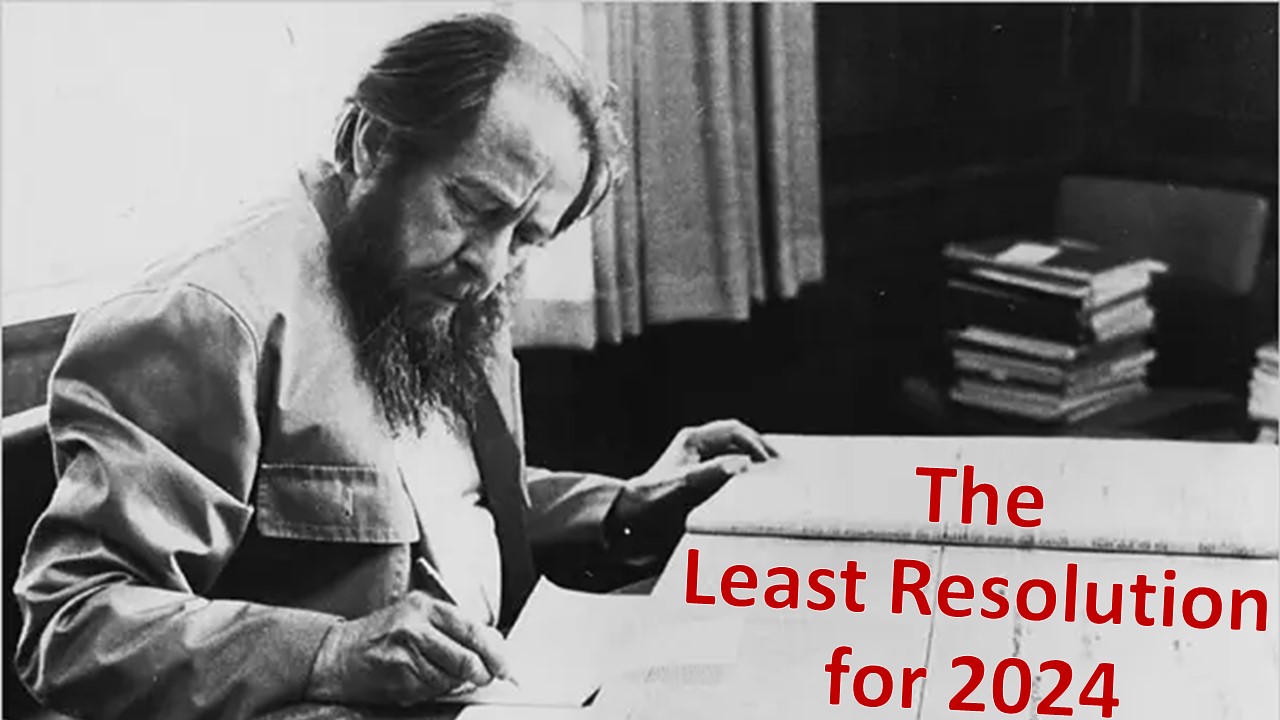
Fifty years later, perhaps it is time for us to revisit this document.  Are we living in times where some, on behalf of all, have determined what society should look like?  Do we see a mounting pressure to conform with what ‘they say’ is acceptable human thought and belief? Indeed, we should not be so naïve as to assume that the absence of marching military on our streets means we face no ideological threat. 

The pressure is growing for everyone quietly to conform.  More than that, the pressure is growing to affirm openly and celebrate what we know to be false.  Surely, it would be better to speak the truth now instead of growing our tendency to fit in and play it safe as the stakes mount.

Truth and Lies – Choosing not to lie was not an original idea for Solzhenitsyn.  Paul urged the Colossians not to lie to one another.  Not only had they put off their old self, but they had put on the new self to reflect their creator’s image (Colossians 3:9-10).  He told the Ephesian believers to speak the truth to one another since they were no longer defined by the lie (Ephesians 4:25).

In the Sermon on the Mount, Jesus addresses the anger underneath murder, the lust underneath adultery, and the daily consistency of speech beneath more flamboyant oaths (Matthew 5:21-37).  There is plenty of Old Testament support for the expectation that God’s people should be consistent speakers of truth (Exodus 20:16; Leviticus 19:11; Proverbs 14:5).  God does not lie, and his people represent him.

Fear and Lies – Solzhenitsyn knew the impact of fear on a population.  He wrote of the great threat facing humanity in his day, which was “about to flare up and engulf us.”  And he described the fear: “While we continue to smile sheepishly and babble; ‘But what can we do to stop it? We haven’t the strength.’”

God asked Isaiah’s listeners, “Whom did you dread and fear, so that you lied, and did not remember me, did not lay it to heart?” (Isaiah 57:11).  Their fear led to lies, as they forgot who was really in charge.

Our world seems to be changing at a frightening rate.  Trying to keep up with the latest adjustments to sense and morality can be tiring.  And it is increasingly revealing how much fear lies within most of us, who are so prone to play along with society’s expectations rather than speak what is true.  It is concerning how easily we fear and perhaps lie while forgetting who is really in charge. 

Some will capitulate completely and speak what is false.  Others hide behind a cloak of not wanting to “sound political” and speak out about the reducing set of acceptable Christian declarations.  Fear of being labelled and criticized leads many to hold back from speaking the simple truth.  After all, it is much easier to quote a Bible verse on social media or avoid the hot topics in conversation rather than offer the most minor form of resistance.

Solzhenitsyn wrote that the fear his people felt was not primarily a fear of nuclear death or a third world war.  The fear was of taking a “civic stance.”  He wrote, “We hope only not to stray from the herd, not to set out on our own, and risk suddenly having to make do without the white bread, the hot water heater, a Moscow residency permit.”  The penalty for a civic stance may have changed, but the fear of the herd has not.

History has never smiled on the timid, and yet each fearful choice always makes sense at the time.  How often do I justify timidity when society needs me to show courage and speak the truth?  We have almost constant opportunities to speak the truth about marriage, gender, sexuality, race, free speech, bodily autonomy, science, medical ethics, corruption, or whatever other prescribed view is being pushed at any given moment.

We cannot simply wait for an ideology to fall apart.  We must be part of the brick wall of reality into which it must crash.  And yet, it is always easier to “continue to acknowledge, glorify, and strengthen” that which we want to see collapse.  At the very least, we must not “recoil from its most vulnerable point.  From lies.”

Violence and Lies – Solzhenitsyn described how violence bursts into peaceful situations with great self-assurance.  “But violence ages swiftly, a few years pass—and it is no longer sure of itself.  To prop itself up, to appear decent, it will without fail call forth its ally—Lies.  For violence has nothing to cover itself with but lies.”

So, even under overt tyranny, people do not have to experience violence at all times.  The demand is only of a “daily participation in deceit” – the tribute paid to maintain one’s position under the power of the oppressive system.  Just play along, it is safer.

The connection between violence and lies is also not a discovery made under the rule of twentieth-century totalitarianism.  Micah wrote to the city in his day, “Your rich men are full of violence, your inhabitants speak lies and their tongue is deceitful in their mouth” (Micah 6:12).

We may not have to stand and fight against violence.  We may not even have to step out publicly and boldly declare the truth. “But let us at least refuse to say what we do not think!”

The Consequences of No Lies – In the Soviet Union, there was a cost to this most simple of stands.  It could cost your job and complicate life.  It could cost your success in education and impoverish your future.  But Solzhenitsyn was clear:

“And as for him who lacks the courage to defend even his own soul: Let him not brag of his progressive views, boast of his status as an academician or a recognized artist, a distinguished citizen or general.  Let him say to himself plainly: I am cattle, I am a coward, I seek only warmth and to eat my fill.”

To choose not to lie was not an easy choice in his day.  It will increasingly not be an easy choice for social standing, or even for physical wellbeing, in our day.  But the choice not to lie is “the only one for the soul.”

The implication of no lies is worthy of note. “The more of us set out together, the thicker our ranks, the easier and shorter will this path be for us all!  If we become thousands—they will not cope, they will be unable to touch us.  If we will grow to tens of thousands—we will not recognize our country!”

As we head into a new year, may we not simply play along with the world.  Instead, let us graciously, prayerfully, and wisely determine that whatever else may happen, we will not participate in the lies expected of us in society.  As representatives of God in this world, this is the least we must do!

(Source of AS quotes: https://www.solzhenitsyncenter.org/live-not-by-lies)