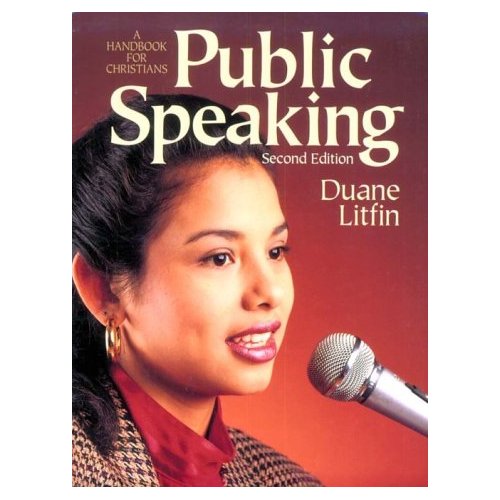
Review: Public Speaking: A Handbook for Christians, 2d ed., by Duane Litfin

litfin.jpg

This is a college text focusing on speech communication, rather than homiletics. The main reason it may be worth reading is because it is built on the Haddon Robinson “Big Idea” preaching model. Robinson’s influence is evident throughout, not only conceptually, but also in specifics.

Since Litfin’s work is not primarily focused on preaching, he is able to challenge the reader to produce latently Christian communication in a variety of fields, a challenge perhaps we in ministry need to hear. Litfin does well to show what an audience centered communication approach looks like, including the factors that make for easier listening (such as concrete, familiar, suspenseful, interesting, humorous and life-related elements). The introduction of other elements of communication such as proxemics, paralanguage and so on add a dimension perhaps weak or lacking in many preaching texts.

Litfin’s emphasis on the importance and function of the idea reinforce Robinson’s work, but the text also goes beyond Robinson to mention other approaches to speech formulation.

Litfin’s final chapter addresses the issue of preparing a Bible message. This chapter provides a helpful and relatively succinct summary of the process of homiletics (at least in reference to preparation). Litfin’s seven steps largely parallel Robinson’s, except for introducing audience need earlier in the process. Introducing audience need prior to writing the speech idea – the same stance taken on this site, seems like the correct order if the Big Idea is to be stated with relevance to the audience.

This book is a useful book for reinforcing and amplifying some aspects of Robinson’s work. For a speech com class, this is a great text. For preachers? It is helpful if you feel the need for help to fully grasp Robinson’s work. Not a preaching text, but not a bad source of supplemental reading.

Expository Preaching is More Than a Commentary

In Christ-Centered Preaching (p55), Bryan Chappell makes the following distinction:

“Expository preaching is not a captioned survey of a passage. By this I mean the typical: ‘1. Saul’s Contention, 2. Saul’s Conversion, 3. Saul’s Commission’ (Acts 9:1-19). In my own circles I think I have heard more sermons of this type than any other. They sound very biblical because they are based on a passage of Scripture. But their basic failure is that they tend to be descriptive rather than pastoral. They lack a clear goal or practical application. The congregation may be left without any true insights as to what the passage is really about, and without having received any clear teaching about God or themselves.”

He is so right. My circles also yield many messages of this type. If you look at tomorrow’s notes and discover you have a message like this, what can you do? Well, with just 24 hours to go, probably not too much. Try to change the points from captions to full sentences that state the idea of that section. Try to change those sentences from historical statements to contemporary applicational points. Or just preach what you have and pray for God to use it anyway.

However, before you start next week’s message, there are things you can do. First of all, remember that your goal is not to present a vocal commentary, but a message where God’s Word is vital and relevant to the lives of your listeners. Take the time to evaluate the listeners as well as the passage. Make clear notes for yourself on the purpose of your message. Seek to integrate relevance and application throughout the message, not only at the level of “illustrations,” but right in the points themselves. Make the points full sentences. Preach to transform lives, trusting the Holy Spirit to do the transforming, but not “despite” your message.

Repent of the faulty idea that merely getting biblical information into peoples’ heads, perhaps with a brief vague application in the conclusion, is enough. To preach an expository message, seek to bring the truth of the Word and the lives of your listeners into an encounter. It is about real life, not vague application. It is about the heart, not just the head.

And When You Think You Know Them . . .

As a preacher it is important to know who you are preaching to.  This takes work.  Often the focus of this work is on building relationships and getting into their world.  Conversations are priceless, counseling matters much, visiting homes and workplaces is all helpful, reading what they read, and entering into their world.  However, sometimes it is helpful to create an opportunity for them to enter your world.  Specifically I am referring to pre-sermon interaction with some of your congregation.  This could take the form of a sermon group that you meet with regularly.  I know some preachers who do this and value it highly.  Even without taking that step, it is possible to benefit from a one-off meeting.

Last year I preached a single message on the subject of euthanasia.  I invited a group of about ten people to come together to discuss the subject in the week before I preached it.  That meeting was very enlightening and critical in my preparation.  The discussion was not primarily concerned with my learning about the subject, but my learning about how people think of the subject.  I wanted their input on how the message could be handled effectively.

I had my pre-conceived commitment to sensitivity reinforced by the real-life experiences of those in the group.  My sensitive approach would now be more personal.  However, I had my pre-conceived ideas of Christian convictions shattered by the discussion.  After that evening I had to rework significant elements of the message.  The over-riding sense from some of the group was a view typical in this culture, that it is not possible to be caring for people and strong on the issue at the same time.  Therefore, in order to be sensitive, I should not take a strong stance on the issue.  That misconception became the foundation of my message – that God’s Word calls us to care for people and at the same time to stand against injustice, precisely because God is a God of immense compassion and uncompromising moral clarity.  My hour with those friends became a critical force driving my message not only toward sensitivity, but also to a more theological level. 

It is easy to assume that Christians think a certain way.  They probably don’t.  Getting some together to talk about the subject is a simple way to find that out!

Take Seven Steps to a Sermon, No Less

As you know, on the right hand menu of this site I have seven stages of preparation for a sermon.  The order is somewhat significant.  There is a general order there, although aspects of stage 7 – sermon details, could be written at various points in the process.  The number is not significant, I could easily adjust it to nine or more.  However, the number is significant.  Let me explain.

It would be possible to go through the first three stages and then present a message of biblical truth.  Some who espouse “expository preaching” do just this.  By adding in stage 4, purpose, it would be possible to also present biblical demands on peoples’ lives.  Again, some do this and only this.  The final three stages allow you to present biblical truth and biblical demands in a way that is relevant, persuasive and effectively communicated.

Expository preaching, by definition, includes not only accurate interpretation and proclamation of the text, but also effective communication with the listeners present.  To achieve both sides of the equation, all seven stages are necessary in the preparation process.

Who You Preach To – Part Two.

Ramesh Richard presents a helpful angle on the variety of people listening to any sermon. He presents three attitudes that will be present at various times in a message. “An expositional ministry,” he writes, “allows you to put a weekly dent in their apathy, passivity, ignorance, or hostility to equip them for godliness and service.” So the three attitudes that we must be aware of and communicate with?

1. The I Don’t Cares! These are not hostile, they just don’t feel they should be there at all. They are there out of a sense of duty to friends or family, or habitual routine. For this attitude the need raised at the beginning of the message is critical. Without it, they are free to continue their inner stance of not caring.

2. The I Don’t Knows! They lack the background awareness that others may have regarding God, the Bible, Christianity and church life. These people need good biblical content clearly explained.

3. The I Don’t Believes! These people are doubtful about the truth of what is said, or the applicability of it to real life. They are likely to test what is said with questions such as, “Is this truth coherent?” or “Is the sermon consistent?” or “Is this truth practical?” and especially, “Will this work?” For this attitude you must demonstrate a coherent consistency as well as practical applicability.

These attitudes may come and go during the same sermon, sometimes within the same person. Before preaching, evaluate your sermon and adjust its design to overcome the potential pitfalls for these attitudes. Is a clear and valuable need raised? Is there sufficient accessible explanation? Is the message relevant and practical? We preach not to get our study into the public domain, but to see the lives, the hearts, the attitudes of our listeners changed by exposure to God’s Word.

On This You Cannot Work Too Hard

Pastoral ministry and family life rarely yield the full quota of hours we would like to perfectly prepare each sermon.  However, there are some elements of a sermon that don’t do well with a short-cut approach.  Time spent on this aspect of the sermon is always time well spent.

Clarity.  It doesn’t come by accident.  The only thing that is clear when you don’t spend time on clarity is that you didn’t spend time on clarity.  It takes work to think yourself clear and then more work to preach in a clear manner. 

However, it is tempting to bypass this aspect of sermon preparation.  This is because everything seems so clear to you, the preacher.  You have spent hours in the text (hopefully).  You have wrestled with understanding the passage and then forming a sermon.  Yet for the clarity to come through, you have to pay close attention to matters of clarity.

I have been both a student and a teacher in preaching classes.  The students know that they need to communicate a clear big idea.  They know that the class will be asked for the big idea once their sermon is over.  Consequently the smart students “work the system” by stating and reiterating their big idea seemingly to an extreme level.  Then when the prof asks the class what the big idea was, there is usually a pause, followed by three or four different ideas.  The preacher sits there with a puzzled look.  “I thought I was being clear!”  If prepped students looking for the idea can’t spot it, what about a congregation who may not even know what a big idea is?  They’ll come up with something, but if you are not clear, then it will not be what you intended.

So before you preach your next sermon, do a review for clarity.  Is the big idea clear?  Does the sermon flow in a clear manner?  Are the transitions clear?  Are you using vocabulary people will understand?  Be clear, be clear, be clear.  If you’re not clear, then what are you achieving?

Story Basics

Much of the Bible comes to us in story form. We should as familiar with the basic ingredients of a story as we are with riding a bicycle or driving our car. Sadly, many preachers are not. Rather than quickly dissecting a story into preachable points, take the time to review the basic ingredients. How does this story work? Consider:

1. The Setting. Where does it begin and end? What is its written context? What is the historical, geographical and cultural setting?

2. The Plot. What is the background information provided? Then what is the crisis, complication, tension point? As the tension rises, where is the resolution or climax of the tension? Then finally how does the story conclude? Is the plot simple or complex? Does it have a second complication and a second climax? Is the story left unresolved? Why?

3. The Characters. Who is major and who is minor in the story? What clues are there to help you picture the characters? Is there direct description? What do they do? What are they called? What do they say?

4. The Narrator. Every story has a story teller, but he is usually very inconspicuous. What is the perspective of the narrator? Does the narrator make any overt comments in the story? Are there brief moments of explanation or helpful asides?

Basic stuff, but we are not harmed by reviewing it again.

Hearing Is Not Like Reading

The difference between writing for the eye and writing for the ear is often overlooked by preachers.  We tend to be book people – we may have studied formally for more years than many others, then our work requires us to keep on reading diligently.  Perhaps we even write books and articles for others to read.  All this means we too easily write for the eye by default, even when we write our sermons.  But our sermons are not for the eye.  They are designed to be heard.  People can’t go back and re-read what we just said, nor pause for thought when a particular sentence strikes a chord.  Consequently, we need to be careful to prepare sermons that work for the ear.  Various techniques will help our listeners.  Here’s an important one:

Restatement – It is not repetition (saying the same thing again, like a parrot), it is restatement (immediately saying the same thing with different words).  Repetition can sound like you think the people listening are stupid (although sometimes it is appropriate to simply repeat what you just said).  Restatement gives the listener time to take in what you are saying.  It’s useful to use with the big idea, with references to the structure of the message, with major points, etc.  When people are reading a book, they can go back and look at an important sentence to make sure they understood it.  When they are listening they can’t go back, so you need to do this for them through restatement.  Practice saying something and then saying it again in other words.  Train yourself to state your point, but then to restate it in different terms.   

How Not To Preach Every Inspired Word

As preachers of the Bible it is important that we hold a very high view of God’s Word. Verbal plenary inspiration is the doctrine that affirms the inspiration of the specific words (verbal), every last one of them (plenary). Any position that holds to less than a fully inspired and inerrant canon is a compromise wracked with inconsistency. However, as preachers who hold a high view of Scripture, there are a couple of mistakes we can easily make when preaching God’s Word:

1. Every word is inspired, but a word on its own has little value. That is to say that a word on its own carries only a selection of possible meanings. As Pasquarello puts it, words get their meaning from the company they keep. It is important to preach the words of a text in their context, rather than skimming the passage for the words that supposedly carry extra theological freight and then preaching those words as if divorced from the text. While it may have been fashionable a generation ago to preach a series of word studies, today we must be more aware of the words in their context, and preach the idea of the discourse unit.

2. Every word is inspired, but every word in a passage is not equally weighted. Since every word is inspired it is tempting to merely provide a running explanation phrase-by-phrase through the passage. While this may produce a commentary, it does not produce a good sermon. Recognize that some words function as subordinate to others in a sentence. What are the weighty words that convey the core meaning of the passage? What are the key moments in the narrative on which the whole thing turns? What words have emphasis through their unusual selection, positioning, or repetition? Preach the whole text, but don’t allow the weighty content to be hidden by giving equal time and focus to every subordinate phrase or term.

Peter has responded to a comment on this post.

Preachers and Their Books

If you’re like me, you are more than happy to receive amazon.com gift vouchers for Christmas. While others may love their cars, guitars, guns or fishing rods, many preachers are in love with their libraries. If you, like me, are a closet bibliophile, this post will make you uncomfortable. Books are a real blessing and a visit to a country where pastors have access to nothing soon puts our personal libraries into perspective. Be sure to be thankful for what you have, but don’t be obsessive:

Don’t hold your books too tightly. If God has blessed you with more than a handful of books then you are very blessed. But don’t let them sit dormant on your shelves as a monument to your past spending. Let them do their work. Share books with people that are motivated to learn from them. Share your books, let them be an extension of your ministry, and if a good book is not returned or is damaged . . . just replace it. It’s not a big deal!

Become passionate about giving books away. Scan your shelves for books that you have outgrown and no longer refer to. I don’t mean trash or heresy that should be recycled like a free newspaper. But good books that are not pertinent for your study any more. Find someone who would benefit and give them the book. Take advantage of your book awareness and become a distributor of free books. You know quality books. You also have opportunities to promote and push books. Now with online sellers you can find a quantity of a good book for cheap and push them from the pulpit. Either give them away, or ask for donations to allow you to replace them with others to give away. Sometimes your free book fund will be up, sometimes down, but if books are changing lives, you are up!