Surrogate Sermons

It is easy to preach something less than a sermon.  We thought of one example yesterday – the curiosity satisfier.  Today I’d like to list a few from a list by Dwight Stevenson (published in A Reader on Preaching).  His goal is to help us spot sermon replacements and erradicate them from our ministry.  Here are his titles with brief explanations:

Moralistic harangue – The exhorting, punishing or whipping of our people because they are not living up to their obligations.  Many people seem to appreciate receiving these bashings.  Why?  Perhaps because they don’t like themselves much anyway, feel guilty and appreciate taking their medicine.  “It is a fine way of paying for sin without repenting of it.”

Aesthetic artifact – The carefully produced work of art that one hopes will be a blessing to behold for generations, rather than carefully designed nourishment for these people now.

Pontifical pronouncement – The preaching of one who seeks to do the thinking for the people, standing in authority for the immature who find security in such “assistance.”

Museum lecture – Often the best one can hope for is mildly interesting and informative, but often becomes dull and boring, and is almost always irrelevant.

Palliative prescription – As we run from moralistic harangue we are always in danger of falling into cheap grace, easy assurance, repentance free pardon and superficial pain-relief.

That’s enough for today.  It’s only half his list, but that’s enough.  Again, these examples of surrogate sermons remind us of the importance of the Bible in expository preaching.   The Bible does not merely give a starting point, or illustrative material, or a stamp of approval.  The Bible has to be in charge of the message – the idea, the content, the relevance, the mood, the goals.
Don’t Shoot the Wheel-Nut

Today in the news there is a story of a man who got frustrated trying to loosen the wheel-nut on his car and decided to try blasting it from close range with a shotgun. The ricochet of buckshot and debris peppered him from ankle to abdomen.

While not wanting to make light of his severe injuries, I would like to draw an analogy for our thinking as preachers. Use as much force as necessary to achieve each goal in a sermon, but don’t exert excessive force that will backfire on you. Here are some examples of backfiring preaching techniques:

* Overstating the introduction. Don’t promise to solve all the problems of the world in your introduction if your message only addresses some of the problems. If the goal is modest, then strive to create a thirst for the message, but a thirst that will be quenched. It is easy to take onboard the importance of surfacing a need and then over-promise. It will backfire.

* Overbearing illustrations. Perhaps you come across a moving story, or have a powerful experience that fits with your message. Be careful it is not too powerful or you might overwhelm the message. Illustrations and stories should drive the idea forward, not overtake it. Even if it happened to you, even if it is all true, even if it agrees with the text . . . if it is too strong it may backfire.

* Over-the-top word choice. Sometimes shocking a congregation can be effective, but you must plan carefully. Just because Tony Campolo once swore at a congregation does not mean we should all try it. For effect or shock value or even for a laugh, it is tempting to go too far. Don’t. It will backfire.

Peter has responded to a comment on this post.

The Problems of Picking a Passage

One of the struggles many preachers face is selecting passages to preach. It is often easier to plan a year’s preaching schedule than to select a passage for a stand-alone message. I don’t have a definitive solution, but perhaps a helpful suggestion.

When selecting a passage there are two extremes on the scale. At one end there are passages that seem so easy and so “preachable.” Perhaps you’ve preached them before, or they are very familiar and seem to yield a message and structure just by looking at them. At the other end of the scale there are those killer passages that make you wonder how they could ever be preached. These may be tempting if you like to take on the great challenges and prove yourself. I suggest you keep a list of those that sit in between these extremes.

As you are reading through the Bible, or researching other messages, keep a log of possible preaching passages. These are passages that would take some work, but you are attracted to. Passages that seem stimulating as you read them, and would be stretching if you had to preach them. I would hope we agree that every passage is worth studying and preaching. However, we should not overlook the extra motivation that we have for some.

When you have the chance to preach a stand-alone message, take the opportunity to study where your motivation points you. But let that be a motivation for study, driven by a desire to know God through His Word, rather than a desire for an easy preaching option. Your attraction to the passage and motivation for its study may prove to be an intangible ingredient that adds zest to the message, stirring in your listeners the same motivation and desire for God.

Spiritual Warfare and Preaching

Whenever the subject of spiritual warfare is raised, there is a danger of falling into one of two extremes.  On the one hand it is easy to become paranoid, “seeing demons behind every tree” and giving Satan far more credit than he deserves.  On the other hand, it is easy to become overly relaxed and essentially treat the spiritual realm as having no effect on our lives.  Yet if there is a realm in which we should be aware of spiritual warfare, surely it is in the realm of preaching.  Surely the enemy would love to disrupt or damage the proclamation of God’s Word, the presentation of the Gospel, the encouragement of believers and the praise of God.

Today I am merely going to scratch the surface of the subject.  Then in future posts I’d like to consider it further.  First of all, spiritual warfare and the preacher.  What tactics does the enemy use against us as preachers?  Here are a few, perhaps you have others to add.  One danger constantly facing us is that of pride, which leads to a lack of dependency on God.  Then there is temptation to sin – how often do we face waves of temptation in areas of vulnerability while preparing to preach, or the day after we preach?  Perhaps distraction is a tool of the enemy – things thrown in our path that keep us for the task at hand.  Then there are lies, the discouragements meant to bring down our high goals with their high prayers.

I’d like to pursue this subject further, but let me ask you – what tactics does the enemy seem to employ in relation to your preaching ministry?

Application’s Oft-Missing Ingredient . . . ?

Recently Steve Mathewson wrote a helpful post on the PreachingToday blog concerning application.  He warned of the danger of too many “life application points” in preaching.  How easy it is to overwhelm our listeners with to-do lists.  I agree that this is a huge danger for us. 

In some church circles people have become very fond of what they perceive to be highly relevant preaching.  This often takes the form of “7 Keys to a Happy Marriage” or “5 Smooth Stones for Spiritual Battle.”  Because people seem to respond to this kind of “list” preaching, it is a temptation to incorporate that into a more expositional model of preaching.  So at the end of an expository sermon, the preacher will give a list of life application points.  These are specific strategies to be implemented in daily life.

It is easy to overwhelm list-driven people with more lists to add to their backlog of lists.  So what should we do?  First, we should be sure to apply the main idea of the text/sermon rather than lists of secondary suggestions.  Second, we should concentrate on helping people visualize how this could look in normal life.  Perhaps we share two or three examples, but not as a list.  Rather, this is a selection of possible scenarios out of which at least one will help listeners to see what the idea would look like in action in their life.  Sometimes several scenarios will be unnecessary.  Third, we must look for ways to include an encouraging tone in our application.  This does not just mean an enthusiastic team talk that fires up our people.  It means stirring an inner sense of motivation and a feeling of competence in our listeners.  We easily overwhelm, but instead we should strive to give appropriate encouragement (the oft-missing ingredient).

If you didn’t see Steve’s post, it is well worth a read: http://blog.preachingtoday.com/2007/10/the_challenge_of_application.html

The Problem of Performance

The danger of performing is not only there when preaching a first-person sermon. It is a danger every time we preach. After all, as a preacher we study an ancient text, determine its main idea and its contemporary relevance, then design a message to communicate both the meaning and the relevance to the congregation who will sit before us on Sunday morning. Our goal is not to fill time, but to stir people and to see lives transformed. As has been said many times, we preach to comfort the disturbed and disturb the comfortable. And if we’re honest, there are ways to get that done. It is not out of our reach to spin a story a certain way in order to turn the emotions of our listeners, or ask a rhetorical question that we know will poke a nerve of guilt in them. So how are we to avoid stepping up to the pulpit and treating it like a stage?

1. Give preparation time to soak. Last minute preparation will lead to last minute desparation wherein “preaching tactics” will seem like our only hope. We must be diligent to begin the study and thinking process early enough for a message or a series to soak in before we must pour out. Even if all we can do is to start reading and making some notes ahead of time, it is worth it. Performance is lines through an actor, but preaching is truth through personality (Phillips Brooks succinct definition). Allow time for the preparation to become a part of who you are so that you preach something you truly believe and know deep down.

2. Prepare more, not less. In the quest for “natural” delivery, it may be tempting to prepare less. The hope is that what comes out will be less of a performance and more “from the heart.” The reality is that unprepared preaching will often lean heavily on our own abilities. It is better to craft, to sweat, to wrestle, to pray, to think and to think some more. As I have written before, in an ideal world it is best to write out a manuscript in full and edit it closely and prayerfully. All that extra work will result not in performance, but genuine preaching “from the heart” as well as “from the text” – choosing to do minimal work will compromise both the text and your heart, leaving only any performance skills you may have.

3. Pray. Not just a “bless this effort” prayer, but real prayer. Personal wrestling with the God who is at work in you first. Persistent wrestling for those who will receive the message. There is a great spiritual battle raging around you and around them. Let us not fight in the pulpit a battle we have not first heavily engaged in the closet.

Images in Preaching, Not Always a Challenge

One thing we all want to avoid is preaching in a way that resembles a lecture more than a living, vivid, full color message.  Somehow we want our preaching to fizz and bubble, rather than lying soggy and lifeless in the pulpit.  One thing we need to give attention to is vivid imagery.

When preaching a poetic passage . . .  such as a psalm, the writer will usually give us some very helpful images.  Why go hunting for new images when the psalm provides a resting child, restless hours fretting in bed, climbing the mountain toward Jerusalem, entering the city gates in procession, etc.  We need to work on relevance and be sure to handle the imagery appropriately, but handle it, it is right in the passage.  It would be a shame to waste the head-start we are given.

When preaching a narrative passage . . .  such as a parable or event, then the passage itself is an image.  Too often I’ve heard preachers at pains to explain the story, but the preaching lacks zing because they forget to actually tell the story.  Don’t dissect a story to death, allow it to live in front of people and let them observe its power.  Be sure to explain and apply, of course, but don’t fail to let the vividness slip by in your preparation.

When preaching a discourse passage . . . such as an epistolary paragraph, then you may have extra work on your hands.  Often the passage will be very effective and logical explanation, or even direct application.  But it may be so direct that it lacks imagery.  This will not be the case in most of James, but is often true in parts of Paul.  Just because it is prose and perhaps plain in presentation, do not fail to look for images that will help the truth stick in the hearts and minds of your listeners.  If the images aren’t in the text, then find them elsewhere.  But don’t preach image-free, that’s a real waste of an opportunity.

How to End the Sermon Series

You are preaching through a book, perhaps an epistle, and you come toward the end.  How will you finish the series?  There are several options available, none of which is always the best route to take:

1. Summarize the “end matter” in a sermon.  You preach the last obvious preaching section and include a summary of the final verses in the book.  So for example, in 2nd Timothy, you might preach 4:6-8, but then summarize the content of verses 9 and following.  The strength of this approach is that it avoids dragging out a series unnecessarily.  The weakness is that you may miss the richness of those final verses, including verses 16-18.

2. Preach the “end matter” as the final sermon.  There are two reasons to always consider this.  First because of a conviction that all Scripture is God-breathed and useful.  Second because it will stretch you as a preacher to wrestle with how to preach sometimes seemingly miscellaneous verses (although whether any are truly “miscellaneous” is open to debate).  If a sermon would truly feel like a stretch, then it is probably better to not pursue this option.  However, it would be a shame to miss such passages and verses as Romans 16:17-27; 1Cor.16:22; 2Cor.13:11-14; Gal.6:11-18, etc.

3. Preach a review sermon at the end of the series.  Instead of finishing with a small part of a book, take the opportunity to review the whole book in one messages. We would be naïve to assume that listeners pull all the pieces together during a series.  Consider preaching the whole thing, making sure to show how those final verses bring the book to a point of closure.  Consider creative preaching options for such a sermon, with first-person being an obvious candidate.

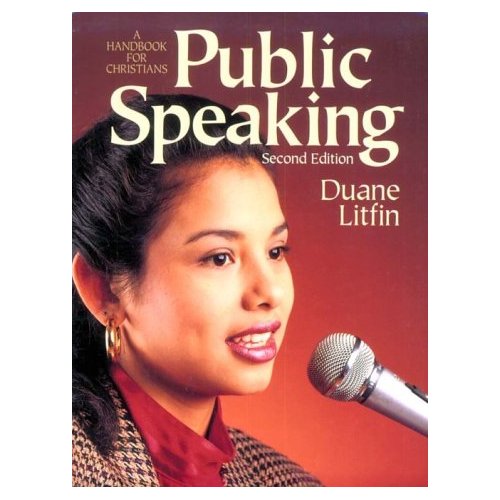
Review: Public Speaking: A Handbook for Christians, 2d ed., by Duane Litfin

litfin.jpg

This is a college text focusing on speech communication, rather than homiletics. The main reason it may be worth reading is because it is built on the Haddon Robinson “Big Idea” preaching model. Robinson’s influence is evident throughout, not only conceptually, but also in specifics.

Since Litfin’s work is not primarily focused on preaching, he is able to challenge the reader to produce latently Christian communication in a variety of fields, a challenge perhaps we in ministry need to hear. Litfin does well to show what an audience centered communication approach looks like, including the factors that make for easier listening (such as concrete, familiar, suspenseful, interesting, humorous and life-related elements). The introduction of other elements of communication such as proxemics, paralanguage and so on add a dimension perhaps weak or lacking in many preaching texts.

Litfin’s emphasis on the importance and function of the idea reinforce Robinson’s work, but the text also goes beyond Robinson to mention other approaches to speech formulation.

Litfin’s final chapter addresses the issue of preparing a Bible message. This chapter provides a helpful and relatively succinct summary of the process of homiletics (at least in reference to preparation). Litfin’s seven steps largely parallel Robinson’s, except for introducing audience need earlier in the process. Introducing audience need prior to writing the speech idea – the same stance taken on this site, seems like the correct order if the Big Idea is to be stated with relevance to the audience.

This book is a useful book for reinforcing and amplifying some aspects of Robinson’s work. For a speech com class, this is a great text. For preachers? It is helpful if you feel the need for help to fully grasp Robinson’s work. Not a preaching text, but not a bad source of supplemental reading.

Expository Preaching is More Than a Commentary

In Christ-Centered Preaching (p55), Bryan Chappell makes the following distinction:

“Expository preaching is not a captioned survey of a passage. By this I mean the typical: ‘1. Saul’s Contention, 2. Saul’s Conversion, 3. Saul’s Commission’ (Acts 9:1-19). In my own circles I think I have heard more sermons of this type than any other. They sound very biblical because they are based on a passage of Scripture. But their basic failure is that they tend to be descriptive rather than pastoral. They lack a clear goal or practical application. The congregation may be left without any true insights as to what the passage is really about, and without having received any clear teaching about God or themselves.”

He is so right. My circles also yield many messages of this type. If you look at tomorrow’s notes and discover you have a message like this, what can you do? Well, with just 24 hours to go, probably not too much. Try to change the points from captions to full sentences that state the idea of that section. Try to change those sentences from historical statements to contemporary applicational points. Or just preach what you have and pray for God to use it anyway.

However, before you start next week’s message, there are things you can do. First of all, remember that your goal is not to present a vocal commentary, but a message where God’s Word is vital and relevant to the lives of your listeners. Take the time to evaluate the listeners as well as the passage. Make clear notes for yourself on the purpose of your message. Seek to integrate relevance and application throughout the message, not only at the level of “illustrations,” but right in the points themselves. Make the points full sentences. Preach to transform lives, trusting the Holy Spirit to do the transforming, but not “despite” your message.

Repent of the faulty idea that merely getting biblical information into peoples’ heads, perhaps with a brief vague application in the conclusion, is enough. To preach an expository message, seek to bring the truth of the Word and the lives of your listeners into an encounter. It is about real life, not vague application. It is about the heart, not just the head.