Profound Preparation

This week I’d like to ponder what it might look like to pursue a more profound preaching ministry.  While most would acknowledge that preaching should neither be dense nor inaccessible, this does not mean that shallowness and dumbing down are the order of the day.

Profound preaching must surely start with profound preparation.  Four suggestions to get a week-long list going:

1. Begin with humble recognition that you yourself need to be changed by God.  It is too easy to think of preaching preparation as being about you the preacher pursuing a message to preach to them, the needy recipients.  At this point in the process you stand very much in their shoes, needing to hear from God.  You need to encounter His heart in His Word.  You need to be marked deeply and changed by a God who communicates, who cares, who challenges and who changes.  It makes no sense to have profound faith for the sake of others, but not an openness and humility in yourself.  The preparation of a sermon will be a privilege, an opportunity for God to mark your life profoundly.

2. Study the passage to know God, not just the facts.  It is easy to treat Bible study as a pursuit of non-trivial trivia.  Don’t.  Study the passage in order to know God better.  What is His self-revelation saying of Him?  How are the characters responding to Him?  Wherever you are in the canon, the passage is theocentric, so make sure that your heart is too.

3. Don’t mix your message preparation with your Bible study.  As a preacher who cares about the congregation, or as a preacher desperate to be ready on time, it is tempting to blend passage study with message formation.  Keep the stages separate.  You have the privilege of doing some in-depth Bible study, take advantage of that!  You may not be able to help thinking of who you will be preaching to, but try to keep those thoughts until you’ve really gotten to grips with the passage (or better, until God has gotten to grips with you through the passage).

4. Saturate your preparation in prayer.  This should go without saying, but it can’t, so it won’t.  The entire preparation process should be absolutely pickled in prayer.  Prayer in passage study, prayer in personal response, prayer in “audience analysis,” prayer in message formation, prayer for delivery, prayer for life change, prayer for immediate impact, prayer for long-term fruit, etc.

Tomorrow I’ll offer a few more thoughts, this time on profound explanation in preaching.  Feel free to comment any time.

Add to FacebookAdd to DiggAdd to Del.icio.usAdd to StumbleuponAdd to RedditAdd to BlinklistAdd to TwitterAdd to TechnoratiAdd to Yahoo BuzzAdd to NewsvineLike This!

Preaching Triangle & Touching a Nerve

This week in Cor Deo I had the chance to give an hour’s introduction to Ezekiel.  A brief look at chapter 28 in our sweeping overview allowed a glimpse of the message to the “King of Tyre” and a chance to ponder the fall of Lucifer through a heart corrupted by a self-ward gaze.
I suspect the enemy isn’t overly concerned by some Christian preaching.  You know, the kind that offers a sanctified version of Genesis 3.  You can be independent, you can be successful, you can be like your own god, you can be equipped for a self-concerned life.  Whether it is evangelistic (you can get yourself the best future for you, here’s a ticket to a nice heaven password) or edificatory (you can be an independent success story, just look to yourself and do these things)…I suspect the enemy isn’t too bothered.

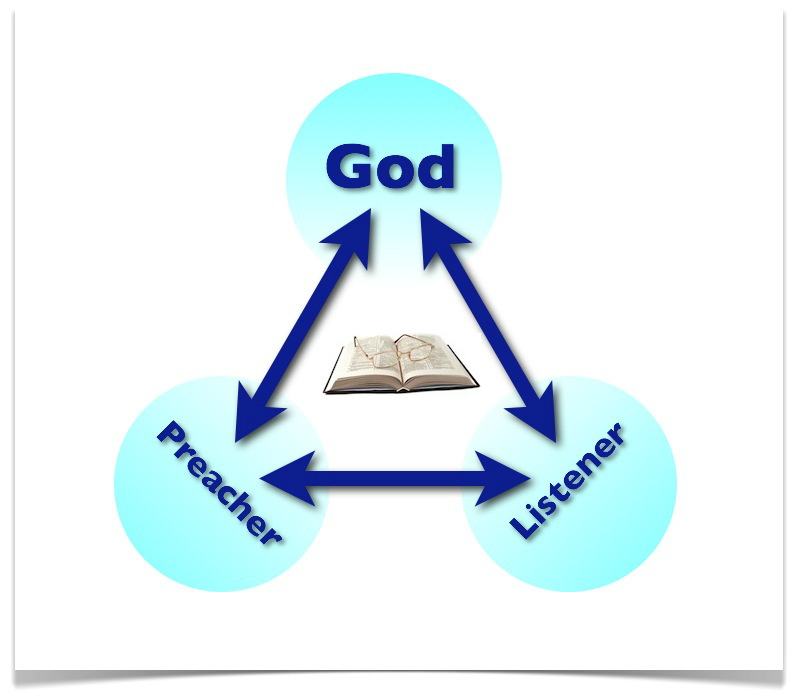
But what if a preacher catches on to the Preaching Triangle reality of interdependence?  The preacher’s own dependence on God in a love relationship, then a shared concern for the listeners to become reliant on God in a love relationship, manifesting in preaching that seeks to forge connections between listeners and preacher, and more importantly, God.  This be fighting talk from the perspective of the enemy of our souls!

Interesting how the verses that jump to mind seem to support this post.  Resist the devil and persist in being right and doing good?  No, resist the devil and draw near to God (in the context of broken relationships, friendship with the world, the jealousy of God over the Spirit made to dwell in us, humble dependence on God).  The devil prowls around like a roaring lion, so resist him and do right in yourself?  No, resist, recognize the experience of your brothers around the world, look to God to restore, confirm, strengthen, etc., which is why in humility we should cast our cares on the God who cares for us.

But what about the armour of God, that is all about individual response isn’t it?  Oh hang on, a key part is praying at all times in the Spirit, and they were to be praying for Paul too.  Never mind.  One more?  The god of this age has blinded the minds to keep folks from seeing the light of the good news of the glory of Christ, the image of God, so how did Paul preach?  Take a look at 2Cor.4 and see his dependence on God and self-giving for them . . . preaching triangle in the context of a great spiritual battle.

Do not lose heart.  Real relationally driven preaching will touch a nerve with the enemy, but the solution can never be a retreat into non-relational solitude, that’s just his way.

Add to FacebookAdd to DiggAdd to Del.icio.usAdd to StumbleuponAdd to RedditAdd to BlinklistAdd to TwitterAdd to TechnoratiAdd to Yahoo BuzzAdd to NewsvineLike This!

Listener and God

In many ways the goal of preaching is this relationship, the listener and God.  We’ve already considered God and the Preacher, the Preacher and the Listener, but now for the third relationship.  As ever, dangers and potential.

1. There is a danger that the listeners connect with the preacher, but not with God, due to the effectiveness of communication that inherently lacks the richness of biblical content.

2. There is a danger that the listeners connect with the preacher, but not with God, due to the richness of biblical content that comes from and to deficient relationships with God (i.e. the preacher’s and the listeners’), to put this differently:

3. There is a danger that God’s personal care and concern and self-revelation not get through the preacher to the listeners.

4. There is a danger that the God presented by the preacher may motivate distance rather than intimacy and thereby hinder true connection.

5. There is a danger that the preacher’s goal be an equipped and informed listener who can then become a “self-made” or “self-starting” Christian (beware of application not built on response to and relationship with God).

But what potential!

First, can there be a greater thrill than to see others growing into a deeply forged relational responsiveness to a loving God?  Does it get any better than seeing others flourish spiritually as they discover the fullness of life offered in the New Covenant where they can actually know God personally?

Second, when people have a genuine relationship growing with God, then it will mean an increase in outward spilling and spreading goodness.  Why should that not result in blessing for the preacher?  While we don’t preach for that benefit, it would make sense in a community of captivated Christians, for preaching to forge a community of mutual delight – God in them and them in God and both in the preacher, etc.  Sadly the relationship between preacher and listeners is too often fraught with the tensions of world-like political power struggles and distrust, but what if the gospel really gripped a church, surely it would be different?

Furthermore, that outward spilling goodness would also mean mutual body life as listeners naturally minister by giving of themselves to each other.

It doesn’t end there, the spill of grace would then surely also reach outward again to the community (and that without the preacher pressuring people to be witnesses!)  That’s the thing about God’s relational bond, it doesn’t end there, it just keeps on spilling outward!

Add to FacebookAdd to DiggAdd to Del.icio.usAdd to StumbleuponAdd to RedditAdd to BlinklistAdd to TwitterAdd to TechnoratiAdd to Yahoo BuzzAdd to NewsvineLike This!

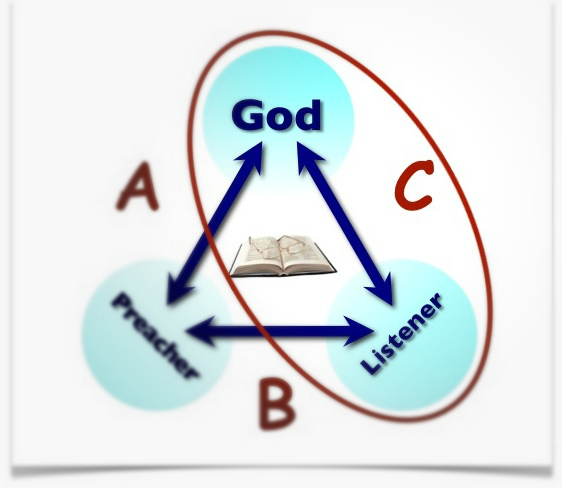
The Preaching Triangle of Relationships

I have introduced the notion of preaching as being the combination of three participants gathered around the Bible.  But the key feature of this approach is to see the importance of the relationships.  Like an electrical circuit, what matters is the connections.  And when there is a full set of connections, then something powerful occurs!

A. God & Preacher.  The preacher doesn’t engage the Bible merely to find a message for the listener.  Rather the preacher’s primary concern is to engage with God relationally.  Out of the overflow of this relationship comes the ministry to the listener.  God doesn’t empower the preacher merely for the sake of the listeners, but loves and delights in His child.  When this relationship fades from view, the preacher will experience dullness in ministry and potentially burnout.  As the preacher engages with God personally, he/she also joins with God to form a community of carers – that is, the preacher starts to look toward the listeners with God’s loving concern.

B. Preacher & Listener.  The preacher speaks with the authority of God’s Word, yet does so as one on the same level as the listener, as a fellow responder to God’s Word.  The listener will appreciate the knowledge and spirituality of the preacher, but also will appreciate the vulnerability of a fellow believer who clearly recognizes the community of believers.  A sermon motivated by love for listeners will be better than one motivated by self-love in the preacher.  As the preacher/teacher’s heart connects with the hearts of the listeners, a community of responsiveness toward God is reinforced.

C. Listener & God.  The effective preaching of God’s Word enables the listener to relate not only, or primarily, to the preacher, but to God himself.  But more than that:  in effective biblical preaching God is giving of Himself to the listener, building the connection between them.  In this connection both God and the listener become a community of listeners, joining together to delight in each other, and even in the preacher as he/she makes much of the grace of God in His Son.  (When preaching offers a non-biblical portrait of God, or leaves Him out altogether, then both God and listener will be grieved or burdened.)

So whatever opportunity you have, be sure to view the teaching opportunity as primarily a relational opportunity – between God and you, then between you and them, for the sake of them and God!

Add to FacebookAdd to DiggAdd to Del.icio.usAdd to StumbleuponAdd to RedditAdd to BlinklistAdd to TwitterAdd to TechnoratiAdd to Yahoo BuzzAdd to NewsvineLike This!

The Preaching Triangle – Omissions 1 and 2

Yesterday I suggested that every participant matters in the preaching triangle.  What happens when we leave one out?

1. God.  The goal of all biblical ministry in the church is to know the God who reveals His heart in His Word.  The Spirit who inspired the biblical authors also empowers the biblical communicator to point to the Son, that through Him, the Father might be known.  God is at work in both the preacher and the listeners, and both need to be responsive to Him.

And when we somehow leave God out?  Then we have an informed presentation, or a human-level exhortation, or a religious performance for a distant deity, but we do not have Christian biblical ministry.

2. Preacher.  God has chosen to use inadequate communicators to enable others to hear His Word and respond.  We also form a connection with the listeners (either good or bad) and communicate with our lives as well as with our words.  Effective communication involves the heart to heart connection of the preacher with the listener, as well as both with God.  This means that as well as the verbal content (the words), the preacher must also effectively communicate by means of the vocal and visual elements (use of voice, plus posture, gesture, expression and movement).

And when we downplay the role of the preacher?  Then we lose the incarnational nature of God’s self-revelation, we lose the privilege of hearing God’s Word spoken with power.  We might be able to affirm a strange view of “reliance on God” (based on a hope that He might work around us and despite us), but we do not have incarnational or effective Christian biblical ministry.

Why would someone leave out either of these participants in their approach to preaching?  I suppose a view that God is distant and disconnected, or excessive confidence in one’s own intellectual ability might lead to the first omission.  A highly “spiritual” view of God’s work despite the preacher, combined with a potentially confused view of humility might lead to the second omission.

Tomorrow I’ll consider the implications of leaving out the other two…

Add to FacebookAdd to DiggAdd to Del.icio.usAdd to StumbleuponAdd to RedditAdd to BlinklistAdd to TwitterAdd to TechnoratiAdd to Yahoo BuzzAdd to NewsvineLike This!

Saturday Short Thought: Luther, Law, Preaching and Popes

This week I’ve been writing about the power of our words as preachers.  Not only can we re-present the Scriptures as we explain and apply, but we can undo the Scriptures as we carelessly overqualify, say too much, or say that which is unhelpful.

They say driving a car is like having a 1.5 tonne bullet with the trigger under our right foot.  What, then, is preaching a sermon?

This week I read through The Freedom of a Christian by Luther.  Yesterday I started reading a book that has become an “I don’t want to put this down” kind of book.  I won’t tell you what it is yet, I’ll reveal it on the Books page once other commitments allow me time to finish it.  But here’s a taster on the this issue of the sermon:

Luther was astonished how many Christian theologies accepted the basic scheme of the law and its morality (opinio legis), but had nothing worthwhile to say about Christ. . . .

Luther is the Great Misunderstood. How could he become so contorted into the form of modern Protestantism? One might reasonably take recourse in Luther’s assumption that the devil was on the prowl ready to pounce on anyone preaching the gospel. The picture of freedom that developed by the nineteenth century has very little to do with Luther’s own theology. On the face of it, Luther’s proposal was not of “reform” nor was it modest, though it was excruciatingly simple: it was to replace the papacy with a sermon: “Christ’s merit is not acquired through our work of pennies, but through faith by grace, without any money and merit – not by the authority of the pope, but rather by preaching a sermon, that is, God’s Word.”

Down comes Christendom, with a word! Preaching is democratized, not in the sense of emerging from the people but of being available to them all equally – in an instant, rich and poor, male and female, circumcised and uncircumcised, German and Italian.  With this the pinnacle of power lay not in Rome or with kings, but at the point of the delivery of a sermon.

(pp3, 8, of ?)

Add to FacebookAdd to DiggAdd to Del.icio.usAdd to StumbleuponAdd to RedditAdd to BlinklistAdd to TwitterAdd to TechnoratiAdd to Yahoo BuzzAdd to NewsvineLike This!

Overqualified! Says, Means.

From a more specific, to a more general post.  Preachers have a tendency to overqualify some things.  For instance, going beyond the plain meaning of the text is a common, but often unhelpful strategy.

The text says this, but it actually means that.  There are many variations on this, some speculative and bizarre, others that appear thoroughly orthodox and sound.  Yet we must always think twice before going beyond the plain meaning of a text.

By all means show how the text fits in the larger flow of progressive revelation.  By all means show how God’s plans are worked out in the fullness of the canon.  But beware of making a leap from what it says to what it means so that listeners are left staring at the text in confusion, or at the preacher in awe.

Typically this doesn’t happen out of some sinister motivation to twist the text and promote heresy (some certainly do this, but I suspect they won’t be allowed to read this site).  Typically this error occurs out of good motivation.

Perhaps the preacher fears that the plain meaning is just too, well, plain.  Their job is to add some fizz to the water of God’s Word?

Perhaps the preacher wants to give a more complete biblical message, but fails to show the linkages to the “greater” content offered.  This leaves the listener without clear sense of where the meaning is supposed to be found in a text.

Perhaps the preacher feels the text at hand is just a little too basic, too obvious, too simple to count as a rich feast of biblical truth, and so unpacks the text to reveal rich truths never before discovered in that corner of the canon.  Oops.  Trust God’s intent in the Bible – maybe the people need to hear that passage clearly explained and applied, rather than the whole canon squeezed in for good measure.

I am not suggesting there is no complexity in Scripture, there certainly is.  But as we preach, let’s try to make it so that listeners looking at the text will see where we are coming from.  What benefit is there in leaving them staring at the text in confusion, or at the preacher in awe?

Add to FacebookAdd to DiggAdd to Del.icio.usAdd to StumbleuponAdd to RedditAdd to BlinklistAdd to TwitterAdd to TechnoratiAdd to Yahoo BuzzAdd to NewsvineLike This!

Overqualified! Go, Stay.

Ok, I can’t help throwing this one into the mix.  How often do we drain the impact of a text by immediate overqualification?  For example, in the area of response to the great commission.

God is a missionary God.  What if the Son had responded to the Father as many preachers respond to texts that assume and expect missionary momentum from lives transformed by the gospel?  What if the Son had insisted that He could be a missionary-messiah right there, in heaven?  What if the Son had pulled out Acts 1:8 and spoken of the need to minister in “His Jerusalem” first?  This does seem bizarre.

But I have to say that as a speaker sometimes asked to preach on “missionary” type texts and at “missions” events, it can get frustrating to see others overqualify and undercut the thrust of a message.  Let’s say I preach a text and in the preaching suggest that it would be a natural response for some of us to respond by seeking to take the message of God’s love to other cultures and lands.  What happens?  The service leader or worship leader then stands up and thanks me for my message, then prays about how “we can all be missionaries right here in our own neighbourhood!”

That’s nice, very inclusive, now everyone can feel involved.  Or, to put it another way, now the potential impact of the message is dissipated and any self-focused listeners can remain comfortably, well, comfortable.

I’ve heard preachers do it too.  They preach on the giving and going and sacrificing nature of God.  Then they preach a passage where the followers of Christ are urged to give and go and sacrifice.  Then they immediately qualify so that all can feel included, and none need feel too stirred.

“Go isn’t an imperative in Matthew 28, it is just ‘as you are going’ – that is, wherever you find yourself.”  (Uh, maybe…or perhaps more accurately, go isn’t in itself an imperative verb, but as an attendant circumstance participle it does carry the force of the verb it goes with – in this case an imperatival force.  Ok, don’t quote the Greek grammar, but be right if you’re going to use Greek to support your explanation.  Jesus is assuming and urging a “go” in this passage!)

“Remember that Acts 1:8 starts with Jerusalem, that’s where we have to start!”  (Uh, ok, but the momentum in that verse is leaning towards the ends of the earth, and if you keep reading you’ll see how God used persecution to get them moving!)

I could go on, but my point applies in lots of areas.  We have a tendency to read one thing, then by unthinking qualification end up preaching something else.  We do it with grace, we do it with Trinity, we do it with missions passages.  Any others you’d add?

Add to FacebookAdd to DiggAdd to Del.icio.usAdd to StumbleuponAdd to RedditAdd to BlinklistAdd to TwitterAdd to TechnoratiAdd to Yahoo BuzzAdd to NewsvineLike This!

Overqualified! Trinity, Mystery.

Yesterday I quoted Andy Stanley on the tendency we have to qualify statements of God’s grace.  This got me thinking, where else might we offer unhelpful qualification?

My mind jumps to Mike Reeves’ new book, The Good God.  I’ve heard Mike speak about the unhelpful habit we have of referring to the Trinity as a mystery.  Someone in a Bible study group notices a reference to the Father and Son or to the Spirit and the Father and makes a comment about the Trinity.  Worse, someone asks a question about the Trinity.

After a couple of brief comments, the group leader then flees for the hills by pulling out the big M-word.  “But of course, as we know, the Trinity is a mystery…!”  A knowing look, a gentle nod and everyone is supposed to say “aaaah!” and move on.

Mike makes the point that to use that approach with other questions would be bizarre.  “Can you explain how I can be saved?”  “Aaaah, the gospel, now that is a great mystery!”  Bizarre.

A mystery in the New Testament meaning of the word is not an Agatha Christie murder mystery kind of mystery.  It’s not a “keep you guessing until we get to heaven” kind of mystery.  It’s a previously hidden secret that has now been revealed.  Paul uses the term in reference to aspects of the church and the person of Christ, previously unknown, now revealed.

I can’t think of a New Testament use of mystery in reference to the Trinity, but in many ways this is exactly what we have.  Could humanity know God?  What He’s like?  Not unless He revealed Himself to us.  Has he done that yet?  Yes, through the Word inspired by His Spirit that points ultimately to the Word made flesh, His Son.

As preachers do we shy away from talk of the Trinity?  When the passage speaks of some aspect of Trinitarian revelation, do we default to throwing in the unhelpful qualifier “of course, we can’t know God, and the trinity is a mystery, after all.  Next point…”

Let’s stop doing that.  The text just communicated something, and all we’ve done is to communicate to people looking to us for guidance on understanding the Bible that the Bible is not understandable.

Instead of being embarrassed by the doctrine of the Trinity, perhaps we should experiment in our ministries and see how people respond when they taste of the delightfulness of God’s other-centred, graciously-loving, glory-giving, self-sacrificing, outsider-embracing and profoundly relational nature.

Like grace, perhaps we just don’t trust God’s revelation of the Trinity enough?  Like grace, perhaps the danger in preaching what is there in the text is the opposite of what we might expect?  Perhaps clear Trinity talk will wake people up and excite them spiritually, I suppose this also might be dangerous!

Add to FacebookAdd to DiggAdd to Del.icio.usAdd to StumbleuponAdd to RedditAdd to BlinklistAdd to TwitterAdd to TechnoratiAdd to Yahoo BuzzAdd to NewsvineLike This!

Overqualified! Grace, But.

Here’s a quote to start the week.  It’s a quote I found very encouraging last night.  Yesterday morning I preached the first message in a series on Galatians.  Paul pulled no punches and I reflected that somewhat in my message.  So this morning I’ve woken up pondering this quote from Andy Stanley:

“The church, or I should say, church people, must quit adding the word “but” to the end of our sentences about grace. Grace plus is no longer grace. Grace minus is no longer grace. We are afraid people will abuse grace if presented in its purest form. We need not fear that, we should assume that. Religious people crucified grace personified. Of course grace will be abused. But grace is a powerful dynamic. Grace wins out in the end. It is not our responsibility to qualify it. It is our responsibility to proclaim it and model it.”

I wonder what proportion of gospel preachers really preach the radical message of God’s grace, and how many feel the need to qualify it and augment it and protect it?  How do we over-qualify grace?

1. We preach grace, but insist on human commitment and responsibility in our gospel preaching.  It’s so easy to preach of God’s wonderful, amazing, life-transforming, gaze-transfixing, heart-captivating grace.  And then in the same breath speak of our need to make a personal commitment, to be diligent, to conform to standards, etc.  Either God’s grace is as good as we say it is, or it is lacking and needs human supply.

2. We preach grace, but quickly shift to focusing on our legal obligations as humans.  Grace plus works is not grace.  Grace minus relational freedom and delight is not grace.  Grace with a good dose of law is not more, but less.  People might abuse grace?  Indeed, so let’s put more effort into communicating how good God’s grace is, rather than feeling obliged to supply qualifiers that are somehow meant to stop people gratuitously sinning in light of the message of the gospel.  When a heart is truly gripped by God’s grace, then it is truly free to live a life of love for God and others – will such preaching lead to licentiousness and abuse?   Certainly not as much as preaching law will lead to rebellion and the fruit of the flesh.

All that I say here applies to both evangelistic and to edificatory preaching.  If the text speaks of our response in some way, or offers guidance on the difference this gospel will make, then of course we must preach the text.  But let’s not automatically feel the need to over qualify and potentially lose the impact of the message if the inspired author didn’t add qualification.

Preaching grace is dangerous.  It is dangerous because unlike overqualified human-centred preaching, it might actually stir a heart to be captivated by the abundant grace of God and lead to radical transformation!

Add to FacebookAdd to DiggAdd to Del.icio.usAdd to StumbleuponAdd to RedditAdd to BlinklistAdd to TwitterAdd to TechnoratiAdd to Yahoo BuzzAdd to NewsvineLike This!