Is Biblical Interpretation Boring?

When Paul wrote to Timothy, the senior apostle urged the younger Timothy to do the work necessary to “rightly handle the word of truth.”  The implication is that it is possible to mishandle the word of truth.  You only need to listen to a few sermons online or visit a few churches to start your collection of scary examples! 

Nuanced technical caveats notwithstanding, it is essential to recognize that every passage says something specific.  Our job as we study is to determine, as best we can, what that something is.  That is to say that each passage has one accurate interpretation.  It cannot mean anything, and it does not mean everything.  It means something.

Once we determine that meaning, that one interpretation, we can then begin to evaluate the many potential applications of the passage.

Here is a video on this specific matter:

But if we are going to talk about the rules and principles of interpretation, then are we not embarking on a tedious task?  After all, who wants to memorize rules?

You could say the same thing about other processes too.  Learning to ride a bike feels tedious, but it opens a new world of adventures for a child.  Learning to drive a car safely can feel overwhelming, but it creates new freedom that is a wonderful blessing.  Learning anything will involve some rules or principles.  The real question is this: is it worth learning?

When we learn to handle the word of truth rightly, we start to see the richness God has put in our Bibles.  We get to understand his glorious message to us.  We get to enjoy the beauty of the divine revelation in all of its literary splendour.  We get to experience the life-change that comes from living a Bible-marked life.  The rules of interpretation sound dull, but they are a means to infinite treasure!  Boring is not the word; let’s try exciting instead!

Check out the video to see which Bible passage I use to introduce this point!

John Wesley’s Advice – Part 2

So last time we started this list of 12 points of advice to preachers from John Wesley.  Let’s keep going!

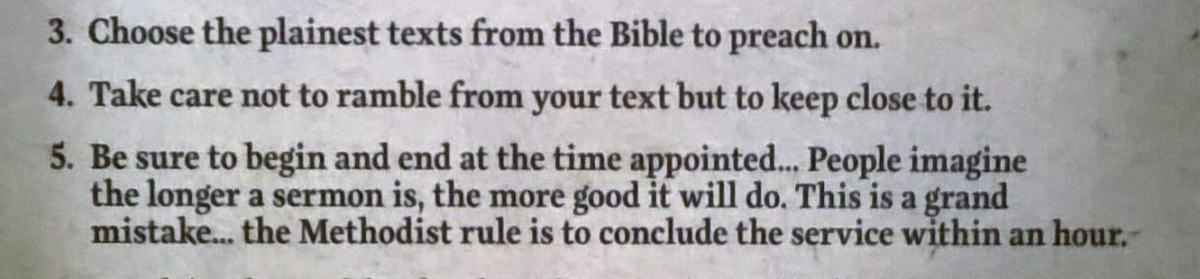
3. Choose the plainest texts from the Bible to preach on.  Again, if I were purely speaking to non-believers then I would completely concur.  However, in a typical church setting, we will be speaking to both Christians and non-Christians.  A steady diet of the same evangelistically oriented passages will lead to some malnourishment among God’s people.  I think it is good to help our churches experience the full breadth and scope of God’s Word.  You might preach more from the New Testament than the Old, but if they never hear the Old Testament preached, why would they read it?  And if they don’t read it, what a vast vista of theological truth is lost.  Different types of text are also important for the health of the church.

So on the one hand, I would agree that every passage has a redemptive force that should be brought out because believers never move beyond the need to hear the gospel being applied to their lives.  On the other hand, while every passage is useful, not every passage is equally useful on every occasion.  Don’t be stubbornly preaching through Jeremiah when people are coming for a Christmas Carol Service.  Bottom line?  Be selective and choose what you are going to preach appropriately for the listeners and the occasion, but in a church choose from the whole Bible because people need more than your favourite five passages.

4. Take care not to ramble from your text but to keep close to it.  Can I just say I agree and move on?  Of course not, otherwise this would be a “Quote” rather than a “Blog!”  It is quite remarkable how little weight the Bible passage will have in some sermons.  Some will leave it behind to ramble into excessive personal anecdotes and humorous illustrations.  Others will leave it behind to ramble into theological presentations that resemble explosions in a concordance factory! (Hyper cross-referencing is very common in some circles!)  Few seem to recognize that this passage is uniquely powerful and should not be missed by superficial coverage in the sermon.  Your church may not be back in that passage for several years.  Keep close to it, do it justice, allow time for clarity to emerge and its impact to be felt.

5. Be sure to begin and end at the time appointed… People imagine the longer a sermon is, the more good it will do. This is a grand mistake… the Methodist rule is to conclude the service within an hour.  Several points in this one.  Let’s go one-by-one – (1) begin and end on time.  I understand that different cultures have different expectations in terms of time.  But the point still applies.  Abide by the expectations of the culture.  Once we break the general expectation, then we distract attention from the sermon.  If we go 10 minutes over, parents are concerned about children in kids’ groups, volunteers in kids’ groups start to lose their joy in serving, and others are concerned about their plans, their lift home, etc.  Generally speaking, stick to time.  Seems fairly simple.

(2) Longer is not necessarily better.  Again, agreed.  Haddon Robinson was captivated by how some preachers preach for ten minutes and it feels like an hour, while others preach for an hour and it feels like ten minutes.  Length tends to become the key focus when too little attention is given to clear, engaging and relevant content and delivery.  Generally speaking, longer sermons could be sharpened into shorter sermons.  But shorter is not automatically better either.  Some things take time.  Just as an illustration might be lost in two sentences, but really capture hearts in two minutes, in the same way, a sermon can be technically precise in a shorter timeframe, but more vivid and engaging with enough time given to let the listeners’ imagination flourish.  There is no right length of sermon.  It depends on preacher’s skill; listener’s background, expectations and focus; and the occasion too.

(3) Service length should be less than one hour.  That feels quite arbitrary and culturally bound.  I imagine that didn’t translate effectively in some other global contexts!  But, service length should be considered for the sake of church attendees, as well as their perception of service length for potential guests they might invite in the future.

Ok, let’s leave it there for this time.

Bible Posture – 2 Points

We live in an age marked by resistance to authority.  The idea of submission has fallen on hard times.  But don’t miss either the logic or the blessing of this concept:

The Logic – Submit yourselves to God (James 4:7).  This is logical.  God is God, and you are not.  And being a Christian involves a thorough acceptance of that reality.  Nobody else has ever achieved even a tiny fraction of success in their attempt to usurp God’s role in the universe.  It is so simple.  God is God.  And I am not.  It makes sense not to pretend otherwise.

The Blessing – The Christian faith is not simply about logic, however.  James 4:8 goes on to describe how we can draw near to God, and he will draw near to us!  What an amazing thing!  If we try to usurp his place, we create a conflict between ourselves and God.  He opposes the proud.  But if we will humble ourselves and submit to him, he gives grace to the humble (see 1 Peter 5:5-6).  The blessing of submission to God is closeness with God.  And since he is a good God, this is a good thing!

So the first posture point to ponder: Be under, not over, the Word!

It would be bizarrely arrogant to think that my finite mind and experience can evaluate and judge God’s Word.  Who am I to imagine that I can decide what to accept, what to dismiss, etc.?   

In Acts 17:11 we read about the Jews in Berea. They were commended for receiving Paul’s message with eagerness, and then checking that teaching against the Scriptures.  May that be our posture too . . . leaning forward, hearts open, head nodding, eager to hear from God’s Word!

Post point two: Receive God’s Word with eagerness!

Here is the latest video (and click here to subscribe to the YouTube channel) –

John Wesley’s Advice

For some years I have had a postcard with “John Wesley’s Advice on How to Preach” sitting on a shelf.  I think one of my children gave it to me.  I thought it would be fun to work through these twelve points and ponder them together. 

Full disclosure, I have no dog in the fight when it comes to John Wesley.  I don’t feel the need to defend him, nor critique him.  So, let’s just engage with these points and see what we can learn in the process.

1. Always suit your subject to your audience.  Well, some might want to argue that since “all Scripture is God-breathed and useful…” therefore this advice is not necessary.  Just preach the Bible and it will be suitable, they might say.  Yes, 2 Timothy 3:16 is certainly true, but it does not mean that every passage of Scripture is equally useful to every set of listeners.  Some will take too much work to arrive at a point of usefulness for the listener.  For example, if I am speaking to a group of children with English as a second language who have no church background, then I probably don’t want to preach from Leviticus.  Seems obvious enough. Technically it may be useful Scripture, but for this group, it is probably not the best-suited text.  

We could restate the advice as follows, “make sure you preach to the people who are in front of you.”  Prayerfully ponder who they are so that your preaching will be suitable for them.  Think about your passage choice, your vocabulary, your manner, your demeanour, your volume, your speed . . . everything.  It would be unloving not to do so.

2. Do not preach more than twice a day during the week or three times on Sunday.  This feels a bit specific to his context.  It was a day of horse riding, handwriting and voice projection.  We live in a different world.  And yet, we are still human.  Perhaps the point still stands.  It will be tempting to do more and more because sometimes, there is more and more to be done.  We would be wise to evaluate our ministry schedules, and our tendency to accept invitations so that we know our limits.  Each of us is thoroughly capable of burning out or flaming out, so let’s think through our limits before we hit them.

Incidentally, I have been in settings where I crammed in as many teaching sessions as could fit and went way beyond these limits. Sometimes there may be a place for sacrificially serving like that, especially during a short and defined window (i.e. a conference or a visit to a place).  Even if we do that, we need to know our own capacity to give, our ability to sleep under pressure, our mental state if our sleep is less than ideal, and our recovery plan for after the event or visit is over.  And one thing is clear to me – we cannot sustain anywhere near as much as we can achieve during these brief windows of time.  Typically there will have been weeks of work prior to the conference or visit. And normal life simply needs more margin – not only for preparation, and for rest, and other responsibilities, but also margin for the unannounced encroachments that always hit us when we think we have found the perfect schedule.

We will keep going next time!

Whose Word?

The Bible is unlike any other book on earth for this reason: it was inspired by God.  Other books may be written by inspiring people or by people inspired by their subject.  But the Bible is “God-breathed” – it comes from God.  God superintended the writing process so that the original authors wrote their thoughts, in their words, in their language, and God made sure that they wrote exactly what he wanted to be written.  That is why we call it God’s Word.  (2Tim.3:16)

So when the prophets wrote their books, they did not dream up their content.  Rather, they were carried along by the Holy Spirit – he was the wind in their sails!  Again, that means that what we have in our Bibles is not just humanly authored but also divinely inspired. (2Peter 1:20-21)

This all means that our goal in reading or studying the Bible is to understand what is there.  What did the Author and the author intend to communicate?  Our job is not to be creative, or fanciful, or original.  We do not get bonus points for making up a meaning nobody has seen before.  No matter how clever you are, what you can make it say is not as good as what God made it say!

Check out the latest video in the Enjoying the Word series:

Say It

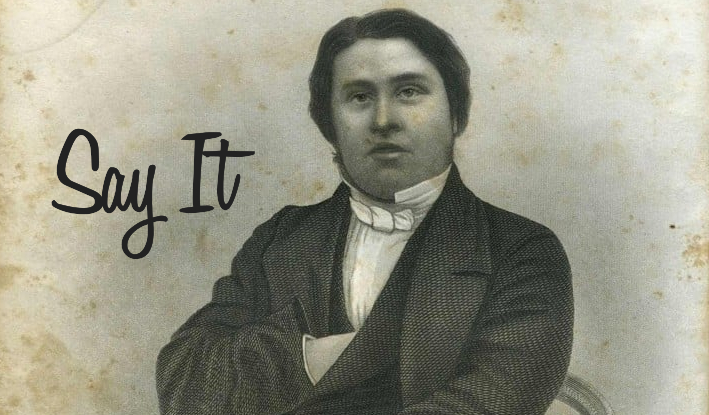
CH Spurgeon’s conversion is one of the great conversion stories in church history. Feeling under heavy conviction and longing to find out how to be saved, he set off for church one January Sunday morning (172 years ago tomorrow, in fact). The weather was atrocious and he couldn’t make it to his intended destination, and instead slipped into a small chapel where about a dozen people were attending. Their preacher had also been thwarted by the weather, so eventually, a thin man stood up to preach. Some have said it was the wrong preacher, in the wrong church, in the wrong weather, with the wrong congregation. Whatever, God is still God!

Spurgeon himself said, “Now, it is well that preachers should be instructed, but this man was really stupid. He was obliged to stick to his text, for the simple reason that he had little else to say.”

Of course, the story continues. The text was from Isaiah. “Look unto Me, and be ye saved, all the ends of the earth.” And the message was on target for young and troubled Spurgeon, “there was a glimpse of hope for me in that text.” So the thin-looking preacher restated the text every way he could manage for about ten minutes, and then told the young guest at the back that he looked miserable and needed to look to Jesus to be saved. And Spurgeon was born again. Spurgeon often told the story and it is well worth reading.

But let’s just ponder that earlier point. “He was obliged to stick to his text, for the simple reason that he had little else to say.”

Three points to ponder:

1. Our job as a preacher is to say what the text says.

2. Our education does not give us something better to say than what the text says.

3. God once spoke through a donkey, so humbly say what the text says.

Looking back on that moment, Spurgeon quoted words you may have sung:

E’er since by faith I saw the stream
Thy flowing wounds supply,
Redeeming love has been my theme,
And shall be till I die.

To read a slightly fuller version of the story, click here. (And if you want to sing the song, I enjoyed this!)

5 Reasons to Study the Bible

Some Christians seem excited about Bible study, while others seem scared of the concept.  Why should we invest time in studying the Bible?  Here are five good reasons!

1. For spiritual life.  Some years ago, I was pointed to a fascinating book about conversions in the Muslim world.  I am sure you have heard of how God is using dreams and visions to bring Muslims to Jesus.  The book’s author pointed out that when these testimonies are investigated, the dreams are a key link in a chain, but they are not the whole chain.  In each case, the person had to encounter God’s written word before coming to faith in Christ. 

When Jesus spoke to the religious leaders in John 5, he shocked them by saying they did not know God or have his word in them.  These were men who spent hours in their scrolls every day.  Jesus pointed out that they thought they could find life in the scriptures themselves, but actually, those scriptures were pointing to a person – him!  (John 5:39)  As we study the Bible, it points us to Jesus.  As we meet Jesus, we find spiritual life itself.  Knowing God the Father, through Jesus the Son, is the very essence of eternal life. (John 17:3)

2. For spiritual growth.  Six times we have had the joy and privilege of bringing a newborn into our family.  Life is relatively simple for the baby.  Eat and sleep.  And those regular meals with Mum result in the biggest growth spurt of their lives (even more than a teenage boy!)  So Peter positively uses the analogy of milk to describe how the Bible will nourish us and grow us as believers.  We should long for that sustenance so we can grow spiritually.  (1Peter 2:2)

3. For spiritual maturity.  That same analogy is also used in Hebrews but in a negative sense.  The preacher to the Hebrews is concerned because these believers have not matured as they should.  Instead of solid food, they are still on a liquid diet.  Mature believers can discern between good and evil because they have been trained for the challenges of spiritual adulthood.  Where should we look for solid food if the Bible provides spiritual milk?  Still, the Bible – that part of the analogy remains consistent!  (Hebrews 5:11-14)  Have you ever met a genuinely mature believer who had arrived at that stage without a steady diet of the Bible shaping their life and character?   No, nor me.

4. For spiritual effectiveness.  We live in an era of unlimited opportunities.  Where do you go if you want thorough equipping for ministry in the church, home, and workplace?  There are so many seminars, workshops, books, courses and institutions inviting us to come along and learn.   Paul wrote to Timothy and described the God-breathed usefulness of Scripture.  It teaches, reproves, corrects and trains us.  What is the result of that biblical influence in our lives?  It is that we may be complete, equipped for every good work.  That is quite the promise! (2Tim.3:16-17)

The Bible offers us salvation, spiritual growth, maturity and equipping for all aspects of life and ministry.  Some might stop there, but there is another reason to study the Bible:

5. For spiritual delight.  Psalm 1 introduces us to the righteous man who doesn’t allow the world’s message to shape his life.  Instead, his delight is in the revelation of the Lord; on that word, he meditates day and night.  Have you ever paused to ponder the word “delight” in Psalm 1:2?  He does not merely concern himself with the message or even simply find his life instructions there.  He delights in it.  There is something about God’s very character, and therefore his inspired Word, that means we can read and study it for sheer delight.  The ultimate reason to spend time in God’s Word is not that we have to, but because we get to!  The heart of eternal joy and never-fading delight is opened toward us in the revelation of Scripture!

There are more reasons to read and study the Bible, but that’s a good starting point. 

Psalms Today Complete

During 2022, I decided to work my way through the Psalms. One video per Psalm. One point relating to interpreting the Psalm, and one point of relevance for today. I completed the playlist this week. I hope this can be useful to you. Please do let others know about this playlist if it might be helpful to them too.

I know some people used these videos as a companion to a personal reading of the Psalms this year, perhaps this can be useful in a similar way next year. Since the playlist is complete, it now allows that to happen at your pace instead of mine!

A Perplexing Silence – part 3

We are living in momentous times when the ethical foundations and nature of western society is being radically reshaped.  In part one, I briefly surveyed the situation.  In part two, I offered three possible reasons for our relative silence as Christians – some are unaware, some are strangely unconcerned, and some are understandably overwhelmed. 

Let’s continue that list with two very important additions:

4.  Some are afraid.  There is a lot of fear in Christian ministry.  Let me put it out on the table.  It is probably better to discuss it rather than pretend it is not there:

  1. Fear of upsetting people in our church.  Every church will have people across a spectrum of political or cultural views.  Our society controls contrarian perspectives by its reaction. This mechanism is evident with gender, sexuality, race, public health, climate crisis, military conflict, etc.  Some people sit primed to be upset if we touch the wrong nerve.  It always feels safer to play it safe.
  2. Fear of upsetting Christians beyond our church.  Maybe your local church is not as diverse as the wider church.  Perhaps you can speak freely in your local pulpit without concern.  But we live in an age of online recordings.  Spurgeon used to have his sermons typed and published in newspapers. At the same time, thousands of other pastors could preach anything, and only their smaller congregation would hear them.  Today the pastor of an obscure church can be heard by someone on the other side of the world. That person might disagree vehemently and take to their keyboard.
  3. Fear of upsetting people in our society.  A decade ago, church leaders were concerned about being forced into a complicated legal situation. “What if someone asks me to perform a wedding I can’t offer in good conscience?  If that happens, then I could get in trouble.” Today, we are already in trouble with many people because of our beliefs.  We don’t have to do anything wrong; we are already wrong.  We are already guilty of wrong-think.  We hold dangerous views.  When some agent in society requires us to affirm certain things, we will already be in trouble.  This dynamic can lead not only to silence but also to participation so as not to stand out.  When Daniel’s three friends did not bow down, they stood out.  They were heroes then, but it is genuinely challenging to know when to stand out in the complexities of today. 
  4. Fear of the backlash.  Nobody wants to be in the sights of the mob.  The destruction meted out by today’s cancel culture can be ruthless and unforgiving.  The antagonistic othering of people who do not conform to society’s expectations has already become quite sinister.  In the last couple of years, I’ve seen people wishing on me imprisonment, the withholding of medical treatment, the restriction of movement, and even death.  Thankfully they did not name me specifically, but I happened to be in a class of people that were overtly “othered.” Nobody wants to face the force of that anger on any of the triggering issues.

Solzhenitsyn’s stunning warning in 1978 at the Commencement of Harvard University still rings out today.  Does it apply to us? “A decline in courage may be the most striking feature that an outside observer notices in the West today.  The Western world has lost its civic courage, both as a whole and separately, in each country, in each government, in each political party, and, of course, in the United Nations.  Such a decline in courage is particularly noticeable among the ruling and intellectual elites, causing an impression of a loss of courage by the entire society.  There are many courageous individuals, but they have no determining influence on public life.”

5.  The category I have not mentioned.  You may have read through these points and said, “yes, but there is another perspective.” I know.  Let me raise the common one that I anticipate.  I agree that the hope of society, indeed the hope of humanity, is the gospel.  Absolutely.  Signing petitions, participating in protests, writing to our representatives, voting one way or another, or any other political action are not the ultimate answer.  I agree.  The gospel is the answer, and we must rest in it ourselves.  Then we must also broadcast it and share it from person to person.  

But can I be candid?  I feel like sometimes we might be hiding behind a gospel-only approach.  To do so allows us to say nothing about what is going on, human rights, moral evils, etc., and thereby not face much in the way of antagonistic response.  I know exactly how to say the right Christian things to avoid criticism or backlash. I’m sure you do too.  We still have the freedom to speak Christian truths to each other, so long as we do not trip the growing number of hyper-sensitivities in our culture.  Gradually the freedom to quote Bible verses will grow ever more restrictive.  When referencing the Bible at all becomes culturally unacceptable, will we then quietly comply with that expectation too?

As Solzhenitsyn provocatively wrote in Live Not By Lies, “And as for him who lacks the courage to defend even his own soul: Let him not brag of his progressive views, boast of his status as an academician or a recognized artist, a distinguished citizen or general. Let him say to himself plainly: I am cattle, I am a coward, I seek only warmth and to eat my fill.”

I do not quote that to point only at others.  I fear that I can too quickly be part of the herd too.

In closing, my mind goes to two scenes:

  1. The best burger I can remember.  I sat with another pastor enjoying both the burger and the conversation.  We were both expressing the same thought.  It isn’t easy to prepare people for what seems to be coming in our society when we are not allowed to mention what is coming.  In my preaching and social media, I can make every public statement both gospel-centred and relatively safe.  But the gospel has always been radically counter-cultural. And as culture pivots away from a Judeo-Christian ethical basis, the gospel will only become more radical. Many people in the church are not prepared for a world that is overtly antagonistic and institutionally persecuting them for their beliefs.
  2. That congress.  The film, Tortured for Christ, begins with the “Congress of Cults” that brought together religious leaders in Romania in 1945.  Richard Wurmbrand, a Lutheran pastor, sits with his wife listening to the leaders praising the “progress” brought by the new Stalinist regime. Then he spoke out. We could just as easily go back to the example of Dietrich Bonhoeffer in Germany a few years earlier. It is hard to speak out when almost nobody else does. I know some Christian leaders are taking a stand today and speaking out on various issues. I am thankful for them. But I also see that many are already choosing to play it safe. We aren’t in the 1930s or 1940s, but we are in the 2020s. How can we be so sure this decade will not prove equally significant?

As we come to the end of the year, we also may be coming to the end of an era.  One last quote from Solzhenitsyn, “If the world has not approached its end, it has reached a major watershed in history, equal in importance to the turn from the Middle Ages to the Renaissance. It will demand from us a spiritual blaze; we shall have to rise to a new height of vision, to a new level of life, where our physical nature will not be cursed, as in the Middle Ages, but even more importantly, our spiritual being will not be trampled upon, as in the Modern Era.” If we were not at a major historic watershed in his day, it feels like we are now.  So, let’s all pray for wisdom, insight, courage, and strength as we head into 2023. Let’s not take part in the lie. We need a spiritual blaze.  God has put us all here for such a time as this.

A Perplexing Silence

As we come to the end of 2022, I want to share a series of three posts with you.  Aleksandr Solzhenitsyn’s writings have been swirling in my mind, as has a single tweet from a few weeks ago.  A massive body of work and a lengthy sentence separated by a few decades yet resonating together.

As you may have noticed, there is always something going on in the news.  Of course, not every story is genuinely momentous.  Perhaps you can remember the end of 1989? The Tiananmen Square protest and massacre had happened earlier in the year.  As the end of the year approached, Hungary proclaimed the end of communist rule, the Berlin Wall came down, and Bulgaria’s long-serving leader resigned.  Apartheid rules were changing in South Africa.  Student demonstrations in Prague started the velvet revolution.  President Bush (senior) and Gorbachev declared the cold war over. Romanian dictator Ceausescu was ousted and then executed on Christmas Day.  The news was fascinating, and everyone knew we were watching history unfold.

How will we look back on our current time?  There have always been news stories, but some news cycles feel more significant. We live in a season of swirling stories – some are featured and polished for maximum coverage.  In contrast, others seem to be painstakingly discounted, twisted or buried.  For instance, and in no particular order:

  • The Ukraine war is stirring the threatening language of Armageddon from global leaders.  At the same time, celebrities fly into Kyiv for photoshoots with the president.
  • Many social media platforms restrict free speech.  However, the media dismiss new revelations of illegal government influence on Twitter as irrelevant.
  • Critical Race Theory is fundamentally shifting every academic discipline, business practice and even whole Christian denominations.
  • Excess deaths remain way above the pre-covid five-year average, or even the pandemic year, when daily and total death counts were constantly before our eyes.  And yet, asking why this is happening seems to be socially unacceptable.
  • Protests and legal wrangling over possible election fraud rumble away in various countries.  Reporting suspicious behaviour results in being labelled an election denier and a threat to democracy.
  • “Fourth Industrial Revolution” ideas derided as conspiracy theories only two years ago are explicitly promoted by proponents today.
  • One western government is confiscating thousands of farms because of the climate crisis.  And we are all required to pay the bill for Net Zero plans that may or may not make any difference to the projected catastrophe.  Again, don’t question it, or you will be labelled a denier!
  • There is a push for digital id and digital currency, a checkpoint society with a Chinese-style social credit system that will replace fundamental freedoms with earned privileges.
  • In another western country, Euthanasia is being promoted, celebrated and normalised with increasingly ineffective controls.
  • Children are being sexualised and offered life-changing surgery and puberty blockers. At the same time, parents are increasingly pushed out of the conversation.
  • And in the last few days, a woman was arrested and questioned by police about whether she was silently praying in a particular location here in England.  

There are many swirling issues, but we must step back and ask about underlying issues. We are living through a fundamental reshaping of the ethical foundations and the nature of the society built on them.  In the past, there was rebellion against the generally accepted Judeo-Christian ethic underlying western civilisation (e.g. think of the sexual liberation movement of the 60s/70s).  Today we see the replacement of that ethic with an entirely new moral code.  We also observe the culture militantly enforcing compliance so that everyone is required to not only tolerate but also proactively participate in and promote the new moral order.  A dictator enforces their will by sheer power, but a totalitarian tyranny seeks to control everything, even what subjects think.

Solzhenitsyn is both enlightening and provocative.  He warned the students of Harvard in 1978: “There are telltale symptoms by which history gives warning to a threatened or perishing society.  Such are, for instance, a decline of the arts or a lack of great statesmen.” I am no art critic, but I suspect many would agree that we are experiencing something of a decline.  And when did we last see a political leader in that category?  We live in a threatened, perhaps even perishing society.

I mentioned a tweet at the start of this post.  On November 18th, Owen Strachan wrote, “Christian men: it’s not Tucker Carlson, Jordan Peterson, Ben Shapiro, Joe Rogan, Elon Musk or other conservative (or just not super-left) voices who should be known for speaking the hard truths, fighting what is evil, taking unpopular stands, and promoting what is good. It’s us.” (We might add a few more names in the UK, like Calvin Robinson, Neil Oliver, Douglas Murray, etc.)

I’ve been pondering that tweet.  I know one of these men I added is a clergyman, but the point is well made.  I also know that merely stating any of these names will cause some to react negatively to this post.  That shows society’s shift from yesteryear, when people used to think and discuss provocative ideas, to today’s hair-trigger dismissal and antagonism.  I might disagree with soundbites from all of these people because of their content or tone. Still, I must be willing actually to hear the points they are making and engage thoughtfully. 

Honestly, I find myself regularly prompted to think, investigate, pray and take action based on monologues by Neil Oliver, interviews by Joe Rogan, books by Douglas Murray, and tweets from Jordan Peterson.  But then, when I look at my feed of Christian leaders?  Honestly, with some exceptions, it can often feel disengaged, out of touch and sometimes eerily silent on contemporary concerns.  It makes me think of that famous quote from Aleksandr Solzhenitsyn, “The simple step of a courageous individual is not to take part in the lie.  One word of truth outweighs the world.”  Yes, there is plenty of biblical truth in the social media voices of Christian leaders that I follow.  But I fear our silence on some matters might mean we are inadvertently starting to take part in the lie.

In part two I will share some reasons for this perplexing silence.