Of Libraries and Book Stores

Books2Here’s an incomplete and flawed analogy. Feel free to offer improvements, but it may make a helpful point.

There is a difference between running a book store and running a library.

When you run a book store your customers complete a mutual exchange. You provide the books they need.  They provide the revenue you need. When it works well it is a wonderful thing, albeit only business.

When you run a library the people who come in tend to take without giving. You provide the books they need. They take those books and hopefully bring them back. It is a wonderful service for the community, but the community itself does not supply all that is needed (let’s ignore taxes at this point). When you run a library you need a source of funding behind the scenes.

Let’s put the tangible issue of revenue and funding to one side and think about a preaching ministry. When we fall into the trap of thinking it is like a book store we will find ourselves being drained and discouraged. Yes, some will be grateful and express that, some will thrive and seeing that makes it worth it, and there are many blessings involved in church ministry.

We need to think a little bit more like a library provider. That is, we give the best we have, but we know that our greatest source of support and resourcing will not come from the people walking in the door. We have the greatest source of life and energy and affirmation and encouragement, but it is behind the scenes. Better than the local government, we have relationship with God.

When our gaze shifts from God to those in the pew, our ministry tanks will drain very quickly.

Imperfect analogy on many levels, but an important point to ponder as we prepare for another year of ministry.

Christmas Preaching and the Nitty Gritty of Life

day 15Too easily our Christmas preaching can slide toward quaint and familiar yore. The Christmas story can feel like a very familiar old fable with all its beautiful and eclectic characters. Yet the first Christmas was a time of great confusion.

Let’s not rush to a post-Christmas presentation of the Gospel, or a present-day application of the Gospel. Let’s consider how entering into their world could give us profoundly relevant insights into the good news of Jesus’ birth.

The shepherds needed guidance from the angel to know that they could even go and meet this child born to be king. If it weren’t for the information about the manger they would have remained in the fields impressed by the vision they’d seen.

The journey of the Magi might have been longer than a lifetime of our journey’s put together. All because of a star and some prophecies in potentially foreign documents – that was quite the complex situation.

For Mary and Joseph there was the information from Gabriel, which answered the big and obvious question, but it left a lot unsaid. What would they say to others? Would they ever be able to live life in the town they knew? How would things go with their families, and those who Joseph relied on for work? So many questions in the nitty gritty side of life.

And yet the Christmas story gave them what they needed. They knew about God’s kindness, God’s faithfulness, God’s with-us-ness, God’s plan to deliver people from their sins, etc.

As we preach Christmas this Christmas, lets think about tapping into the reality of that first Christmas to stand shoulder to shoulder with Mary, with Joseph, etc., and to look toward Jesus and all that he means. Let’s feel the complexity of their lives and discover that in the numerous unanswered questions in our lives we can also share their soul posture and trust God.

Let Christmas Improve Your Preaching

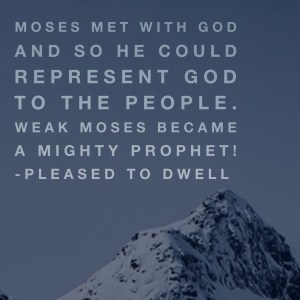
designI just wrote a brief devotional post stirred by the quote from Pleased to Dwell in the image. You can click here to go to that post. This quote stirs a preaching thought:

How can Christmas improve our preaching?

Think about Moses for a moment. Moses was a great prophet. Not because he was eloquent (he was not). Not because he was confident (again, he was often not). If you boil it down, Moses was a great prophet because we read of how he, time and again, met with God face-to-face. Moses could speak of the God he was representing because he knew that God. It wasn’t just a knowledge of Scriptures or theology, it was a personal repeated encounter with God himself.

Most of us have probably never had the experience Moses enjoyed. But that does not mean we should preach as purveyors of facts. We are called into God’s presence in a way that was not possible in Moses’ day. We are called to know God in a way that was not possible back then.

Christmas has changed things. The greater prophet than Moses, one who has spent far more time watching the Father and hearing his words, the ultimate prophet has come into our world. Jesus not only brings us the ultimate revelation, he has also created the ultimate access. Because we can be united to Jesus by the Spirit, we can boldly approach the heavenly throne at any time. Because we are united to Jesus by the Spirit, we can know the heart of God more clearly than ever before.

Christmas is critical to understanding the ministry we now have. We don’t speak facts only about a distant God. We speak of a God we can know personally. We speak of a God we can meet with day by day and speak with as a man speaks with his friend. And when Christmas so saturates our understanding of everything that we dwell closely with the God who wants to dwell with us, then when we preach we will be able to represent him better than ever before.

Let Christmas Preaching Point Deeper

AdventDay2Christmas sermons can feel a little bit superficial. Nostalgic Christmas card scenes described with platitudes about peace on earth, etc. If we are not careful, we can miss a great opportunity to preach the gospel to visitors who may only come to church at this time of year.

The traditional way to get to the Gospel in our Christmas preaching is to paint an arrow from the crib to Calvary. This is certainly an important link to make. By all means let folks know why Jesus chose to come and where it was all headed.

But maybe in our eagerness to move the story forwards, we may be missing something. After all, our listeners may not be as surprised by the cross as we seem to think they will be.  Maybe they anticipate hearing about those old Bible stories and maybe they find Christmas and the Cross to be two of the familiar facts about Jesus. If so, then it can still all feel very “long ago and far away.”

Perhaps people might be surprised to discover that Christianity actually speaks to the heart of their daily struggle.

For instance, ever since the Fall we have all been saturated in the brine of self-solutions. I can get my act together. I should work my way out of this. I need to turn over a new leaf. I am the master of my own destiny. I, I, I.

Add in the Gospel and people may find it slightly foreign and a little irrelevant.  Maybe Jesus can bring peace on earth in some hypothetical future, but how does that help this week? It doesn’t stop wars today and my life is still a struggle.

So this Christmas, instead of simply drawing a line from Jesus’ birth to death, why not pause and ponder if there is a way to reveal an underlying theological issue that people feel. How about this – Christmas points away from “what-must-we-do” to “who-can-we-trust.”  And we need that.

Please take a look at a brief devotional post on this issue, it might help with your Christmas preaching this year.  Click here to go to the site dedicated to Pleased To Dwell: A Biblical Introduction to the Incarnation.

God With Us: A Nazarene?

Pleased-to-Dwellv5Would you carry the label, Nazarene?  For some, it is just one of the more obscure labels for Jesus or His followers.  For many believers in the Middle East today, it means the most extreme persecution and terrifying uncertainty.  For all of us, it should prompt us to consider the One who invested the label with such profound significance.

Matthew’s infancy narrative ends with Joseph taking Mary and Jesus back to Nazareth, “so that what was spoken by the prophets might be fulfilled, that he would be called a Nazarene.” (Matthew 2:19-23)  Is this a low-key transition to the rest of the Gospel, or is it a fitting climax for the whole birth narrative?

Moving Back To Nazareth

Joseph’s flight to Egypt was short-lived. The tyrant Herod died shortly after the massacre in Bethlehem. So God directed Joseph back to the land, specifically to Nazareth.  Joseph knew of the challenges facing the family in the town that thought it knew Joseph and Mary all too well.

How could Joseph rebuild his business when everyone doubted his word on the circumstances surrounding Jesus’ conception? How would Mary face the comments as she returned, ‘the virgin’ with her baby boy?

Perhaps Joseph planned a fresh start in Bethlehem, but Herod’s replacement made that difficult.  Maybe Galilee made sense after all. Still, it took divine direction for Joseph to go back to Nazareth.

Joseph was directed to Israel, the land of the Jews. Then he was directed to Galilee. Still Jewish territory, but Galilee had a high number of Gentiles and was scorned by the ‘better Jews’ of Judea. This Messiah was not just for the Jews, but for the Gentiles too. In fact, by growing up in Nazareth, we will see that He was for all of us.

The Place of No Good Thing: Nazareth

Matthew mentions Nazareth three more times. After a passing reference in 4:13-16, then comes 21:11. Jesus’ triumphal entry so stirred Jerusalem that the locals asked the crowds who He was. The visiting Galilean crowds replied that this was the prophet Jesus, from Nazareth. Probably not what the locals wanted to hear!

Finally, in 26:71, Peter was in the courtyard of Annas’ house when he was identified as an accomplice of Jesus of Nazareth. Was there venom in that label? Probably, since Peter was again confronted due to his Galilean accent. To be from Nazareth was not a positive thing in Judea. In fact, it was not a good thing, even in Galilee!

Nazareth was five miles from Sepphoris, the strongest military centre in Galilee. It was on a branch of the great caravan route to Damascus. For traders, soldiers and travellers, Nazareth was just a rest stop on the way to somewhere better.

Essentially, Jesus grew up in Nowhere, Galilee. Was this the next best thing since God’s plan A (Bethlehem) had been thwarted by troublesome Herodian rulers? Not at all. God directed Joseph so that Jesus was brought up in Nazareth. This meant that the Messiah born in Bethlehem would always be called the Nazarene.

The Prophets Fulfilled

Where does the Old Testament say the Messiah will be raised in Nazareth, or be called a Nazarene? Nowhere. Interestingly, Matthew refers to the prophets, plural, when he writes of prophetic fulfillment (2:23). Perhaps several options should be combined to get a composite sense of Matthew’s subtlety here:

Jesus was, perhaps, to be considered a Nazirite (Nazir)—a chosen holy one set apart for God’s service from His mother’s womb.

Furthermore, Jesus was the Messianic ‘branch’ (Neser)—the Davidic branch of Jeremiah 23:5/33:15, who would reign in righteousness; the branch who would be a priest and a king, rebuilding the temple, as in Zechariah 6:12; the branch from Jesse’s stump anticipated in Isaiah 11:1 (part of the great royal Immanuel section).

Maybe we don’t have to choose, perhaps Matthew is making two great themes converge: the deliverer is both priest and king.  Perhaps we have come full circle back to the Immanuel prophecy of 1:22-23.

Joseph called His name Jesus in chapter 1, and by the end of chapter 2 Joseph brings Him to Nazareth so that all would call Him a Nazarene. This child, the son of

Abraham, son of David, son of God, is to be known by all people, forever, as the Nazarene!

Actually, was Matthew pointing to a location, rather than a subtlety in the name? After all, every Old Testament citation in Matthew 2 pointed to a location: Bethlehem, an allusion to ‘the nations’, Egypt, Ramah, and now, Nazareth.

Whether it is a reference to his person, or his hometown, the label is stunningly unimpressive.  This priest-king is exceedingly lowly.

A Reputation Worth Carrying?

Jesus knew what it was to be poor. He was not sheltered in an ivory tower, protected from the ‘dross of society’. He lived in the midst of it all, and He carried it as His label.

Jesus was a very common name at that time, so He needed an identifier. Who was His Dad? That was complicated. What was His job? Again, not easy. So where was He from? Nazareth became the label typically appended to His name.

We see Nazareth mentioned in Jesus’ childhood (Luke 2:51); as He called His disciples (John 1:45-46) – remember Nathanael’s sarcastic question: ‘can anything good come out of Nazareth?’; as the location of choice for launching his preaching ministry (Luke 4:16).

His subsequent visit to a synagogue in Capernaum sees Him identified as Jesus of Nazareth by an unclean spirit, who also acknowledges that He is the Holy One of God. Jesus accepts the label, but silences the spirit once His heavenly identity is declared (Mark 1:24-25; Luke 4:34-35).

As Jesus headed toward Jerusalem, blind Bartimaeus recognizes the Nazareth label (Mark 10:47; Luke 18:37-38); then it is used in His arrest, (John 18:5); during Jesus’ trial it is used disparagingly of Peter (see also Mark 14:67); and even in His death, Pilate’s inscription reads, “Jesus of Nazareth, the King of the Jews.”

After His resurrection the two disconsolate disciples on the road to Emmaus refer to Jesus as being ‘of Nazareth’ (Luke 24:19). Fair enough, their hopes had been dashed.

But even the angel in the tomb used the label! Surely an angel sent from God could come up with something better!? (Mark 16:6)

Even after His ascension Jesus continues to bear the lowly label ‘of Nazareth.’ Peter’s Pentecost sermon climaxes with Jesus as Lord and Christ, but it launches with Jesus of Nazareth (Acts 2:22).

The lame man is healed, not in the name of the risen and ascended Christ, but in the name of Jesus of Nazareth (Acts 3:6; 4:10). Stephen’s accusers use the label (Acts 6:14). Peter tells Gentiles that God anointed and was with the Nazarene (Acts 10:38).

Then we discover that Jesus used the label of Himself when He appeared to Paul at His conversion (Acts 22:8)! This had been the name opposed by Paul in his days of Christian persecution (Acts 26:9), and indeed even Jesus’ followers bore the disparaging label (Acts 24:5).

Conclusion

God was with this Jesus of Nazareth. And in His willingness to carry this label in ministry up north and down south, in His arrest, His crucifixion, His resurrection and even in His ascension, this Jesus of Nazareth was most assuredly ‘with us.’

Immanuel, God with us. Not just near us, in some nice palace somewhere. But with us, like ‘in Nazareth’ with us. Jesus of Nowhere, Galilee. He came to be with us, so that He could be for us. And He is forever with us, for He still carries the lowliest of labels. It was all part of God’s plan, that He should be called a Nazarene.

________________________________________

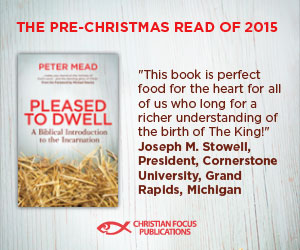
Adapted from Pleased to Dwell: A Biblical Introduction to the Incarnation, by Peter Mead (Christian Focus, September 2014).  For more information on the book, please visit www.trinitytheology.net  [Used with permission from Christian Focus.]

Meaningless Chatter

blabla2Apologies for a quiet couple of weeks on here . . . have been enjoying our new little girl and the sleepy first weeks with a little one in the house.

______________________________________

Our culture seems to be an effective generator of meaningless chatter. I am not referring to relaxed conversation.  I am think more specifically of the excessive use of clichés and standard phrases that mean very little.

Listen in to folks chatting with each other and you will often hear a back and forth of relative nothingness.  One person will express an opinion. The other will counter with “we’ll just have to agree to disagree,” which stirs a swift, “you’re entitled to your opinion,” countered with a, “fair enough, free country,” or a reference to “freedom of speech,” a reference to “a bit of give and take,” and so on.  Before you know it, such free speech has moved a conversation nowhere over the course of many minutes.

Turn on the TV and listen to a footballer being interviewed and typically you can play cliché bingo with a line completed every 30 seconds.  A game of two halves, play until the whistle, a striker’s finish, he’s got a great engine, a game of cat and mouse, a bit cagey, etc.  (This list would be different in the USA, for instance, but probably similar in effect.) Every phrase is actually saying something, but it can all feel very predictable and slightly like rote behavior.  To someone not used to listening to British footballers it can seem like another language.

What about your preaching?  Do you have any stock phrases that come out too easily?  Do you preach in Christianese so that visitors don’t actually know what you are talking about?

Here are some categories of phrases that could very well be true, and yet still be classified by some as potentially meaningless chatter.  Since I am slightly sleep deprived, I won’t list the dozens of examples, but by all means feel free to list ones that come to mind in a comment!

1. Churchy language – gathering under the sound of the gospel, where two or three are gathered, the church is not the building, Sunday morning is like a mountaintop, let’s approach the throne of mercy, bring our prayers to a close, etc.

2. Preacher language – turn with me to . . . , by way of application, finally (this one is often confusing when 15 more minutes of sermon follows it!), as we all know (dangerous and pointless phrase, unless we like to alienate people), etc.

Remember, some of these phrases are profoundly true, but still might require some explanation so that they don’t sound like a pastor being interviewed on TV about the service and his message.

3. Theology language – its all about Jesus, Jesus is the answer, let go and let God, our problem is that we just don’t believe enough, its not about us, etc.

I am sure you could add to these lists.  By all means do.  And let’s prayerfully consider whether our language each Sunday actually communicates.  Maybe some of us will dare to ask some newer people in our churches to write a list from their perspective!

Fighting Gravity – part 5

Gravity2Gravity pulls, and pulls, and pulls. So does the theological gravity that we live in in this world – the Fallen World Gravity (FWG). We have pondered this pervasive force during the last days. Let’s look at one more facet of this ugly gem.

5. The pull toward pride.  Perhaps we are just circling the many facets of the same false gem.  In the Fall we usurped God’s selfless throne and put the self-absorbed ego in His place.  Naturally, then, we will tend toward pride. Again, this is not simply true for those outside of Christ. It is also true for everyone of us that is in Christ, but also still in the flesh and in this world. One day this gravity will be gone and what a burden will lift from us!  For now, it is best that we become more aware and pray for clearer eyes to see the wonder of the good news of God’s love in Christ.

We are pulled toward pride. In everything we do, maybe especially the good things we do as believers, we still suffer the pull toward pride. In the future we will look back on all this pride and wonder what we were thinking. But for now, this fallen world ‘theological gravity’ makes some nonsensical things seem perfectly normal.

I suspect I will spend the rest of this life purging my view of ‘normal’ in light of God’s Word.  There is so much that is so fallen and yet I remain unaware. Let’s pray that God would give us eyes to see where the FWG, rather than biblical perspective, is influencing our perspective in life and ministry. Let’s pray for a clearer vision of God in His world, and of our listeners in theirs, so that our preaching might better address the reality of what is before us each Sunday.

How else does the Fall influence us, even as believers, and in ways we tend to not notice?

Fighting Gravity – part 4

Gravity2We live lives pulled by gravity. Physical gravity keeps on pulling us downwards. We can be a research physicist or a playful toddler. It doesn’t matter, gravity pulls. Fallen World Gravity (FWG) keeps on pulling us too. It pulls us toward a worldview where I am at the centre, where glory is a-relational and based on how weighty we can be in competition and comparison, and where independence just makes sense.

Here’s a fourth pull that is there whether we recognize it or not:

4. The pull toward speculation. This one is less obvious to us, even if we have done some good study biblically and theologically. It is strange, but the ‘theological gravity’ of this fallen world pulls us to enjoy speculation. We seem to be naturally pulled toward speculating intellectually, or experientially, or both.

Of course, God has created us to learn and to explore, but somehow this fallen world gives us a corrupted version of that. So rather than chasing all there is to know about God in His self-revelation through the Word, we will quickly put the Bible to one side and delve into intellectual and philosophical speculation.

Or we will quickly put the Bible back on the shelf and pursue some sort of spiritual exercise that might lead us into an experience that goes beyond anything God has directly offered in His self-revelation. Somehow these pursuits are permeated by an inherent independence, and that gravity continues to pull us away from God’s good plan to a fallen and twisted theological pursuit or practice. It is strange how much this happens and, for the most part, we remain quite unaware of how strange it is.

We will preach to people who just want to accumulate knowledge so that their intellectual curiosity can be assuaged. That is a problem. We will preach to people who just want to find some spiritual exercise that might lead them to a spiritual high. That is a problem.

What is more, since FWG is so pervasive, our listeners may hear a preacher who really just wants to accumulate knowledge so that his fleshly compulsion to speculate philosophically can be satisfied. That is a problem. Or they may hear from someone who is more concerned with climbing into some sort of anointed euphoria than growing in relationship to the God who can be known in Christ. That too is a problem.

Be a learner with curiosity. Let it drive you deeper into your relationship with Christ. Let the Bible be the ground you dig, and let God’s heart in Christ be the treasure you find. Let the pulpit be a place of sharing that treasure. May our churches be communities of increasingly captured hearts enjoying knowing the God who has revealed Himself in Christ so that we can know Him!

Fighting Gravity – part 3

Gravity2Fallen World Gravity (FWG) is a silent but constant force at work in this world. It does not discriminate between believers and unbelievers. Its insidious influence is persistent and pervasive. Like known “natural laws” it works irrespective of whether we know it is there, and typically we don’t.

So we are pulled toward self-centredness, and toward a corrupted, arelational understanding of glory. Consequently our view of God is distorted, and our view of what it means to live as creatures made in God’s image.  Here’s a third feature to prayerfully ponder before we preach again:

3. FWG pulls persistently toward independence. Ever since the hiss of the serpent in the Garden of Eden, our own independence has been one of the most self-evident truths in all the world – even though it is a lie! We cannot fathom the idea that perhaps we are not individual and autonomous beings who are free to self-initiate whatever we choose.  Even when we come to know God we are still under the influence of the Lie and we tend to think we can enter into some sort of mutual arrangement with God. I am a lesser being, of course, but I still naturally try to negotiate with God as if I have some sort of independence at the core of who I am.

The Christian Gospel knows nothing of works, nothing from me. We cannot and we will not merit our salvation. This goes against everything in the world’s way of thinking.

The Christian life continues in the same vein. We are called to look to Christ, to love Him, and live in dependent response to Him. This lack of independence and autonomy continues to go against everything this world has taught to be self-evident.

Consequently, in our preaching we will be tempted to corrupt Gospel truth with worldly lies. We will be tempted to offer a two-way arrangement between God and independent beings that can choose to autonomously apply instruction. However well we present a non-independent message, our listeners will filter everything through a default lens that colours everything in hues of personal independency.

Fallen World Gravity is dangerous because we tend to ignore or deny it.  And like physical gravity it does not mind whether we believe it or not, feel it or not, understand it or not. It just keeps on pulling.

Fighting Gravity – part 2

Gravity2I am pondering the silent but pervasive impact of FWG – Fallen World Gravity.  This force is not only at work in unbelievers, but also believers. Not only do people listening to us preach live typically unaware of its impact on their perspective and life, but so do we as preachers!  Yesterday we thought about the incessant self-centred pull of this fallen world on us all. Maybe we are only aware of 5% of this pull. If so, that should cause us to pray and ponder!

Here’s another effect of FWG:

2. The pull toward a fallen version of glory.  Our fallen world makes a compelling case that glory is about the radiating gravitas of an individual.  They could be a successful sports star, or a powerful business leader, or an impressive intellectual giant, or it could be God shining out his impressive knowledge, power and position. The fallen world makes us think that glory is about an individual impressing lesser beings either in some earthly sphere, or in the heavenly sphere.

But where is love in this picture? Where is the other-centred love of the Trinity that radiates in the perfection of loving holiness, not only impressing every creature, but inviting some fallen and undeserving creatures to participate in that loving community of other-centredness?  Somehow FWG can cause us to bring a corrupted view of glory into our understanding of God and then we can miss much of the wonder of the Gospel.

At the same time we inadvertently pursue our sanctified version of chasing glory . . . and we are right back to elevating self again!

As before, this is not just the case with those outside of Christ. Our salvation does not immediately purge us of the presence or effects of fallenness. Maybe as preachers, or as listeners, we would do well to come before God in prayer and ask Him to search us and try us, highlighting where we may be pursuing a so-called sanctified version of self-centred glory-grabbing?  Does this happen in our ministry? In our self-presentation? In what we write on Facebook?