Preaching Epistolary Texts as Story

The question that led to the previous post implied the problem of repetition of style when preaching epistolary texts. It is easy to get into a rut of one deductive sermon after another. One option to consider that may help bring some variety into a preaching series, is to preach an epistolary text as story.

A story has characters, a situation, tension, and some form of response to that tension. Most stories resolve, although a story without full resolution can be very powerful. In reality, an epistle is an episode in a story. There are characters (the writer and recipients, at least), a situation, some type of tension that the writer is responding to through writing the epistle. Furthermore, in most cases, we do not know how the story actually resolves.

So when preaching a text from an epistle, consider telling the story of the situation. Perhaps offer some incomplete responses that might only make the situation worse. Then introduce the actual response of the apostle. Describe how that response might resolve the situation. Describe what successful application of the passage would look like back then, and today. Make clear the claims of the passage on the listeners both then and now. Conclude without resolution, recognizing that the story is incomplete until the listeners have become doers of the Word also.

Does Passage Determine Sermon Shape?

Tim asked the following question:

Do you think it is ok to preach inductively when the passage is clearly worked out in a deductive way? For example, (sweeping statement coming up!!!) a lot of Paul’s epistles seem to be fairly deductive in the way he makes points and then goes on to prove or explain them. Does this tie you into preaching deductively every week as you go through Paul’s epistles?

Another way of saying this question is ‘do you have to stick to the order that the Biblical writer sticks to?’ If Paul makes his big point in verse one, and then proves or explains it subsequently, do you also have to move in this same order?

Peter responds:

1. The passage outline is the place to start – I think the Biblical order is a great place to start, and often it makes sense to preach a passage according to its order.  If it is a deductive passage, probably preach it deductively.  If it is a narrative passage, usually preach it narratively.  And so on.  The stages of sermon preparation require the study of the passage before the preparation of the sermon, so the shape of the text should be clear before designing the sermon.  Often there is no reason to do something different than preach the text in its order.

2. There are good reasons to shape your sermon on the text – If you were to use no notes and just be looking at the text, it is easier to preach the text as it stands.  Even if you have notes, the text is all the listener has.  Generally it is better to give people the impression that they can also follow through a text as it was written and learn its lesson.

3. There may be good reason to change the shape – As a preacher you have a foot in both worlds: the Bible and the listeners’ world.  So the purpose you have for the sermon may differ from the purpose of the writer, which then implies an alternative strategy or outline may be worth considering.  For example, Peter preached to an antagonistic crowd in Acts 2 and so preached a very inductive sermon.  Likewise, you may be preaching a passage in the epistles that is up front with its main idea, but you know your listeners are more antagonistic than the original readers were, so perhaps it would be worth changing the sermon shape accordingly.  Our goal is to present and explain the passage and communicate the main idea in order to achieve the intended purpose in our situation.  Strategize accordingly.

4. A sentence and a sermon are different – Don Sunukjian teaches a helpful point.  He argues that a sentence has an immediacy to it that allows a certain order, but in preaching that order may need to be changed to reflect the order of thought.  For example, he uses a sentence like, “I am going to town, to buy some food, because my dog is hungry.”  Now, if that sentence were to be preached, it would be better to reverse the three elements.  “Going to town” and “buy some food” are dependent on the final element “my dog is hungry” for their meaning.  In preaching we may take an element of a thought and expand it.  What expanded exposition of “Going to town” might result without the underlying issue of the hungry dog?  Consequently, in order to help people know where they are in the thought of a sermon, the order of thought is an important issue to bear in mind.

Getting to Grips with a Genealogy

What do you do when you are preaching through a book and there is a genealogy? I have faced this a few times, although I don’t claim to have a ‘one-size-fits-all’ solution to the challenge. Here are a few tips:

1. Study the function of the genealogy. The author included it for a reason. How does it fit with the flow of thought in the book? It is easy to get caught up in the details of the list, but miss the function of it.

2. Select the preaching passage carefully. If you are able to divide the preaching passages, do not assume lots of verses in a genealogy mean lots of preaching material. It may be that the genealogy can be summarized briefly, leaving plenty of time for an adjoining text.

3. Survey the framing of the genealogy. What does the author write as a lead in, and what are the first comments leading out of the genealogy? Consider, for example, Luke 3:21-23 and 4:1-3.

4. See if any pattern is broken. Sometimes there is a pattern in the way the text is written, which can become quite rhythmic to the ear. Be sure to check for any breaks in that pattern that might suggest a place of emphasis. For example, consider the change in pattern for Enoch in Genesis 5:24.

5. Scrutinize the places of emphasis. Be sure to consider carefully the first and last names in the list. Often a genealogy is a bridge through time linking one place in history with another. For example, see Ruth 4:18-22.

6. Scan for misfits. In light of the apparent function of the genealogy, are there individuals whose inclusion might be considered surprising? For example, the presence of, and similarities between the women, in Matthew 1:1-17. Be careful not to allow an interesting observation to overwhelm the rest of the genealogy. This example in Matthew has more than one interesting feature!

7. Search for every clue to the author’s intent. Your goal is not to preach random details from a list, nor to exhaust listeners with exhaustive historical details, but to search diligently for the author’s intent when he wrote and/or included the genealogy. This is a repeat of the first point, but this is worthy of restatement in this final position of emphasis!

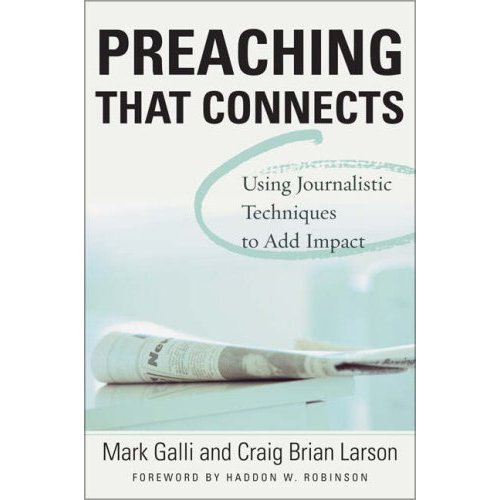
Review: Preaching that Connects, by Mark Galli and Craig Brian Larson

Subtitle: Using Journalistic Techniques to Add Impact

preachingthatconnects.jpg

Both authors are journalistic editors (Christianity Today and PreachingToday.com respectively). Both are also preachers. They wrote this book to show how the skills of journalism can help the effectiveness of preaching.

The book is short, but a worthwhile read. A dozen brief chapters deal with the following subjects: the motivation of effective communication, creativity, introductions, sermon structure, illustration, story telling, language style, and conclusions. The goal in journalism is effective and captivating communication. What preacher does not desire to be effective and captivating?

As the foreword suggests, this book might only take a couple of hours to read, but there is potentially a lifetime of benefit.

Why Bother With an Outline?

I was recently chatting with a pastor who told me he never writes down an outline in preparation; rather, he just studies hard and then preaches. If it is possible to study a passage and then preach from it without doing an outline, then why bother?

Haddon Robinson teaches that the outline is for the preacher, not the congregation. The benefits of diligently outlining a message are at least four:

1. The unity of the message. You can view your sermon as a whole, and therefore, get a clear picture of its unity. Since an outline is essentially a hierarchical structure, any disconnected elements will not fit comfortably under the headings where they are placed.

2. The logic of the message. An outline clarifies in your mind the logical connection between the parts of your sermon. How does movement one flow into movement two, and why in that order? The outline will demonstrate this (or fail to do so if there is a problem).

3. The order of the message. An outline crystallizes the order of the ideas so that you can give them to your listeners in the appropriate sequence.

4. The flesh of the message. You will be able to recognize places in your sermon that require additional supporting material. Or you may see that your supporting material is all clumped together in one section, while other cupboards are bare.

Preaching First-Person: 5 Essential Questions

I am no expert on first-person (in character) preaching. However, when I have preached in this way I have had very positive feedback. Here are some basic questions I ask myself before preaching in this way.

1. Which character? It can be a character explicitly involved in a passage, or an implied character (an observer of the events).

2. Who is traveling through time? Is the character coming to today to speak to the congregation, or is the congregation going back in time to the historical context of the character?

3. Will I use costume or props? There is no benefit to looking like a child in a Christmas play, but a carefully thought out costume or prop may help the presentation. On the other hand, it may serve as a distraction.

4. Will I conclude in character? Transitioning between character and self is not easy, but applying the message in character is also not easy . . . so who will drive the message home? The character, me, or someone else?

5. Is this a true sermon? Preaching in character is no excuse for sloppy preaching. The message still needs solid exegesis, a definite main idea, clearly defined purpose and relevance to my listeners. Preaching first-person must never be less work than a normal sermon. It takes the normal preparation, plus a lot of extra work.

Make Your Sermon Sizzle!

There is one of you, and lots of them. So in your desire to be relevant to as many listeners as possible, perhaps you tend to speak in general terms. Don’t.

Remember that generalities are as gripping as generic goods in a grocery store. Specifics sizzle. When you describe a Biblical scene, or an applicational situation, or an illustration, be as specific as possible. When you are specific, then listeners will be able to see, feel and experience. Do it well and your sermon will sizzle.

Galli and Larson, in Preaching that Connects, agree, “Being specific means saying Luger, rather than weapon; ’89 Taurus, rather than vehicle; adultery rather than sin; the nails through Christ’s palms, rather than Christ’s sufferings; Bob, the 45-year-old, overweight Chicago detective with the scar on the back of his hand, rather than officer.” (Obviously, be specific in the cultural language of your listeners.)

Like generic own label products in the supermarket – generalities are easy to find, they cost us little and they do a job. But they are bland and uninspiring. If a sermon was a meal you took many hours to prepare, you would want it to sizzle. Be specific.

Peter has responded to comments on this post – see comments.

Tell the Story, but Preach the Text

I believe in vivid description during preaching. It takes time for an idea to form in the minds and hearts of listeners. It takes specific detail for listeners to “see” a Biblical story and to feel its tension. But the solution is not simply to add and embellish freely.

1. Preach the text, not the event. The writer made choices. He chose to selectively include limited detail and was inspired in the choice of each word. So while it is tempting to fill out the details, be careful not to lose the point the writer is making. For example, in the gospels, each writer is writing historically accurate accounts, but is doing so theologically. A writer may include or omit specific details in order to make his point. If we simply harmonize all four gospels and preach the resulting composite story, we will be preaching the event rather than the text. It is a good idea to consult a harmony of the gospels to make sure your description is historically accurate, but preach your specific text. The event is historically true, but the text is inspired.

2. Preach the text, not added detail. There is a constant danger that in telling a story well, we might preach an idea born out of the added (uninspired) detail. Therefore, it is critical to do solid exegetical work in the text before working on how to tell the story. Work on the passage must come before work on the message. Then if you decide to add some detail, you can do so carefully, seeking to honor the emphasis and detail of the text.

Let a Story be a Story

If God inspired a story, why don’t we preach it as a story? Simple question. Sometimes we think stories are for the flannel-graph in the children’s Sunday School room. But in church, to adults, we don’t tell stories. Perhaps we summarize the story and then get down to preaching our points – lessons derived from and illustrated by the text. Or we dissect the story and preach a protruding skeletal outline that makes our points as we work through the text.

Maybe we should tell the story? When faced with a Biblical story, in very basic terms, the default approach might be a simple three steps. 1. Tell the story. 2. State the main idea of the story. 3. Apply the main idea. There are many other approaches that might be worth considering, but consider this one first. StoryPrinciple – Application.

Allow the dynamics of a story to work, even for adults. After all, God inspired it as a story . . . and it was written for adults.

Peter has responded to comments on this post.

The Preacher’s Cutting Room

Watching a movie on VHS was simple. Watch it, rewind it, return it. Now we use DVDs – watch it, then watch as many hours of extra bonus material as you can tolerate! You can enjoy “The Making of . . .” and “Meet the cast . . .” and “Humorous gaffes.” Then there is also “Deleted scenes.”

A scene might take days to film, more days to edit, cost thousands of dollars, and then be mercilessly cut from the final edition of the film. One such scene was in the movie Gladiator. As Maximus waited under the Coliseum, he looked out through a barred window to see Christians praying as the lions approached. A powerful scene, very moving. It was cut.

The director’s commentary on the scene explained the situation. It did not help the progress of the plot. It was potentially overwhelming, too weighty.

After many hours of preparing a sermon, get out the scissors. It isn’t easy, but there may be an element of explanation, an illustration, or a story that does not help the message, or may overwhelm it. If it would not be missed, or if its absence would not result in reduced understanding of the message . . . cut it. Perhaps when your sermon is on a DVD you can make it available, but for now we are still preaching in VHS.