The Thirties – Part 3 (The Threats Identified)

In the last post, I noted a few parallels between the 1930s and our times.  But what about the threat itself?  The Nazi threat was totalitarian, oppressive, ideological and quasi-religious.  Since the fall of the Third Reich, the world has been more focused on Communism, supposedly coming from the opposite end of the political spectrum.  Also, on the expansion of militant religion, and latterly, activist agendas driven and funded by globalist ideologues.   While the media seems to scream “Nazi!” quite freely as an insult, there appears to be an eerie ignorance of where the threat lies for our society today.  What would be the cost in both freedom and lives if we continue to push in the direction of the utopian dreams being touted?

Interestingly, the ideologies swirling in the 1930s seem to come from both ends of the traditional political spectrum as people understand it. 

“Hardly had the republic been established, when the enemies started to attack in earnest.  From the left . . . the communists savagely pounded away at the people’s state and its institutions . . . fighting and belittling everything created by the republic. . . . Propelled by the insane belief in a world revolution, the communists caused millions of gold rubles to flow into Germany for the fight against the republic.” It is interesting to read how “time and again [the communists] joined forces with the Nationalists and Nazis in parliament.  They cast their vote against democratic government and, together with the Nazis, did immeasurable harm to the dignity of parliament by turning it into a place of political rowdyism and unheard-of brawls.” ACG was not surprised to see communists joining the brown-shirted storm troop army by the thousands, nor “the most radical communist districts . . . becoming strongholds of the National Socialist movement and its sluggers.” (p361) 

In another place, he notes how “Some SA formations had as many as thirty per cent communists in their ranks.  This was not at all surprising. Both the Nazi SA and the communists had much in common; above all, their hatred of democracy and especially of the social democracy.” (p252)

Wait, we are constantly told that the Nazis and the Communists represent opposite extremes on the political spectrum.  Instead of focusing all our attention on Left versus Right, we should instead contrast control and freedom.  Tyranny is tyranny, whatever uniform it wears.  And perhaps tyranny is the threat to liberal democracy and human freedom that lingers and re-asserts itself time and again.

Suppose the constitutional rights of the individual are not protected. In that case, any solution offered for any actual or imaginary crisis will prove to be a force of control.  In other words, self-proclaimed saviours tend to become tyrants.

 ACG finished his 1939 book with a prescient finale:

“National Socialism stands for the propagation of a system aimed at the destruction of individualism, the enslaving of other peoples, and barbarism. Civilization gives way to the law of the jungle. Wherever Hitler goes, the four horsemen of the Nazi Apocalypse follow. National Socialism is synonymous with war, devouring uncounted millions of lives, destroying culture and civilization. Hitler consciously or unconsciously is driving toward this goal. He is taking Germany and with her, all Europe and the whole world on the road to disaster.” (p367)

We would do well to understand what is meant by the political “left” and “right” but also to grasp that the real battle might be between control and freedom.  As preachers, our calling is not to preach a party political message.  The pulpit is not a soapbox; we have something much more important to proclaim.  But let us not bury our heads in the sand and live in ignorance of what is happening in the world around us. 

In the next post, I want to explore how the great shift happened so quickly and whether that may be helpful for our awareness today.

The Thirties – Part 1 (A Seismic Shift)

At the height of restrictions during the times of Covid, I made a comment to a friend.  His response has stayed with me.  My comment made a specific comparison of a contemporary trend with 1930s Germany.  He immediately reacted and told me that we should never make such a comparison because it implied that the motives of certain influential people were as evil as Hitler himself.  I find censorship to be a huge red flag, and I felt like my thought process was being shut down.  A few years later, whether the situation warranted my comment is still up for discussion.  Perhaps, over time, we will know.  But my interest in 1930s Germany has continued.

What did they know?  And significantly, how did they respond during an era of multiplying warning flags?

Recently, I discovered Inside Germany, a book written by Albert C. Grzesinksi [herein ACG] – a member of the Social Democratic Party who helped to found the German Republic after the First World War.  Intriguingly, he published the book in 1939 without the benefit of hindsight.  After six years of the Third Reich, he wrote without knowing what would unfold in the next six years. The horrors of Nazi Germany during the Second World War, especially the “Final Solution” to the “Jewish problem,” were eventually revealed to the world.  But what about before the war?  How did the German Republic become the Third Reich?  How did so many accept such a rapid transition from liberal democracy to tyrannical evil?  It is a fascinating read.  And maybe, a century later, there could be lessons for us as we pray for our world, influence Christians and lead churches in a time of potentially tectonic political shifts.

The German Republic was quite an achievement after the devastation of the Great War of 1914-18.  On the 31st of July, 1919, the National Assembly in Weimer “gave the German people a constitution that was one of the most liberal, progressive and inspiring documents in the history of the world.  On the 23rd of March, 1933, the parliament of the same republic passed an empowering act which concentrated all powers in the hands of Hitler, and which wrote finis to German democracy and the liberal republic.” (p357)  Strikingly,  ACG wrote, “Those two dates . . . mark Germany’s road to Golgotha, the road to the crucifixion of the German people under the Nazi swastika.” (ibid.)

It would be easy to assume that Germany, after WWI, simply rebuilt itself, leading to WWII.  Not so.  The Germany of 1919 had to be radically changed to become the Third Reich of 1933 and following. “Seemingly by a stroke of the pen, political liberties were achieved which not even the boldest optimists and democratic dreamers of Germany had dared to envision. Germany became a state of, by and for the people; a democratic fatherland dedicated to the needs and aspirations of the working masses.” (p358)  And it is that seismic shift from liberal democracy to totalitarian tyranny that intrigues me.  How can that happen so quickly?  And, if you will indulge a series of posts about Nazi Germany, I’d like to ponder what it might mean for how we preach and influence both church and society in our tumultuous times?

7 Defining Moments in Your Sermon – Part Two

As we work through this list of seven defining moments in the sermon, we have so far thought only about the unseen preparation of all involved and the first impressions before the sermon really starts.  Now let’s consider two that are part of the introduction to the message:

3. The motivation to listen – Most sermons will have the same elements: a beginning, a middle, an end, a Bible passage explained and applied, and some illustrative material to help communicate.  Now, all of these standard elements can be better or worse.  But they tend to be present.  However, the motivation to listen is by no means guaranteed.  It is not guaranteed from the listener’s side, and it is not guaranteed in the details of the sermon.  How could it be missed?  Easily.  Too many preachers assume that their listeners are interested in Elijah’s encounter with a widow or Paul’s answer to the church’s question.  And too many introductions offer something less than motivation. 

We can easily settle for familiarity or interest.  Familiarity introductions are the ones that refer to something we all experience – you know, going upstairs and forgetting what you went up to get.  Everyone smiles and relaxes a bit.  Then, the message continues as if that connection is enough.  Or interest introductions are the ones that raise eyebrows with an interesting tidbit – you know, that it is impossible to lick your own elbow.  Some knew that, some didn’t, some try it, etc.  And the message moves on.  Familiarity introductions and interesting introductions are probably better than just launching into 1 Kings 19 and its background, but better by far would be an introduction that makes listeners want to hear what is coming. 

Inasmuch as you are able, motivate listeners to listen.  Robinson used to talk about surfacing a need in your listeners that the passage would then be able to address.  Use your introduction to grab their attention, convince them that they need what this passage is going to show them, and win their hearts to be open to you as you lead them into the passage.

4. The overview – At the end of the introduction, it is easy to skip the overview.  Generally, you should not skip it.  Give people a sense of the shape of the message.  We are going to see the problem described, and then the solution.  Or Paul gives three truths that we will look at together.  Or the passage comes to us in two chunks, verses 1-5 and verses 6-9.  Or we will see the transformation we need is coming, the triumph over death is certain, and the therefore that changes how we live – the transformation, the triumph, and the therefore.  The overview can be detailed or a very high-level glimpse, but if it is missing, the listeners are slightly in the dark as to where the message is headed.  If your message is an inductive shape, then make sure the question that is going to be answered is clear: what is the critical ingredient that we need if we are to have a ministry like the master?

Feel free to comment about introductions – what works well?  What do you hear that doesn’t connect or help the listener?  Introductions are critical to the effectiveness of a sermon.  Next time, we will look at two more defining moments in the sermon.

7 Defining Moments in Your Sermon

As you preach, there are numerous defining moments.  That is, pivotal decisions or moments that will multiply the impact of the sermon.  The whole sermon matters, of course.  You can’t expect one great line to do great work when it is packaged in fluff.  But while you work on the whole sermon, remember that there are some defining moments that could make or break it.

1. The unseen preparation (yours and theirs!) – Whatever happens during the sermon itself is really just the final part of a process.  There has been a whole lot of unseen preparation before the moment of delivery.  Of course, there have been the ups and downs of sermon preparation for you, the preacher.  The prayer, the study, the wrestling with word choices, the hunting for illustrative material, the interruptions, the storm, and the calm inside you and in your study.  The journey to the pulpit may have been arduous, or somehow serene, but hopefully God has been at work in you before he will work through you. And I am only describing the last few days, but God has been at work for years.  However, the sermon is not just about the preacher.  How has God been stirring the listeners?  Providential circumstances, carefully timed conversations, quiet questions inside, or overwhelming challenges without.  It is not unusual for a sermon to touch a nerve that was only sensitized in the preceding days.  “How did the preacher know that about me?”  Often, the preacher didn’t.  But someone did.  It is helpful to remember that a lifetime of preparation is brought into the sermon from all sides, and only God can be aware of that, let alone influential in it!

2. The first moments of the introduction – It is hard to overstate the importance of the first moments.  I don’t mean the introduction.  I mean the first impressions.  Do you seem comfortable, or nervous, or indifferent, or agitated?  Will listeners get the sense that you have something to say that is worth their focus and time to listen?  Will people who have never heard you before feel welcomed and engaged?  Will regular listeners sense that you are well prepared, or will they get the sense that you are somehow “off” this week?  Remember, humans are wired relationally.  When you sit at a table in a restaurant, you know whether you like the server before you have a chance to evaluate your first interaction.  Sometime, watch a video of yourself.  Watch up until your first word.  Prayerfully and conversationally evaluate (that is, ask God what he thinks, and ask someone else what they notice – don’t just trust your own perspective).  Then watch the first couple of sentences, and evaluate again. 

We will continue this list of defining moments in your sermon next time, but feel warmly invited to comment with any that are on your mind!

Nowhere, Now!

What is the greatest commitment we see in our world today?  Is it the commitment of a classical musician, or a sports professional?  They say it takes 10,000 hours of practice to really master any skill.  Apparently, it takes nine to twelve months of specialist training to be ready to attempt to climb Mt Everest. While the idea of commitment may be dismissed by so many in our society, there are still countless people dedicating themselves to various pursuits.

In Matthew 8:18-22, Jesus speaks about commitment at an extraordinary level.  After three chapters of the Sermon on the Mount (chapters 5-7), Matthew seems to be shifting to an all-action presentation of Jesus performing healing miracles.  He heals the leper, the centurion’s servant, and Peter’s mother-in-law.  It feels like we have left the teaching block behind and settled down for an action-adventure section of the Gospel.  But then we come to these few verses and two powerful sayings of Jesus about commitment.  

Essentially, Jesus declares that to follow him means to belong nowhere and the demand is to follow now.

Now when Jesus saw a crowd around him, he gave orders to go over to the other side. And a scribe came up and said to him, “Teacher, I will follow you wherever you go.” And Jesus said to him, “Foxes have holes, and birds of the air have nests, but the Son of Man has nowhere to lay his head.” 

Matthew 8:18-20

Belong Nowhere! – The scribe sounded so committed.  He would follow Jesus anywhere!  But Jesus pointed to the rhythm of creaturely life.  A fox?  It gets up and puts in a night shift touring its territory, marking the boundaries, catching a vole or two, enjoying some worms and bugs, even feasting on some berries if the opportunity arises.  Then, when its work is done, it returns to its hole and lays down its head to sleep.  Work done, it heads for home.

Just to reinforce the point, Jesus mentions birds too.  They wake up nice and early, some get in a singing practice before dawn, then head out and fly the skies looking for food.  Some catch flies mid-air, others swoop down for voles and mice, while others prefer seeds and worms.  Then, when their work is done, they return to their nest and lay down their heads to sleep.  Work done, they head for home.

Every creature is the same.  Including humans.  Wake up, work, head home, and sleep.  But not Jesus.  His work never seemed to be done.  When he finished healing Peter’s mother-in-law, then many more were brought to him late into the evening.  When he headed out early to a deserted place, he sometimes found crowds looking to get more from him there too.  And Jesus was not home.  We never read of him heading back to Nazareth for a home-cooked meal with mother Mary. 

To follow Jesus is not about a shift and then back to base for some relaxation and creaturely comforts.  To follow Jesus means to belong nowhere in this world.  It means we are not really at home in our home town, nor if we move to the other side of the world in missionary service.  If we follow Jesus, then our citizenship is in heaven, and our home town is still in the future (Philippians 3:18-21; Hebrews 11:13-16). 

These are challenging words, especially if we have grown too much at home in this world.

Another of the disciples said to him, “Lord, let me first go and bury my father.”  And Jesus said to him, “Follow me, and leave the dead to bury their own dead.”

Matthew 8:21-22

Follow Now! – The disciple’s request seems reasonable.  Surely, Jesus is not against family funerals, is he?  I don’t believe he is.  The point here is a striking one.  Nothing can come before following him.  Not a funeral that is scheduled for next week, nor a Jewish reburial in a few months, or even an anticipated death in order to collect an inheritance (all are explanations given for this cryptic moment in the text).  As Jesus said elsewhere, if we are to follow him, then we must first hate everything we hold dear.  Jesus wants his followers to honor their parents and so hatred seems extreme, but that is the point.  There can be nothing that comes first.

How often we can fall into the same problem?  Not so much with funerals, but with other things.  “I will be completely committed to Jesus, but first I . . . “  What?  What comes first?  Career first?  Promotion first?  Payrise and then folks will see my dedication to Jesus?  Or maybe family first?  Once married, once there are children, once they are grown, then the commitment will show?  Of what about fun first?  So many say they will live a little and be committed to Jesus when only a little life is left in this world.  Bucket lists get elevated to the level of an idol as Jesus is left to wait his turn.

No.  To follow Jesus at all means that we need to follow him now.  Not later.  Not after.  Now.

Reasonable Demand? – How can Jesus be so demanding and expect us to belong nowhere and follow now?  The demand is so extreme.  But the key is to look at who is saying the words.

Jesus had no home in this world.  He left his eternal home and entered into this world in the most humble of circumstances.  He was born in a peasant town and laid in a manger.  He was an infant refugee in Egypt, then grew up in Nazareth – a place with a rubbish reputation.  Nazareth was a rest stop on the way to somewhere better.  And then, once he launched into his ministry years, he had no home of his own in this world. 

Jesus’ work never seemed to be done.  He had nowhere to lay his head, not only because of a lack of address, but also because his work demanded so much.  There was always another person to heal, another demon to cast out, another crowd to feed, another dispute among the disciples to unpick, another conflicted conversation to navigate.  His work, his mission demanded so much.  Actually, it demanded everything.

As we read through the Gospels we find that Jesus did eventually lay down his head.  When was that?  It was in John 19:30, when his mission was accomplished, when he cried out “It is finished!” and then lay down his head and gave up his spirit.

The reason that we should take Jesus’ demand so seriously is because his mission cost him everything.  Since he gave his all for us, his call is for us to give everything in response.  Belong nowhere in this world, and follow now.  Nothing else would make sense in light of who said it.

At Work in His Word

As we enter February, there will be many new year Bible reading plans that are fading away.  Perhaps the challenge of a full work schedule, combined with dark mornings, drains the motivation to be in God’s Word.  Or maybe the second half of Exodus and Leviticus is proving too great a challenge.  Whatever the reason, many will settle into a rhythm marked more by guilt than regular enjoyment of the Bible.

It is hard to relate to a God we cannot see, hear, or touch.  And while we know that the Bible is his glorious gift of communication to us, it can often feel distant and disconnected from our everyday lives.  How can we find motivation for a relationship with God that has the Bible at the centre?

The critical issue is right in the question itself.  Do we experience the Bible in the context of a relationship?  Or have we let the relational aspect drain away, leaving the Bible as an optional tool or merely an interesting document for our fascination with religious history?

In 2 Timothy 3:14-17, Paul gives us a critical passage on the nature of Scripture.  In these verses, Paul points to the role of Scripture in our salvation and our growth to maturity.  In these verses, Paul clarifies what Scripture is and how it works in us.  Let’s look again at these verses and remind ourselves that God lovingly works in us as we are in his Word.  To put it differently, the Bible is not just a “past tense” book for our studies.  It is a “present tense” gift for our relationship with God.  God lovingly works (present tense) in us as we are in his Word and as his Word gets into us.

Entering into a relationship with God, 2 Tim. 3:14-15.  As Paul wrote to Timothy to encourage him in the challenges he would face, he wanted him to remember where his ministry all started.  It started by coming to know salvation in the first place.  Timothy had learned and came to believe in the sacred writings of Scripture from his grandmother, his mother, and Paul himself.  His Bible exposure taught him about the wonder of salvation through faith in Christ Jesus.  Without the Bible, we would only be guessing about God, and our guesswork would never have led us into a relationship with him.  God has taken the initiative in our salvation, revealing his character, plans, and great gift.  There is no relationship with God if there were no Bible.  But since there is, let us not lose the relational nature of our connection to him!

So, what is Scripture? 2 Tim. 3:16a.  “All Scripture is God-breathed.”  What a way to describe it!  It comes from the very core of God’s being.  He made sure that the authors wrote exactly what God wanted to be written.  All Scripture, every last Word, was as he intended.  On a human level, the Bible is astonishing – so many authors, different languages, different types of literature, and yet an incredibly coherent and consistent collection of documents.  But the Bible is not written just on a human level – it is “God-breathed!”  That means it is unique – no other book is in the same category.  It also means it is a loving gift – God wanted it written for his people.  It is a purposeful gift – God intended it to achieve something in us.

Based on what we know of God, what might we assume his Scriptures would do?  Would God give us a mindless distraction to pass some time?  I don’t think so.  That does not fit what we know of his character. Indeed, he would want to work in our hearts since that is the core of who we are and the heart of all our problems.  Surely, he would want to instruct our minds since God made us incredible thinking beings.  And he would want to guide us in how to live since God had a good plan and we have so profoundly rebelled against him.  Is it a living communication designed to work in our hearts, heads, and hands?  That seems about right.

How does God work in us through Scripture? 2 Tim. 3:16b. Regarding our beliefs, the Bible is profitable for teaching and rebuking.  We need instruction to understand God, the world, and ourselves.  And since we don’t always think well, we must be rebuked, lest we persist in error and come to harm.  How many newcomers to Christianity put information together and end up with errant thinking, only to be corrected as they read the Bible?  For example, many think they have solved the complexity of the Trinity by assuming there must be one God who dresses up in three different outfits to suit the occasion.  Sometimes, he is a father, but other times, he shows up as a man, and sometimes, what we need is a more empowering Holy Spirit.  But then they might read about the baptism of Jesus, and suddenly, they are confronted by all three persons involved distinctly and simultaneously.  Oh dear.  Rebuked by Scripture.  Taught the truth.  This correcting rebuke might happen with logical ideas about salvation, eternal judgment, or whatever.  If we want “to overcome error and grow in truth … we must turn to the Scriptures!” (John Stott)

Regarding our actions, the Bible is profitable for correcting and training in righteousness.  We need to be set straight at times.  Perhaps we have drifted into an area of compromise and the Scriptures confront us as a mirror.  Or perhaps we have drifted from God and run up against Jesus’ letter to the church at Ephesus.  Maybe you have already been corrected by that passage?  So much about that church is so impressive, but “this I have against you: that you have left your first love!”  It can stop you dead in your tracks.  And then, it instructs you to repent and do the things you did at first.  A way back to the healthy reality of a real relationship with God.  The Scriptures train us in righteousness – growing us up in all areas of character, endurance, maturity, etc.  Do we hope “to overcome evil and grow in holiness?  Then it is to Scripture we must turn, for it is profitable for these things.” (John Stott).

What is God’s goal as he works in us through the Scriptures? 2 Tim. 3:17.  The goal is clear: you will be complete or mature, thoroughly equipped for every good work.  We know that God has good works for us in every stage of life.  But how can we be ready for them?  The answer is easy.  Get your nose in the Bible and get the Bible into you, relationally, so that God’s work will be done in your life.

Two Errors to Avoid.  Some Christians will come from a background that might be labelled “text-optional” – it is a divine-hotline approach to living, with an eager expectation that God will speak through my thoughts, feelings, and circumstances.  The Bible may be sitting there, but so is the red flashing phone that offers direct encouragement along the way.  If this is your background, then be sure to recognize that along with all the perceived blessings comes a tendency to leave the Bible sitting there.  But the Bible Ais not optional.  For a healthy relationship with God, we need to be soaking and swimming in his Word, enjoying the wonder of God at work in us passage by passage, day by day.

Other Christians will come from a background that might be labelled “text-only” – it is the intellectual curiosity approach to living with a Bible.  There may be an eagerness to study the Bible and a hunger to learn more and more, but often, there is too little expectation that God will speak to me as I read and study.  The Bible is open, and the study is focused, but somehow God is not expected to be at work.  If this is your background, then be sure to recognize that along with the blessing of study, there is also a tendency to stop studying before fully responding to God’s Word.  We should look at the text and learn what it says and means and consider how it is stirring us to love God and live for God in this world.  Engaging relationally is not optional. Again, for a healthy relationship with God, we need to be soaking and swimming in his Word, enjoying the wonder of God at work in us passage by passage, day by day.

Let’s move beyond “what is God saying to me through my thoughts and feelings” and “what is this text saying” to the relational reality of “what is God saying to me as I read or study this text?” 

God is at work in us as we are in his Word.  What a privilege.  A present tense, today, privilege.

______________________________________

The Least Resolution for 2024

January does not just bring a new page on the calendar but a whole new calendar.  And with the new year, we tend to generate renewed commitments.  Maybe you have already determined what 2024 will mean for you.  Perhaps your mind has already pondered daily step counts, gym visits, dietary changes, or other healthy habits.  Or maybe you are thinking about Bible reading, daily prayer routines, or other spiritual goals.  May your resolutions last and bear good fruit!  But perhaps the resolution we need for 2024 is more foundational than healthy habits and more straightforward than spiritual practices.

As I write this, I am in Budapest, where I have just visited a museum of the political terror of the twentieth century.  As you can imagine, it is a sobering experience to see the vast walls of victims, the displays focused on the political prisoners, a room commemorating the persecution of the religious leaders, the torture chambers, the prison cells, and the gallows.  But perhaps the lingering memory for me will be the final room.  With red walls and hundreds of pictures, it felt like yet another presentation of victims.  But it was not.  It was a room of “victimizers” – ordinary people who were merely doing their job, simply following orders, just playing along, and thereby facilitating the evil machine.  We can remember the victims, and we must.  Yet we must also face the uncomfortable reality that most cogs in the cruel machine of death were ordinary people.

Fifty years ago, in February 1974, Alexander Solzhenitsyn was arrested in the Soviet Union and exiled to the West.  There, he was welcomed as a hero.  On the day of his arrest, he released a document entitled “Live Not by Lies.”  He knew the power of an ideology that sought to reshape society.  He also knew the power of individuals who simply refuse to lie (and the even greater power of a crowd joining together in this conviction).  He knew that the ideological system would totter and collapse when it ran up against the brick wall of reality, exemplified by many individuals refusing to play along with the evil fantasy.
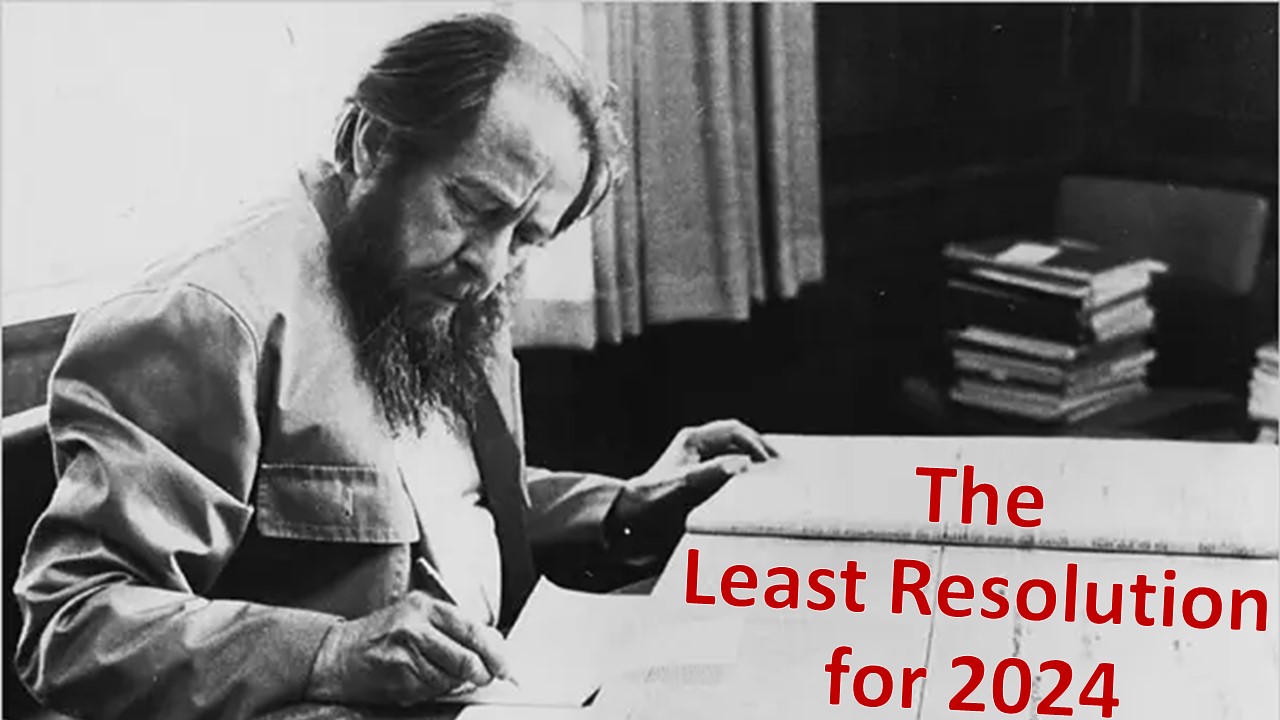
Fifty years later, perhaps it is time for us to revisit this document.  Are we living in times where some, on behalf of all, have determined what society should look like?  Do we see a mounting pressure to conform with what ‘they say’ is acceptable human thought and belief? Indeed, we should not be so naïve as to assume that the absence of marching military on our streets means we face no ideological threat. 

The pressure is growing for everyone quietly to conform.  More than that, the pressure is growing to affirm openly and celebrate what we know to be false.  Surely, it would be better to speak the truth now instead of growing our tendency to fit in and play it safe as the stakes mount.

Truth and Lies – Choosing not to lie was not an original idea for Solzhenitsyn.  Paul urged the Colossians not to lie to one another.  Not only had they put off their old self, but they had put on the new self to reflect their creator’s image (Colossians 3:9-10).  He told the Ephesian believers to speak the truth to one another since they were no longer defined by the lie (Ephesians 4:25).

In the Sermon on the Mount, Jesus addresses the anger underneath murder, the lust underneath adultery, and the daily consistency of speech beneath more flamboyant oaths (Matthew 5:21-37).  There is plenty of Old Testament support for the expectation that God’s people should be consistent speakers of truth (Exodus 20:16; Leviticus 19:11; Proverbs 14:5).  God does not lie, and his people represent him.

Fear and Lies – Solzhenitsyn knew the impact of fear on a population.  He wrote of the great threat facing humanity in his day, which was “about to flare up and engulf us.”  And he described the fear: “While we continue to smile sheepishly and babble; ‘But what can we do to stop it? We haven’t the strength.’”

God asked Isaiah’s listeners, “Whom did you dread and fear, so that you lied, and did not remember me, did not lay it to heart?” (Isaiah 57:11).  Their fear led to lies, as they forgot who was really in charge.

Our world seems to be changing at a frightening rate.  Trying to keep up with the latest adjustments to sense and morality can be tiring.  And it is increasingly revealing how much fear lies within most of us, who are so prone to play along with society’s expectations rather than speak what is true.  It is concerning how easily we fear and perhaps lie while forgetting who is really in charge. 

Some will capitulate completely and speak what is false.  Others hide behind a cloak of not wanting to “sound political” and speak out about the reducing set of acceptable Christian declarations.  Fear of being labelled and criticized leads many to hold back from speaking the simple truth.  After all, it is much easier to quote a Bible verse on social media or avoid the hot topics in conversation rather than offer the most minor form of resistance.

Solzhenitsyn wrote that the fear his people felt was not primarily a fear of nuclear death or a third world war.  The fear was of taking a “civic stance.”  He wrote, “We hope only not to stray from the herd, not to set out on our own, and risk suddenly having to make do without the white bread, the hot water heater, a Moscow residency permit.”  The penalty for a civic stance may have changed, but the fear of the herd has not.

History has never smiled on the timid, and yet each fearful choice always makes sense at the time.  How often do I justify timidity when society needs me to show courage and speak the truth?  We have almost constant opportunities to speak the truth about marriage, gender, sexuality, race, free speech, bodily autonomy, science, medical ethics, corruption, or whatever other prescribed view is being pushed at any given moment.

We cannot simply wait for an ideology to fall apart.  We must be part of the brick wall of reality into which it must crash.  And yet, it is always easier to “continue to acknowledge, glorify, and strengthen” that which we want to see collapse.  At the very least, we must not “recoil from its most vulnerable point.  From lies.”

Violence and Lies – Solzhenitsyn described how violence bursts into peaceful situations with great self-assurance.  “But violence ages swiftly, a few years pass—and it is no longer sure of itself.  To prop itself up, to appear decent, it will without fail call forth its ally—Lies.  For violence has nothing to cover itself with but lies.”

So, even under overt tyranny, people do not have to experience violence at all times.  The demand is only of a “daily participation in deceit” – the tribute paid to maintain one’s position under the power of the oppressive system.  Just play along, it is safer.

The connection between violence and lies is also not a discovery made under the rule of twentieth-century totalitarianism.  Micah wrote to the city in his day, “Your rich men are full of violence, your inhabitants speak lies and their tongue is deceitful in their mouth” (Micah 6:12).

We may not have to stand and fight against violence.  We may not even have to step out publicly and boldly declare the truth. “But let us at least refuse to say what we do not think!”

The Consequences of No Lies – In the Soviet Union, there was a cost to this most simple of stands.  It could cost your job and complicate life.  It could cost your success in education and impoverish your future.  But Solzhenitsyn was clear:

“And as for him who lacks the courage to defend even his own soul: Let him not brag of his progressive views, boast of his status as an academician or a recognized artist, a distinguished citizen or general.  Let him say to himself plainly: I am cattle, I am a coward, I seek only warmth and to eat my fill.”

To choose not to lie was not an easy choice in his day.  It will increasingly not be an easy choice for social standing, or even for physical wellbeing, in our day.  But the choice not to lie is “the only one for the soul.”

The implication of no lies is worthy of note. “The more of us set out together, the thicker our ranks, the easier and shorter will this path be for us all!  If we become thousands—they will not cope, they will be unable to touch us.  If we will grow to tens of thousands—we will not recognize our country!”

As we head into a new year, may we not simply play along with the world.  Instead, let us graciously, prayerfully, and wisely determine that whatever else may happen, we will not participate in the lies expected of us in society.  As representatives of God in this world, this is the least we must do!

(Source of AS quotes: https://www.solzhenitsyncenter.org/live-not-by-lies)

Everyone Hides, But Where?

For several generations, some of us have lived with relative stability.  Yes, our cultures have shifted and changed.  And yes, we have seen our military forces participate in conflict.  But seismic shifts that rock our world have not been so familiar to many of us.  The past few years have changed that.  If the world can change so suddenly, then maybe we would do well to be ready for significant events.  Actually, if we are involved in church leadership, we should be both preparing our people for the future and preparing ourselves for major moments that will surely come.

Recently, my wife and I enjoyed another anniversary and took some time together in Psalm 46.  This is a great passage to soak in for your own benefit.  And it is a great passage to be ready to share with others both before and when the need arises.  It is a Psalm of healthy hiding.

When the constant stream of news is suddenly shattered by something genuinely significant, where can we go?  When the normal rhythm of daily tasks grinds to a halt because something huge is happening, how can we find safety?  And when we look beyond the normal news narrative and see such significant and terrible agendas at play, who can be trusted?  Psalm 46 points us to the answer.

Psalm 46 falls neatly into three stanzas, neatly demarcated by a Selah to give us the opportunity to contemplate.  The first stanza establishes a key thought that is then picked up in a refrain at the end of stanzas two and three.  It is a clear Psalm, easy to read, and probably well worth committing to memory!

Stanza 1 serves to establish a truth that will weave through the whole Psalm.  Our refuge and strength is God himself, and our God is always accessible to us.  The result is that we will not fear.  Four situations are described to underline how secure we are in our God.  Even an earthquake, even mountains being relocated, even raging seas, even the normal secure boundaries of creation trembling – even if the whole created order should revert to utter chaos, we will not fear.  The character of God is more trustworthy than the apparently permanent mountains and boundaries of the seas?  Yes.  Selah.

Despite appearances in the first three verses, I do not think the writer is really focused on natural disasters.  He seems to be using them as descriptions of having your world rocked.  Even a hypothetical upheaval that impacts everything considered permanent and stable would not undermine the reality of God being our ever-present refuge and strength.

In the second stanza, from verses 4-7, the writer zeroes in on the threat of war.  He begins with two verses describing the tranquil city of God, the place where he reigns and is present.  And then, just as our hearts calm to ponder the hope of one day experiencing life in that city, verse 6 breaks in with a reminder that in this world everything is going crazy!  The nations are raging and tottering, like mountains falling into the seas.  When geopolitical change crashes down around us, and we might add, when the ethical foundations of society are completely turned upside-down beneath us, then we find ourselves experiencing a seismic shift from the stability we have always known. 

But the truth of the first stanza is the anchor for us.  Our God is the LORD of hosts, he is with us, and the God of Jacob is our refuge.  Selah.

Let’s pause and ponder that refrain for a moment.  The LORD is the God who makes promises and keeps them; he is faithfully committed to following through on his plans and purposes, and he will continue to care for us.  He is also so very strong.  He is the LORD of hosts – the God of angel armies.  One angel killed 185,000 Assyrian warriors in one night – presumably powerful, intimidating, physically impressive, well-armed Assyrian warriors.  Imagine two angels.  How about ten?  What if there were 100?  Now try to picture a number so big that it could not be counted – that is the army of heavenly hosts.  Our God leads that army, and that God is with us.  And since that God is our refuge, we run to hide in him.

In light of that truth, the final stanza, from verses 8-11, invites us to come and consider what God has done.  Implicitly, then, we are also to consider what he will do in the future.  God ends wars, he topples powerful foes, and he will take away every weapon.  The armies of the world – whether they fight in military uniform, or with any other costume of control –will one day be commanded to stop!  To stand still.  To be quiet.  Hush.  Know that God is God.  Know that he will be exalted above all.

This world can generate raging nations, swelling armies, plotting despots, powerful dictators, destructive terrorists, and no end of new versions of evil.  But it can never generate anything or anyone that is more powerful than our God.  He is the God of angel armies, and he is with us.  He is our fortress, and we must run to hide in him.  The refrain repeats in verse 11.  This truth needs to repeat in our hearts and drive us to him whenever this world generates the slightest hint of fear in us.

When threats rise up, everyone hides.  One option is to run to God.  We know that he is bigger than anything in creation.  We know that he wins in the end.  And yet, we often struggle to believe that he is with us, or that he will do anything when we cry out to him.  What if I have to face more than discomfort for my faith and God does not immediately show up?  What if standing for what I know is true costs me pain and suffering – is he still a fortress even then?  Psalm 46 is an anchor to the truth that God can and must be trusted in the darkest of times.

The other option that many seem to choose is to hide their heads in the sand.  Just live life pretending there is no threat.  How often does the media reinforce the distraction of this perspective?  Stories get spun so that we think the threat is coming from the opposite direction.  When we have more information than ever before, are we actually growing more numb, and maybe more dumb, the more we watch our screens?  There could be a genocide taking place all around us, and yet we are trained to have our gaze redirected to Hollywood’s latest newsflash.  Our propensity to hide our heads in the sand is supercharged by the media we lean on so heavily.

When the news stirs fear in you, do not choose distraction and pretend all is well.  Instead, hide in a healthy way – running into the fortress that is our God.  That is, our God, the God of angel armies, the God who has chosen to be with us.

__________________________________________________________

Have you seen the ABCs of application?

Love, In the Church

The most famous literary description of love is surely 1 Corinthians 13.  It has been read aloud at countless weddings, and yet, it was not written for a wedding.  It was written for a church.  Actually, it was written for a struggling and divided church in Corinth.  This was a church that was splintered by factions, by immature Christians flaunting their supposed superiority, and by a whole host of interpersonal tensions and issues.  This was the church into which Paul unleashed “the love chapter!”

The chapter sits at the heart of a section addressing the right use of spiritual gifts in the church.  It begins by underlining the necessity of love (v 1-3) and ends with the never-ending reality of love (v 8-13).  And at the heart of the chapter, in verses 4-7, we find a familiar and poetic depiction of the nature of love.  In just four verses, Paul offers fifteen descriptions of love.

Their world, like ours, was a confusing melee of ideas when it came to love.  There was romance, passion (appropriately marital and many harmful alternatives), family, and friendship.  I don’t know whether they used “love” to speak of food and sport, quite like we do in English, but let’s not imagine their culture was any less confused than ours.  In the face of that confusion, Paul offered a confrontation with God’s kind of love.

What do we do with a list like this?  Our tendency is to see it as a behavioural checklist and to consider it as a suggestion for greater effort on our part.  The problem is, not only do we all fall short of God’s perfect love, but we are unable to self-generate genuine godly love.  We can only love, John tells us, because God first loved us (1 John 4:19).  So, while it may look like a list of descriptions, actually, Paul wrote it as a list of verbs.  This is love dressed up and going to work! 

So, as we consider this love in action, we should let it confront our own areas of lack, but also point us to the only one who perfectly lived out God’s love in this world.  Let this list point you to Jesus, and then let his love flow more freely in your local church setting.  As we look to Christ’s love, it will stir Christlike love in us.  And when the body of Christ starts to look like Christ, we can pray for the church to have an impact like Christ!

1. Paul begins with a basic foundation: Love gives.  He begins his list with two positive statements: love is patient and love is kind (v 4a).  Patience here speaks of having a long-fuse with other people, giving them space and time, instead of flaring up at the first opportunity.  Patience is partnered with kindness, which gives of our own usefulness for the higher good of the other.  A loving church is a place where grace infiltrates every relationship.  Grace for the weaknesses of others, and grace that gives of ourselves to build them up.  Love gives.

2. Paul zeroes in on the Corinthian core issue: Love is not selfish.  His list shifts into a sequence of nine points, most of which are negative.  The central thought in this list of nine points is like a summary of the whole section: love is not self-seeking (v 5b).  Ever since the Garden of Eden, we humans have been largely unaware of how self-oriented our hearts now are, by nature.  Our selfishness is built-in from birth, but it is only because our nature is fallen.  It seems so normal to seek our own good, but God’s design is love that is not self-seeking.  (Look at the Trinity for the greatest example of this: how consistently does the Father lovingly honour the Son, and vice versa?  Our God is a God who lovingly and selflessly lifts up the other, and the good news is that can even include us!)

Before and after that central thought, Paul offers two sets of four descriptions of love.  When there are differences between us, love does not self-elevate (v 4b-5a).  It does not envy what others have, longing for self to be satisfied by that salary, that house, that spouse, etc.  Neither does love boast, trying to make the other person long for my ability, possessions, or strengths.  Love is not arrogant, puffing up self to push others down.  And love does not disregard accepted standards of behaviour to elevate self and so disregard and dishonour others.  Some versions have “love is not rude” at this point.  That might bring to mind inappropriate vocabulary or noises at the dining table.  But Paul’s word goes beyond the odd little social faux pas.  It is the same word used for unnatural sexual relations in Romans 1.  It is that casting off of restraint and acceptable norms, because, well, because I want to . . . so I should.  Actually, love wouldn’t.

And when there are problems between us, love does not self-protect (v 5c-6).  Love is not easily angered, that is, it is not irritable and touchy.  If we take any of Paul’s negatives and pursue the opposite, we will discover a painful loneliness.  Now, there is a place in the Bible for legitimate provocation.  Jesus was provoked by death at Lazarus’ tomb, and Paul was provoked in spirit by the idols of Athens.  Luther was provoked by a false view of God and so launched the Reformation, and Wilberforce was so provoked he sought to end the slave trade.  Maybe today many of us have grown too nice before the provocations of society, but perhaps still too easily angered at little personal slights in church life.  Love is not easily angered in church fellowship.  When people say and do wrong things, love lets the grievances go instead of inscribing them in our internal memory ledger of grudges against others.  And when those people that grate on us turn out to be sinners in some way or other, love does not rejoice in their sin.  Rather, it rejoices in what is true – God’s love for them, their position in God’s family, their gifting, and their key role in our lives. 

3. Paul points them beyond any notion of personal ability because true love relies on God (v 7).  Undoubtedly, Paul is offering a literary flourish to complete the list.  The last four descriptions add the word “always” or “all things.”  It feels good to the ear, but if you consider it carefully, it feels impossible to the heart.  How can I always protect?  The idea is to cover, like the seal on a ship that keeps all water out.  One commentator describes the idea of “throwing a blanket of silence over the failings of others.”  Obviously, there are legal and moral exceptions to this.  But as a general rule, when I am annoyed, provoked, antagonized, and bothered, love will keep that sin hidden from others who do not need to know about it.  Paul points upwards to God – love always trusts and always hopes.  That is not easy.  And back to the struggles here below again, it always perseveres.  That kind of persistent endurance of inter-church tensions can easily take us beyond ourselves. 

Paul’s great list is a bit like the Law of Sinai.  A wonderful revelation of what is right and good, but beyond our ability to keep.  And so, let 1 Corinthians 13 not only confront your struggle to love like Jesus.  Let it also point you to Jesus.  We can only love at all because God has first loved us.  May our hearts be so captivated by his love that our churches increasingly look like the body of Christ!  We can only live this life in the flesh by faith in the Son of God, who loved us and gave himself for us.

Love is patient, love is kind.

~

It does not envy, it does not boast, it is not proud. It does not dishonor others,

it is not self-seeking,

it is not easily angered, it keeps no record of wrongs. Love does not delight in evil but rejoices with the truth.

~

It always protects, always trusts, always hopes, always perseveres.

1 Corinthians 13:4–7 (NIV)

_________________________________________________________

If this playlist of videos about Bible study is helpful, please like, comment, share and subscribe – thanks!