Getting Stuck in Sermon Prep (Podcast Post 7)

I was chatting about preaching with a friend on Sunday after preaching in his church. We talked about ways we sometimes get stuck.

Sometimes, the outline won’t quite work, and we keep looking at the text until eventually something clicks. Once it clicks, we can’t understand how we could not see the passage’s logic before.

Sometimes, the details of the message are the issue. What illustrations would work? How can I introduce the sermon? And so on. Again, the breakthrough moment is always a real relief and cause for rejoicing.

Sometimes, everything seems jammed up, and we simply can’t get the sermon to work.

In the latest episode of the podcast, Mike and I discuss seven specific logjams and offer some ideas that might help you break through the next time you get stuck.

But here is a thought: let’s be careful not to see the ideal as a jam-free future. While logjams can feel like hard work, there is also a blessing in them. Without the logjam, there might not be the desperate prayer. Without prayer, there would not be sweet moments of answered prayer as God lifts us in preparation for Sunday.

Preaching Easter (Podcast Post – Episode 6)

In the latest Biblical Preaching Bitesize, I share ten pointers for preaching Easter effectively.  The Easter story is the heart of the Christian faith, and a key moment in our church calendar.  So why might we struggle with preaching at Easter?

1. The story is so familiar.  The Easter story comes up repeatedly throughout the year as we present the gospel in various situations.  Sadly, the most wondrous news of all can become stale and predictable.  We can end up saying the same things about the cross and the same things about the empty tomb.  Listeners can bring assumptions from artistic images they have seen, or from presentations they have heard before. 

2. The wondrous truth can get buried.  Each passage that we might choose to preach is saying something about Easter.  But sometimes, that theological and potentially life-changing truth can get buried in the story’s recounting.  Or it can be lost because listeners get the sense they are listening to a famous old myth rather than the central moment of human history. When stories feel like a myth, listeners listen differently.

3. The preacher can feel flat.  Familiar material, a busy time of year, and a preacher recounting history rather than feasting on the Word of God can lead to a flattened heart at the front of the church.  We don’t want that, for our sake and theirs.

So, ponder the ten pointers in this Biblical Preaching Bitesize! To watch the Bitesize, click here.

And don’t miss the encouragement at the end.  What could be more powerful than a vivid image projected on the screen in a church using the best contemporary software?

To follow the Podcast, click here for Apple, or here for Spotify.

Thank you for helping to get this podcast to others by sharing it with people who care about preaching, as well as for any positive reviews, comments, etc. All good interaction with this material helps the algorithm put it in front of more people.

Jonathan Thomas on Revival (Podcast Post – Episode 5)

“A reawakening of religious fervour” – that is a dictionary definition of revival. But in our latest podcast episode, Jonathan Thomas says we shouldn’t want revival. Jonathan has studied revival and produced documentaries on the subject. It was so good to interview him recently.

I remember reading Walter Kaiser’s book on the sixteen biblical revivals. Psalm 85:6 says, “Will you not revive us again, that your people may rejoice in you?” It is thrilling to read of seasons of God’s work being so tangible and imminent. Think of the revival under Josiah and Jeremiah or in the book of Acts. Kaiser finishes his book with these words, “I conclude that there can be no revival without the Lord initiating it and carrying it out. But I also conclude that no one can hide behind the doctrine of God as the explanation for why we have not had a revival in our day.”

So, how should we, as preachers, think about revival? After all, while we might assume we are unlikely to experience a revival, we cannot ignore the fact that revivals tend to involve preachers. I encourage you to watch these two podcast episodes, be encouraged by Jonathan’s thoughts, and join the conversation via the comments under the episode. (As always, please subscribe to the Cor Deo YouTube channel to easily find more content like this as it is released!)

And to find out why we shouldn’t want revival, here is part 2:

Transitions Matter! (Podcast Post – Episode 4)

Is there a small detail in your preaching that would yield disproportionate fruit if you gave it some attention?  Maybe even a “non-content” element of preaching that would make your biblical content land with more precision and penetration?  The answer is, yes, absolutely.  Give some thought to your transitions!

As I listen to sermons in the classes I teach, it is often the transitions between points that either let a sermon down or help a sermon land with force.  Each transition is an opportunity to give breathing space (for fast-paced preachers), or assurance of progress (for more ponderous presenters), as well as a re-entry point for distracted listeners, and an opportunity to restate the main idea at a key moment in the sermon.  Then, of course, there is the main function of a good transition: to set up the next point in the sermon!

Transitions are small moments with big impact. In sporting terms, transitions provide assists so that the sermon points can score goals. Every coach knows the person giving the assist will get less glory but is critical to the team’s success.

So, hopefully, I have convinced you that transitions matter.  Feel free to go to your next sermon and think through how each transition could be most effective.  Or, if you want five specific suggestions on how to transition well, please check out this Bitesize episode on The Biblical Preaching Podcast!

Please do follow the podcast on your preferred podcast directory, or subscribe to the YouTube channel. Thank you for helping get the word out about the podcast!

Compelling Conclusions: 5 Ineffective Ingredients (Podcast Post – Episode 2)

A compelling conclusion contains three ingredients: a look back, a look forward, and a definite finish.  However, many sermon conclusions are harmed by extra ingredients.  Here are a few to watch out for and avoid when bringing your sermon down to its landing.

1. The conclusion is not the place for new information.  Do not go deeper into the text, nor bring in extra scholarship at this point in the sermon.  A helpful story or quote could be helpful, but remember that you are trying to finish, not trying to add more to the message.

2. The conclusion is not the place for emotional manipulation.  Do not try to ramp up the emotion at the end of the message.  Let the affective force of the text do its work in the body of the message.  While there is scope for enthusiasm and encouragement, listeners are rightly wary of added emotion designed only to stir response at the end of a message.  It feels manipulative, so don’t do it.

3. The conclusion is not the place for an untrusting final effort.  You have prayerfully prepared and presented God’s Word.  Trust the Word and trust the Spirit.  Do not think that if you just give one last push, then you will be able to push people into a response.  Sometimes a brief message review can become one last try to drive the truth home to the listeners.  This final and added push, often generated by the apparent lack of responsiveness in the listeners, is not faith-filled but is a fleshly effort to achieve a goal that is not ours to achieve.  The Lord brings the growth.

4. The conclusion is not the place for a discouraging, downbeat fade towards the finish.  A sea of apparently unresponsive faces can be pretty disheartening.  But the conclusion is not the time to show your discouragement.  If the listeners sense it in your tone, or see it in your face, then your conclusion will undo the good that may be present but invisible.  Again, trust God to change lives, even if it feels like a failure in this moment.

5. The conclusion is not the place for disconnected applications.  Some preachers feel the conclusion is a special moment to throw extra applications at their listeners.  Don’t do it.  After a message on prayer, don’t add in an extra “Oh, and also be sure to tell someone about Jesus this week and invite them to next Sunday’s special event.” 

For a fuller explanation of the three ingredients for compelling conclusions and Peter’s acronym to remember them, please watch the video or listen to the podcast.  We appreciate any help getting the word out about this new resource – thank you in advance for any likes, comments, reviews, follows, shares, and prayers!

To follow the Podcast, click here for Apple, or here for Spotify.

Why Biblical Preaching? (Podcast Post for Episode 1)

The Biblical Preaching Podcast is live!  My plan is to build on episodes with blog posts here so that you can get extra content on the blog, but also hopefully want to check out either the podcast or the related videos on YouTube.

In Episode 1, we discuss “Why Biblical Preaching?” 

People often raise the issue of a changing society.  The logic is simple – our world is changing at a rapid rate.  Technology is advancing faster than ever; people are bombarded with highly stimulating, rapidly moving content, and consumers access information differently than they did even a few years ago.  Therefore, many say that a verbal monologue delivered to a gathered congregation must be a mode of communication that should be consigned to history.  Spurgeon’s Victorian England may have needed preachers, and maybe Lloyd-Jones’ twentieth-century London required preachers, but surely we now live in a different world?

In the first part of the podcast, we discuss the question, “why preaching?”  We mention three reasons:

1. Because of the Biblical example – From Moses and Joshua, through the times of the Old Testament prophets, to the ministry of Jesus and the apostles in the early church, the consistent example is that of spoken messages pointing people to God’s person and purpose in this world.

Note: The world of the Bible is not monolithic.  There were vast shifts and changes between the preaching of Moses in Sinai, and the message of Joshua in the Promised Land, to the proclamation of Paul in Athens or Miletus.  And yet, through all the rising and falling of great empires, the shifting of cultures, the progression in God’s plan of history, still the pattern is consistent.  God’s messengers spoke a word that changed lives and shifted history.  It could be considered arrogant to think that our brief period of change should override millennia of shifting contexts in which preaching was a primary means of God working in the world.

2. Because of Biblical instruction – Paul’s final letter, written to Timothy, closes with the instruction to preach the Word.  It is fascinating that he does not focus on spectacular spiritual gifts or any other possible emphases for continuing ministry beyond his own time.  Instead, he urges Timothy to prioritize reading God’s Word and preaching it!  In other places, we can see instruction that would lead us to consider preaching as a critical component of gospel ministry.

3. Because of theological reality – What is God like?  He is a revealing, speaking and incarnational God.  In preaching, we see all persons of the Trinity in action – the Father’s loving initiative driving the whole mission of God in this world; the Son’s revealing of his Father and rescuing of humanity is the focus of both Scriptural and biblical preaching; and the Spirit woos, convicts and changes hearts through preaching.  In the podcast, I note how preaching (in this case, including spoken testimony), plays a key role in the story of salvation.  Where humanity fell into sin by doubting the word of an apparently absent God, so God wins a redeemed people back based not on a great show of power but based on the apparent weakness of words spoken in the kingdom of darkness.

In the second part of the podcast, we get into why we use the label “Biblical Preaching” and whether that is the same as “Expository Preaching.”  I will let you listen to the podcast to find out more!  Please check out the podcast, follow it on your podcast platform of choice, and thank you in advance for every interaction with the podcast or YouTube clip, as it helps the algorithm spread the content to more people.  Positive reviews are invaluable as we get the podcast going – thank you!

Click here to find the podcast on Apple Podcasts, and click here to find it on Spotify, or search for The Biblical Preaching Podcast on whatever app you use to find podcasts. And here is the YouTube video if you like to watch:

Introducing the Biblical Preaching Podcast!

I’m excited to announce the launch of our brand-new podcast: The Biblical Preaching Podcast! Unlike the many great sermon podcasts, this podcast is designed for those who preach, those who are learning to preach, and anyone who cares deeply about the ministry of preaching.

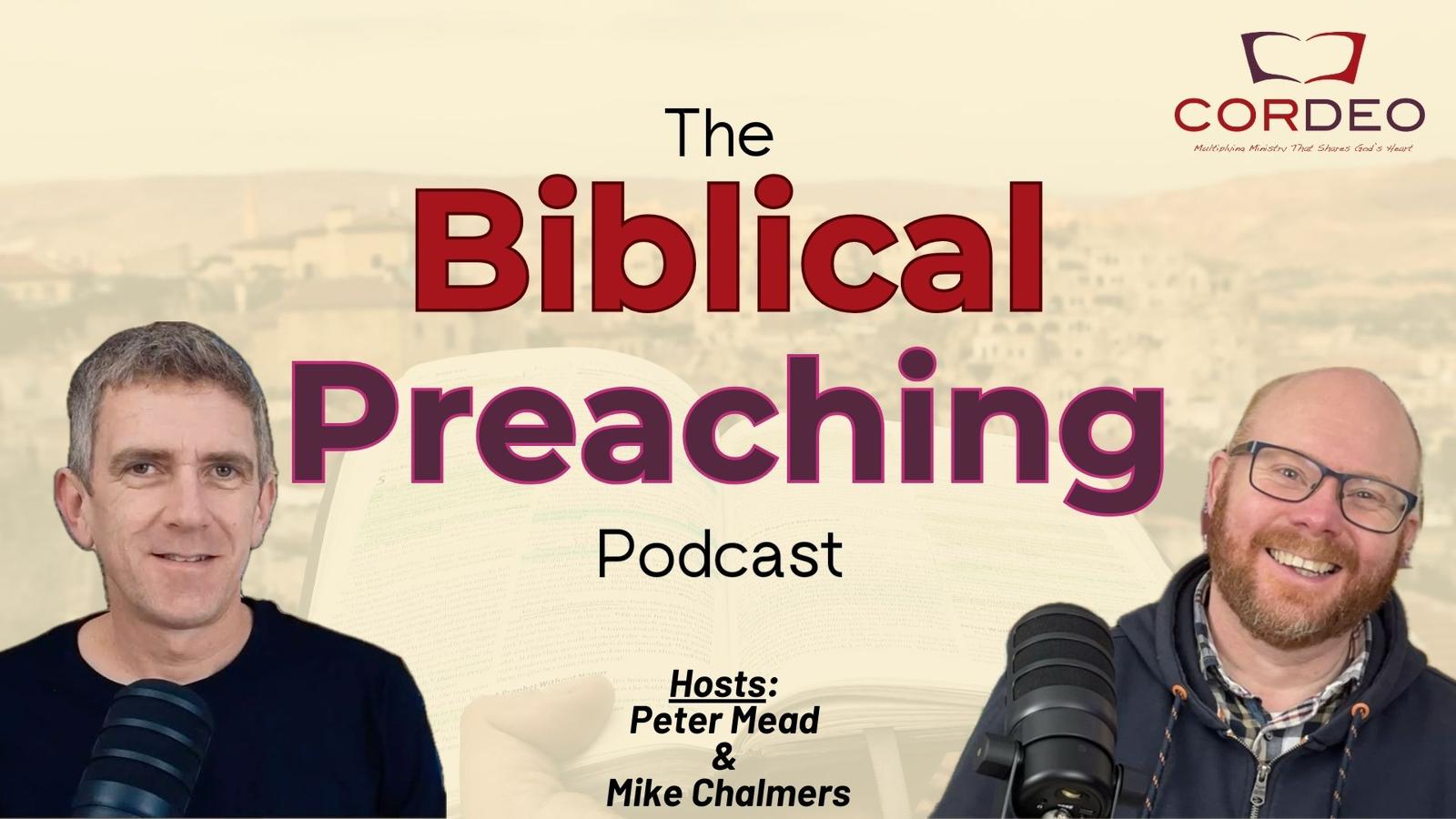
My Cor Deo colleague, Mike Chalmers, will join me as we discuss all things preaching. Together, we’ll explore this ministry’s joys, challenges, and complexities.

Here’s what you can expect:

  • Engaging Discussions: Insights into various aspects of biblical preaching.
  • Special Guests: We’ll feature some amazing voices from the world of preaching—our first guest joins us next week!
  • Encouragement for Preachers: Each full episode concludes with a segment designed to encourage those in preaching ministry.
  • Bitesize Episodes: Shorter episodes focusing on one specific aspect of preaching.
  • Related Blog Posts: From time to time, I’ll share blog posts that dive deeper into themes we discuss in an episode. These posts won’t be mere transcripts but will provide additional perspectives, practical tips, or reflections to help you take the conversation further.

Our hope and prayer for this podcast is simple: that it will strengthen and encourage biblical preaching in churches around the world. Where biblical preaching thrives, the church grows healthier, and healthy churches reach their communities.

We want this podcast to be a gathering point—a place where preachers can connect, reflect, and grow together. This is your conversation! We’ll celebrate the goodness of God, explore the transformative power of rightly handled Scripture, tackle the complex realities of ministry, and share the joy of seeing lives changed through the preached Word.


How to Listen & Connect:
🎙️ Listen to the Podcast on Your Favorite Platform:

📺 Watch Episodes on YouTube:
Subscribe to our channel for video versions of the podcast and exclusive content: YouTube Channel.

🖋️ Read the Blog
Continue to visit BiblicalPreaching.net for posts related to specific episodes, offering fresh insights and practical takeaways.


Can You Help Spread the Word?
We’d love your help in making this podcast a resource for as many people as possible! Here’s how you can support us:

  • Subscribe on your favorite podcast platform and/or to the YouTube channel.
  • Like and Comment to share your thoughts and join the conversation.
  • Follow Us for updates on new episodes and blog posts.
  • Share with your friends, fellow preachers, and anyone who might find this helpful.
  • Review the podcast on your favourite podcast platform – apparently, positive reviews are the most helpful thing!

Thank you for your prayers and support. We’re excited to see how God uses this podcast to encourage and equip preachers worldwide!

New Book Released in the USA

I am very pleased to announce that my new book, The New Birth, has now also been released in the USA.

If you would like a copy of the book and will see me in person during January/February, please ask. (I will be in Oregon, St Louis and Chicago.) To order the book from my affiliate link in the USA – click here. (To order the book from my affiliate link in the UK/Europe – click here.)

Thanks so much! I hope you enjoy the book! (Please comment on this post if you’ve read the book already, but I would also greatly appreciate any positive reviews on 10ofthose, Amazon, GoodReads, etc.)

Endorsements

“Peter Mead presents this essential doctrine in a way that warm, clear, rich, and readable. The book is accessible and engaging, and the addition of stories and reflection questions at the end of each chapter enables us to consider and imagine the way that the truth of the gospel can and should shape our lives. This is a lovely and helpful book—a great introduction to those new to or exploring faith, and a refreshing encouragement to those who have been Christians for a while.”

Ellidh Cook, Student Worker at All Souls Langham Place, London

“This tiny book conveys a huge reality: that Jesus came to raise spiritually dead people into abundant life! Peter Mead’s insights into the new birth that Jesus offers are both pastorally wise and profoundly helpful.”

Philip Miller, Senior Pastor, The Moody Church, Chicago

“When I became a Christian, I didn’t really grasp what had happened. It was an infinitely bigger deal than I realised-it was (and is) beyond my wildest dreams. Peter has given us an excellent primer into this huge adventure. This lovely, heart-warming book opens up the foundational truth of the new birth. As with the rest of the Essentials series, it is short and simple, yet full of deep and delightful teaching.”

Jonathan Thomas, pastor, author & broadcaster

“I found Peter Mead’s The New Birth contribution to the Essentials’ series most helpful, because it weaves together our story with the big story of Scripture through the lens of the work of the Holy Spirit. Taking as its anchor point Jesus’ encounter with Nicodemus, it wonderfully explains the theology and the felt experience of Christian conversion, and all along there are thrilling stories of how the Spirit transformed the likes of Spurgeon, Whitefield, C.S. Lewis, and modern men and women.”

Rico Tice, Co-Founder of Christianity Explored

We Must Not Lose Christ at Christmas

As Christmas approaches, plans are coming together—not only for family gatherings but also for church events.  Last year, our church put on a Christmas musical, which involved lots of cast, support crew, set building, costume making, songwriting, etc.  This year, we are keeping it simple with just a couple of carol services.  Whether we “go big” or “keep it simple,” there is one important ingredient that must not be forgotten.

It is so easy to have everyone frantically pulling together a Christmas production and then have nobody remembering to bring the baby for the manger.  In the same way, it is easy to be busy with Christmas plans, even Christmas preaching, and fail to keep the focus on the baby at the centre of the story.

If Jesus is forgotten for a nativity scene, then someone will be quickly despatched to go and pick up a baby doll before anyone notices.  But what happens if we lose Jesus from our Christmas, and even from our Christianity?

If the theme is Christmas, but Christ is missing, then there will be lots of peace on earth and goodwill to all men, but no basis for such a message of hope.  And if the focus is more general, then a Christianity without Jesus will descend into moral tirades and an attempt to police either church or society.  There can be no real Christianity without Christ.

And yet, it keeps on happening.  How often is the gospel presented as a moral and legal logical presentation?  “You have been bad, judgment is coming, God can help you get fixed, and there are some other benefits too…”  It might involve some presentation of truth, but the heart of the message is missing.

John Piper wrote these words in God is the Gospel:

“The critical question for our generation – and for every generation – is this: If you could have Heaven, with no sickness, and with all the friends you ever had on earth, and all the food you ever liked, and all the leisure activities you ever enjoyed, and all the natural beauties you ever saw, all the physical pleasures you ever tasted, and no human conflict or any natural disasters, could you be satisfied with Heaven, if Christ was not there?”

We have briefly considered Christmas, and Christianity in general, as well as our evangelism.  But what about on a personal level?  When Jesus is missing, we will tend to see God as distant and become increasingly self-focused.  This does not necessarily mean we will become rebellious and overtly sinful.  We might just become religious and self-righteous.  Whether in compliance or rebellion, we will become much more behavioural in our focus.

Without Jesus, we will start to see our Bibles as instruction manuals, more than God’s self-revelation.  For instance, in John 5, Jesus is rebuking the religious leaders for diligently studying their Bibles and yet missing him completely.  They would study and recite the Hebrew Scriptures, but they were blind to the self-revelation of God that should have had them excited at the arrival of Jesus.  Sadly, their study spectacles only allowed them to see the dazzling lights of self-glorification, and they missed the main focus of the Scriptures who now stood in front of them.

When we let Jesus drift out of the spotlight in our Christianity, we will lose that vital sense of the relationship with God that Jesus came to establish.  Instead of gazing on Jesus and being transformed (2 Corinthians 3:18), we will see only ourselves and drift toward self-glorifying, or self-loathing, or we will become self-appointed evaluators of others and start to inflict unhelpful pressure on others. 

There is a world of difference between Christianity with Jesus at the centre, and religion with me at the centre.  Actually, there is an eternity of difference.

As we come to another Christmas, let’s be sure to pause and allow our hearts to be wowed by the wonder of it all.  Charles Wesley’s hymn says this: “In vain the first-born seraph tries, to sound the depths of love divine!”  If angels are amazed, surely we should slow down and make sure we are too.  Can we ever fully grasp the wonder of Christmas?  Wesley’s words again, “Veiled in flesh, the godhead see, hail the incarnate deity, pleased as man with man to dwell, Jesus our Immanuel!”

Before the year is done, take a moment to stop and take stock.  Jesus has to be the centre of everything, not only at Christmas, but in all of Christianity.  He is much too precious to lose!

______________________________________________________

As we enter the month of December, click below for the advent series of videos in Pleased to Dwell – Peter’s book about the Incarnation . . .

Not a Guilt Trip

When Christians talk about the need for purity, it can easily sound like a guilt trip.  If part of our goal in ministry is tangible life change, does that make ministry a glorified guilt trip?  Or is there a more powerful motivation available?

1 John is a glorious letter written by Jesus’ disciple, John, to a church that was shaken by a church split.  The group that had left claimed to have a superior spirituality, but the genuine believers left behind were feeling bruised and doubtful about the authenticity of their faith.  Were they somehow missing out on the “real thing?”  John wrote this letter to assure them of their standing with God, their fellowship with the Trinity, and the reality of their less spectacular spiritual experience.  He writes gently and with a pastoral sensitivity.  But still, he writes with plenty of theological truth and perspective.  Then comes the beginning of chapter three, when suddenly there seems to be an emotional explosion:

“See what great love the Father has given us that we should be called God’s children—and we are!” 1 John 3:1a

In the first three verses of chapter three, John gets them to look back and to look forward.  Looking back, it is clear that we are already extravagantly loved as God’s children.  Looking forward, we discover that our revelation as the bride of Christ is still to come.  God’s “exotic” love for us provokes a purifying love in us.  Here is a motivation that far outstrips any guilt trip. Let’s look at these three verses.

Looking Back – We are already extravagantly loved as God’s children (v1). It is striking that as John is pondering great truths, it is as if the riverbanks of his intellect burst, and his heart gets flooded.  We must remember that intellectual curiosity alone is never the goal of theological or biblical study.  The truth of the gospel should regularly flood our hearts and bring its cleansing power to our motives, values and affections.  The Bible is not pushing us towards a sterile intellect and will-centred faith.  Behold the love of God!  As the hymnwriter put it: The love of God is greater far, than tongue or pen can ever tell!

The word John uses to ask the question in verse 1 is intriguing.  See what “great love” God has given us.  He uses the word that carries the sense of “Where is it from?”  After the Second World War, I imagine what it was like when some foreign foods were reintroduced after years of restrictions.  What it must have been like for those children to see and taste a banana for the first time, mango, or whatever.  “Where is this from?!”  Everything must have seemed so exotic and exciting.  That’s the thrill of looking at God’s love for us –an out-of-this-world exotic love!

For example, what would we see if we looked through John’s Gospel and thought about what God’s “exotic” love had given to us?  He gave us the right to be his children (1:12).  He gave us his Son (3:16) and the Holy Spirit (14:16).  Through Jesus, God gives us living water that satisfies (4:14) and the bread of life that fills us (6:32).  He gives us eternal life (10:28); his peace (14:27), and his word (17:14).  We also receive his Son’s name (14:27), and whatever is asked in that name (15:16; 16:23).  God gives so generously!

Could we with ink the ocean fill,
  And were the skies of parchment made;
Were every stalk on earth a quill,
  And every man a scribe by trade;
To write the love of God above
  Would drain the ocean dry;
Nor could the scroll contain the whole,
  Though stretched from sky to sky.

And this is not something we are working on or trying to achieve.  We either are God’s children, or we are not.  John continues to underline the fact for his readers, “And we are!”  What a privilege to be loved with this out-of-this-world love as God’s children!

Looking forward – we are not yet revealed as the bride, but the wedding is coming (v2-3).  Here, we have one of the most thrilling verses to ponder.  When he appears, we will see him, which will do something to us that reveals something astonishing.

Dear friends, we are God’s children now, and what we will be has not yet been revealed. We know that when he appears, we will be like him because we will see him as he is. And everyone who has this hope in him purifies himself just as he is pure.  (1 John 3:2-3)

These verses describe the final and complete sanctification experience that lies in store for every believer.  Right now, we are living in the midst of a process.  It is described in 2 Corinthians 3:18.  As we look at Jesus, we are gradually being transformed from one degree of glory to the next.  But when we see him, that ultimate vision will be so glorious it will mean a total transformation for us!

Notice that in 1 John 2:28, John writes about shrinking in shame from Jesus at his coming.  That would make sense, since we are all still marred by sin.  But he is writing to give them assurance, not condemnation. 

So, what is it about seeing Jesus fully that will bring about such a total transformation?  I believe the full realization of every longing will burn away every possible alternative.  Just imagine every appetite you have, every craving, every hope, every desire, every taste, every hint of what is good.  Try to picture how our hearts have been stirred by creation – a stunning sunset, a breathtaking thunderstorm, a beautiful frosted spider web.  Try to imagine how your very human heart has been stirred by feasting with friends and family, by the touch of poetry, by travel shows on TV, or by picturesque country living magazines—a lifetime of longings.  But then we will see him as he is and discover that Jesus is more than enough to satisfy every last longing of our hearts!  After all, he has satisfied the Father’s loving heart for all eternity; how much more will he satisfy ours?  Seeing Jesus is our ultimate hope!

The anticipation of seeing him is the motivation we need to put our energy into living a pure and godly life now in this age.  It is not a guilt trip – ‘you should do, or else!’  It is a motivated heart – ‘I get to because my hope is in seeing him, not in any of the idolatrous replacements I can invest in now.’

The motivation for this hope is like when a guest comes to visit your home.  You are excited to see them, so you clean and tidy the house before they arrive.  Actually, it is greater than that – it is like your grown child coming home from a year abroad.  No, more than that, it is like when your spouse has been away for a few days, so you invest time and energy into cleaning the house before they arrive.  Actually, biblically speaking, our hope motivates us in the same way that someone is motivated by the approaching reality of their wedding day!  After all, we live as children of God now, waiting for the return of our bridegroom to take us to be with him – the marriage supper of the lamb and the arrival at the home prepared for us, and being together forever.

“Everyone who has this hope in him purifies himself.” (1 John 3:3)

____________________________________________________________

Please see Peter’s book, from Christian Focus, looking at the great theme of God’s marriage throughout the Bible: