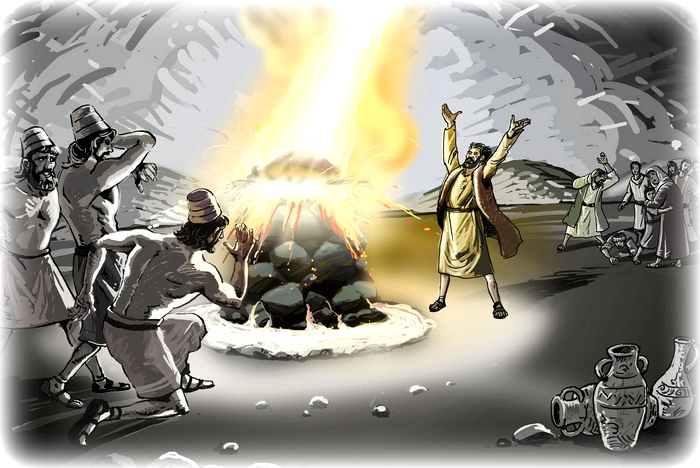
Following a recent set of posts on this site, I’ve added a further piece on the Cor Deo blog. Should we bring back Ba’al? I have no desire to promote any despotic and demonic deities, but I do wonder if we are too quick to assume that people are on the same page when it comes to the term “God.” As preachers this is critical. I was listening to Mike Reeves again recently at Transformission (click here to find Mike’s talks), and he made a very clear point in his first talk about why the good news isn’t typically perceived to be good news by the world around us: because of the god they think we are inviting them to. Anyway, should we bring back the ba’als? Click here to see today’s post . . .
Christianity
Easier to Read One
The other day I spent a great morning with a friend reading through some fairly weighty church history. For a couple of hours we stretched our thinking and responded with heavy hearts to an in-depth overview of medieval theology. One paragraph in particular caught my attention and my mind went back to this blog, especially in light of the Lit! review a couple of days ago.
I won’t try to give all the details here, but essentially the book was engaging a debate over the state of theological thought in the fourteenth and fifteenth centuries. Was the fourteenth century about decline into chaos, or was it heading toward the harvest of medieval theology? And then what happened in the fifteenth century? Was it all progress and growth, or was there largely a retreat to the great masters of the thirteenth century? And our thoughts should go on to consider what really happened in the sixteenth century as well – was that all progress, or was there some significant relapses there too?
Your brain might be stretching trying figure out who was around in those centuries, but that’s not the point, here’s the sentence:
[The intellectual decline is attributed to] “the indolence of ‘easy-going scholars,’ who found it ‘so much more convenient to study one author rather than ten or twenty.'”
Ok, one more bit, then back to today:
Like war-weary Europeans who surrendered to strong-arm rule in the late fifteenth century, many argument-weary scholars appear to have given their minds passively to the intellectual giants of the past on the eve of the Reformation.
So fast forward to today. For most Christians, the preacher is the closest they typically come to a Christian scholar. But the question that sits up to be answered is fairly obvious, I think. Is my church being fed by preacher(s) who are enriched by good reading, or by preacher(s) who are “easy-going scholars?” It is, after all, so much more convenient to study one author rather than ten or twenty.
If you’ve read this site with any sort of frequency, I’m sure you’ll have noticed that my real passion is to get preachers to genuinely preach the Word (rather than just preaching from, or using, or in association with, the Word).
But I would also encourage wider reading too. Some preachers hardly read anything, and there is a “thin-ness” to their ministry. Other preachers constantly read one author, and there is a “superficial tone of emulation” in their ministry. Let’s be preachers who read, who read widely, who read quality, and who read so as not to give our minds passively to intellectual giants of the past, or the present.
Book Review: Lit! by Tony Reinke
Lit! – A Christian Guide to Reading Books by Tony Reinke is bordering on a must read for preachers and church leaders. Years ago it was a given that leaders have to be readers, but today I wonder if we’ve not bought into the notion that leaders have to be too busy to be real readers. Headlines? Yes. Emails? Of course. Web browser? Certainly. Blogs? Staying in touch. Books? Uh, too busy, sorry.
This book is a thoroughly enjoyable pithy little promo for the right kind of reading. The first half of the book lays a theological foundation for books and reading. The second half offers nine dynamite chapters of practical wisdom to help the motivated reader become a real reader.
When we commit ourselves to literature rather than a superficial spinning through surface hype, we find a richness of personal enlightenment that is truly of God. Reinke doesn’t advocate an only-Christian book approach to reading, but he does clearly recognize two categories of books in the world. The Bible. And everything else.
The book engages with what to read, as well as how to read. It addresses issues of conscience, of priorities, of benefits. And it does it all in an engaging energetic manner that makes you want to keep reading, and pick up something else, something good, to read at the same time (if only that were possible!)
Should we read non-Christian books? Absolutely – at least, the best of them, if we already have a well-formed biblical worldview (which I think he assumes too easily and most readers would also assume naively). In fact, Reinke gives biblical examples of reading non-biblical authors as well as a couple of giants from church history on the subject.
Actually, with a passionate commitment to reading like Reinke, we are having to leave behind over 10,000 books for every one that we choose. So we need to choose well, read discerningly, and benefit as fully as possible.
I’ve been struck many times by how many people do not read wisely. “I can’t buy another book until I’ve finished the last one I started . . . three years ago!” Bad logic. Preachers need to be reading and we can’t afford to get log-jammed by a bothersome book.
Randy Alcorn writes of Lit! : “Seldom have I enjoyed a book more than this one.” I concur. Hence I read it in a day. I think your ministry would be blessed if you enjoyed it too.
(If you are in the UK, click here to buy book.)
I Like To Pick a Prophet or Two
When did you last preach a series from one of the writing prophets? When did you last lay open a minor prophet in a single session? I think God gave us a great squad to choose from with the 16 in the canon. Here are five reasons why I like to pick a prophet or two:
1. God’s Heart on the Sleeve – This is the big one for me. The prophets don’t keep you waiting to let you know what is on God’s heart. They were wonderful communicators of God’s passion, concern, anger, love, etc. In a church deeply stained by centuries of stoic thinking, it is a delight to offer the fullness of God’s affections, passions, compassion, emotion.
2. Punchy Relevance in Abundance – The prophets weren’t under the impression that their job was to fill a sermon slot with an informative soliloquy. They cried out to God’s people in specific application to their pain, their misery, their complacency, their present reality. Preaching on overtly applied texts tends to stir greater levels of contemporary relevance today too.
3. Messianic Goldmine in Places – This is what they’re famous for, of course. It’s a delight to preach of the Servant of the Lord, or of Immanuel, or of Zerubbabel’s signet ring, or of the New Covenant blessings. I’d be careful not to cherry pick the messianic predictions, but to preach them in their full context for full effect. We have a wonderful Christ, so preach the prophets!
4. Thematic Contrasts and Crescendos Galore – Like a stunning diamond on black velvet, so read the prophets. Impending judgment flowing into kingdom hope. Human sin overwhelming, then God’s grace superabundant. Faithless people, faithful God. Doom! Salvation! Darkness! Glory! The bulging muscular arm and clenched fist of the Lord! The tender shepherd holding the little ones close to His beating heart!
5. Novelty Value for Jaded Listeners – Perhaps they’ve heard stories from the gospels for months on end. Maybe they are saturated in epistolary logic. Perchance they have experienced the odd dip into Isaiah 6, 40, and 53. But what about Ezekiel 16, or Jeremiah 20, or Hosea, or Zephaniah? Typically the prophets, presuming they are well preached, will get a good hearing because listeners aren’t used to hearing them.
There you go, five reasons why I like to pick a prophet or two.