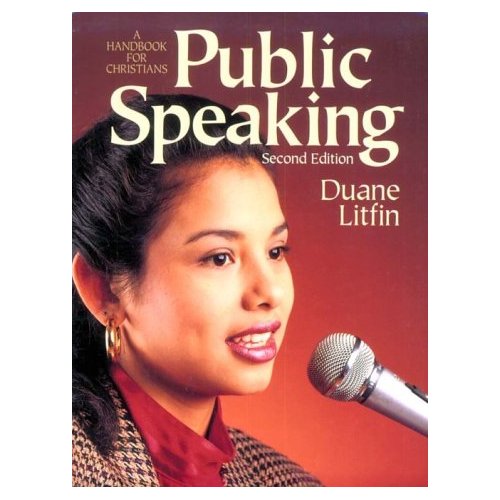
This is a college text focusing on speech communication, rather than homiletics. The main reason it may be worth reading is because it is built on the Haddon Robinson “Big Idea” preaching model. Robinson’s influence is evident throughout, not only conceptually, but also in specifics.
Since Litfin’s work is not primarily focused on preaching, he is able to challenge the reader to produce latently Christian communication in a variety of fields, a challenge perhaps we in ministry need to hear. Litfin does well to show what an audience centered communication approach looks like, including the factors that make for easier listening (such as concrete, familiar, suspenseful, interesting, humorous and life-related elements). The introduction of other elements of communication such as proxemics, paralanguage and so on add a dimension perhaps weak or lacking in many preaching texts.
Litfin’s emphasis on the importance and function of the idea reinforce Robinson’s work, but the text also goes beyond Robinson to mention other approaches to speech formulation.
Litfin’s final chapter addresses the issue of preparing a Bible message. This chapter provides a helpful and relatively succinct summary of the process of homiletics (at least in reference to preparation). Litfin’s seven steps largely parallel Robinson’s, except for introducing audience need earlier in the process. Introducing audience need prior to writing the speech idea – the same stance taken on this site, seems like the correct order if the Big Idea is to be stated with relevance to the audience.
This book is a useful book for reinforcing and amplifying some aspects of Robinson’s work. For a speech com class, this is a great text. For preachers? It is helpful if you feel the need for help to fully grasp Robinson’s work. Not a preaching text, but not a bad source of supplemental reading.
 Biblical Preaching