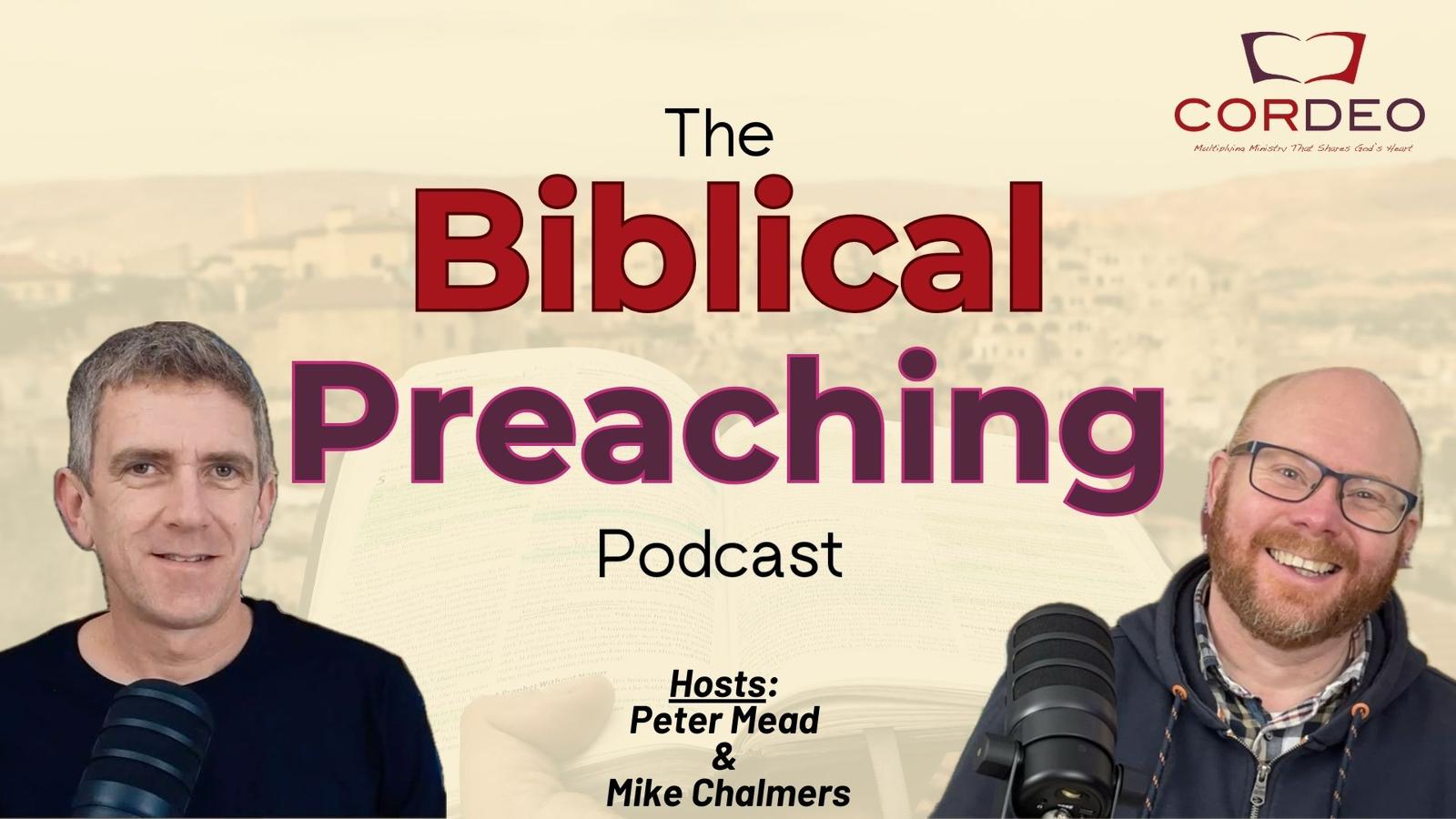
Introducing the Biblical Preaching Podcast!

I’m excited to announce the launch of our brand-new podcast: The Biblical Preaching Podcast! Unlike the many great sermon podcasts, this podcast is designed for those who preach, those who are learning to preach, and anyone who cares deeply about the ministry of preaching.

My Cor Deo colleague, Mike Chalmers, will join me as we discuss all things preaching. Together, we’ll explore this ministry’s joys, challenges, and complexities.

Here’s what you can expect:

  • Engaging Discussions: Insights into various aspects of biblical preaching.
  • Special Guests: We’ll feature some amazing voices from the world of preaching—our first guest joins us next week!
  • Encouragement for Preachers: Each full episode concludes with a segment designed to encourage those in preaching ministry.
  • Bitesize Episodes: Shorter episodes focusing on one specific aspect of preaching.
  • Related Blog Posts: From time to time, I’ll share blog posts that dive deeper into themes we discuss in an episode. These posts won’t be mere transcripts but will provide additional perspectives, practical tips, or reflections to help you take the conversation further.

Our hope and prayer for this podcast is simple: that it will strengthen and encourage biblical preaching in churches around the world. Where biblical preaching thrives, the church grows healthier, and healthy churches reach their communities.

We want this podcast to be a gathering point—a place where preachers can connect, reflect, and grow together. This is your conversation! We’ll celebrate the goodness of God, explore the transformative power of rightly handled Scripture, tackle the complex realities of ministry, and share the joy of seeing lives changed through the preached Word.


How to Listen & Connect:
🎙️ Listen to the Podcast on Your Favorite Platform:

📺 Watch Episodes on YouTube:
Subscribe to our channel for video versions of the podcast and exclusive content: YouTube Channel.

🖋️ Read the Blog
Continue to visit BiblicalPreaching.net for posts related to specific episodes, offering fresh insights and practical takeaways.


Can You Help Spread the Word?
We’d love your help in making this podcast a resource for as many people as possible! Here’s how you can support us:

  • Subscribe on your favorite podcast platform and/or to the YouTube channel.
  • Like and Comment to share your thoughts and join the conversation.
  • Follow Us for updates on new episodes and blog posts.
  • Share with your friends, fellow preachers, and anyone who might find this helpful.
  • Review the podcast on your favourite podcast platform – apparently, positive reviews are the most helpful thing!

Thank you for your prayers and support. We’re excited to see how God uses this podcast to encourage and equip preachers worldwide!

Are We Trying To Be Too Clever?

With 2024 now consigned to the history books, we are launching into 2025.  Inevitably, a new year tends to bring at least a small burst of new energy.  Externally, we may joke about others joining gyms and going through the standard routine of resolution and then inevitable failure.  However, we may still feel motivated internally to start the year well.  So, what is your approach to the new year?

I think we often look for sophisticated solutions to complicated problems.  Are we trying to be too clever?  In reality, the basics are usually the most fruitful focus.

For instance, we assume that taking a new and obscure supplement or getting a new piece of exercise equipment will help us achieve our health goals.  But we will probably accomplish a lot more by focusing on eating whole foods, moving more, and sleeping better.

Or, we can think that our ministry challenges will be unlocked by a key lesson we have never encountered before, so we hunt for the book or the seminar that will bring that critical insight.  But 2025 will be far more fruitful if we focus on hearing from God, praying, and investing in people.  These things are the basic stuff of ministry.

And what about on a personal level?  I think we would all benefit from a “back to basics” mindset as we launch into another new year:

Relationally – It is really about time.  Spend time with your spouse, children, and key friends (and there may be some other meaningful relationships, perhaps your parents).  The world is continuing to bombard us with time-saving technology that seems to suck all time away from meaningful relationships.  So make the deliberate and courageously counter-cultural step of going for a walk with your spouse, getting on the floor to have fun with your child, taking your teen out for lunch, or sharing some downtime with a friend.  If necessary, turn your phone off too – this “appointment” may be the most important in your day. 

Theologically – A few years ago, I wrote the book Foundations.  I looked at the apostles’ speeches in Acts.  I demonstrated how their first concerns were to answer foundational questions rather than to impress their listeners with sophisticated complexity.  I am more convinced than ever that our theological energy is best spent chasing four basic questions: what is God like?  What does it mean to be human?  What is our problem?  What is God’s solution to our problem?  As we prayerfully pursue better answers to these basic root questions, we will find abundant fruit all over the tree of our lives.

Spiritually – And if your spiritual health is critical for all aspects of your ministry in the home and beyond, what would a “back to basics” approach look like?  It isn’t complicated.  Surely it means hearing from God by being in the Word, speaking to God in prayer, responding to God in worship, and ensuring you invest in authentic and life-giving relationships with other believers, too.

Every year, in the UK, we have to take our cars for the annual “health check” required of every vehicle on the road.  We occasionally get a token physical “health check” from our medical system.  Why not take the New Year as an opportunity to take stock of the basics of life?  It may not seem very sophisticated or feel particularly clever.  Still, actually, it is the basic changes that bear the most fruit.

____________________________________________________________

Coming soon . . . a new podcast for all who preach or care about biblical preaching – watch this space!

The Strongest Arm

Where do we turn when we are troubled?  Whether that is a personal struggle, a complicated situation at church, or a concerning development in the world, we should turn to the Bible.  Sometimes, we find a specific verse that resonates and lingers within us.  Other times, the treasure we need will come from a more purposeful digging into a theme or concept.  As more people realise that our world is teetering on the edge of political and societal collapse, let’s find help by mining the blessing of just one word in one Bible book.

The Hebrew term translated as “arm” is found in Isaiah more than any other Old Testament book.  Fourteen times, it refers to the arm of the LORD.  Could it be what we need to lift our spirits in troubling times?

The Image Introduced: The Two Functions of the Arm

The term is only found twice in Isaiah 1-39.  The first time, in Isaiah 30:30, it is used to describe lightning crashing down on the mountain of the LORD.  Just as thunder is God’s majestic voice, lightning is the descent of “God’s arm.” The enemies of God should fear because the LORD himself is guaranteed to win in battle.  In Isaiah 33:2, the second use comes in the cry of God’s people as they ask him to be gracious, to “be our arm every morning, our salvation in the time of trouble.” God’s arm is indeed his strength as he steps in to fight against the enemies of his people, but for his people, his arm is their salvation, a symbol of their hope. 

At the start of Isaiah 40-66, we again meet this double image of the LORD’s arm.  In chapter 40, as the Babylonian exile is anticipated, the prophet looks forward to the hope of returning to Zion, where God himself will dwell.  They hope to look to him, to “Behold your God!” (Isa. 40:9)  What are they looking at?  The Lord GOD comes with might, his arm ruling for him (an image of strength and an instrument of justice); this is their God (Isa. 40:10).  But this strong arm is also secure.  He gathers his flock like a shepherd, holding the lambs in his arms close to his chest (Isa. 40:11).  The arm of the LORD is an instrument of justice to be feared by all nations and yet the means of deliverance for his people.

There are two clusters of references to the arm of the LORD in the later chapters of Isaiah.  The two themes of salvation and justice remain paired throughout the book; however, the first cluster of references focuses on God’s saving work, and the second cluster focuses on God’s judging work.

Cluster One: The Surprising Arm of Salvation (chapters 49-53)

Isaiah 40-66 consists of three sets of nine chapters, each ending with a promise of judgment for the wicked (see 48:22; 57:21; 66:24).  At the end of the first set of nine chapters, which offers a strong contrast between the living and speaking God of Judah and the dead and dumb idols of Babylon, we find another reference to the arm of the LORD.  God has indeed called his people, loving them and simultaneously judging the Chaldeans with his arm outstretched against them (Isa. 48:14). That arm becomes very evident in the following chapters.

With the focus on the Servant of the LORD (see Isa. 49:1-6), the contrast shifts onto the sin of God’s people versus the obedience of the LORD’s Servant.  Repeatedly, God is shown to be a God of justice and salvation.  Thus, “my arms will judge the peoples,” and the far-off nations wait for “my arm” (Isa. 51:5).  While creation itself may wear out, God’s salvation and righteousness will be forever.  And so the cry rings out for the arm of the LORD to “awake” and “put on strength” (Isa. 51:9).  It was the arm of the LORD that delivered Israel from Egypt in the past. It will deliver them again in that future return from exile.

As the oracle continues into chapter 52, the good news of salvation reaches Jerusalem, and the watchmen sing for joy.  The LORD has comforted Zion (Isa. 52:9, cf. 40:1); all the ends of the earth will see his salvation.  Why?  Because “The LORD has bared his holy arm before the eyes of all the nations.” (Isa. 52:10).  He has rolled up his sleeves to act before the eyes of the whole world.  The following reference must be climactic.  What will God do?  The last reference in this cluster comes, poignantly, in the final servant song, in Isaiah 52:13-53:12.  At the start of the second stanza, Isaiah asks, “Who has believed what he has heard from us?  And to whom has the arm of the Lord been revealed?” (Isa. 53:1). Surprisingly, the powerful saving arm of God has been revealed in the unimpressive Servant, despised and rejected by men, the man of sorrows.  We know the arm of the LORD can bring salvation; we need only remember the cross of Christ to see that reality revealed to all who have eyes to see.

Cluster Two: The Powerful Arm of Righteousness (chapters 59-63)

Of course, the story of human sin persists, and the later chapters of Isaiah reinforce that the Servant’s saving work does not mean that sin’s effects are already finished.  When we come to Isaiah 59, we find a litany of evils persisting, and human nature is still set against God’s holiness.  In Isaiah 59:15-16, the LORD sees the sin, the lack of justice, and the absence of righteousness, and he is displeased.  So, while no humans would do the right thing, God himself, by his own arm, brought salvation and righteousness.  The same pair of goals, established by the same strong arm, yet again.  Could this refer back to the same events described in chapters 51-53?  Perhaps, but there is a hint of vengeance now, a tone of final judgment.  This eschatological focus becomes more evident as the chapters progress.

By chapter 62, it is clear that the LORD is seeing the return of the people to the land in final and complete terms. Jerusalem’s righteousness and salvation must ultimately shine forth (Isa. 62:1).  The nations will finally see that Israel is God’s delight, a nation married to him (Isa. 62:4).  The establishment of Jerusalem is the great eschatological goal of Isaiah, with the nations praising what God has done (Isa. 62:7).  And this plan is guaranteed by the LORD’s oath, which is made by his right hand and mighty arm (Isa. 62:8).

The celebration of the city feels like the end of the story. But then, Isaiah introduces a warrior riding in from Edom, his garments stained blood red (Isa. 63:1).  Here is the one who has made it all possible by treading the winepress alone.  This Warrior is the Servant of Isaiah 53, now having returned to conquer and judge, to fight God’s great battle, and to establish righteousness and salvation on the earth.  He had looked for others to join in, but again, he fought that battle alone, and his “own arm” brought him salvation (Isa. 63:5).  The Servant had returned, now a Warrior: a different role, but the same mighty arm.  This was the same “glorious arm” that had formerly fought for Israel in the wilderness in the days of Moses, dividing the waters and going before his people.  (Isa. 63:12)

Conclusion

Isaiah paints a powerful portrait of the LORD of Israel.  One feature of this God is his arm, awakening and going forth in power to establish righteousness and achieve salvation for his people.  The arm of the LORD is a symbol of might and power, a glorious arm that the nations should fear, and yet a symbol of tender strength that God’s people should trust.  In the first cluster of references, in Isaiah 48-53, we find the arm revealed surprisingly in the suffering Servant, despised and rejected, yet achieving God’s great salvation plan.  In the second cluster of references, in Isaiah 59-63, we find the arm revealed again, now in the conquering Warrior-King, judging the enemies of God and establishing God’s great eschatological plan for his people. 

In the past, the arm of the LORD went forth for Israel in the wilderness.  Then the arm of the LORD was revealed in the suffering Servant at the cross.  Ultimately, the arm of the LORD will conquer and establish God’s purposes in the future. 

Righteousness and salvation are ever God’s dual concerns.  The nations are ever his sphere of influence.  His people are ever his beloved focus.  And his arm is never too short to save.

So what about today?  With sin ramping up to apparently unprecedented levels in abject rebellion against God’s rule and the world seemingly teetering on the edge of human-led disaster, let us again look for the arm of our LORD.  He is mighty to judge, and he is tender to save.  His plans will be established, the nations will be judged, and we will be safely in his arms.

Let us dig into the Scriptures to find truths about our God that will assure us that his embrace is secure, whatever may be happening in the world around us.

The Thirties – Part 6 (Contemporary Shifts)

In the last post, we brought out the question sitting in the shadows throughout this series of posts.  What part did the church play in allowing the Nazi takeover of Germany?  We can never know what would have happened if more stood up and overtly resisted.  But that is one of the critical questions we must wrestle with in our day.  First, when will we stop supporting the general direction of travel?  Second, how will we resist?

Whatever we may feel is the driving force behind the changes, we surely must get our heads out of the sand and recognise the shifts that are taking place.  There are moral shifts regarding gender, sexuality and crime.  There are human rights shifts regarding free speech, free movement, the right to assemble, and bodily autonomy.  There are ideological shifts in respect to traditional religions, cult-like agendas, and globalist unaccountable power grabs.  The world could be a very different place in a very short time.

Morality and change – Even before the full extent of their atrocities were revealed, people knew the Nazi morality. “The Nazis claim that all that is beneficial to the German people is right.” (p192)  This, of course, meant that they could do whatever they liked.  When right and wrong are redefined, a culture is under threat.  We live in a culture where you are judged to be a threat to progress if your actions, words, and even thoughts do not support the approved narrative, the dominant ideology, or the power imposing religion. 

Why do people assume that the freedom of speech, freedom of religion, and freedom to disagree will persist when those asserting their power are committed to a different morality?  If any try speaking against certain sanctions and medications, kneeling ceremonies, well-known religions, or theories in climate science, then they soon discover that there are consequences in our day.  There has been a major shift in the ethical foundations of our society – we must not pretend otherwise.

Democracy and change – People naively believe that societies change from good to bad in free and fair elections.  Sometimes that has happened.  But revolutionary change tends to require a crisis. “On the day after the Reichstag fire, a new law ‘for the protection of the people and the state against communist acts of violence’ was made public.  It had been obviously prepared beforehand. … This law deprived every citizen of his few remaining civil rights and left him at the mercy of the new masters and their heavily armed sluggers now elevated to the rank of authority. Person and home were no longer inviolate. Privacy of mail, telephone and telegram had ceased to exist. Freedom of speech, press and assembly was a thing of the past.” (p215)  It was not an election that changed everything but a manufactured crisis.  A crisis means that change can be imposed ‘for the good’ of the people. 

Individuals as the threat to change – As with every tyrannical takeover and revolutionary moment, the free-thinking individual is an instant threat to the people in power.  Germany had “confined itself to the deliberate destruction of the rights of all those who think independently and come to conclusions different from those of the masters of the Third Reich.” (p230)  We see the same thing when Communist revolutions grab hold of a country – immediately the useful idiots who helped create the crisis are a threat to be discarded, along with the educated, the religious leaders, the writers, the influencers.

The Nazis considered the “fourth battlefield” to be enemies from within the state.  So, they used the SS troops to bear arms freely as they brought terror and control to the nation.  The SA “brown shirts” were more of an accessory to the Nazis but were used either in uniform or in everyday clothes “to arouse enthusiasm among the masses.” The jubilant masses described by foreign press correspondents were usually “well-rehearsed SA formations.” They would create disturbances outside Jewish-run businesses, where the Gestapo would sweep in to arrest the owners for their own protection and dispatch them off to concentration camps.  Then, the SA performance would quiet down.  (See p250-251)

The recurring theme of thought crime came out strongly in the book: “None of those imprisoned under the pretext of protective confinement had committed crimes. Their only guilt in the eyes of the Nazis was to have opinions contrary to Nazi creed.” (p338)  A society can never be considered free when people are punished for holding specific opinions.

Is change a surprise? It is easy to assume that the German people were unaware of the evils of the Nazi regime until the secrets were revealed after the end of the Third Reich and the humbling death of Hitler in his bunker. “Again it must be emphasised, that everything that has taken place within the last five years has been publicly and repeatedly proclaimed by the Nazi regime long before it came to pass.  Only the degree in which early predictions have been fulfilled is a matter of surprise.” (p267)  I can’t help but wonder if such published predictions were also disparagingly called conspiracy theories a century ago.  There does seem to be a pattern – troubling things are proclaimed and published, the media run a different narrative, people quote those troubling things, the media decry those people as quacks and conspiracy nuts.  And then, sometimes very quickly, those troubling things turn out to be true.

In the next post in this series, we will consider more parallels to our time.

The Echo of Easter

I recently imagined a global tour that could be called the “tour of the tombs.”  That might not sound too exciting, but it would include great cities in Europe, the Middle East, Africa, Asia, and North America!  Were we to travel that itinerary, we would see the burial sites of philosophers and Pharaohs, Kings and Emperors, religious leaders and mass murderers.  It would be quite the tour!  And along the way, we would get an inadvertent “tour of the troubles.”  After all, Europe, Asia, the Middle East, etc., are all marked by political protests, persecution, death, wars, and terrorism.  The world of today is not so different from the world of our history books.

In the first century, the events of one Sunday led to one of the greatest books ever written.  Imagine being John, possibly the youngest of Jesus’ disciples.  For three years, being with Jesus had transformed his life.  He was there when Jesus taught, healed, and shook the world.  John was there when Jesus was arrested and crucified.  He was there the day Jesus rose from the dead and met with his disciples.  John was there when Jesus met the group by the Sea of Galilee, when he uttered the Great Commission, and when he ascended into heaven.

The three years were over, but for the next six decades, John served his beloved Jesus.  He saw the gospel spreading in Jerusalem and the persecution that arose.  He saw his brother and the other disciples systematically slaughtered over the following decades.  He lived beyond the destruction of Jerusalem, the dispersion of the Jewish people, and the rise of nasty Emperor Domitian.  John lived for six decades serving Jesus.  And it was for preaching Jesus that John was sent to the penal colony of Patmos in his old age.

Then, one Sunday morning towards the end of the first century, John heard the voice of the risen Jesus (see Revelation 1:9-11).  The voice commissioned him to write everything he saw so that the Revelation of Jesus might be sent to the seven churches John cared about in Asia Minor.

If you look at the introduction to that book, the book of Revelation (1:1-8), you will find that John believed it to be a uniquely special book.  In a dark and troubling world, it offered grace and peace from the eternal God, especially the risen and victorious Son, Jesus Christ.  John underlined how Jesus revealed the Father, has risen from the dead, rules over the kings of the Earth, has rescued sinners from this world, and, in the future, will return.  The Revelation of Jesus Christ was exactly what the aged John needed.  It is what we need, too.

So what was it that John saw?  When we read through Revelation 1:12-20, how Jesus is portrayed is striking. 

The risen Jesus is impressively powerful.  He is impressively dressed, with a God-like description of his features.  There is the eternal wisdom seen in the white hair, the penetrating eyes, the judging feet and mouth, the thundering voice, and the brighter-than-the-sun face.  It might be really obvious, but this is no description of a corpse.  Jesus is very much alive and impressively powerful.  If we think of the tour of the troubles in this world, what hope do we find in the many tombs of emperors and kings?  None.  But one tomb is empty, and death has been defeated – Jesus holds the keys of death and Hades!  We all need to be gripped by the wondrous vision of Revelation 1.  But don’t skim through the description too quickly.  Jesus is not only impressively powerful, but he also explains the cryptic imagery of lampstands and stars that appear in that vision, leading us to reconsider all those powerful features.

The risen Jesus is intimately present. I wonder how many times John had remembered Jesus’ words, “I am with you always, to the end of the age.” (Matthew 28:20)  Surely, those words had meant a lot during the difficult days when the apostles were being killed, when the Middle East was being rearranged, when John’s ministry in Asia was being opposed, when persecution was rising, and when John suffered on the prison island, kept away from the people he loved.  Jesus had promised to be present, and he was.  And now, this entire book was pointed in the direction of those seven churches.  When John turned, he saw Jesus walking in the midst of the lampstands, that is, the churches.  Jesus was present with John and with the churches.

Specifically, Jesus wore the clothing of a high priest (Rev. 1:13).  We can surmise that he was praying for the churches.  His features point to the purifying work of this high priest (Rev. 1:14-15) – the penetrating eyes, the feet ready to stamp out sin, etc.  And his thunderous voice proclaims boldly to the church (Rev. 1:15-16).  It is interesting that this is no whisper, but like the sound of many waters pounding on the shore – it makes me wonder how many of those churches had closed their ears to the words of Christ by closing their Bibles.  How many churches today are doing the same?

Jesus is risen; he is alive.  The Easter truth transforms our experience of this troubled world.  And the vision described in Revelation 1 declares a vital message.  The risen Jesus is both impressively powerful, and intimately present in the church today.  We need not despair at what we see around us.  We can look back to the empty tomb.  We can look forward to the return of Christ.  And we can look up, knowing that our great High Priest is praying for us, purifying his church, and proclaiming his word to this day.  Easter echoes down through the years. He is risen.  He is alive.  He is powerful and present.

Food and Following (Matthew 9:9-17)

It seems like food is significant in every culture.  Whether a culture is known internationally for its food or not, something about sitting down together to eat carries more significance than the mere fuelling of the body or renting restaurant space for a meeting.  In Jesus’ time, it is evident that table fellowship mattered greatly.

In Matthew 9:9, Jesus called Matthew from the tax booth to a new life as a follower of Jesus.  That may seem like a familiar idea to us, but having such despised sinners as followers was a radical act by Jesus.  Who deserves to be his follower?  Who deserves to be his apprentice, learn from him, become like him, relate to him, and be launched into a life of ministry representing him?  Did Matthew deserve it?  Do you or I deserve it?  May we never lose the wonder of the call to be his followers!

Immediately, we read of Jesus reclining at the table with many tax collectors and sinners.  Luke’s account points out that Matthew laid out a “great feast,” although Matthew was too humble to mention that detail.  (Luke 5:29)

The Fellowship Question (Matthew 9:10-13) – The meal sparked a fairly obvious food-related question – who should Jesus eat with?  To the religious evaluators, it was obvious that Jesus should not be eating with tax collectors and sinners. Indeed, they were the ones who’d earned the invite to the special meal.

I was recently with a pastor whose church seeks to reach out to the marginalized and the maligned of society.  He took my family to dinner, and we enjoyed a wonderful meal together at his favourite restaurant.  He told us how, when his church had started, they hired this restaurant and filled it with people who may never have eaten in a restaurant before.  The feast was a gift.  The gift was not just the food; it was a fantastic way to get to know a Jesus who would sit and eat with societal nobodies like Matthew’s friends.

It is interesting how Jesus responded to the question.  He differentiated between those who are healthy and those who are sick.  It is the sick who know they need the help of the physician.  After all, whoever says, “Let me allow my broken ankle to heal, and then I will head for the hospital,” or “Let me wait for this abdominal pain to pass before I go and get checked out?”  It makes no sense to hold back when you know you need help.

Jesus called the religious to soften their hearts toward those who knew their spiritual need.

The Fasting Question (Matthew 9:14-17) – Matthew follows up with another food-related question.  Why do Jesus’ followers eat?  Some of John the Baptist’s disciples wanted to know about fasting.  After all, the Pharisees were promoters of the Old Testament Law and promoted fasting.  Then, they were followers of the final Old Testament prophet and were into fasting, too.  So, indeed, if Jesus were a step forward religiously, he would promote fasting even more.  The Law, the Prophets, and now came Jesus; therefore, his followers should be fasting extra!  But they missed something: Jesus was not just another step forward. He was the goal of it all!

Jesus spoke in wedding terms.  A wedding day is not a normal day.  You never walk into a wedding reception and expect to find people fasting.  It is a day of feasting!  It cannot be a typical day when the bridegroom is present! 

Jesus went on to give two everyday examples to make a point.  Nobody would put a piece of unshrunk cloth onto an old garment because it would self-destruct when it got wet and dried again.  Everyone knew that.  Likewise, nobody would put new wine into old, hard, shrunk, leathery wineskins.  Again, it would self-destruct when the wine fermented and expanded.  Everyone knew that, too.  So, to Jesus’ point – his work was not just another step forward in the Old Testament line of promise.  It was the launch of something profoundly new that could not be contained in the old framework.

We may not be from a Jewish background and tempted to try to squeeze the radically new gift of New Covenant life into the framework of the Old Covenant.  But actually, we are all tempted to try to add the new life Jesus offers into the old way of religious effort that always characterizes humanity.  It is so easy to think that becoming a Christian adds a few more responsibilities onto my to-do list of moral efforts for respectable living.  However, that is not how it works.  It is a radically new life.

Jesus came to transform our lives by his presence.  He calls us to live a radically new life as his followers.  We are called to be with him, enjoy time together, learn from him, and be transformed from inside to out.  We are called to feast in joy because he has come.  We are called to fast in earnest because he is currently away.  Jesus is not asking you to become more religious; he is offering something far more radical than that.

As our thoughts are drawn to the first Easter, remember the radical nature of all that Jesus has done for us.  And then don’t settle for a modified version of religious living.  We get to follow the risen Christ through the year ahead.  Jesus offers a radically new life to really needy folks like you and me.

Nowhere, Now!

What is the greatest commitment we see in our world today?  Is it the commitment of a classical musician, or a sports professional?  They say it takes 10,000 hours of practice to really master any skill.  Apparently, it takes nine to twelve months of specialist training to be ready to attempt to climb Mt Everest. While the idea of commitment may be dismissed by so many in our society, there are still countless people dedicating themselves to various pursuits.

In Matthew 8:18-22, Jesus speaks about commitment at an extraordinary level.  After three chapters of the Sermon on the Mount (chapters 5-7), Matthew seems to be shifting to an all-action presentation of Jesus performing healing miracles.  He heals the leper, the centurion’s servant, and Peter’s mother-in-law.  It feels like we have left the teaching block behind and settled down for an action-adventure section of the Gospel.  But then we come to these few verses and two powerful sayings of Jesus about commitment.  

Essentially, Jesus declares that to follow him means to belong nowhere and the demand is to follow now.

Now when Jesus saw a crowd around him, he gave orders to go over to the other side. And a scribe came up and said to him, “Teacher, I will follow you wherever you go.” And Jesus said to him, “Foxes have holes, and birds of the air have nests, but the Son of Man has nowhere to lay his head.” 

Matthew 8:18-20

Belong Nowhere! – The scribe sounded so committed.  He would follow Jesus anywhere!  But Jesus pointed to the rhythm of creaturely life.  A fox?  It gets up and puts in a night shift touring its territory, marking the boundaries, catching a vole or two, enjoying some worms and bugs, even feasting on some berries if the opportunity arises.  Then, when its work is done, it returns to its hole and lays down its head to sleep.  Work done, it heads for home.

Just to reinforce the point, Jesus mentions birds too.  They wake up nice and early, some get in a singing practice before dawn, then head out and fly the skies looking for food.  Some catch flies mid-air, others swoop down for voles and mice, while others prefer seeds and worms.  Then, when their work is done, they return to their nest and lay down their heads to sleep.  Work done, they head for home.

Every creature is the same.  Including humans.  Wake up, work, head home, and sleep.  But not Jesus.  His work never seemed to be done.  When he finished healing Peter’s mother-in-law, then many more were brought to him late into the evening.  When he headed out early to a deserted place, he sometimes found crowds looking to get more from him there too.  And Jesus was not home.  We never read of him heading back to Nazareth for a home-cooked meal with mother Mary. 

To follow Jesus is not about a shift and then back to base for some relaxation and creaturely comforts.  To follow Jesus means to belong nowhere in this world.  It means we are not really at home in our home town, nor if we move to the other side of the world in missionary service.  If we follow Jesus, then our citizenship is in heaven, and our home town is still in the future (Philippians 3:18-21; Hebrews 11:13-16). 

These are challenging words, especially if we have grown too much at home in this world.

Another of the disciples said to him, “Lord, let me first go and bury my father.”  And Jesus said to him, “Follow me, and leave the dead to bury their own dead.”

Matthew 8:21-22

Follow Now! – The disciple’s request seems reasonable.  Surely, Jesus is not against family funerals, is he?  I don’t believe he is.  The point here is a striking one.  Nothing can come before following him.  Not a funeral that is scheduled for next week, nor a Jewish reburial in a few months, or even an anticipated death in order to collect an inheritance (all are explanations given for this cryptic moment in the text).  As Jesus said elsewhere, if we are to follow him, then we must first hate everything we hold dear.  Jesus wants his followers to honor their parents and so hatred seems extreme, but that is the point.  There can be nothing that comes first.

How often we can fall into the same problem?  Not so much with funerals, but with other things.  “I will be completely committed to Jesus, but first I . . . “  What?  What comes first?  Career first?  Promotion first?  Payrise and then folks will see my dedication to Jesus?  Or maybe family first?  Once married, once there are children, once they are grown, then the commitment will show?  Of what about fun first?  So many say they will live a little and be committed to Jesus when only a little life is left in this world.  Bucket lists get elevated to the level of an idol as Jesus is left to wait his turn.

No.  To follow Jesus at all means that we need to follow him now.  Not later.  Not after.  Now.

Reasonable Demand? – How can Jesus be so demanding and expect us to belong nowhere and follow now?  The demand is so extreme.  But the key is to look at who is saying the words.

Jesus had no home in this world.  He left his eternal home and entered into this world in the most humble of circumstances.  He was born in a peasant town and laid in a manger.  He was an infant refugee in Egypt, then grew up in Nazareth – a place with a rubbish reputation.  Nazareth was a rest stop on the way to somewhere better.  And then, once he launched into his ministry years, he had no home of his own in this world. 

Jesus’ work never seemed to be done.  He had nowhere to lay his head, not only because of a lack of address, but also because his work demanded so much.  There was always another person to heal, another demon to cast out, another crowd to feed, another dispute among the disciples to unpick, another conflicted conversation to navigate.  His work, his mission demanded so much.  Actually, it demanded everything.

As we read through the Gospels we find that Jesus did eventually lay down his head.  When was that?  It was in John 19:30, when his mission was accomplished, when he cried out “It is finished!” and then lay down his head and gave up his spirit.

The reason that we should take Jesus’ demand so seriously is because his mission cost him everything.  Since he gave his all for us, his call is for us to give everything in response.  Belong nowhere in this world, and follow now.  Nothing else would make sense in light of who said it.

Is Our View of Satan Too Small?

I have noticed something strange.  Many Christians will acknowledge the existence and the general agenda of Satan.  They will affirm that he is alive and active on planet Earth.  Yes, they recognize that he hates God and God’s people.  Yes, he hates truth and wants to steal, kill and destroy.  Yes, he wants to tempt us into rebellion, crush us under guilt, and destroy all that is good, beautiful and anything that has even the faintest reflection of God’s character. 

And yet, oddly, as quickly as those affirmations are made, that awareness seems to evaporate just as quickly.  For many Christians, the devil appears to be a very limited antagonist.  He might get some vague credit (for want of a better term) for any temptation we consciously notice. Still, he gets specific credit for very little activity. 

For example, suppose the subject of the occult is raised with the related concepts of devil worship, seances, fortune telling, etc. Many will shudder and point to the enemy’s works in that case.  But is that the whole story?  Is Satan just tempting us as individuals and running a relatively obscure dark religious operation? 

Let’s take a few moments to review some essential biblical background. 

Origins of Satan – The name Satan means adversary and came to be applied to the greatest adversary of all – the devil.  It is a well-earned label!

What we know of his origins is described primarily in Ezekiel 28:11-19, where it is clear that prideful arrogance was the key driver of his original fall from perfection.  Since his fall, his primary domain has been Earth and Sheol.  We see him cursed by God in Genesis 3 – the one whose goal was to be the most high became the most low, eating dirt close to the underworld.

Influence in the world – The big question in this post essentially relates to his influence.  According to 1 John 5:19, the whole world is under the control of the evil one.  He is called the ‘prince of this world’ on several occasions (John 12:31; 14:30; 16:11).  He influences through lies, especially the original lie that we humans can be like God, and he masquerades as an angel of light, deceiving people (John 8:44; 2 Corinthians 11:14).  There are plenty of people whose spiritual father is the devil, and it is possible to identify them by their actions and their lack of love (John 8:44; Matthew 13:36-40; Acts 13:10; Ephesians 2:2; 1 John 3:10)

Influence over nations – He rules the nations and tried to strike a deal with Jesus in exchange for Jesus bowing down to him. Still, Jesus did not affirm his ultimate ownership of the nations and did not bow down.  Jesus knew and trusted that, at the right time, the Father would give the nations to him.  (See Matthew 4:10.)  Jesus confronted the power of evil by casting out demons from people. It is evident that Satan commands the realms of darkness (see 1 John 3:8).  What Jesus began in his ministry, he is continuing – building his church and the “gates of hell” continue to be unable to resist the onslaught.  Satan is on the defensive. 

Influence in the Church – Paul wrote to the Romans, “The God of peace will soon crush Satan under your feet.” (Romans 16:20). Yet, it would be naïve to assume that Satan does not influence the church.  While our minds might go to Judas Iscariot, whom Satan influenced (John 13:2) and then entered (John 13:27), we do not need to live in fear of being taken over by the evil one.  We belong to God, who is greater than the one who is in the world (1 John 4:4).  However, we should recognize that discord, anger, unforgiveness and resentment can provide an opportunity to the devil, and we should actively resist him (James 4:7; 1 Peter 5:8-9).

Our hope as the spiritual war rages – Because of Jesus’ victory over the rulers and authorities on the cross (see Colossians 2:13-15), Satan’s power of death is now broken (see Hebrews 2:14-15).  We now know that death is swallowed up in victory (1 Corinthians 15:54).  And yet, the one who comes only to steal and kill and destroy does not give up easily (John 10:10).  His ultimate downfall is already determined; he will be thrown into the lake of fire (Revelation 20:10).  In the meantime, he fights on.  Indeed, as his time gets short, we might expect him to offer a big final push, but we know the end of the story.

The hole in our spiritual warfare – So, what is missing in our understanding of the spiritual battle that we are in?  Satan exists and is active on earth.  Yes, he does tempt us and would delight to see us derailed by sin and defiled by discord.  And yes, the occult does exist, and some people are drawn into religious acts of pure evil.  But at the start of this post, I suggested our view of Satan may be too small.  Is Satan just tempting us as individuals and running a relatively obscure dark religious operation? 

To be candid, I have been struck by how much we are inclined to bury our heads in the sand regarding evil in this world. “Oh yes,” people will affirm, “Satan is real, and we are in a spiritual battle.” But mention some specific aspects of society and watch the response change:

Could there be evil at work in news reporting designed to shape our thinking? “No way, we can trust the news media.” 

Might the enemy be shaping education to harm children?

Don’t be ridiculous!”

What about medical professionals who seem driven by something other than ‘first do no harm?’

“Of course not! The doctors I know are good people.”  

What about government decisions that seem to benefit them but harm people and cost lives?

Absolutely not!  They have our best interests at heart.” 

What about unelected and unaccountable groups of the hyper-rich and influential seeking to gain control over ordinary people?

If such groups exist, then I’m sure they mean well.”

What about influential people who have publicly declared the global population needs to be reduced by whatever means?

Of course not; they only want to help the poor!”

What about the entertainment industry that so fills our consciousness?

Oh, but I like him, she’s my favourite, etc.”

It does not mean much to acknowledge that Satan is real and active if we then immediately deny that he could be at work in almost every layer of human authority and influence.  And I would suggest we are utterly naïve if we don’t believe that the prevailing paradigm of our day, with its “lofty opinion raised against the knowledge of God”, is influenced by Satan.  (See 2 Corinthians 10:3-6) 

In the past, Christians seemed ready to recognize the malevolence of hedonism or materialism as it confronted our worldview in the so-called “Christian West” or the evils of totalitarian regimes in the East.  But today, too many Christians seem happy to play along with and believe the best about media-driven narratives concerning identity politics, critical theories, social justice, weather worship, globalist agendas, neo-communist ideologies, uncontrolled immigration and encroaching violent religion.  Are we sure that we should ‘believe the best’ and ‘affirm the good’ in all the ideas swirling around and in all the layers of authority setting themselves up over us?

Perhaps it is time for us to fix our eyes on Jesus and recognize that we are genuine outsiders in this world and that we will be hated by it. And yet we are here as ambassadors to represent God’s truth, to share the hope of Jesus, to stand for what is right and to not love our lives even unto death. Let’s stop smiling at the devil as if he is an insignificant foe.  Let us instead armour up, stand firm, be ready to speak, be prayerful as if we are in a war (for we are), and when we have done everything we can, to stand.

(HT – https://www.logos.com/grow/satan-in-the-bible/ )

The Heart of Hermeneutics – Part 3

How Does Hermeneutics Require Love?

Last time we looked at John 5 and Jesus’ critique of the Jewish leadership.  They were eminent Bible scholars, but something was missing.  They could well have been an example to us in terms of observing the text, technically interpreting the text, and fastidiously applying the text.  They thought that in the Scriptures they would find life.  But they were missing the person revealed there.

For the Jewish leadership, there was apparently confidence in the inductive process.  However, their incurved hearts spelled the corruption of that process.  They did not see the person, and the reason was a heart issue.  Why is the heart so often left out of hermeneutics?

A More Complete Process

A complete approach to biblical study needs more than “look, learn, live.”  We need to put the heart back into our hermeneutics.  What does the text say?  What does the text mean?  What should the text stir?  What difference should the text make? 

Look —- Learn —- Love —- Live

When we lose the sense that the biblical text is primarily revealing a person, and that the intent of the author is to stir the reader’s heart in response, then our approach will necessarily fall short.  Even if we progress from “back then” and arrive at “for today,” we can end up with something stripped of its relational dynamic.

Principles and Morals

In a process that is blind to the significance of the heart, some will end up with just an abiding theological principle.  This statement of truth and instruction is what remains after traversing the millennia from back then to our own time.  Others will end up with a “moral of the story.” 

That’s what people do with old stories.  Since the people are all dead in history, or figments of fiction that will soon fade from memory, at least there is a lasting lesson for us all.  So, our children might enter the land of make-believe for an old tale, but what remains when the story ends and it is time to sleep?  Well, the moral of the story is that we should be like the tortoise, or don’t speak to strangers who look like wolves or witches, or whatever.  These may well be good life lessons well worth learning.

And what of the people in the pew?  After entering the world of a Bible story in the sermon, they must then re-enter normal life.  As the story fades and present reality dawns, at least they can carry an abiding theological principle into their week. 

The Bible is Not a Fable

But isn’t the Bible different?  Is not the goal of the Bible something more than divinely sanctioned and historically accurate Aesop’s fables?  It is critical that we keep clear the ultimate purpose of Scripture – to reveal the living God, his heart, his plan, his Son.

In the next post, I will suggest a relational responsive hermeneutical checklist to enliven the critical love stage of the Bible study process.

Love, In the Church

The most famous literary description of love is surely 1 Corinthians 13.  It has been read aloud at countless weddings, and yet, it was not written for a wedding.  It was written for a church.  Actually, it was written for a struggling and divided church in Corinth.  This was a church that was splintered by factions, by immature Christians flaunting their supposed superiority, and by a whole host of interpersonal tensions and issues.  This was the church into which Paul unleashed “the love chapter!”

The chapter sits at the heart of a section addressing the right use of spiritual gifts in the church.  It begins by underlining the necessity of love (v 1-3) and ends with the never-ending reality of love (v 8-13).  And at the heart of the chapter, in verses 4-7, we find a familiar and poetic depiction of the nature of love.  In just four verses, Paul offers fifteen descriptions of love.

Their world, like ours, was a confusing melee of ideas when it came to love.  There was romance, passion (appropriately marital and many harmful alternatives), family, and friendship.  I don’t know whether they used “love” to speak of food and sport, quite like we do in English, but let’s not imagine their culture was any less confused than ours.  In the face of that confusion, Paul offered a confrontation with God’s kind of love.

What do we do with a list like this?  Our tendency is to see it as a behavioural checklist and to consider it as a suggestion for greater effort on our part.  The problem is, not only do we all fall short of God’s perfect love, but we are unable to self-generate genuine godly love.  We can only love, John tells us, because God first loved us (1 John 4:19).  So, while it may look like a list of descriptions, actually, Paul wrote it as a list of verbs.  This is love dressed up and going to work! 

So, as we consider this love in action, we should let it confront our own areas of lack, but also point us to the only one who perfectly lived out God’s love in this world.  Let this list point you to Jesus, and then let his love flow more freely in your local church setting.  As we look to Christ’s love, it will stir Christlike love in us.  And when the body of Christ starts to look like Christ, we can pray for the church to have an impact like Christ!

1. Paul begins with a basic foundation: Love gives.  He begins his list with two positive statements: love is patient and love is kind (v 4a).  Patience here speaks of having a long-fuse with other people, giving them space and time, instead of flaring up at the first opportunity.  Patience is partnered with kindness, which gives of our own usefulness for the higher good of the other.  A loving church is a place where grace infiltrates every relationship.  Grace for the weaknesses of others, and grace that gives of ourselves to build them up.  Love gives.

2. Paul zeroes in on the Corinthian core issue: Love is not selfish.  His list shifts into a sequence of nine points, most of which are negative.  The central thought in this list of nine points is like a summary of the whole section: love is not self-seeking (v 5b).  Ever since the Garden of Eden, we humans have been largely unaware of how self-oriented our hearts now are, by nature.  Our selfishness is built-in from birth, but it is only because our nature is fallen.  It seems so normal to seek our own good, but God’s design is love that is not self-seeking.  (Look at the Trinity for the greatest example of this: how consistently does the Father lovingly honour the Son, and vice versa?  Our God is a God who lovingly and selflessly lifts up the other, and the good news is that can even include us!)

Before and after that central thought, Paul offers two sets of four descriptions of love.  When there are differences between us, love does not self-elevate (v 4b-5a).  It does not envy what others have, longing for self to be satisfied by that salary, that house, that spouse, etc.  Neither does love boast, trying to make the other person long for my ability, possessions, or strengths.  Love is not arrogant, puffing up self to push others down.  And love does not disregard accepted standards of behaviour to elevate self and so disregard and dishonour others.  Some versions have “love is not rude” at this point.  That might bring to mind inappropriate vocabulary or noises at the dining table.  But Paul’s word goes beyond the odd little social faux pas.  It is the same word used for unnatural sexual relations in Romans 1.  It is that casting off of restraint and acceptable norms, because, well, because I want to . . . so I should.  Actually, love wouldn’t.

And when there are problems between us, love does not self-protect (v 5c-6).  Love is not easily angered, that is, it is not irritable and touchy.  If we take any of Paul’s negatives and pursue the opposite, we will discover a painful loneliness.  Now, there is a place in the Bible for legitimate provocation.  Jesus was provoked by death at Lazarus’ tomb, and Paul was provoked in spirit by the idols of Athens.  Luther was provoked by a false view of God and so launched the Reformation, and Wilberforce was so provoked he sought to end the slave trade.  Maybe today many of us have grown too nice before the provocations of society, but perhaps still too easily angered at little personal slights in church life.  Love is not easily angered in church fellowship.  When people say and do wrong things, love lets the grievances go instead of inscribing them in our internal memory ledger of grudges against others.  And when those people that grate on us turn out to be sinners in some way or other, love does not rejoice in their sin.  Rather, it rejoices in what is true – God’s love for them, their position in God’s family, their gifting, and their key role in our lives. 

3. Paul points them beyond any notion of personal ability because true love relies on God (v 7).  Undoubtedly, Paul is offering a literary flourish to complete the list.  The last four descriptions add the word “always” or “all things.”  It feels good to the ear, but if you consider it carefully, it feels impossible to the heart.  How can I always protect?  The idea is to cover, like the seal on a ship that keeps all water out.  One commentator describes the idea of “throwing a blanket of silence over the failings of others.”  Obviously, there are legal and moral exceptions to this.  But as a general rule, when I am annoyed, provoked, antagonized, and bothered, love will keep that sin hidden from others who do not need to know about it.  Paul points upwards to God – love always trusts and always hopes.  That is not easy.  And back to the struggles here below again, it always perseveres.  That kind of persistent endurance of inter-church tensions can easily take us beyond ourselves. 

Paul’s great list is a bit like the Law of Sinai.  A wonderful revelation of what is right and good, but beyond our ability to keep.  And so, let 1 Corinthians 13 not only confront your struggle to love like Jesus.  Let it also point you to Jesus.  We can only love at all because God has first loved us.  May our hearts be so captivated by his love that our churches increasingly look like the body of Christ!  We can only live this life in the flesh by faith in the Son of God, who loved us and gave himself for us.

Love is patient, love is kind.

~

It does not envy, it does not boast, it is not proud. It does not dishonor others,

it is not self-seeking,

it is not easily angered, it keeps no record of wrongs. Love does not delight in evil but rejoices with the truth.

~

It always protects, always trusts, always hopes, always perseveres.

1 Corinthians 13:4–7 (NIV)

_________________________________________________________

If this playlist of videos about Bible study is helpful, please like, comment, share and subscribe – thanks!