10 Biggest Big Ideas – 5. Faith

So what are the biggest recurring ideas underlying the whole sweep of Scripture?  I am enjoying tracing out a few thoughts on ten of the biggest.  So far I’ve pondered our triune God, His wondrous creation, our profound fall, His glorious grace.  Now to the mechanism of our restoration:

5. Every person in every situation stands at a fork in the road, free to trust God’s good word or to orient their hearts after the words of another – for the just shall live by faith.

In that garden the first couple were presented with a lie.  It was a lie about God’s character: He cannot be trusted to determine what is best for you.  It was a lie about human status: you can be like God.  And in God’s apparent absence it was a battle of words: His word versus the lie.  It has been ever since.

Every person in every narrative of Scripture stands at a fork in the road.  We stand continually at that same fork in the road, whatever the situation.  The question remains the same.  Will we trust the good word of God, or the forked tongue of the serpent.  The truth versus the lie.

What is God’s solution to the great problem of sin?  It is His grace.  Yet it would be no solution if that grace were forced on people.  They freely chose to love another.  So God offers His word and invites us to trust, drawing our hearts from the magnetic captivating grip of self-love to respond to His self-giving love.  Faced with the lie, gripped by the lie, saturated in the lie, we are invited to trust His Word.

Faith?  Seriously God, will you make it all dependent on fallen ones trusting in your Word?  Yes.  The word of God’s promise can be trusted.  The Word of God’s presence calls us to trust.  Just as the serpent skewered and lifted up was a solution for snake-bitten sinners, so the snake crushing elevation of Him who knew no sin becomes for us the focus of a trusting gaze.

So faith is absolutely the antithesis of works.  Works can never be a ladder out of death.  Only God can raise the dead, so He calls humanity not to work, but to trust.  Faith is not the answer to what must I do?  Faith is the answer to the cry, I can do nothing!

God is God, we are not.  God is good, we are not.  And God is ours, if we will trust Him, His word, His provision, His grace.  Faith is trust in His Word.  Faith is gaze on His gracious provision.  Faith is the bond that brings us into the fellowship of our Triune God.

May our preaching of His Word offer opportunity to trust in His goodness, both for those dead in sin, and for us who now having been made alive are delightd to do the good that He prepared beforehand for us.

Add to FacebookAdd to DiggAdd to Del.icio.usAdd to StumbleuponAdd to RedditAdd to BlinklistAdd to TwitterAdd to TechnoratiAdd to Yahoo BuzzAdd to NewsvineLike This!

10 Biggest Big Ideas – 3. Sin

The 10 biggest ideas in the Bible?  We’ve considered God and His creation.  Now we need to probe the problem.

3. Our profound capacity for love has been perverted into a self-love that drives a charade of independent divine status, in mockery of and in sickening rebellion against the loving leadership of our good God.

Within three biblical chapters God’s perfect creation is corrupted to the core.  It is corrupted from the core.  And the story of God’s resolution to our relational rebellion takes the whole canon to fully resolve, leaving only two chapters for the briefest glimpse of a post-fall new creation.  This is the great tension in the grandest of meta-narratives.

Lovingly created for relational interdependence and trusting dependence, the human race is marred by love perverted and trust destroyed.  The manifestation of the fall, the fruit, if you will, was in the eating of the forbidden fruit.  Yet the core of the event was at the level of the heart, not merely a matter of rule-breaking.  The corruption was caused by a love turned inwards, by a rebellious spurning of God’s right to rule in love, and by a fatal distrust of His good Word.

A God-given capacity to love another, delight in another, live for another, trust in another and give to another was twisted, perverted and corrupted.  It became the horrific reorientation of the power of divine love into a love of divine power – shamefully manifesting in a love for self, delight in self, living for self, trusting in self and giving to self.

Now the god of a human heart is the perceived good of that same human heart.  Instead of lovingly trusting a loving and trustworthy self-giving God, the default wiring of humanity is to hate and despise Him, performing the charade of god-hood as if that is really about self-concern, independence and power.  Even the pathetic performance shows a profound corruption of God’s true nature.

Believing the lie, we present a lie.  Every person a theologian by birth, and every person profoundly wrong.  God is not self-concerned and power-obsessed – it’s not just the “who is God?” question we answer so badly, but also the “what is God like?” question.

Sin re-orients the heart, taints the mind and manifests in broken behavior.  Some shake their fist at heaven in acts of overt rebellion, demonstrating the horrific and grotesque nature of sin by the evil that they do.  Others shake their fist at heaven in an act of apparent goodness, diligently demonstrating their ability to do good in a self-loving independence from the God who alone is good.   Even righteous deeds are as filthy rags.  Whatever is of independent un-faith is sin.

Sin is the tension in every biblical narrative, and every personal narrative.  It isn’t a question about whether we can do good, or whether we can be empowered to do good.  It is a question about what or who can ever recapture our hearts and draw our incurved souls from addiction to self, to gaze on the truly lovely, the genuinely loving and the profoundly trustworthy God who made us for participation in His love.

So as we preach the Bible we must never miss the fallen condition focus of every passage, the context of sin in which every text swims.  Neither must we offer any sense of instruction for independent goodness, for that was the root of the issue.  Sin is pervasive and profound, and God’s solution is glorious beyond words.  Yet we preach.  We preach . . . you finish the sentence: “we preach . . . and Him . . . .”

Add to FacebookAdd to DiggAdd to Del.icio.usAdd to StumbleuponAdd to RedditAdd to BlinklistAdd to TwitterAdd to TechnoratiAdd to Yahoo BuzzAdd to NewsvineLike This!

Saturday Short Thought: Glorious Gospel

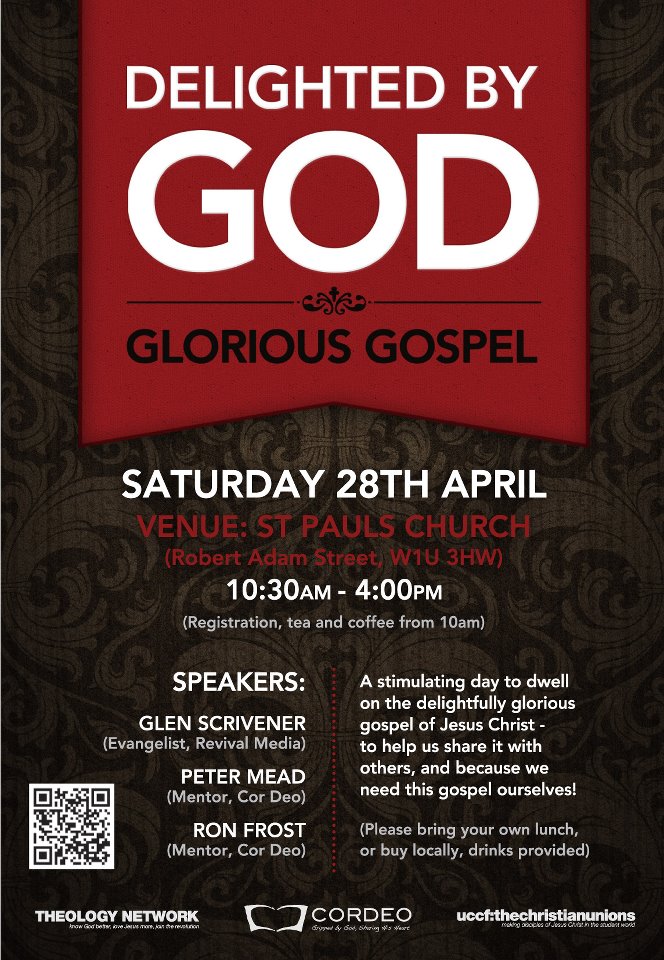
In a little while I’m heading to London to speak at a Cor Deo Delighted by God conference.  Our subtitle for the day is Glorious Gospel.  I am excited to hear the other sessions and to ponder together just how glorious the gospel really is.

What it comes down to, I suppose, is how glorious our God is, and what kind of gospel He has given us.  Too often the presentation of the gospel I hear is less than glorious.

It seems like a negotiation between a willing sinner and a reticent God.  The sinner is willing to say some words in order to gain a significant package of benefits.  And God is open to some sort of a contractual deal, but really is essentially resistant without the intervention of a kind lawyer working for us.

This is such a corruption of the truth.  God’s initiative is critical, and the extent to which He has gone to overcome the resistance of the human heart is stunning.  And as for the language of contracts, let’s dump that in the grip of His fatherly embrace!

The gospel is wondrously glorious, but it’s the kind of glory that involves His being high and lifted up, in absolute self-giving humiliation.

Let’s be sure we don’t preach a watered down, or petty, or negotiated gospel.

PS We’d really appreciate your prayers for today’s conference to go well!

_______________________

Next Week: The 10 Biggest Big Ideas

In the classroom Haddon Robinson said more than once that there are basically eight to ten big big ideas in the Bible.  He never gave us a list, but I’ll offer mine starting on Monday.  What would you include?

Bible Clarity and Preaching Clarity

The doctrine of the clarity of Scripture does not mean that the Bible is instantly clear, or equally clear to all, or fully clear to anyone.  What it does mean is that the Bible can be understood.

I’ve often made the passing remark in teaching settings that the authors of the Bible were neither drunk nor wasteful.  That is, they were coherent in their thoughts, and efficient in their writing.  They didn’t waste words or papyrus, they wrote in order to be understood by their intended audience.

But their is a greater Author involved too.  He is the master communicator and He made sure the Bible communicates exactly what He wants communicated, down to the very last word.  Praise God that He is a communicating God to the core of His triunity!  He is not a glory-hungry despot who communicates with impenetrable complexity in order to make us feel small!

This truth does not negate the necessary work involved in making sense of the Bible.  We do have to cross a significant historical, geographical, political, religious, cultural and linguistic divide.  It does take effort, and prayer, and time, to make sense of the Bible.  But no matter how tough some parts may be, it can be understood!

So what are some implications of the doctrine of biblical clarity for preachers?

1. Preachers have to work at understanding the Bible, there is no excuse for making up our own message (ab)using a passage.  When we preach our own message from a passage, we subtly give the impression that the text is not there to be understood, but abused.  Don’t be surprised when listeners copy our textual abuse patterns and come up with ideas we don’t like.

2. Preachers don’t have to make every detail instantly understandable to listeners, but we should be breeding confidence that study leads to understanding.  The doctrine of the clarity of Scripture does not imply that God is patronizing.  We don’t need to be, either.  Some parts are very tough, acknowledge this, don’t fudge.  There is much more that can be understood than is seemingly impregnable – help people see this.

3. Preachers are representing a God who made His book understandable, we should model a passion for clarity in our communication.  We don’t represent Him well when we make our message dense, impregnable or overly complex.

Tomorrow I will add one more aspect that is perhaps the most crucial of all.

Add to FacebookAdd to DiggAdd to Del.icio.usAdd to StumbleuponAdd to RedditAdd to BlinklistAdd to TwitterAdd to TechnoratiAdd to Yahoo BuzzAdd to NewsvineLike This!

Saturday Short Thought: Reinforcing Every Time

This week I have been pondering how to preach with a more developed set of motivational tools than just the pressure of guilt.  I’m convinced this is an important issue, and not just a homiletical detail.  It gets to the heart of our faith.

Is Christianity really and primarily about our responsibility to function in our own strength?  Is Christianity about how, thanks to Christ, I can now become a good person?  Is Christianity about creating good independent citizens, or is there the hiss of Genesis 3 in this version of the faith?

What if Christianity is much more about our response to Christ and His work in our lives?  What if Christianity is about transformation from the inside out, born of a family relationship that changes our hearts and consequently, our behaviour?  What if Christianity is not at all about independence, but dependence and inter-dependence?

The tension of duty versus delight is present in every sermon.  Do I pressure people to perform, or do I offer the vision of Him who transforms?

Responsibility preaching throttles the life out of the gospel.  Response preaching offers true life.  Our preaching subtly reinforces one view of the gospel or the other, every time.

Add to FacebookAdd to DiggAdd to Del.icio.usAdd to StumbleuponAdd to RedditAdd to BlinklistAdd to TwitterAdd to TechnoratiAdd to Yahoo BuzzAdd to NewsvineLike This!

Beyond Guilt – Part 4

Some preachers rely exclusively on the pressure tactic of guilt in their preaching.  Surely there must be a more biblically rounded approach?  This week I’ve suggested we need to consider our stance, our tone and yesterday, our strategy.  Let me offer the fourth factor today:

4. The Preacher’s Vision.  Essentially, when we boil it down, what are we offering when we preach?  Ok, the message of the text.  So there will be an individuality to each message since every text is unique.  But what does the Bible offer – even allowing for each text to be its own unique entity in the tapestry of the whole?

If you think the Bible offers instructions for living, your preaching will reflect that.  If you think the Bible offers engaging ancient stories with helpful morals, then your preaching will reflect that.  But if you think the Bible offers a vision of the heart and character and grace and personality of God, then your preaching will reflect that.

To put this another way, what is the good news offered in the Word?  Is it the good news of a way in which a sinful humanity can now be empowered to live a more righteous life – that is, a gospel that somehow misses God out?  Or is it the good news of who God is, offering a sinful humanity the privilege of relationship with Him who to know is life, and who to know will transform a life?

I wish this were so obvious that I didn’t see the need to write the post, but I have heard sermons where God is essentially, or even actually, omitted and absent.  These are the kind of messages I might see as party political speeches, or “if only people would be good society would be better” messages, etc.  There are many types of speeches in the world today, but the ones where God is at most a bit-part player are not the kind of speeches we need in the church.

If the vision captivating the preacher’s heart is the Law, then the message will likely be a guilt focused message.  If the vision captivating the preacher’s heart is the grace and love of a loving God, then the message is likely to be more compelling, more transformative.  After all, the gospel involves the transformation of lives from the inside out, not by the pressure of responsibility, but by the attractive invitation to respond to the goodness of our so very good God.

The vision captivating you will show in your preaching, and if it is the vision of the God who reveals Himself throughout His Word, then I suspect you will offer that same vision in your preaching – a vision that alone can truly transform lives.

Add to FacebookAdd to DiggAdd to Del.icio.usAdd to StumbleuponAdd to RedditAdd to BlinklistAdd to TwitterAdd to TechnoratiAdd to Yahoo BuzzAdd to NewsvineLike This!

Beyond Guilt

A friend asked me how we can preach to encourage listeners apart from making them feel guilty.  He and I would both recognize the need for genuine conviction of sin, a work of the Spirit and a feature of some texts (and therefore some messages).  But I understand the need for the question – too much preaching relies too much on guilt as the primary, or even the only, change mechanism.

Guilt is a poor motivator.  The Spirit of God certainly does bring conviction to people, to me.  An absence of conviction of sin in a life is an indication of a real problem.  But there is much more to the Spirit’s work than just conviction of sin.  There is much more to life transformation than guilt.

As I read the Bible I find myself convicted, yes, but also stirred, inspired, encouraged, enlightened, intrigued, reassured, enlivened, thrilled, calmed, galvanized, spurred, moved, attracted, delighted, renewed, transformed, changed.

God uses the Bible to change lives, and He changes lives by more than just guilt.  So how, as a preacher of God’s Word, can I beneficially engage the lives of listeners with more than just a guilt session?

This week I’d like to offer several elements of an answer to this question.

1. The Preacher’s Stance.  Where do we stand?  Guilt-only approaches tend to take a domineering and confrontational stance.  This comes through sometimes before a word is even spoken.  It shows in demeanour, in expression, in attitude.  It may be justified in terms of the authority of God’s Word, etc., but it is worth rethinking.

I would suggest a stance that is empathetic rather than confrontational, although there is a place for the latter.  I am not suggesting the preacher stands amongst the listeners as a sympathetic fellow-struggler with nothing more than shared struggle.  We do stand with God’s Word and so do have something very profound to offer.  But we also stand as recipients of that Word.

Sometimes our talk of authority can lead us to authoritarian approaches.  Yes, God’s Word has authority and as I preach God’s Word there is a “thus saith the Lord” aspect.  But it is right here that some betray their narrow view of God and come right back to a guilt-only approach.  That is, they see God as being purely authoritarian and a guilt-approach-only Deity.

Thus saith the Lord.  We represent Him.  How did God reveal His own character, personality, values, etc.?  On Sinai, through the prophets, in Christ?  God didn’t just come as a pounding fist.

We should consider the stance we take as one standing and speaking God’s Word, while at the same time being one standing as a recipient of God’s Word.  If our stance is simply a “lording it over” stance then we betray a worldly passion for power that reflects a twisted view of God Himself.

Tomorrow I’ll add another element to consider in pursuing how to preach with more than just guilt.

Add to FacebookAdd to DiggAdd to Del.icio.usAdd to StumbleuponAdd to RedditAdd to BlinklistAdd to TwitterAdd to TechnoratiAdd to Yahoo BuzzAdd to NewsvineLike This!

Profound Preparation

This week I’d like to ponder what it might look like to pursue a more profound preaching ministry.  While most would acknowledge that preaching should neither be dense nor inaccessible, this does not mean that shallowness and dumbing down are the order of the day.

Profound preaching must surely start with profound preparation.  Four suggestions to get a week-long list going:

1. Begin with humble recognition that you yourself need to be changed by God.  It is too easy to think of preaching preparation as being about you the preacher pursuing a message to preach to them, the needy recipients.  At this point in the process you stand very much in their shoes, needing to hear from God.  You need to encounter His heart in His Word.  You need to be marked deeply and changed by a God who communicates, who cares, who challenges and who changes.  It makes no sense to have profound faith for the sake of others, but not an openness and humility in yourself.  The preparation of a sermon will be a privilege, an opportunity for God to mark your life profoundly.

2. Study the passage to know God, not just the facts.  It is easy to treat Bible study as a pursuit of non-trivial trivia.  Don’t.  Study the passage in order to know God better.  What is His self-revelation saying of Him?  How are the characters responding to Him?  Wherever you are in the canon, the passage is theocentric, so make sure that your heart is too.

3. Don’t mix your message preparation with your Bible study.  As a preacher who cares about the congregation, or as a preacher desperate to be ready on time, it is tempting to blend passage study with message formation.  Keep the stages separate.  You have the privilege of doing some in-depth Bible study, take advantage of that!  You may not be able to help thinking of who you will be preaching to, but try to keep those thoughts until you’ve really gotten to grips with the passage (or better, until God has gotten to grips with you through the passage).

4. Saturate your preparation in prayer.  This should go without saying, but it can’t, so it won’t.  The entire preparation process should be absolutely pickled in prayer.  Prayer in passage study, prayer in personal response, prayer in “audience analysis,” prayer in message formation, prayer for delivery, prayer for life change, prayer for immediate impact, prayer for long-term fruit, etc.

Tomorrow I’ll offer a few more thoughts, this time on profound explanation in preaching.  Feel free to comment any time.

Add to FacebookAdd to DiggAdd to Del.icio.usAdd to StumbleuponAdd to RedditAdd to BlinklistAdd to TwitterAdd to TechnoratiAdd to Yahoo BuzzAdd to NewsvineLike This!

Preaching Triangle & Touching a Nerve

This week in Cor Deo I had the chance to give an hour’s introduction to Ezekiel.  A brief look at chapter 28 in our sweeping overview allowed a glimpse of the message to the “King of Tyre” and a chance to ponder the fall of Lucifer through a heart corrupted by a self-ward gaze.

I suspect the enemy isn’t overly concerned by some Christian preaching.  You know, the kind that offers a sanctified version of Genesis 3.  You can be independent, you can be successful, you can be like your own god, you can be equipped for a self-concerned life.  Whether it is evangelistic (you can get yourself the best future for you, here’s a ticket to a nice heaven password) or edificatory (you can be an independent success story, just look to yourself and do these things)…I suspect the enemy isn’t too bothered.

But what if a preacher catches on to the Preaching Triangle reality of interdependence?  The preacher’s own dependence on God in a love relationship, then a shared concern for the listeners to become reliant on God in a love relationship, manifesting in preaching that seeks to forge connections between listeners and preacher, and more importantly, God.  This be fighting talk from the perspective of the enemy of our souls!

Interesting how the verses that jump to mind seem to support this post.  Resist the devil and persist in being right and doing good?  No, resist the devil and draw near to God (in the context of broken relationships, friendship with the world, the jealousy of God over the Spirit made to dwell in us, humble dependence on God).  The devil prowls around like a roaring lion, so resist him and do right in yourself?  No, resist, recognize the experience of your brothers around the world, look to God to restore, confirm, strengthen, etc., which is why in humility we should cast our cares on the God who cares for us.

But what about the armour of God, that is all about individual response isn’t it?  Oh hang on, a key part is praying at all times in the Spirit, and they were to be praying for Paul too.  Never mind.  One more?  The god of this age has blinded the minds to keep folks from seeing the light of the good news of the glory of Christ, the image of God, so how did Paul preach?  Take a look at 2Cor.4 and see his dependence on God and self-giving for them . . . preaching triangle in the context of a great spiritual battle.

Do not lose heart.  Real relationally driven preaching will touch a nerve with the enemy, but the solution can never be a retreat into non-relational solitude, that’s just his way.

Add to FacebookAdd to DiggAdd to Del.icio.usAdd to StumbleuponAdd to RedditAdd to BlinklistAdd to TwitterAdd to TechnoratiAdd to Yahoo BuzzAdd to NewsvineLike This!

Is That All?

I was just reading a book that made a simple, but memorable point.  The author asked a carpenter working on his house what difference Jesus made to his life and work.  The answer was telling, “I suppose he makes me an honest carpenter.”  Is that all?

How often do we essentially preach a salvation ticket to heaven with morality for the present? How often do we fall painfully short of offering to people in our meetings what Jesus called “life to the full” or “eternal life” … now?  I believe many are failing to preach much of a hope for the future, with the watered down vesions of, or totally ignored subject of, the future.  Yet it is hard to say that the future is neglected for the sake of the present.  For many, the present life offered by Christianity is merely moral.

Have we become dulled and insensitive to the richness of life in fellowship with the God of the universe?  Have we over-simplified gospel preaching to a simple solution for guilt, but stripped it of the richness of reconciliation, regeneration, adoption, fellowship, not to mention the horizontal overflow of these vertical realities?

I’ll keep this post short and not chase down the theological possibilities.  But perhaps we would do well to evaluate the net presentation of the Christian life in our preaching – is it merely that now we can be honest carpenters?