The Thirties – Part 3 (The Threats Identified)

In the last post, I noted a few parallels between the 1930s and our times.  But what about the threat itself?  The Nazi threat was totalitarian, oppressive, ideological and quasi-religious.  Since the fall of the Third Reich, the world has been more focused on Communism, supposedly coming from the opposite end of the political spectrum.  Also, on the expansion of militant religion, and latterly, activist agendas driven and funded by globalist ideologues.   While the media seems to scream “Nazi!” quite freely as an insult, there appears to be an eerie ignorance of where the threat lies for our society today.  What would be the cost in both freedom and lives if we continue to push in the direction of the utopian dreams being touted?

Interestingly, the ideologies swirling in the 1930s seem to come from both ends of the traditional political spectrum as people understand it. 

“Hardly had the republic been established, when the enemies started to attack in earnest.  From the left . . . the communists savagely pounded away at the people’s state and its institutions . . . fighting and belittling everything created by the republic. . . . Propelled by the insane belief in a world revolution, the communists caused millions of gold rubles to flow into Germany for the fight against the republic.” It is interesting to read how “time and again [the communists] joined forces with the Nationalists and Nazis in parliament.  They cast their vote against democratic government and, together with the Nazis, did immeasurable harm to the dignity of parliament by turning it into a place of political rowdyism and unheard-of brawls.” ACG was not surprised to see communists joining the brown-shirted storm troop army by the thousands, nor “the most radical communist districts . . . becoming strongholds of the National Socialist movement and its sluggers.” (p361) 

In another place, he notes how “Some SA formations had as many as thirty per cent communists in their ranks.  This was not at all surprising. Both the Nazi SA and the communists had much in common; above all, their hatred of democracy and especially of the social democracy.” (p252)

Wait, we are constantly told that the Nazis and the Communists represent opposite extremes on the political spectrum.  Instead of focusing all our attention on Left versus Right, we should instead contrast control and freedom.  Tyranny is tyranny, whatever uniform it wears.  And perhaps tyranny is the threat to liberal democracy and human freedom that lingers and re-asserts itself time and again.

Suppose the constitutional rights of the individual are not protected. In that case, any solution offered for any actual or imaginary crisis will prove to be a force of control.  In other words, self-proclaimed saviours tend to become tyrants.

 ACG finished his 1939 book with a prescient finale:

“National Socialism stands for the propagation of a system aimed at the destruction of individualism, the enslaving of other peoples, and barbarism. Civilization gives way to the law of the jungle. Wherever Hitler goes, the four horsemen of the Nazi Apocalypse follow. National Socialism is synonymous with war, devouring uncounted millions of lives, destroying culture and civilization. Hitler consciously or unconsciously is driving toward this goal. He is taking Germany and with her, all Europe and the whole world on the road to disaster.” (p367)

We would do well to understand what is meant by the political “left” and “right” but also to grasp that the real battle might be between control and freedom.  As preachers, our calling is not to preach a party political message.  The pulpit is not a soapbox; we have something much more important to proclaim.  But let us not bury our heads in the sand and live in ignorance of what is happening in the world around us. 

In the next post, I want to explore how the great shift happened so quickly and whether that may be helpful for our awareness today.

The Least Resolution for 2024

January does not just bring a new page on the calendar but a whole new calendar.  And with the new year, we tend to generate renewed commitments.  Maybe you have already determined what 2024 will mean for you.  Perhaps your mind has already pondered daily step counts, gym visits, dietary changes, or other healthy habits.  Or maybe you are thinking about Bible reading, daily prayer routines, or other spiritual goals.  May your resolutions last and bear good fruit!  But perhaps the resolution we need for 2024 is more foundational than healthy habits and more straightforward than spiritual practices.

As I write this, I am in Budapest, where I have just visited a museum of the political terror of the twentieth century.  As you can imagine, it is a sobering experience to see the vast walls of victims, the displays focused on the political prisoners, a room commemorating the persecution of the religious leaders, the torture chambers, the prison cells, and the gallows.  But perhaps the lingering memory for me will be the final room.  With red walls and hundreds of pictures, it felt like yet another presentation of victims.  But it was not.  It was a room of “victimizers” – ordinary people who were merely doing their job, simply following orders, just playing along, and thereby facilitating the evil machine.  We can remember the victims, and we must.  Yet we must also face the uncomfortable reality that most cogs in the cruel machine of death were ordinary people.

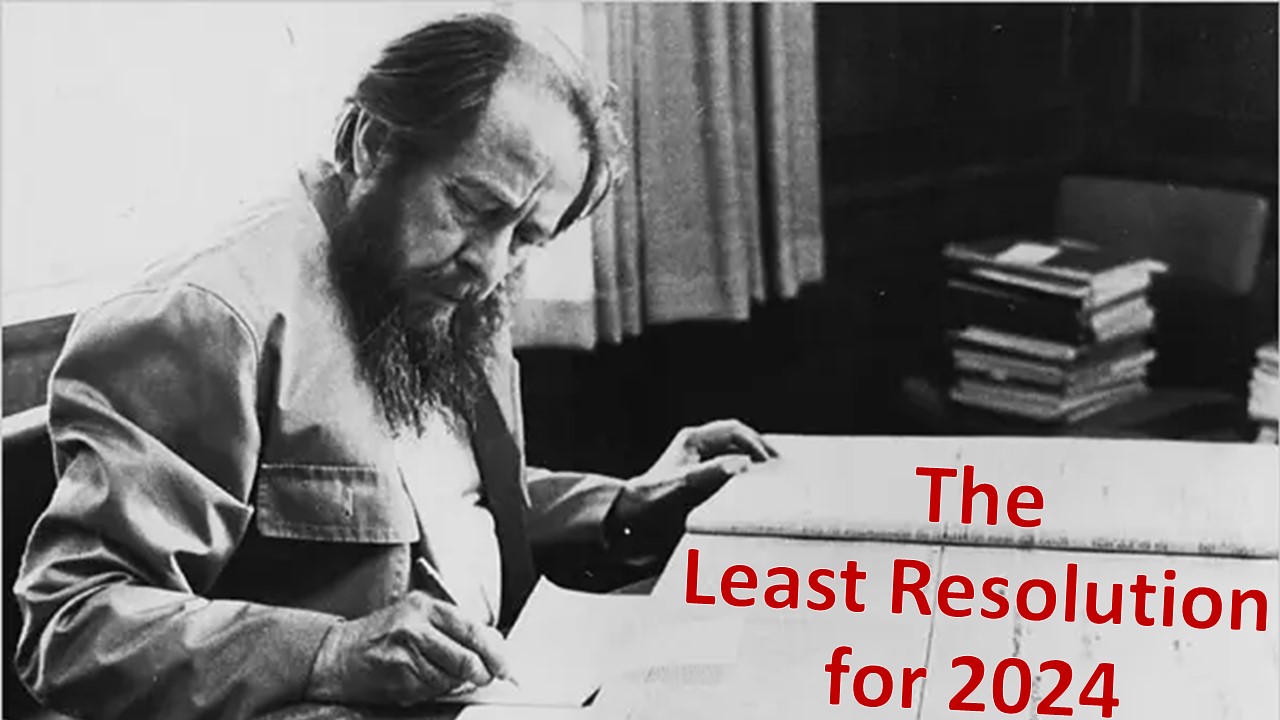
Fifty years ago, in February 1974, Alexander Solzhenitsyn was arrested in the Soviet Union and exiled to the West.  There, he was welcomed as a hero.  On the day of his arrest, he released a document entitled “Live Not by Lies.”  He knew the power of an ideology that sought to reshape society.  He also knew the power of individuals who simply refuse to lie (and the even greater power of a crowd joining together in this conviction).  He knew that the ideological system would totter and collapse when it ran up against the brick wall of reality, exemplified by many individuals refusing to play along with the evil fantasy.
Fifty years later, perhaps it is time for us to revisit this document.  Are we living in times where some, on behalf of all, have determined what society should look like?  Do we see a mounting pressure to conform with what ‘they say’ is acceptable human thought and belief? Indeed, we should not be so naïve as to assume that the absence of marching military on our streets means we face no ideological threat. 

The pressure is growing for everyone quietly to conform.  More than that, the pressure is growing to affirm openly and celebrate what we know to be false.  Surely, it would be better to speak the truth now instead of growing our tendency to fit in and play it safe as the stakes mount.

Truth and Lies – Choosing not to lie was not an original idea for Solzhenitsyn.  Paul urged the Colossians not to lie to one another.  Not only had they put off their old self, but they had put on the new self to reflect their creator’s image (Colossians 3:9-10).  He told the Ephesian believers to speak the truth to one another since they were no longer defined by the lie (Ephesians 4:25).

In the Sermon on the Mount, Jesus addresses the anger underneath murder, the lust underneath adultery, and the daily consistency of speech beneath more flamboyant oaths (Matthew 5:21-37).  There is plenty of Old Testament support for the expectation that God’s people should be consistent speakers of truth (Exodus 20:16; Leviticus 19:11; Proverbs 14:5).  God does not lie, and his people represent him.

Fear and Lies – Solzhenitsyn knew the impact of fear on a population.  He wrote of the great threat facing humanity in his day, which was “about to flare up and engulf us.”  And he described the fear: “While we continue to smile sheepishly and babble; ‘But what can we do to stop it? We haven’t the strength.’”

God asked Isaiah’s listeners, “Whom did you dread and fear, so that you lied, and did not remember me, did not lay it to heart?” (Isaiah 57:11).  Their fear led to lies, as they forgot who was really in charge.

Our world seems to be changing at a frightening rate.  Trying to keep up with the latest adjustments to sense and morality can be tiring.  And it is increasingly revealing how much fear lies within most of us, who are so prone to play along with society’s expectations rather than speak what is true.  It is concerning how easily we fear and perhaps lie while forgetting who is really in charge. 

Some will capitulate completely and speak what is false.  Others hide behind a cloak of not wanting to “sound political” and speak out about the reducing set of acceptable Christian declarations.  Fear of being labelled and criticized leads many to hold back from speaking the simple truth.  After all, it is much easier to quote a Bible verse on social media or avoid the hot topics in conversation rather than offer the most minor form of resistance.

Solzhenitsyn wrote that the fear his people felt was not primarily a fear of nuclear death or a third world war.  The fear was of taking a “civic stance.”  He wrote, “We hope only not to stray from the herd, not to set out on our own, and risk suddenly having to make do without the white bread, the hot water heater, a Moscow residency permit.”  The penalty for a civic stance may have changed, but the fear of the herd has not.

History has never smiled on the timid, and yet each fearful choice always makes sense at the time.  How often do I justify timidity when society needs me to show courage and speak the truth?  We have almost constant opportunities to speak the truth about marriage, gender, sexuality, race, free speech, bodily autonomy, science, medical ethics, corruption, or whatever other prescribed view is being pushed at any given moment.

We cannot simply wait for an ideology to fall apart.  We must be part of the brick wall of reality into which it must crash.  And yet, it is always easier to “continue to acknowledge, glorify, and strengthen” that which we want to see collapse.  At the very least, we must not “recoil from its most vulnerable point.  From lies.”

Violence and Lies – Solzhenitsyn described how violence bursts into peaceful situations with great self-assurance.  “But violence ages swiftly, a few years pass—and it is no longer sure of itself.  To prop itself up, to appear decent, it will without fail call forth its ally—Lies.  For violence has nothing to cover itself with but lies.”

So, even under overt tyranny, people do not have to experience violence at all times.  The demand is only of a “daily participation in deceit” – the tribute paid to maintain one’s position under the power of the oppressive system.  Just play along, it is safer.

The connection between violence and lies is also not a discovery made under the rule of twentieth-century totalitarianism.  Micah wrote to the city in his day, “Your rich men are full of violence, your inhabitants speak lies and their tongue is deceitful in their mouth” (Micah 6:12).

We may not have to stand and fight against violence.  We may not even have to step out publicly and boldly declare the truth. “But let us at least refuse to say what we do not think!”

The Consequences of No Lies – In the Soviet Union, there was a cost to this most simple of stands.  It could cost your job and complicate life.  It could cost your success in education and impoverish your future.  But Solzhenitsyn was clear:

“And as for him who lacks the courage to defend even his own soul: Let him not brag of his progressive views, boast of his status as an academician or a recognized artist, a distinguished citizen or general.  Let him say to himself plainly: I am cattle, I am a coward, I seek only warmth and to eat my fill.”

To choose not to lie was not an easy choice in his day.  It will increasingly not be an easy choice for social standing, or even for physical wellbeing, in our day.  But the choice not to lie is “the only one for the soul.”

The implication of no lies is worthy of note. “The more of us set out together, the thicker our ranks, the easier and shorter will this path be for us all!  If we become thousands—they will not cope, they will be unable to touch us.  If we will grow to tens of thousands—we will not recognize our country!”

As we head into a new year, may we not simply play along with the world.  Instead, let us graciously, prayerfully, and wisely determine that whatever else may happen, we will not participate in the lies expected of us in society.  As representatives of God in this world, this is the least we must do!

(Source of AS quotes: https://www.solzhenitsyncenter.org/live-not-by-lies)

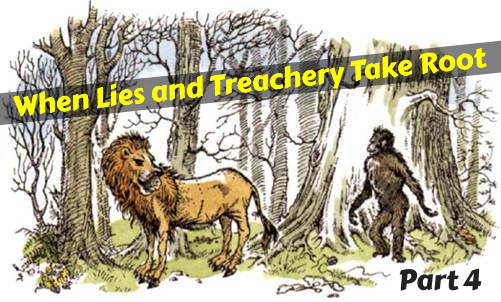
When Lies and Treachery Take Root – Part 4

In part 1, we set the scene and considered how a crisis can be used to wrest control, but the tyrants taking charge may not be impressive to all.  In part 2, the thin veneer of tyranny does not protect subjects from the harsh realities of the suffering that always follows.  In part 3, we scratched at the religious veneer to see that the biggest question in life is the right question at any time of change.  However, asking the right questions will not be welcomed, but oppressed.  Thus, the truth matters, even if everyone seems to be buying into the lies.  This brings us to this final post.  Surely the truth will set society free?  Ultimately, yes.  But we should not be shocked when a hypnotized people choose to stay under the spell.

20. Revealing the lie does not automatically break the spell.  “The light is dawning, the lie broken.”  It seems so simple.  Show everyone how they have been lied to and everything will be alright.  Well, not necessarily.  After defeating some captors, the king cried, “Now, Dwarfs, you are free.  Tomorrow I will lead you to free all Narnia.  Three cheers for Aslan!”  But, Lewis goes on, “the result which followed was simply wretched.” If everyone rallied to the side of the king, there was hope.  But not “if half the Narnians – including all the Dwarfs – just sat and looked on?  or even fought against him.”  Would the German population have rallied to the side of truth if there had been time for it to be revealed?  How many might have been saved if the populations of the communist soviet countries had revolted sooner?  And what if our own population does not react when lies are revealed?  The result of apathy to truth will be simply wretched.

21. When a lie is revealed, there may well be more sinister aforethought than previously realised.  By chapter 9, Jewel recognizes how much planning had taken place.  “We see that the Ape’s plans were laid deeper than we dreamed of.  Doubtless he has been long in secret traffic with The Tisroc.”  It is hard to fathom the depths of evil conspiratorial planning that may exist, but where is the benefit in believing everything is driven by good intentions and some accident?  Will we look back and wonder why we were so naively accepting of the lines we were fed? Perhaps we would do well to ask questions sooner, rather than just having to take stock of the damage once it is done.

22. When a lie is revealed, the evil tyrants will continue to spin yet more lies.  It is the most infuriating plot twist, but it is repeated time and again.  When the lie is revealed, it is met with yet more lies.  The Ape explained how a beast had dressed up and pretended to be Aslan.  “Jill wondered for a moment if the Ape had gone mad.  Was he going to tell the whole truth? . . . It was seen last night, but it got away.  It’s a Donkey!  A common, miserable Ass!  If any of you see that Ass—”  The Ape lied to cover his lies, and so retained control of the population!  “Jill looked at the King: his mouth was open and his face was full of horror.  And then she understood the devilish cunning of the enemies’ plan.  By mixing a little truth with it they had made their lie far stronger.”

It is a story that has been told again and again.  The Ape in its glory.  So much harm is done along the way, but eventually, every dressed-up Ape will be brought down.  May we learn from the story before we live unnecessarily through another chapter of the same old tale.  May we never accept any self-declared-wise old ape who sets himself up as the better leader to take us toward utopia.  The world does not need a year zero, a new beginning, a great leap forward, or a reset, no matter how great it might sound, or how urgently the need is portrayed.  What the world needs is truth, as well as humble leaders ready to serve the people, and for those who have met Aslan to make sure they are never fooled by a doddery donkey dressed up as divine.

When Lies and Treachery Take Root – Part 3

In part 1 we were introduced to the thin veneer of tyranny, and then in part 2, we noted how subjects will suffer nonetheless.  Now, let’s dig below the surface and ponder some of the religious aspects of the imposed new normal.

14. Different gods are treated as one.  A Lamb spoke up, “Please, I can’t understand. What have we to do with the Calormenes? We belong to Aslan. They belong to Tash.  They have a god called Tash.  They say he has four arms and the head of a vulture.  They kill Men on his altar.  I don’t believe there’s any such person as Tash. But if there was, how could Aslan be friends with him?”  The underlying impulse of tyrants is always a collective uniformity.  There is no space for diversity of thought or diversity of religion.  And so, like a recurring refrain, the religions are pushed together and effectively true religion is pushed out.  It was true in Narnia.  It was true in Nazi Germany.  It was true in the Soviet Union.  It is true in China.  It is always the same.  There is always one version of religious thought allowed, and the new leaders get to define it.

15.  The God question is the best question to ask.  Once the Lamb had spoken, we are told that they knew this was the best question anyone had asked yet.  It always is.  In a world where the boundaries are blurred and the gods are blended together, the most important question is always to ask about the true God.  After all, He will always be different, and better, than their imposed amalgam deity.

16. Good questions incite aggressive answers.  The Ape jumped up and spat at the Lamb.  “Baby!” he hissed. “Silly little bleater!  Go home to your mother and drink milk.  What do you understand of such things?”  The subjects are ridiculed if they dare to question.  The experts know best.  They always do.  If you question them, then you discover that you are questioning “The Science” itself.  Abusive relationships do not always require shouting and overt aggression.  However, the presence of shouting and overt aggression tends to be a good indicator of an abusive relationship.

17. The blending of gods will always mean the diminishing of the true God.  The Ape declared, “Tash is only another name for Aslan.  All that old idea of us being right and the Calormenes wrong is silly.  We know better now.  The Calormenes use different words but we all mean the same thing.  Tash and Aslan are only two different names for you know Who. . . . Tash is Aslan: Aslan is Tash.”  The true God always seems to be reduced when the proud claim to have new insight.  They know what is best and they should be trusted with the future.  But Lewis described how every tail was down, and every whisker drooped.  Except one.  The Ginger Cat asked a clarifying question – “Aslan means no more than Tash? . . . I think I am beginning to understand.”  When we add another god to the true God, the true God becomes nothing more than that other so-called god.  You can add nothing to the true God and make him better.  Some might use the ecumenical impulse for their own gain, but the Narnian beasts were right in their downed tails and drooped whiskers.

18. Silencing of contrary voices is always required for a tyrannical coup.  King Tirian cried with a loud voice and was silenced.  “If he had been allowed to speak, the rule of the Ape might have ended that day; the Beasts might have seen the truth and thrown the Ape down.”  Instead, with violence, the Ape put down the truth-crier.  “Take him where he cannot hear us, nor we hear him.”  Which is more important, that he not hear their lies?  Or that they do not hear his truth?  Since tyranny is always a fragile house of cards, it must surely be the latter.  Therefore, there will be ruthless silencing, censoring, cancelling and de-platforming of any counter-opinions.  After all, it is for the good of the people.  The destruction of free speech should always be a big red flag to thinking people.

19.  The pantomime leader is ridiculous, but you may be tempted to believe that he is real until you remember the truth.  In the next chapter, the Beasts are crying out to Aslan as he is paraded in front of them, briefly.  King Tirian looked on from a distance, “He had not expected Aslan to look like that stiff thing which stood and said nothing.  But how could he be sure? For a moment horrible thoughts went through his mind: then he remembered the nonsense about Tash and Aslan being the same and knew that the whole thing must be a cheat.”  The doddery old donkey in fancy dress almost fooled him, but the truth won out.

There is one more post to come . . . next time.

When Lies and Treachery Take Root – Part 2

In part 1, we introduced the sinister situation in The Last Battle – the created crisis, the prevailing atmosphere and the thin veneer of tyranny.  Now let’s continue our list of thoughts and ponder matters of authority, tyrants and how subjects are treated.

7. True authority is always kept out of reach.  A Boar asked the Ape about seeing Aslan properly and talking to him.  But it was not allowed.  In a truly free modern society, the authorities serve at the pleasure of the citizenry.  Ultimate power lies with the people, not in a palace, nor a secret government discussion.  In a dictatorship there is really no access for thinking subjects, only a carefully staged presentation that will have an impact on the crowds.  The Roman Caesars would go into hiding and then appear in a spectacular show of splendour.  “He is a god!”  The crowd would cry. But it was all staged. 

8. Tyrannical authority always knows better than you.  Accused of being an Ape, the Ape declares,   “I’m not.  I’m a man.  If I look like an Ape, that’s because I’m so very old: hundreds and hundreds of years old.  And it’s because I’m so old that I’m so wise.  And it’s because I’m so wise that I’m the only one Aslan is ever going to speak to.  He can’t be bothered speaking to a lot of stupid animals.  He’ll tell me what you’ve got to do, and I’ll tell the rest of you.  And take my advice, and see you do it in double quick time, for he doesn’t mean to stand any nonsense.”  Notice there is no reasoning, no discussion, no debate.  The tyrant knows better than you and so you must obey.

9. The subjects of tyranny are always necessarily treated as stupid.  Since the authoritative council of stakeholders is made up of experts, it means those under their rule must necessarily be treated as stupid.  “Stupid animals!”  They are to take what they are given and do as they are told.  It has always been true in every dictatorship down through history.  When you can smell disdain from on high, know that tyranny approaches again.

10. Freedom is turned into slavery.  Some of the horses were speaking about getting the work done quickly, in order to return to freedom.  “Well, you can get that idea out of your heads at once.  And not only the Horses either.  Everybody who can work is going to be made to work in future.  Aslan has it all settled with the King of Calormen – The Tisroc . . . All you Horses and Bulls and Donkeys are to be sent down into Calormen to work for your living – pulling and carrying the way horses and such-like do in other countries.  And all you digging animals . . .”  The Ape had no intention of releasing control and letting the Beasts run free again.  When freedoms are taken away, they are seldom returned without a struggle.

11. Slavery is described as for the common good, but it isn’t.  When the Beasts howled about being sold into slavery, the Ape snarled back, “None of that! Hold your noise!  Who said anything about slavery? You won’t be slaves.  You’ll be paid – very good wages too. That is to say, your pay will be paid into Aslan’s treasury and he will use it for everybody’s good.”  The repeated commonality in coups across the globe is the utopian vision of the betterment of society.  It is for your benefit!  Yes, there will be some work involved.  There must be, to make things better.  But your slavery, that is, your work, will make you free!  The Ape made promises to the Beasts of Narnia.  The Nazis put that assertion over the gates at Auschwitz.  The Communist Party always promises a collective utopia beyond the struggle.  And yet, who benefits?  It is never the common man and woman.  It is always the ruling elite.

12. The goal of the common good is described as a form of utopia, but the cover always slips.  The Ape described the goal of their newly imposed future.  “And all for your own good. We’ll be able, with the money you earn, to make Narnia a country worth living in.  There’ll be oranges and bananas pouring in – and roads and big cities and schools and offices and whips and muzzles and saddles and cages and kennels and prisons – Oh, everything.”  Actually, Narnia was pretty good before slavery was imposed.  The future only seemed to mean added restrictions and silencing for the subjects, but luxuries and control for the ruling elite.  Oh, you will own nothing, and you won’t be able to go too far, but you will be happy.  Utopian dreams with revealing slips.

13. The new and false freedom is defined by the tyrant.  “You think freedom means doing what you like.  Well, you’re wrong.  That isn’t true freedom.  True freedom means doing what I tell you.”  A truly free society is a rare commodity on this earth.  Even in Narnia it seemed easily lost.  When tyrants take over, they get to set the rules.  And when they do, the people suffer.

Next time, we will continue our list. . .

When Lies and Treachery Take Root – Part 1

I feel sorry for the last book in a collection.  While many may enjoy the first, and probably the next couple too, not all readers will complete a series.  This was certainly true in my case.  It is only now, with my last pair of children, that I have finally cracked open The Last Battle and journeyed back into Narnia one last time.  What I discovered felt like a commentary on devilish and despotic democracide.  I had to check the publication date.  Was this written in 2023?  Obviously not, for it treads on far too many sensibilities for our day!

However, The Last Battle, the final chronicle of Narnia, remains eerily relevant.  I am sure it was to its own day, a day of reflection on the atrocities of National Socialism (Nazi-ism) in Germany, and a day of growing suspicion of the murderous evil of International Socialism (Communism) in the East.  Like all great stories, The Last Battle remains eerily relevant today, too.  “Narnia faced its fiercest challenge,” the back cover explains, “not an invader from without but an enemy from within.”  Indeed, so often the greatest threat to society lies within its own ranks.  And that threat does not always come from the most intelligent enemies of the state.  Often the mind behind the evil is devilish, while the actors used are less than impressive.  His antagonism to all that is good lies behind the puppet leaders used to enact the sinister effort to transform a safe society into something so much more malevolent.

By the time we reach the third chapter of The Last Battle, we already know that a self-serving Ape and his hapless Donkey have stitched up a lion’s pelt for some nefarious purpose.  We also join King Tirian and his Unicorn, Jewel, as they discover that Aslan has returned and ordered the felling of the holy trees and the murder of their dryads.  Arriving at the newly cut gash in the Narnian landscape, they discover Calormenes who are mistreating a Narnian talking horse.  It is all too much and they kill the two foreigners in a fit of rage. 

Struck by their noble consciences, they determine to surrender their fate to the justice of Aslan.  Whereupon we encounter “The Ape in its glory.”

I know that this is not directly related to biblical studies or preaching. But if you will indulge me as I share a brief series of reflections on a prescient work of fiction, here are twenty-two eerie parallels to ponder – parallels between Narnia, C.S.Lewis’ day, and even perhaps, our own.

1. A crisis was created and used by the leader of the coup.  The felling of trees, the gash in the landscape, the sale of noble tree trunks to the Calormenes, the profound upset of Narnian peace – it was all created by the one who now used that same crisis to wrest control of the territory and to serve his heinous purposes.

2. Death is in the air.  In the first chapter Shift cunningly manipulates Puzzle with the notion that he “shall probably die” if he tries to fetch the lion pelt from the pool.  Puzzle retrieves it and is “almost tired to death.”  In the second chapter the dryad is killed, then two Calormenes.  This is a story of death after death so that by the end, all the characters are dead.  Multiple characters state that it would have been better to be dead than…, and later on, we see Cair Paravel “filled with dead Narnians.”  Death becomes an everyday conversation when societies are taken over by tyrannical forces.  Lewis may not have known how accurate his picture was in the Communist east.  We may not know all that is swirling in our world today, but it does feel like the subject of death is hanging in the air.

3. Everyone is saying the same thing.  The King is struck by the fact that “the Horse said it was by Aslan’s orders. The Rat said the same.  They all say Aslan is here.”  Even though he had been warned that this was a lie, everyone was repeating the same message.  There is a strange power in a common story.  It will grow its own legs and generate its own credibility.  Sometimes a coup will take over a land by force, but not always.  Sometimes it is by stealth and the subjects will carry the tale of their own downfall willingly as if what they say is true.

4. For those that see clearly, it was clearly a charade.  There in the clearing, at the peak of the hill, “there was a little hut like a stable, with a thatched roof.”  But for those who could not see clearly this charade became their focal point.  “On the grass in front of the door there sat an Ape.  Tirian and Jewel, who had been expecting to see Aslan and had heard nothing about an Ape yet, were very bewildered when they saw it.”  As readers we can see through the whole charade – don’t believe what he says, he is a fancy-dress ape with a dressed-up donkey prop!  It is frustrating when others cannot see what is plainly before them.

5. Tyrants always look silly.  When the Ape, chewing his supply of nuts, was handed the king’s sword with its belt, “he hung it around his own neck: it made him look sillier than ever.”  Did the German population wonder about the short, shouting Austrian tyrant?  Did the bigger moustache of Stalin command the respect he may have thought it should?  And what of the potential tyrants in our day?  If you look carefully, they always look silly.

6. Tyrants are always self-serving.  “Now listen to me, everyone.  The first thing I want to say is about nuts. . . . I want – I mean, Aslan wants – some more nuts.”  The squirrels had already given the Ape more than they could spare.  That’s the thing about tyrants: they take everything from the people and lavish luxuries on themselves.  Beachfront villas, fine foods, private jets.

Next time we will continue our list . . .

(Illustration by Pauline Baynes)