Our church recently celebrated “International Sunday,” a day to praise God for the many nations He has brought together in our church. We enjoyed different foods and national dress, and we prayed for many countries. Whenever Christians from many countries come together, whether in a local church or at an international conference, someone will usually call it a “taste of heaven.” Why?
A gathering of multiple nationalities is not unique to Christian events. But it might be uniquely united. Gatherings such as the United Nations have never lived up to their original promise, and even the Olympics or the World Cup usually have a nation boycotting or tensions beneath the surface.
One reason we might call such a Christian gathering a taste of heaven is that only heaven’s King can make it happen. On earth, if a situation gets messy, a powerful leader is needed to clean it up. A struggling school might get a “super” head teacher who lays down the law, or a city might get a tougher chief of police. Perhaps a powerful king might bring a country into line. But pure power is never enough. It can impose law and order, but it can never change even a single human heart. That is where the problems all stem from.
Thankfully, God offers us a perfect King—exactly what we need. In Revelation 5, the apostle John is caught up to the throne room of heaven, and he sees a scroll in the right hand of the One who sits on the throne. When no one worthy is found to take and open the scroll, he starts to weep. But then he is told that there is one who is worthy—the Lion of the tribe of Judah. The Lion—a powerful leader, a triumphant king—is strong, majestic, and courageous. And yet, there is more.
In the next verse, John turns to see this great leader, and he sees a Lamb. This Lamb has been slain, and yet is standing—an innocent sacrifice, clearly a different kind of leader. In fact, Revelation calls Jesus the Lamb another twenty-seven times. God’s King is both a Lion and a Lamb, and He is worthy of all worship.
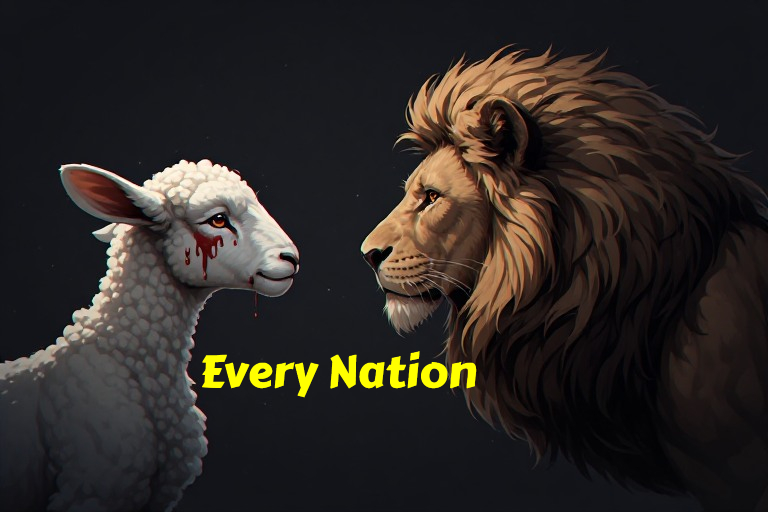
When we get a glimpse of this reality, the combined truth of the triumphant Lion and the sacrificed Lamb now standing again, we can grasp the uniqueness of our Saviour. His blood has ransomed people for God from every tribe and language and people and nation (v. 9). And His glorious rule has been shared with those people (v. 10). The slain Lamb and the ruling Lion are two aspects of the wonder of Christ that both reflect God’s glorious love to us.
Indeed, the wonder of our Lion-Lamb-Lord is such that He alone is worthy of total worship. And that is how the passage concludes. John sees and hears everyone around the throne worshipping, including vast hosts of angelic voices (v. 11). Together, they are all crying out that the slain Lamb is worthy of seven-fold praise (v. 12). Then John hears every creature, in every dimension of creation, declaring He is worthy of praise for all time (v. 13). And even the highest and closest ones to the throne agree, falling and worshipping. This is total worship, because the Lamb is totally deserving of all praise.
We live in a world where bringing nations together in unity is increasingly out of reach. No human power can achieve it. But God’s King will, and does. It is as we see our triumphant King, our humble and self-sacrificing King, our Lion-Lamb-Lord, that we can find hope for true unity and harmony. That is why He alone is worthy of all the praise, both now and forever.
_____________________________________________________


