Charlie Kirk – One Week On.

Our brother Charlie Kirk was assassinated because his love for Christ, for his country, and for others drove him to speak.  He spoke openly and gave the microphone to whoever wanted to disagree with him.  He was imperfect, of course, but he was gracious, kind, informed and increasingly influential. 

I’ve watched him for years, and have watched his testimony become clearer during that time. Last Wednesday morning, I watched a couple of clips as I often do.  In one of them, Charlie spoke so clearly of his love for Jesus.  I thanked God that my brother was reaching so many with such a clear testimony.  On Wednesday evening, Jesus welcomed him home. 
Here are my thoughts about some of the things people are saying, in no particular order:

“It hurts“.  I’ve seen many people expressing on social media, or to me personally, how much this hurts.  People are saying they have never felt grief over the death of a public figure like they have this past week.  Me too.  God doesn’t expect us to respond to something like this with stoic resolve.  If I saw a family member shot and brutally killed, it would stir all sorts of emotions.  I did see that last week.  I can’t unsee it.  And it hurts.  Let’s not hide our emotions; I’m sure that is not going to help.  Obviously, we need to be wise with the swirling anger and rage that can be mixed in with the sorrow and grief, but pretending it doesn’t affect us would be a weird response under any circumstance. Let yourself grieve.

“Did I agree with everything he said?”  Can I politely ask, what if I did?  Why do we have to caveat anything and everything we say that might seem remotely political?  Why do we often hesitate to speak up when others hold different opinions and might be upset?  Self-censorship is becoming a crippling feature of society. I loved how joyfully confident Charlie was in the truth and, therefore, how little he needed to be defensive if someone disagreed with him or criticised him.  I want to be more like that. 

(Just for clarity, I do not agree with things taken out of context and attributed to him to smear him.  Also, I have not checked his view on every issue, so I do not know if I agree with him on everything or not.  My point is, what if I did?  Are we allowed to have opinions? Or is it only permitted if we share those opinions deemed acceptable by the media?)

“The killer was just one mentally unstable person.”  Thankfully, the murder of public figures is not an everyday occurrence in our society.  It is in some places.  It could become more common in the West.  However, the problem may not be restricted to one lone gunman. This killer seems to have been radicalised by the same education system and cultural media that have obviously influenced countless thousands, judging by the disgusting reactions to Charlie’s death from so many.  Why are we shocked when so many celebrate such a heinous act, or call for more of the same?  Are our memories so short?  It wasn’t long ago that significant numbers of people on social media, on mainstream media, and for some, in person, were wishing death on those people who chose not to take a certain medical intervention.  Condoning or celebrating death based on opinions is a disgusting development of our time, but it didn’t start in the last week.

“Words are violence.”  Actually, no, violence is violence.  The prevailing ideology which says that words are violence directly feeds into this kind of atrocity.  If words are violence, then physical violence can be justified as an act of self-defence.  Feed that “words are violence” mindset with a constant stream of terrible slurs and lies, and there will be someone ready to perpetrate an evil act of violence.  After all, the public are being repeatedly told of the danger to democracy posed by people like Charlie because they are __________ (you can guess the labels.)  I think Charlie said something like, “The most important thing is to tell people about Jesus, and the second most important thing is to fight for the freedom to do the first most important thing.”  We live in a society that is hurtling towards the loss of free speech, and I am perplexed that so many people seem so unconcerned about that, or think it is just a political matter that can be left for others to defend.

“This is all just about politics.”  True, Charlie was an outspoken supporter of values that meant broad alignment with one side of the political divide, and he actively worked to campaign for one presidential candidate.  Sadly, I don’t think people in Britain understand the American political scene, and many only see the twisted impression promoted by the British media.  Nevertheless, we cannot keep acting as if politics and faith are totally distinct.  Politics is not just made up of parties.  It is also made up of issues: issues that impact the lives of people, issues that relate to morality, issues that matter to us as Jesus followers.  I am not suggesting politics is the answer.  No, Jesus is the answer.  But many of the issues really matter, and we cannot, we must not, keep abdicating our responsibility to speak out about those issues appropriately. 

Too many Christians act as if they are “above politics”, and they simply want to focus on the gospel. But for some, the driving motivation seems to be fear of ruffling the feathers of those who may disagree.  I see that fear impulse in myself, too.  Yes, let’s preach the gospel; it is the only hope for our world.  But self-censoring out of fear is not the faith-filled approach to the life that we are called to as followers of Jesus.  You don’t have to become a party-affiliated influencer, but let’s have the courage to speak about what is true, what is right, and what is good.  Politics matters because people matter.  We, of all people, should be ready to speak, precisely because we believe that people matter.

So we have a choice.  Either we continue to shy away from anything that could be considered political, or we face the fact that there is an existential battle raging in our society that is much bigger than traditional left vs right policy squabbles.  It is a spiritually charged battle of ideologies.  It is about unaccountable control versus freedom.  It is about death versus life. It is a clash of worldviews.  We need to speak about issues that matter, even if we get labelled with a political slur (either way).  No party will ever represent key biblical values perfectly, but can we stop hiding our heads in the sand and acting like we are somehow “above all that stuff?”  We cannot be “above” freedom of speech, or morality and the redefinition of crime, or sexual ethics, or the protection of children, or assisted suicide, or abortion, or war, or terrorism, or compassion, or any number of other issues.  Values drive agendas, which in turn drive policies, legislation, and ultimately, change, affecting people’s lives for better or worse.  Some political issues are directly related to our Christian values, and so we must speak up. 

“Charlie shouldn’t have been so outspoken.”  Why?  First, a lot of people are taking the British media slurs of “hateful”, “racist”, etc. as if they are accurate.  Watch Charlie for yourself, don’t trust the BBC, Sky News, ITV, etc.  Second, realise that if you or I were significant enough for the media to go after us, they would probably use some of the same derogatory labels for you and me.  Unfair?  That’s precisely my point.  Third, many people, especially young people, admired Charlie for his courage in speaking out.  Was it the silence of many church leaders on “controversial” issues that made so many young people flock to Charlie as a mentor from a distance?  We would do well to consider that possibility and examine ourselves.  I am doing that myself.  Let’s not fall into the trap of fear.  Speaking truth and the gospel may cost any of us our lives, but we should speak it anyway.  With grace, of course.  With kindness, absolutely.  Christlike?  Without a doubt.  But silence, fear, and trying to be acceptable to a fallen world is not the Jesus way. 

“If you live by the sword…”  Can we be clear, please?  Charlie lived “with two microphones” – he let people disagree, he listened to people, he encouraged dialogue, and he believed in open debate.  He put people who disagreed with him at the front of the line. He spoke as a Christian, and he was killed for it.  He didn’t live by the sword.

“There is hate speech and violence on both sides.”  Can we find bad examples of individuals on all sides of political divides? Of course.  Are there good-willed people on all sides of political issues? Absolutely. But this “both sides” line is a misleading and disingenuous summary.  Compare and contrast the response to Charlie’s murder and other high-profile deaths.  Where is the looting, the rioting, the destruction, etc.?  Do we see Christians or political conservatives celebrating the deaths of others, or even worse, calling for the killing of more people they disagree with? No, we don’t. The way of Jesus is profoundly different. We are called to love our enemies and not to return evil for evil. Ideologies differ, and it shows.  Let’s stop pretending every ideology is the same. 

“He has been silenced.”  No, he hasn’t.  He has been amplified and multiplied.  Charlie’s death is only going to raise up thousands of others like him who are ready to be courageous and speak for Christ and for the truth. God is going to build his church and the gates of hell will not prevail against it.

“What will the impact be?”  We cannot know yet.  I’ve seen people posting videos saying that they’ve been fearful in the past, but now they want to start speaking the truth, sharing their faith, and so on.  I’ve seen people writing about buying their first Bible and beginning to read it. I’ve seen people asking where to go to church. When the five missionaries were martyred in Ecuador in 1956, nobody could have known the multiplication in missionary sending that would follow that atrocity.  Perhaps Charlie Kirk’s death will turn out to be a turning point in history, too.  Actually, not perhaps, but definitely.  God knows what He is doing, even when evil seems to get the upper hand.  He is building his church, and we know the end of the story.  Somehow, in the midst of grief, indifference, and even evil celebration, God is working out His purposes, and we will eventually see that God does all things well.

“Things feel different.”  My brother was assassinated, and I know many are feeling it deeply.  However we’ve been impacted, may it make us all different.  Perhaps more courageous, gracious, informed, and deeply committed to Jesus, to truth, to communication and to conversation.  If speaking costs you your life on earth, is it worth it?  I’m sure Charlie would say absolutely, Jesus is worth it.

______________________________________________

We sang these words on Sunday, words I am sure Charlie would have sung wholeheartedly:

If you curse me, then I will bless you

If you hurt me, I will forgive

And if you hate me, then I will love you

I choose the Jesus way

If you’re helpless, I will defend you  

If you’re burdened, I’ll share the weight

And if you’re hopeless, then let me show you

There’s hope in the Jesus way

[Chorus]

I follow Jesus, I follow Jesus

He wore my sin, I’ll gladly wear His name

He is the treasure, He is the answer

Oh, I choose the Jesus way
If you strike me, I will embrace you

And if you chain me, I’ll sing His praise

And if you kill me, my home is Heaven

For I choose the Jesus way

[Chorus]

I follow Jesus, I follow Jesus

He wore my sin, I’ll gladly wear His name

He is the treasure, He is the answer

Oh, I choose the Jesus way
[Bridge]

And I choose surrender, I choose to love

Oh God, my Savior, You’ll always be enough

I choose forgiveness, I choose grace

I choose to worship, no matter what I face

I choose the Jesus way, I choose the Jesus way

I choose the Jesus way, I choose the Jesus way

[Chorus]

I follow Jesus, I follow Jesus

He wore my sin, I’ll gladly wear His name

He is the treasure, He is the answer

Oh, I choose the Jesus way

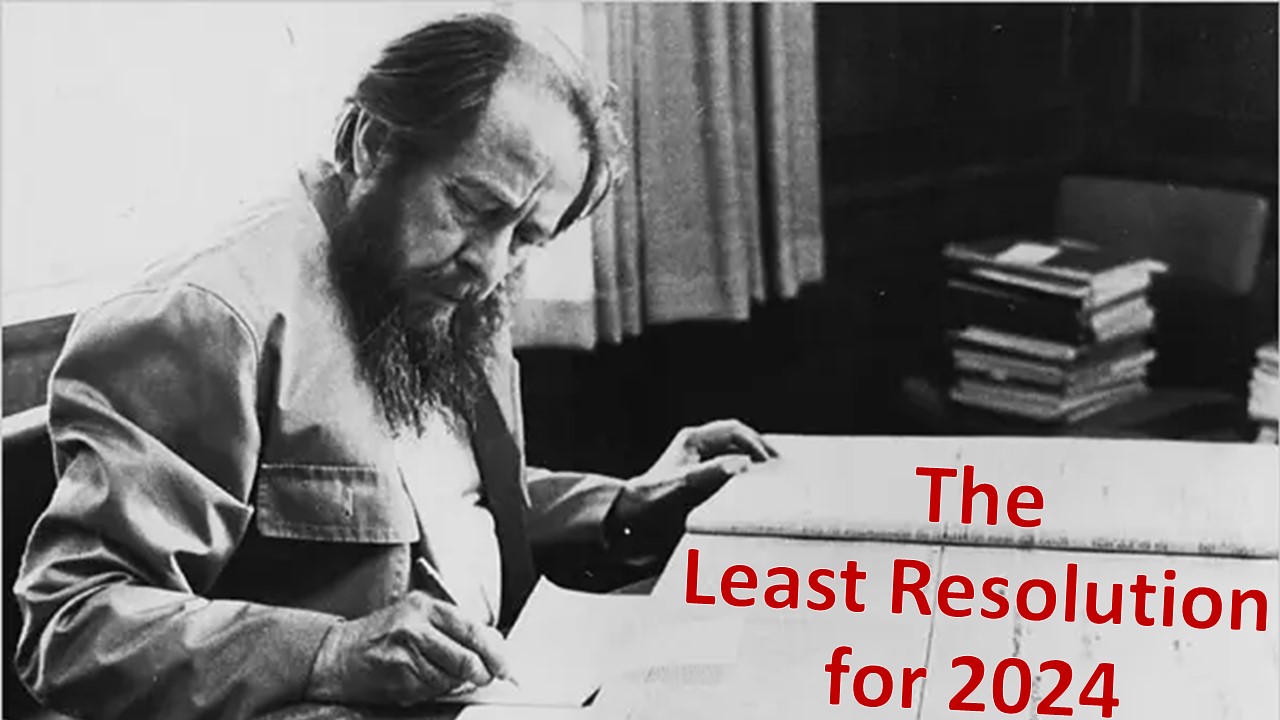
The Least Resolution for 2024

January does not just bring a new page on the calendar but a whole new calendar.  And with the new year, we tend to generate renewed commitments.  Maybe you have already determined what 2024 will mean for you.  Perhaps your mind has already pondered daily step counts, gym visits, dietary changes, or other healthy habits.  Or maybe you are thinking about Bible reading, daily prayer routines, or other spiritual goals.  May your resolutions last and bear good fruit!  But perhaps the resolution we need for 2024 is more foundational than healthy habits and more straightforward than spiritual practices.

As I write this, I am in Budapest, where I have just visited a museum of the political terror of the twentieth century.  As you can imagine, it is a sobering experience to see the vast walls of victims, the displays focused on the political prisoners, a room commemorating the persecution of the religious leaders, the torture chambers, the prison cells, and the gallows.  But perhaps the lingering memory for me will be the final room.  With red walls and hundreds of pictures, it felt like yet another presentation of victims.  But it was not.  It was a room of “victimizers” – ordinary people who were merely doing their job, simply following orders, just playing along, and thereby facilitating the evil machine.  We can remember the victims, and we must.  Yet we must also face the uncomfortable reality that most cogs in the cruel machine of death were ordinary people.

Fifty years ago, in February 1974, Alexander Solzhenitsyn was arrested in the Soviet Union and exiled to the West.  There, he was welcomed as a hero.  On the day of his arrest, he released a document entitled “Live Not by Lies.”  He knew the power of an ideology that sought to reshape society.  He also knew the power of individuals who simply refuse to lie (and the even greater power of a crowd joining together in this conviction).  He knew that the ideological system would totter and collapse when it ran up against the brick wall of reality, exemplified by many individuals refusing to play along with the evil fantasy.

Fifty years later, perhaps it is time for us to revisit this document.  Are we living in times where some, on behalf of all, have determined what society should look like?  Do we see a mounting pressure to conform with what ‘they say’ is acceptable human thought and belief? Indeed, we should not be so naïve as to assume that the absence of marching military on our streets means we face no ideological threat. 

The pressure is growing for everyone quietly to conform.  More than that, the pressure is growing to affirm openly and celebrate what we know to be false.  Surely, it would be better to speak the truth now instead of growing our tendency to fit in and play it safe as the stakes mount.

Truth and Lies – Choosing not to lie was not an original idea for Solzhenitsyn.  Paul urged the Colossians not to lie to one another.  Not only had they put off their old self, but they had put on the new self to reflect their creator’s image (Colossians 3:9-10).  He told the Ephesian believers to speak the truth to one another since they were no longer defined by the lie (Ephesians 4:25).

In the Sermon on the Mount, Jesus addresses the anger underneath murder, the lust underneath adultery, and the daily consistency of speech beneath more flamboyant oaths (Matthew 5:21-37).  There is plenty of Old Testament support for the expectation that God’s people should be consistent speakers of truth (Exodus 20:16; Leviticus 19:11; Proverbs 14:5).  God does not lie, and his people represent him.

Fear and Lies – Solzhenitsyn knew the impact of fear on a population.  He wrote of the great threat facing humanity in his day, which was “about to flare up and engulf us.”  And he described the fear: “While we continue to smile sheepishly and babble; ‘But what can we do to stop it? We haven’t the strength.’”

God asked Isaiah’s listeners, “Whom did you dread and fear, so that you lied, and did not remember me, did not lay it to heart?” (Isaiah 57:11).  Their fear led to lies, as they forgot who was really in charge.

Our world seems to be changing at a frightening rate.  Trying to keep up with the latest adjustments to sense and morality can be tiring.  And it is increasingly revealing how much fear lies within most of us, who are so prone to play along with society’s expectations rather than speak what is true.  It is concerning how easily we fear and perhaps lie while forgetting who is really in charge. 

Some will capitulate completely and speak what is false.  Others hide behind a cloak of not wanting to “sound political” and speak out about the reducing set of acceptable Christian declarations.  Fear of being labelled and criticized leads many to hold back from speaking the simple truth.  After all, it is much easier to quote a Bible verse on social media or avoid the hot topics in conversation rather than offer the most minor form of resistance.

Solzhenitsyn wrote that the fear his people felt was not primarily a fear of nuclear death or a third world war.  The fear was of taking a “civic stance.”  He wrote, “We hope only not to stray from the herd, not to set out on our own, and risk suddenly having to make do without the white bread, the hot water heater, a Moscow residency permit.”  The penalty for a civic stance may have changed, but the fear of the herd has not.

History has never smiled on the timid, and yet each fearful choice always makes sense at the time.  How often do I justify timidity when society needs me to show courage and speak the truth?  We have almost constant opportunities to speak the truth about marriage, gender, sexuality, race, free speech, bodily autonomy, science, medical ethics, corruption, or whatever other prescribed view is being pushed at any given moment.

We cannot simply wait for an ideology to fall apart.  We must be part of the brick wall of reality into which it must crash.  And yet, it is always easier to “continue to acknowledge, glorify, and strengthen” that which we want to see collapse.  At the very least, we must not “recoil from its most vulnerable point.  From lies.”

Violence and Lies – Solzhenitsyn described how violence bursts into peaceful situations with great self-assurance.  “But violence ages swiftly, a few years pass—and it is no longer sure of itself.  To prop itself up, to appear decent, it will without fail call forth its ally—Lies.  For violence has nothing to cover itself with but lies.”

So, even under overt tyranny, people do not have to experience violence at all times.  The demand is only of a “daily participation in deceit” – the tribute paid to maintain one’s position under the power of the oppressive system.  Just play along, it is safer.

The connection between violence and lies is also not a discovery made under the rule of twentieth-century totalitarianism.  Micah wrote to the city in his day, “Your rich men are full of violence, your inhabitants speak lies and their tongue is deceitful in their mouth” (Micah 6:12).

We may not have to stand and fight against violence.  We may not even have to step out publicly and boldly declare the truth. “But let us at least refuse to say what we do not think!”

The Consequences of No Lies – In the Soviet Union, there was a cost to this most simple of stands.  It could cost your job and complicate life.  It could cost your success in education and impoverish your future.  But Solzhenitsyn was clear:

“And as for him who lacks the courage to defend even his own soul: Let him not brag of his progressive views, boast of his status as an academician or a recognized artist, a distinguished citizen or general.  Let him say to himself plainly: I am cattle, I am a coward, I seek only warmth and to eat my fill.”

To choose not to lie was not an easy choice in his day.  It will increasingly not be an easy choice for social standing, or even for physical wellbeing, in our day.  But the choice not to lie is “the only one for the soul.”

The implication of no lies is worthy of note. “The more of us set out together, the thicker our ranks, the easier and shorter will this path be for us all!  If we become thousands—they will not cope, they will be unable to touch us.  If we will grow to tens of thousands—we will not recognize our country!”

As we head into a new year, may we not simply play along with the world.  Instead, let us graciously, prayerfully, and wisely determine that whatever else may happen, we will not participate in the lies expected of us in society.  As representatives of God in this world, this is the least we must do!

(Source of AS quotes: https://www.solzhenitsyncenter.org/live-not-by-lies)

Politics? Oh, We Don’t Go There!

I suspect we need to give some more thought to this oft-stated contemporary wisdom: “We should just focus on the Gospel and not get political.”

We live in a society that seems to be increasingly divided and polarized by political discussion and media misrepresentation of opposing views on a variety of topics.  It is understandable that many will automatically agree that in the church, and in preaching, we should simply focus on the Gospel and not get dragged into the political tensions of our time. 

Here are seven preliminary points for us to ponder:

1. Politics is no substitute for the Saviour.  It is easy for some people, preachers included, to get swept up into current affairs and to put their hope in politicians or political parties.  We live in a sinful world and the world of politics tends to highlight human sin and the futility of godless solutions.  Anyone who puts their hope in a political solution to our greatest needs will be deeply disappointed.  Our church and our world need us to preach Christ and him crucified, not a party manifesto.

2. Silence can be highly political.  While we can easily see the problem if our pulpit shifts into a soapbox for a particular political agenda, merely exorcising any hint of a political opinion from our preaching is not the solution.  Sometimes saying nothing about something is really saying something.  In fact, there are times when silence is actually saying something quite strongly.  Saying nothing about gender, sexuality, morality, etc., can serve to reinforce the cultural narrative – especially as the younger generation grow into adulthood.  A lifetime of one message from the media, from social media, from educators and from peers may be affirmed rather than countered by a silent pulpit.

I recently read Martin Luther King Jr’s Letter from Birmingham Jail.  It is well worth reading!  He wrote, “So often the contemporary church is a weak, ineffectual voice with an uncertain sound. So often it is an archdefender of the status quo. Far from being disturbed by the presence of the church, the power structure of the average community is consoled by the church’s silent—and often even vocal—sanction of things as they are.”

3. We must define what we mean by “political.”  I hear people referring to “political” as if such a label automatically confirms that the subject must not be touched.  What do we mean by the term?  A dictionary definition is “relating to the government or public affairs of a country.”  So, does this mean the church should have no voice on slavery, racism, human rights, poverty, crime, corruption, etc.?  I think we tend to all celebrate the political stand and achievements of past believers like William Wilberforce, George Muller, Dietrich Bonhoeffer, etc.  But we also forget how many churches remained silent on the slave trade, on child poverty, or on Nazi tyranny.

4. Why do we retreat – does the Bible have nothing to say?  So, does the Bible have nothing to say on matters that could be labelled political?  Of course, it does.  The prophets were not typically the “popular preachers” in their era.  They spoke out for God about real issues in their society, whatever the cost.  Today, God cares passionately about the poor, the unborn, the marginalized, the vulnerable.  God hates the damage done by racism, or abuse, or trafficking, or crime, or unjust laws, or human rights violations, etc.  None of these issues is greater than the need for the Gospel to be preached, but let’s not claim to proclaim the whole counsel of God while refusing to address injustice or any other issue that might be labeled “political.”

5. Why do we retreat – are we living in fear?  Today we live in strange times.  We don’t have to go back to the era of the prophets to sense the change.  It was not that long ago that people would disagree and then have a conversation about it.  They might even take onboard the perspective of another and do some genuine personal research in order to understand that position better.  We were all bettered by that approach.  Today we live in a culture that increasingly models “triggered grievance and cancellation.”  If someone does not say the right things and openly affirm the sacred cows of our time, there are plenty of people ready to declare deep grievance and instigate a public take-down and cancellation of the offending party.  This can feel crippling to the Christian in the workplace, to the Christian on the campus, and to the preacher in the pulpit.  I hope we are all learning to speak wisely and avoid unnecessary problems, but we cannot afford to retreat into a silent fear where our salt loses any saltiness, and our light is extinguished by darkness.

One more quote from MLK’s letter: “I have almost reached the regrettable conclusion that the Negro’s great stumbling block in his stride toward freedom is not the White Citizen’s Counciler or the Ku Klux Klanner, but the white moderate, who is more devoted to “order” than to justice; who prefers a negative peace which is the absence of tension to a positive peace which is the presence of justice.”

6. The church should be diverse.  The church is not supposed to be a group of people that are identical to each other.  The church is strengthened by its diversity.  This is true ethnically, as well as educationally, or materially, or demographically.  A church is blessed to have senior citizens fellowshipping with teenagers, or the surgeon praying alongside the cleaner.  And the same is true politically.  There is a blessing that comes from being able to not just tolerate people with different views, but to really know and love one another – no matter how they might vote when the next election arrives. 

7. There is a difference between addressing political issues and being “party political.”  I think this is the distinction that we would do well to introduce into our discussions about whether or not something is political and therefore not to be mentioned among believers.  There are countless issues that are political in nature that we should be talking about.  But, generally speaking, we should think very carefully before equating one particular political party with “the Christian position.”  On specific issues, some parties do hold abhorrent views.  However, maybe we would avoid some unnecessary angst if, as a general rule, we avoided promoting our preferred political party.  After all, our hope is not in a particular party, which brings us full circle back to point 1.

I recognize that different countries and cultures have differing dynamics on this issue.  I also recognize that it takes real wisdom to handle controversial issues carefully and to lead a diverse congregation humbly.  I am not suggesting we become bombastic or blunder carelessly around complex issues.  What I am suggesting is that we don’t just settle for a simplistic “rule” that will silence us when we should be speaking.  It is easy to say we should never discuss politics or religion in polite conversation.  Actually, I hope we see that we may sometimes need to do precisely that.  May God give us humility and wisdom, as well as clarity and boldness, when we do!

__________________________________________________

(Westminster Photo by Deniz Fuchidzhiev on Unsplash)

Preaching and Politics

Politics2Should the preacher be influential when it comes to politics?  The USA is coming to the end of the presidential primaries and moving towards the most controversial presidential election ever.  The UK is fast approaching a long-awaited referendum on EU membership.  Other countries are facing equally significant decisions.  Should the preacher be influential in these things?  I believe the answer is yes, we should.  But how?

How we are influential is a very important question. And it is a complicated question.  Here are 4 of the ways that preachers handle politics and the pulpit . . .

1. No mention of politics.  Some preachers will avoid reference to politics in their preaching and keep the focus on the good news of Jesus. This does not, and should not mean that they have no political influence. It does mean that the influence will be more subtle and indirect.

2. Standing on ethical/moral issues without being party political.  Some preachers will overtly take stands on certain issues, but without becoming party promoters. They might sound like they affiliate with one party for an issue like the sanctity of life, and then sound like they affiliate with another party on an issue like social justice and care for refugees.

3. Jump on the bandwagon and preach to the choir. Some preachers will go with the majority party in their audience. Some churches will want preachers to sound very conservative, while other subcultures lean much more to the left. How easy it is to be fashionable in these things. So some preachers will effectively jump on the bandwagon and end up preaching to the choir, fearful of displeasing the perceived majority. One danger, of course, is that the few dissenters who listen may struggle to hear what really matters and feel unnecessarily alienated.

4. Use position of influence to push an overt political agenda.  Some preachers seem to think that their political influence is a primary calling. They won’t just tow the expected party line, as in #3 above, but will seek to push and change the opinion of others. God has given them influence, and they feel their calling is to shape opinion for the good of society.

In a year like this one, I believe we should prayerfully think through several issues regarding politics and our preaching:

A. We are to influence society, but the greatest influence will not be the outcome of the next vote. Yes Christians matter in society, yes we should be voting, yes we should be informed, and yes, these decisions matter.  But our calling has eternal ramifications, not just four-year cyclical implications. Don’t confuse political decisions with the far greater influence that knowing Christ will bring to our society one person at a time. Our hope is not in any party, but in Christ.

B. People need hope, not bitterness, if things turn out differently than expected. Whether we have nailed our colours to the mast or not, we will need to pastorally point people to Christ once results are in. Don’t be so politically invested that you then become a beacon of bitterness for your hurting political subculture (or triumphalist if things go as you hoped!)

C. Could we be placing trip hazards on the path to Jesus? This is huge. In our church we say we don’t want anything to get in the way of people meeting Jesus. How about in yours? If they hear the rhetoric they are getting all week in the media when they step into church, could that not be a huge trip hazard that keeps people from Christ? Do we want to see all coming to Christ, or just those that agree with us politically?

D. Is there a difference between preaching and social media?  Just to finish, here’s a caveat.  I have chosen to generally avoid being political in my use of social media, but I fully respect the rights of others to use social media differently. Our preaching and our social media proclamations don’t have to match. Maybe you choose to avoid overt party politics in the pulpit, but choose to tweet and share articles that you think will be helpful in forthcoming elections and referenda.  Obviously it is worth prayerfully pondering the points above, but by all means seek to influence in the way that you feel is appropriate.

May God give every one of us wisdom to know what to say and when to say it. May we be known in heaven for influencing eternity on our knees, and shaping culture for good, but never for simply soapboxing with temporal blinders on. May we have real wisdom in how we vote, and how we care for the souls of voters too.

The Long Term Half Quit

There are ups and downs in ministry, often from week to week and even day to day.  But there is another danger too.  It is the long term half quit over the years or decades.

Ministry is not automatically rejuvenating.  Over the years we can find our motivation and attitudes wearing down.  What can cause this?  Here are some factors to get us started, a list of seven:

1. Church Battle Scars – Church ministry can be a real battle ground, sometimes out in the open, often under the surface.  For some reason people seem to choose the church as their venue for political significance and they can really go after those who have any up-front ministry.  Gossip, slander, attack, critique, and so much more.  It shouldn’t be, but it too often is.

2. Spiritual Warfare Fatigue – There is a spiritual warfare dimension in ministry.  The enemy loves to attack those with any prominence.  We should not be unaware of his attacks, and over time we may well feel worn by the experience.  There are times when stepping out of the ministry feels genuinely tempting.  The half-quit is the more acceptable option that too many fall into.

3. Emotional Drain – Someone said that preaching is the closest thing men come to giving birth.  I’ve been at a few births and I wouldn’t want to push the analogy, but there is something to it.  We give of ourselves in preaching, and then again, and then again.  It can be emotionally draining to pray so intently, hope so absurdly, preach so intensely and then go at it again.  Over time the drain can leave us functioning in second gear through the whole process.

I will finish the list tomorrow…

Process and Forgive First

At times we get angry.  Perhaps justly so.  But remember the advice you give to others.  I would tell others to prayerfully process their feelings and even forgive someone who had offended them before confronting them.  The same applies in preaching.  You read something or hear something.  It makes you hot with anger or even rage.  It is tempting to unload in the pulpit.  People do respond to a fiery preacher with his heart on his sleeve.  But be careful.

I just read something that really made me angry.  No details here, but it relates to the planned actions of someone vying for a leadership position.  I would be tempted to make reference to this in a forthcoming sermon.  But if I did so, without first processing it before God, I would be making comments with an edge.   I’d be lashing out without preparing my own heart.

It may be appropriate to speak the truth.  It may fit with the message and be highly relevant.  It may even be my role to represent a biblical perspective on contemporary culture.  But it is also my role to represent a biblical perspective in a godly manner.  I must spend time prayerfully processing, and even forgiving, before risking a misrepresentation of my righteous, but gracious God.