Remembering George Verwer (1938-2023)

I just heard that George Verwer went to heaven late last night (14th April 2023).  So many memories are swirling as I remember all that George has meant to me and my family.  It is hard to overstate how much God has used George in our lives.

I probably met George when I was two years old at the commissioning service for the Doulos.  I don’t remember that, of course.  My earliest memory of George was being introduced to him by my Dad after a service in Bristol.  I was a teen.  I was struck by George’s enthusiastic greeting of my Dad – “One of God’s faithful warriors in Italy!”  It was George’s invitation back in 1962 that motivated my Dad to go over to Europe that summer, indirectly resulting in my parents going to Italy as missionaries.

Once I was introduced to George, he stayed in touch.  It is easy to think of George the public speaker, but many thousands also know of the George who continued to care for the next generation of OM kids.  He had no connection to me except my Dad’s involvement in OM thirty years before, but that was plenty for George.  I remember him phoning me one day.  He was on a train in Scotland and he wanted to let me know that he was praying for me.  Getting a phone call like that as a teen rocked my world.  I used to listen to cassettes of George preaching – those messages consisted of a sort of overflow of his energy, his drive, his gospel passion, and his transparency, blended with some oft-repeated doses of his humour. 

He often told of the time in Pakistan when a pigeon dropped a mess onto the sleeve of his suit.  “Praise God that elephants can’t fly!”  He would tell of the time he lost his temper with his long-suffering wife, Drena, kicked a box which turned out to be full of books, and stormed out of the house in pain, only to re-enter the house by the back door and repent of his sinful outburst.  He would share honestly about his struggles with lust.  He would pour out stories and statistics of the great need in the world.  He would recount God’s goodness through the years of OM’s history.  And somehow it would all fit together in one message.

When I spent a year serving on the OM Ship, the Logos 2, I got to work alongside George a little.  His gopher (travel companion and assistant) and I went to collect George and Dale Rhoton (co-founder of OM) from LA Airport.  George didn’t like the idea of waiting for Dale so he found an empty row of seats and sat down.  When we came back with Dale 45 minutes later George had covered a huge area of airport floor with piles of paperwork that he swiftly collected together.  It was a privilege to listen to George and Dale chatting together in the back of the car.  The third member of the original Send the Light trip to Mexico, Walter Borchard, also joined George during the 40th anniversary celebrations onboard.  (Note – I heard that Walter also went to be with the Lord just a few days before George did.)

I secretly prayed for some months about becoming George’s gopher as I really aspired to the role.  On my 21st birthday, he was onboard the ship and called for me to come to his room.  He found out it was my birthday and so gave me a half-eaten bar of Dairy Milk, as well as a bag full of correspondence that he thought I should look through.  More important than English chocolate, he asked if I’d ever considered being his gopher.  I was so thankful and promised to continue praying about it.

I met up with George again at the OM conference in De Bron, NL, that September.  We went for a walk around the conference site.  He had just left the skylight on his bus open and his wife’s laptop had been rained on.  He was feeling very guilty about that.  He asked again about the gopher role for the following year.  Maybe he sensed my hesitation, because he immediately followed up with, “you’ve met a girl?”  I explained that I had met a girl in Portland.  Of course, George knew her parents – also OMers from back in the earlier years.  “Ah!  Good Brethren stock!”  Actually, Melanie’s parents had met on an OM team, so Melanie’s very existence was a result of George’s ministry! He had prayed for her family for years too. I was disappointed to not be his gopher, but was encouraged by his understanding of my desire to go to seminary and not be travelling in the year before we married.

During the seminary years that followed, my wife and I pondered where our future might lie.  We wanted to be involved in missions.  But where?  We explored options all over the world but no doors seemed to be opening.  Then one day my mother-in-law passed me a note: George wanted me to call him.  I called him from the phone in the seminary building.  He asked me, “Are you prepared to leave America?  I know a lot of people like the salary that they can get from a US church. And I’d hate to see you stuck in a classroom teaching somewhere.”  I assured him that we were looking at missions options rather than salaries and we planned to leave the US.  “Come and be based here in the UK, we need trained Bible teachers like you. The UK is a place of real nee too . . . let me help you launch…”

Our church leaders all felt that this invitation was of God and they gladly sent us to be based in the UK with ministry details still to be determined.  Lots of people in OM warned us that George would not be arranging meetings for me and it might end in disappointment.  It turned out I did not need George to arrange meetings. I was happy to work loosely in his team and arrange my own opportunities with God’s help.  As it turned out, we ended up living next door to George and Drena for that first year.  Our third child was born “through the bedroom wall” of our adjoining houses.  He enjoyed that little fact.  “Which one of you was born next door?” he would ask my children on later visits.
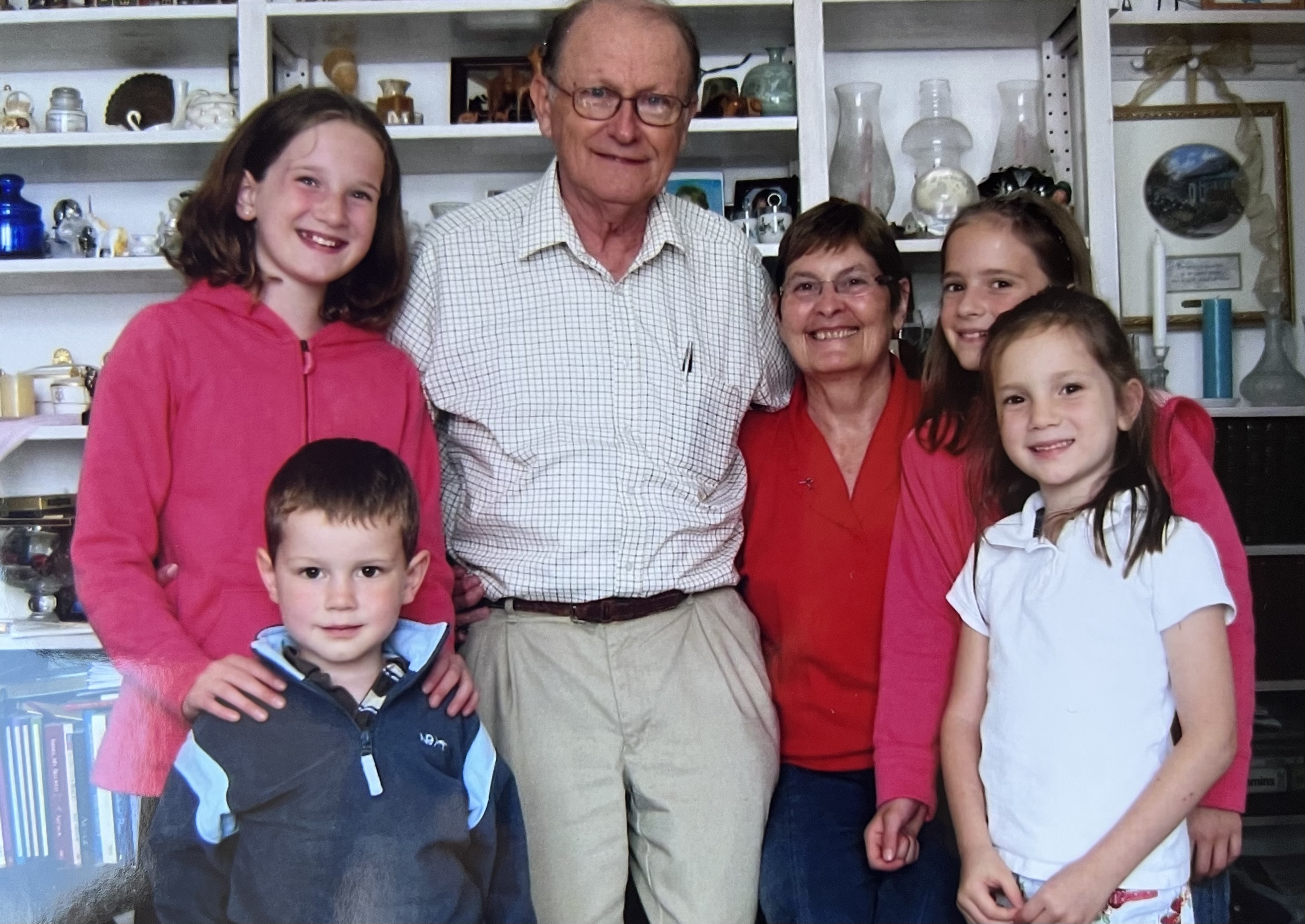
During our time living next door to George, I enjoyed a number of walks with George as we talked about life and ministry and navigating the complexities of theological disputes and issues in world missions.  My wife and I enjoyed a meal out with George and Drena.  I was so enjoying his story of how he had been banned from India for smuggling two typewriters, but then saw the look on Drena’s face – she had endured a lot at George’s side.  The weekly prayer meeting at Forest Hill was always so much better when George was there.  He would whistle through worship songs, sort his mail during various phases of the meeting, spill little tidbits of random OM history in reference to any guests that happened to be there, and refer to an awful lot of ministry as “tremendous.”  George had a way of building people up, and building up their contribution to world missions – even though most would have felt massively intimidated by George’s global impact!

What was George’s impact?  George was a pioneer.  In an age where missionary boards wanted seminary graduates, George pioneered a missionary force of willing volunteers.  In a time when missionaries made a career commitment, George saw the value in short-term teams.  Then there was the idea of getting a ship – totally crazy, but God was in that craziness.  Mexico, Europe, behind the Iron Curtain, India, the Middle East and North Africa, etc . . . all across the world George’s pragmatic pioneering spirit has spread with OM.  And then there are the hundreds or thousands of ministries that have launched out of OM.  People who came to OM for a couple of months or a couple of years, but went on to have lifelong ministries under a different banner.  George’s impact and legacy as a missions pioneer is vast.

George was a prolific speaker.  If you were looking for careful expository preaching, that wasn’t George.  But if you were ready to hear the overflow of a life set on fire by Jesus, then George was pure gold.  Whether it was in front of thousands of students at Urbana, or a handful of saints in a little church, George spoke (often while holding a giant inflatable globe) and lives were marked.  The last time I heard him preach he had three sets of seven points.  It was classic George.  But it was still so good.  He might have been known as a “pied piper missionary speaker,” but his greater passion was always “reality in Jesus” – he knew that if people experienced that revolution of love that comes from really knowing Jesus, then missions involvement would follow naturally.

George believed and preached the radical grace of God for undeserving sinners. He would say, “Where two are three are gathered in my name, sooner or later there will be a mess.” It was not just a humourous line to get a laugh. It was the reality he lived time and again. People mess up, and God’s grace is critical. George would preach about that grace, and then he would live it as a leader drawing alongside strugglers as a fellow struggler and recipient of God’s great grace.

You might assume that George’s impact was all about leadership and speaking. After all, he was the International Director of OM (until 2003), a global missions pioneer, and had a full speaking schedule (apparently he dropped from 900x per year to just 350x per year after he retired!)  But even if he spoke multiple times in a week, there were still so many hours outside of those slots – George wanted to use all of his hours for Jesus.  Living next door for a season and working alongside him during those years, I noted several ministries that could easily be overlooked. 

Prayer.  George prayed for people.  He had his gopher put pictures of people on his phone so he could pray for people when he was on the London Underground and lost his phone signal.  If he couldn’t be talking to someone, then he could be talking to God about someone. He had photo albums full of ancient prayer cards – one day he knocked on our door to show us pictures of Melanie and me as little children.  Another time we had guests and our friend was shocked to meet George for the first time as he held out a picture of her with her family when she was a toddler – he’d pray through these collections of memories again and again. In these last years, George was excited to know that our children also went out with OM – to Ireland, to Albania, and to the Logos Hope. That’s three generations involved in missions, in part, because of George’s prayers.

Connecting.  George would get a phone call from someone.  He would introduce them to someone else.  He literally multiplied his ministry by connecting people to other people that could be an encouragement to them.  He asked me to get in touch with an evangelist that could do with a friend.  It might have seemed like a mess, but the chaos continually spawned more ministry fruit.

Giving.  George was one of those people who God seemed to trust with money.  After raising funds for OM over the years, he focused on his Special Projects for the last twenty years.  Bibles, books, the Dalit Freedom Network, under-supported OMers, etc.  George was constantly passing on funds to where they were needed most.  Only eternity will reveal just how much money was recycled for God’s work through George.  His extreme frugality was well-known in OM (George and Drena trading their wedding cake for gas to drive to Mexico is a well-known story from the early years).  He repented of some of the more legalistic emphases that grew out of his own personality quirks, but that frugality surely led to him being trusted as a faithful conduit of Kingdom funds.

Books.  You can’t have met George and overlooked his passion for books.  Every meeting had an overflowing book table, with his incessant attempts to convince people to take books (post-date a cheque for a year beyond your college graduation!)  His book pushes were superb.  There was Operation World, of course. Grace Awakening – how many times did he push Swindoll’s classic (and mention that the first section was a bit dull, which somehow didn’t seem to put you off reading it!)  Calvary Road – he loved Roy Hession books and worked with the Roy Hession Trust for many years.  He would refer to A.W.Tozer books just sizzling away on the book table.  And his own, Hunger for Reality and Revolution of Love were two powerful examples from the earlier years.  Then Messiology came later – some of his most controversial comments compiled in a book.  Yes, George had a passion for books that came through in every meeting.  But he didn’t stop outside of meetings.  He was constantly sending packages of books, plus calendars, and single sheet papers on subjects like making a prayer meeting work.  If you were on George’s mailing list, then these packages would reassure you that you were in his prayers too.

It was so sad to hear that George was nearing the end.  If you haven’t seen his final blog, please click here to do so.  Right to the end he spoke of the many who still need Jesus.  Hundreds of thousands have been involved in missions directly or indirectly because of George.  That means millions will have heard the gospel directly or indirectly because of George.  To many of us, George was a hero. Of course, he was no superhero.  He was far too real for that.  And he was definitely a little bit quirky and unique too. But he was a hero to my wife and me because of how God used him to mark our lives so profoundly.

Today I grieve for George and I also praise God for his willingness to give his all for Jesus. I will miss his energy and drive, I will miss his passion for Jesus and world missions, and I will miss his love for me and my family. I know there will be many around the globe who are sad at George’s passing, yet thrilled at George’s promotion.  Maybe one of his crowns could be a global jacket like he so often wore.  He will be thrilled to cast that down before his Lord!

Stepping Out Into a New World

The last year has felt like a whirlwind for us all.  There have been constant government guideline changes and the kinds of interruptions to everyday life that most of us have never seen before.  Now it feels like we are starting to emerge from the Covid-19 crisis.

The world has been shifting.  Due to the pandemic or due to societal changes, the world is not the same place as it was just a few years ago.  So my mind has gone to the second half of Acts.  Acts 13 and following chronicles when the followers of Jesus first stepped out to take the message of Jesus to a very different world.

Let’s take Acts 13-14 as a case study to consider.  Here we read Luke’s account of the first missionary journey.  The church at Antioch in Syria sent out Barnabas and Paul.  These two travelled to Cyprus, then up to what we would call Turkey.  We read of their ministry in places like Pisidian Antioch, Iconium, Lystra and Derbe.

Perhaps we can note some basic principles that will be helpful to us as we step out into our new world with the message of Jesus today:

1. God is active in the spread of the message.  In Acts 13:1-4, we see how God is the initiator who launched the mission of Barnabas and Saul.  As we read further, we can recognize that God is involved in every aspect of their ministry.  That same God was not surprised by the challenges of 2020.  He is continuing to work out His purposes in 2021. 

2. The enemy opposes the spread of the message.  In Acts 13:8-11, we read about the active opposition of a false teacher called Elymas.  This “son of the Devil” was trying to turn others away from the faith.  Paul did not hold back in dealing with that opposition.  Remember that this was a foreign culture, but the apostles knew that people everywhere need to hear the truth about Jesus.  We will face opposition as we seek to speak of Jesus this year.  Let’s pray for the courage and boldness we need to carry that message effectively.

3. People respond to the message in different ways.  In Acts 13:42-52, we witness a typical response to Paul’s preaching.  Some of the hearers were stirred and wanted to know more.  But opposition arose from the local Jews who eventually drove the apostles out of town.  We might expect the opposition to come from overtly evil people. However, often it is the religious and self-righteous who prove to be most resistant to the good news of Jesus.   We should never be discouraged by a mixed reaction to the gospel.

4. Remember to begin at the very beginning.  In Acts 14:8-20, we watch Barnabas and Paul as they came to Lystra.  These were not Jews with a background understanding of the Old Testament.  These were pagans with no Bible background at all.  They soon gathered in a crowd with the local priest of Zeus, ready to offer sacrifices to Barnabas and Paul (who they mistakenly thought were Zeus and Hermes in the flesh!).  Barnabas and Paul could have seized the opportunity.  After all, here was a crowd, including a strategic influencer, who all thought Paul and Barnabas were gods – they could have worked with that position of influence!

Paul could have launched into preaching about God’s greater sacrifice.  Or he could have demonstrated the similarities between Zeus and the true God.  With some careful editing, it is always possible to forge the connections between other deities and our God.  Lystrans believed Zeus was the sovereign of the universe, master of heaven and earth.  It sounds biblical.  Zeus was concerned with justice and order; God too.  Zeus showcased his power in extreme weather; there are Bible stories that come to mind. 

But Paul and Barnabas did not entertain this approach at all.  Why not?  Because truth matters.  And the truth of the matter was that the God they had come to represent was not like Zeus or any other god hanging around the area.  The true God was so much better!  So Paul launched into a brief message introducing the true God.  Paul spoke boldly, calling them to turn from vain things.  He also spoke invitingly, calling them to turn to God.  And he spoke clearly, setting out the character of the true God: the living and generous creator God, patient and kind. 

The God we represent is not the same as the other gods worshipped in our world.  People worship the gods of other religions, or celebrities, or ideologies.  We can always edit the details and form connections. Still, the foundational truth is that the true God is different, and He is better because He is so so good!  Let’s be sure to start at the beginning, with the God question: which God is God?  What is He like?

5. Be prepared to suffer because it is worth it.  In Acts 14:19-23, we see Paul stoned, dragged out of the city and presumed dead.  When the disciples gathered around him, though, he stood up.  Amazingly, he then went back into the city!  After travelling on to Derbe, Paul and Barnabas don’t continue down the road to their ultimate destination, their sending church in Syria.  Instead, they turn around and go back to Lystra, Iconium and Pisidian Antioch – the three cities involved in trying to kill Paul! 

Why would they do something so inherently dangerous?  Because it is worth it.  It is worth it to help people know the true God instead of their false gods.  And it is worth it because those small groups of new believers matter to that God.  We may be offering encouragement and teaching to unimpressive little groups of young believers in Europe this year, but they matter to God!

There is plenty more we can learn from this section of Acts.  Let’s find encouragement in these missionary journey accounts, and then let us press on in our ministries empowered by God!

The Local Church and the Missionary

The relationship between the local church in the West and the missionary sent to a far-off land has always been unique.  In one respect, the roles in this relationship may soon be reversed.

In some cases, the local church has revered missionaries and almost idolized them.  When visiting their home country, they are honoured as they regale the congregation with tales of life in exotic far flung lands. 

In other cases, the local church has felt awkward around missionaries and almost ignored them.  When they visit they have a token opportunity to “show their slides” and they sometimes feel like fish out of water – trying to communicate in a culture that is no longer their own.

Cultural Awkwardness

Whether the missionaries are somewhat celebrated or generally forgotten, they will speak to one another of the cultural awkwardness they feel when they return to their sending country.  They arrive and hear passing questions like, “is it nice to be home?”  But often missionaries feel far from home and uncertain of how to fit into the culture that has moved on from the one they left years ago.

In contrast, the local church in the West has typically felt very much at home.  It has always been the missionary’s context that has seemed strange and hard to comprehend.  The church in the West might wonder about the missionary: How do you live in a culture dominated by that strange and zealous religion?  How do you communicate to people who see the world completely differently?  How can the church exist and grow in a culture that considers Christians to be a danger and a threat to society? 

Times are Changing!

In recent years, western cultures have been experiencing significant changes.  The shift feels very rapid.  Years of preparatory work in education, the media, and entertainment culture are now bearing fruit as a much more activist-driven cultural upheaval is quickly turning everything upside-down (or right-side up, depending on your perspective!).  This is no superficial shift.  The very foundations of Western society are being replaced so that we now face a totally different worldview and a whole new morality.  Our culture is radically different than it was even at the turn of the century.  Truths everybody knew until a few minutes ago are now dogmatically dismissed and everyone is increasingly required to agree with the new truths. No debate is permitted.

Times have changed and now the home church does not feel like it is at home.  Increasingly, it feels like our culture is strange and hard to comprehend.  In the next few years we will be asking ourselves, how are we supposed to live in a culture dominated by another ideology that feels almost religious and fundamentalist in its zeal?  How can we communicate with people who are conditioned by their education and media to see the world very differently than we do?  How can our church exist and grow in a culture that is increasingly antagonistic to its very existence and considers the church to be dangerous and a threat to the safety and unity of society?

Maybe if we are not already asking ourselves these questions, we will be asking them soon.  Perhaps we should think about asking our missionaries how they would answer them.  Their experience of life and ministry in some foreign countries may become more relevant to life in “the West” than it would have been forty, or even ten, years ago. 

In the past, we may have asked the missionary about the dominant religion in their mission field because we saw families with that same religion moving in locally.  This is still true.  But maybe there is much more we can learn from them now that our culture is moving so far away from its Judeo-Christian roots and worldview.  Our culture will increasingly feel like the ideologically dominated cultures we used to think of as foreign mission fields.  Maybe we should be asking the missionaries how we can effectively reach people here.

(Photo by Roman Denisenko on Unsplash)

Saturday Short Thought – Preaching to Listeners

This week I have blogged about listeners.  I was preaching at a Christian Union gathering again this week, this time in Northampton.  I preached from Matthew’s gospel to a gathering of missions agency reps and students.  Since numbers were down on last week, it was more tempting to try and please the reps, rather than speak specifically to the students.  I hope I managed to keep the message on target for the listeners that were the focus of the message.

I’m reminded of John Stott’s great book on preaching – Between Two Worlds.  In it he introduces the metaphor of the preacher as bridge-builder.  I often come back to his thought that we have to land the message on both sides.

Some preachers start in the Bible text and build straight up to heaven, without landing the world of the listener.

Other preachers start in the world of the listener and never make any real connection in the world of the Bible text.

True biblical preachers have to be at home in both worlds and make sure their messages are firmly planted in the text, and land solidly in the realm of the listener.

Simple thought, but so important.  As you preach tomorrow, are you well-rooted in the text?  Good, but don’t forget to land very clearly and relevantly in the experience of the listeners too.

Like This!

FaceTweet it!

– – – – – – – – – – – – – – – – – – – – – – – – –

Next week – Preparing to Preach Christmas Messages

Beware the Power of Propagated Rumors

There are always troublesome trends around, even in the church. They may be ideas or vague concepts, but they creep in and stick around for a while. Perhaps books are written to support them, but something published is not something certain. Maybe it’s time to put your finger on the pulse of your church and see if there are any ideas drifting around. In some cases we don’t need to address them, but simply be careful not to propagate them in our preaching, either by attitude, inference or reference. In other cases we need to step in and overtly correct with direct Bible teaching.

The heretical understandings. For example, how many people in our churches have the idea that the Trinity can be explained by the illustration of water, ice and steam (a modalistic explanation) or three friends in one group (a tritheistic explanation). If there is heretical thinking, look for appropriate moments to clarify the truth.

The fashionable trends. Not everything we disagree with is outright heresy. Often they are theological fashions and trends. Perhaps an idea pushed in a book that is imbalanced or narrow. Perhaps an idea emanating from a certain “camp” in Christendom. Perhaps an idea pushed on us from pressure groups outside the church. Fashionable “trends” that I’ve heard lately would include the idea that eschatology is other-worldly, always “retreatist” in orientation and therefore irrelevant. The blanket statement that foreign missionaries are no longer needed in other countries. The notion that Paul hated women. Or that any social concern among Christians means they have given up on the gospel. Or the opposite idea that Christians concerned with evangelism have no concern for people. I want to be careful not to add weight to any of these ideas, no matter how popular they might be in some circles.

We don’t have to address every issue going on in broader Christianity. But we should be aware of any way in which a passing comment, or perceived attitude, might continue to propagate ideas we don’t support. And we should have our finger on the pulse enough to recognize when an idea is becoming imbalanced, or worse, when a heresy is becoming acceptable.

Musts From Beyond The Schedule

It is so easy to get into ministry maintainance mode.  We do what we have to do to keep things ticking over.  As soon as one program is over, the next is looming.  And there is certainly something to be said for faithful plugging away in local church work.  But while remaining faithful to what must be done, we should remember that there are other things that must be done too.  These “musts” comes not from the tyranny of the weekly schedule, but from the beating heart of God.

Dream – Take some time to dream.  Let’s unshackle our imaginations and prayerfully imagine what could be.   We should break out of the small confines we easily find ourselves in and engage sanctified imaginations for God.  Imagine what could be for individuals in the church, for ministries in the church, for the church itself.  Dream dreams that don’t fit in the weekly schedule.  Tangibly meeting specific needs in the local community.  Mobilizing missionaries who will actually go and make a difference.  Taking a stand on a key ethical issue and seeing God work through that.  As we walk close with the Lord, His values become our values, and increasingly our dreams should reflect His.

Strategize – Pray about taking steps toward these bigger goals.  Your strategy will go beyond preaching on the subject, but it should include that.  The pulpit ministry of the church has a unique and definite role to play.  Even if you are not able to define a five-year detailed strategy, just taking some steps is worth it.

Preach – It’s easy to lose sight of how influential preaching is in the life of the church.  It’s easy to allow negative feedback or a perceived lack of response to drain your motivation.  But preaching does matter and it does influence.  So preach.  Preach the Word of God for the transformation of lives.

Pursue – If you are pursuing a goal, then pursue it after you preach on it.  That might involve further messages.  It’s easy to expect too much from a single message.  It might involve conversations, convening an interest group, distributing resources, the targeted giving of key books, further prayer, of course.  If you want to lose your passion for something, then reflect only on the apparent lack of response from a message.  If you want to see greater things happening, then pursue with further preaching and more.

The Smaller Hats Worn in the Pulpit

This site is dedicated to stimulating biblical preaching.  The main hat the preacher wears is that of the biblical and relevant communicator.  There are lots of angles on that main role, and they are explored post by post on this site and others.  But I would like to mention some smaller hats worn in the pulpit.  These are typically not your main role in preaching (although in a particular sermon they may be), but these are roles to be aware of.  Areas of strategic influence for the preacher:

Materialism Underminer – Throughout the week the people in our congregation are bombarded by messages of materialism.  It’s everywhere they look – billboards, TV, radio commercials, shop windows, magazine racks, etc.  A constant stream of a very powerful big idea.  When we preach, whatever the text and message might be, we break into that stream of information and give a few moments of spiritual reality again.  Perhaps in passing comments or illustrations we even undermine the message of materialism too!  (The same could be said of society and media obsessions with independence, evolution, humanism, etc.)

Family Support Officer – Many people come from, live in or have come out of broken homes.  The enemy is attacking the family unit at every level.  Yet for those minutes on a Sunday morning, people are allowed to look through the windows into your life.  I’m not saying you should air your private laundry, or show-off your family or children (be sensitive to those who don’t have what you have).  However, glimpses into a healthy home can be powerful antidotes to the stream of failure society parades before us.  I still remember the illustrations given from the home life of one of my profs at seminary.  Bruce Fong is now president at Michigan, but in his Multnomah days the Fong family functioned as an inspiration to single me and others.

Missions Mobilizer – We’re living in a world of desperate needs, yet none as desperate as the 9 people dying every 5 seconds, most of whom step into a lost eternity.  The greatest need in world missions today is still people, followed by finance and other resources.  The only source of people who could go and make a difference is the local church.  That puts us as preachers in a key role.  Let’s be aware of the opportunity and inspire our people to be genuine global Christians!

That’s three more hats to ponder.  Any others that come to mind?