The Least Resolution for 2024

January does not just bring a new page on the calendar but a whole new calendar.  And with the new year, we tend to generate renewed commitments.  Maybe you have already determined what 2024 will mean for you.  Perhaps your mind has already pondered daily step counts, gym visits, dietary changes, or other healthy habits.  Or maybe you are thinking about Bible reading, daily prayer routines, or other spiritual goals.  May your resolutions last and bear good fruit!  But perhaps the resolution we need for 2024 is more foundational than healthy habits and more straightforward than spiritual practices.

As I write this, I am in Budapest, where I have just visited a museum of the political terror of the twentieth century.  As you can imagine, it is a sobering experience to see the vast walls of victims, the displays focused on the political prisoners, a room commemorating the persecution of the religious leaders, the torture chambers, the prison cells, and the gallows.  But perhaps the lingering memory for me will be the final room.  With red walls and hundreds of pictures, it felt like yet another presentation of victims.  But it was not.  It was a room of “victimizers” – ordinary people who were merely doing their job, simply following orders, just playing along, and thereby facilitating the evil machine.  We can remember the victims, and we must.  Yet we must also face the uncomfortable reality that most cogs in the cruel machine of death were ordinary people.

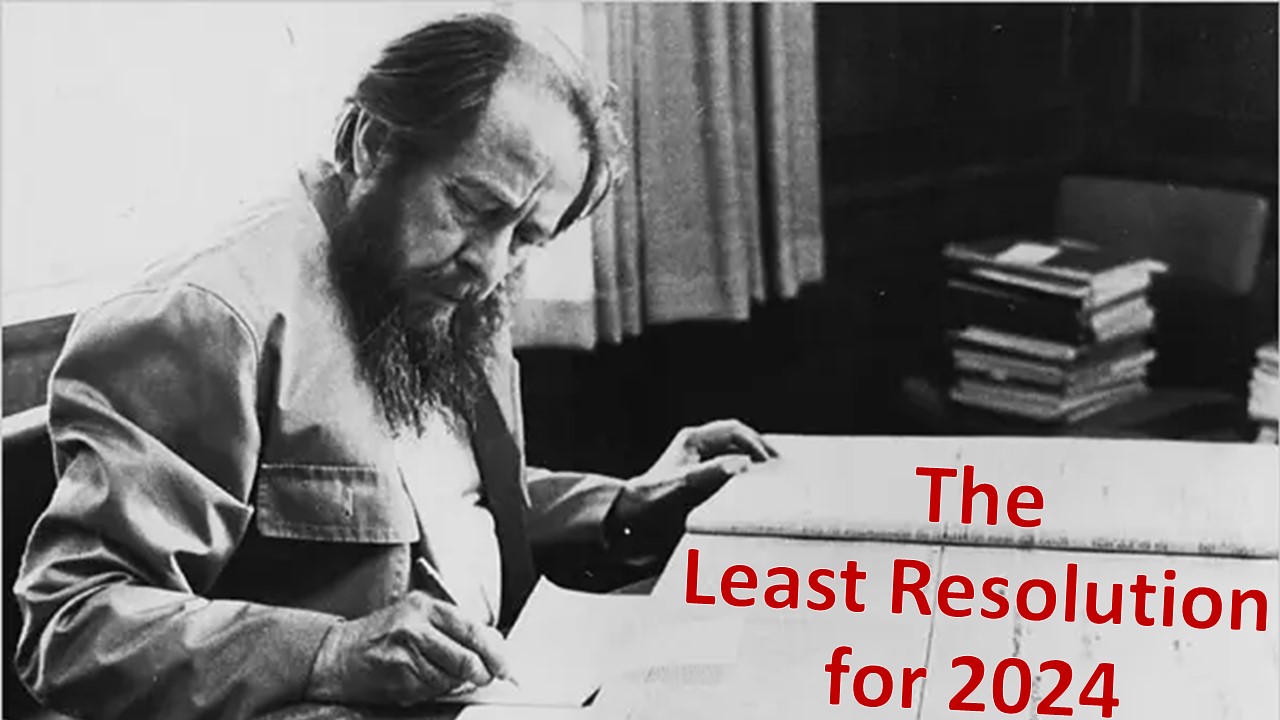
Fifty years ago, in February 1974, Alexander Solzhenitsyn was arrested in the Soviet Union and exiled to the West.  There, he was welcomed as a hero.  On the day of his arrest, he released a document entitled “Live Not by Lies.”  He knew the power of an ideology that sought to reshape society.  He also knew the power of individuals who simply refuse to lie (and the even greater power of a crowd joining together in this conviction).  He knew that the ideological system would totter and collapse when it ran up against the brick wall of reality, exemplified by many individuals refusing to play along with the evil fantasy.
Fifty years later, perhaps it is time for us to revisit this document.  Are we living in times where some, on behalf of all, have determined what society should look like?  Do we see a mounting pressure to conform with what ‘they say’ is acceptable human thought and belief? Indeed, we should not be so naïve as to assume that the absence of marching military on our streets means we face no ideological threat. 

The pressure is growing for everyone quietly to conform.  More than that, the pressure is growing to affirm openly and celebrate what we know to be false.  Surely, it would be better to speak the truth now instead of growing our tendency to fit in and play it safe as the stakes mount.

Truth and Lies – Choosing not to lie was not an original idea for Solzhenitsyn.  Paul urged the Colossians not to lie to one another.  Not only had they put off their old self, but they had put on the new self to reflect their creator’s image (Colossians 3:9-10).  He told the Ephesian believers to speak the truth to one another since they were no longer defined by the lie (Ephesians 4:25).

In the Sermon on the Mount, Jesus addresses the anger underneath murder, the lust underneath adultery, and the daily consistency of speech beneath more flamboyant oaths (Matthew 5:21-37).  There is plenty of Old Testament support for the expectation that God’s people should be consistent speakers of truth (Exodus 20:16; Leviticus 19:11; Proverbs 14:5).  God does not lie, and his people represent him.

Fear and Lies – Solzhenitsyn knew the impact of fear on a population.  He wrote of the great threat facing humanity in his day, which was “about to flare up and engulf us.”  And he described the fear: “While we continue to smile sheepishly and babble; ‘But what can we do to stop it? We haven’t the strength.’”

God asked Isaiah’s listeners, “Whom did you dread and fear, so that you lied, and did not remember me, did not lay it to heart?” (Isaiah 57:11).  Their fear led to lies, as they forgot who was really in charge.

Our world seems to be changing at a frightening rate.  Trying to keep up with the latest adjustments to sense and morality can be tiring.  And it is increasingly revealing how much fear lies within most of us, who are so prone to play along with society’s expectations rather than speak what is true.  It is concerning how easily we fear and perhaps lie while forgetting who is really in charge. 

Some will capitulate completely and speak what is false.  Others hide behind a cloak of not wanting to “sound political” and speak out about the reducing set of acceptable Christian declarations.  Fear of being labelled and criticized leads many to hold back from speaking the simple truth.  After all, it is much easier to quote a Bible verse on social media or avoid the hot topics in conversation rather than offer the most minor form of resistance.

Solzhenitsyn wrote that the fear his people felt was not primarily a fear of nuclear death or a third world war.  The fear was of taking a “civic stance.”  He wrote, “We hope only not to stray from the herd, not to set out on our own, and risk suddenly having to make do without the white bread, the hot water heater, a Moscow residency permit.”  The penalty for a civic stance may have changed, but the fear of the herd has not.

History has never smiled on the timid, and yet each fearful choice always makes sense at the time.  How often do I justify timidity when society needs me to show courage and speak the truth?  We have almost constant opportunities to speak the truth about marriage, gender, sexuality, race, free speech, bodily autonomy, science, medical ethics, corruption, or whatever other prescribed view is being pushed at any given moment.

We cannot simply wait for an ideology to fall apart.  We must be part of the brick wall of reality into which it must crash.  And yet, it is always easier to “continue to acknowledge, glorify, and strengthen” that which we want to see collapse.  At the very least, we must not “recoil from its most vulnerable point.  From lies.”

Violence and Lies – Solzhenitsyn described how violence bursts into peaceful situations with great self-assurance.  “But violence ages swiftly, a few years pass—and it is no longer sure of itself.  To prop itself up, to appear decent, it will without fail call forth its ally—Lies.  For violence has nothing to cover itself with but lies.”

So, even under overt tyranny, people do not have to experience violence at all times.  The demand is only of a “daily participation in deceit” – the tribute paid to maintain one’s position under the power of the oppressive system.  Just play along, it is safer.

The connection between violence and lies is also not a discovery made under the rule of twentieth-century totalitarianism.  Micah wrote to the city in his day, “Your rich men are full of violence, your inhabitants speak lies and their tongue is deceitful in their mouth” (Micah 6:12).

We may not have to stand and fight against violence.  We may not even have to step out publicly and boldly declare the truth. “But let us at least refuse to say what we do not think!”

The Consequences of No Lies – In the Soviet Union, there was a cost to this most simple of stands.  It could cost your job and complicate life.  It could cost your success in education and impoverish your future.  But Solzhenitsyn was clear:

“And as for him who lacks the courage to defend even his own soul: Let him not brag of his progressive views, boast of his status as an academician or a recognized artist, a distinguished citizen or general.  Let him say to himself plainly: I am cattle, I am a coward, I seek only warmth and to eat my fill.”

To choose not to lie was not an easy choice in his day.  It will increasingly not be an easy choice for social standing, or even for physical wellbeing, in our day.  But the choice not to lie is “the only one for the soul.”

The implication of no lies is worthy of note. “The more of us set out together, the thicker our ranks, the easier and shorter will this path be for us all!  If we become thousands—they will not cope, they will be unable to touch us.  If we will grow to tens of thousands—we will not recognize our country!”

As we head into a new year, may we not simply play along with the world.  Instead, let us graciously, prayerfully, and wisely determine that whatever else may happen, we will not participate in the lies expected of us in society.  As representatives of God in this world, this is the least we must do!

(Source of AS quotes: https://www.solzhenitsyncenter.org/live-not-by-lies)
The Heart of Hermeneutics – Part 2

What Did Jesus Say About Bible Study?

In John 5, Jesus is both in trouble and on trial.  He had healed a man on the Sabbath and then made himself equal with God when confronted by the authorities.  His extended speech in verses 19-47 is actually a legal defense speech in what had quickly become a capital trial.  By the time we get near the end of the chapter, Jesus is actually turning the tables and putting the Jewish authorities on the back foot.

Jesus knew that he needed a second witness.  But as the angry leaders looked at this man from Nazareth, they could not see anyone standing with him.  However, he had the best witness of all: God himself.  The problem was on their side though, because according to Jesus, they had never heard God’s voice, nor seen God’s form, and they did not have God’s word abiding in them. 

Bible Study Experts?

Understandably these Jewish leaders would have balked at that diagnosis of their spiritual state.  They, of all people, spent the most time with their nose in the scrolls.  They were the Bible men of their day.  They could quote more of the Old Testament from memory than many Christians today have even read.  And yet, Jesus was right.  Something was missing.  And it meant that their hermeneutical approach was rendered useless.

Did they look at the text?  Every day, at length.  Did they learn what the text meant?  They would say so.  Did they follow through and consider its implications for how they lived?  Fastidiously.  These men were the eminent biblical studies professors of their time.  And yet, in Jesus’ estimation, they did not have God’s word abiding in them.  What was missing?

The Missing Piece

In the Scriptures there is a relational dynamic at play.  The text is about a person, but they did not believe in him.  They refused to come to him.  Jesus immediately drew the contrast between him and them.  He did not live for horizontal glory from people but lived with a total orientation toward his father.  However, they did live for the glory that would come from people.  Because the horizontal dimension meant everything to them, the vertical dimension was missing.  And how did Jesus phrase that vertical dimension in their case?  They did not seek the glory that comes from God.  Which meant that they did not have the love of God in them.  (John 5:37-44)

It is not possible to rightly handle God’s word if the love dimension is missing.  In the next post, we will probe that love dimension.

Studying the Bible – Look!

I have completed a series of videos that detail the Look phase of the Bible study process. Using the triumphal entry passage in John 12, I look at the kind of details that we need to notice as we look at a Bible passage. The more closely we look at and observe the text, the easier it will be to accurately learn what the text means in the next phase of our study. So, what type of details are we noticing?

1. Who? – Who is being referred to in the passage? How are they being described? Who do the pronouns refer to? This is the first and, in some ways, the most important detail to notice. Why? Because the entire Bible is primarily a revelation of God and so noticing who is in the passage should get us thinking about God from the very beginning. (Click here for the video.)

2. When? – Are there any time references in the passage? Perhaps a time of day, or a point on the calendar. But it is not just about explicit time references, there is also the whole issue of tenses. Is something written with a tense that stands out – perhaps a reference to the past or the future. (Click here for the video.)

3. Where? – Does the passage refer to any locations? These could be geographic (i.e. Jerusalem), or circumstantial (sitting on a donkey), or they could be out of this world (God’s throne). Notice any details to places or locations in the passage. Do you need to check a map to note a specific location? (Click here for the video.)

4. What? – This is a catch-all question! What is repeated? What seems to be significant? What other details are you seeing in the passage? What key terms are being used? (Click here for the video.)

5. Which? – Which other passages are feeding into the passage you are looking at? These could be earlier Biblical content that is being quoted or alluded to in the passage you are studying. Or it could be earlier passages in the same book that are influencing our understanding of the passage we are studying. (Click here for the video.)

6. How? – How did the writer choose to write the passage? Is it a narrative, poetry, or discourse? At the Look stage, we don’t need to conclude why they did it, but we do need to notice how it was written. (Click here for the video.)

After the Look! stage of Bible study, we will then move on to Learn (what does the text mean?) Here is a one-video summary of the Learn phase for this passage. And then there is the Love/Live response (what should the text stir?) Here is a one-video summary of the Love/Live phase for this passage. I will release another series that uses a different passage but focuses on the Learn phase instead of the Look phase as I have this time. Then another focusing on Love/Live. Hopefully, that makes sense! Please subscribe to the YouTube channel so that you can see the new videos as they are released.

Desperate Places

In English, we have a phrase, “on top of the world!” It describes someone flying high because of some success or good news. Perhaps they got engaged, passed their driving test, earned a promotion, or won a prize. 

What is the opposite of “on top of the world”? Perhaps it is “carrying the weight of the world on their shoulders.” Another very English phrase, but also easy to understand. It’s when someone feels so weighed down by trouble that they are almost crushed. They feel desperately small and hopeless. All it takes to go from being on top of the world to having the weight of the world on your shoulders is one phone call. 

One bit of bad news can crush our lives. And that is why it is essential to know how Jesus treats people in desperate straits. Let’s look briefly at a story in Mark 10. It comes right at the end of the chapter, and that is important. Let me explain.

Jesus was on a mission. He was headed for Jerusalem. Back in Mark 8, we see Peter’s great confession of Jesus as the Christ, which was immediately followed by Jesus predicting his death. It becomes clear that you cannot have Christ without the cross. Jesus repeated the prediction in chapter 9, then again in chapter 10. In 10:32, we read that “They were on their way up to Jerusalem, with Jesus leading the way, and the disciples were astonished, while those who followed were afraid.” Jesus was marching out ahead – he was on his great Easter mission. His disciples were astonished, perhaps because of how boldly Jesus was walking towards trouble. And the entourage of followers felt fear as they anticipated whatever tensions would face them once they arrived. 

Again, Jesus repeated his prediction that he was going to Jerusalem to be condemned, awfully mistreated, and killed. Next, we read that James and John decided to stake their claim to positions of prominence in his future kingdom. It was an awkward moment. But it did allow Jesus to give the key verse in the whole Gospel. Mark 10:45 – “For even the Son of Man did not come to be served, but to serve, and to give his life as a ransom for many.”

With the great line delivered, the natural next verse would be Mark 11:1 – “And they approached Jerusalem . . .” The most significant verse in the book, and then the big arrival in Jerusalem – Easter week! 

But, instead, we get one more story. An interruption. As they left Jericho to climb the long road to Jerusalem, someone started crying out to Jesus. The man could not see, but when he heard who was passing by, he began to shout. “Jesus, Son of David, have mercy on me!” 

Throughout Mark’s Gospel, the identity of Jesus has been gradually revealed. Now we hear a great Messianic title echoing through a crowd who immediately rebuked the shouting man. Perhaps the Messianic language felt too risky, especially this close to Jerusalem. Maybe they feared the authorities, who could be in the midst and ready to hit back against this famous troublemaker from Nazareth and his supporters? But the rebukes failed. He just shouted more.

We watch Jesus’ reaction to this interruption in the last four verses of the chapter. Remember that he was on a mission, and the next stop: Easter week. Now a blind beggar is shouting at him. A nobody, especially in those days. But he was a somebody to Jesus. Notice the three things that Jesus does for this man:

  1. He calls him. In verse 49, we see Jesus calling the man. What an honour! Jesus is effectively saying, “You are somebody, you matter, you have value, and I want to speak with you.” Dismissal, further rebuke, even rejection, could all happen from a distance, but Jesus called him close. Isn’t it wonderful to pause and reflect on what this shows us about the heart of Jesus, and therefore, the heart of God? Yes, God sits on the throne above everything that is. He is high and exalted, in charge of the cosmos. Yet time and again, the Bible shows us that God humbles himself to reach down to the very lowest of the low, to people like this man, crushed under the weight of the world, but important to God.
  1. He asks him. After coming quickly to Jesus, the man is met with a question, “What do you want me to do for you?” (see v. 51). It seems like an obvious question. After all, he is blind. But we shouldn’t judge a situation so quickly. Jesus asked him a question and effectively communicated, “You are a full human, with dignity; let me not assume anything.” After all, we do not know this man’s story. What would he answer? Would he say something about needing to provide for his family? Would he ask something for a family member suffering from an illness? We cannot assume to know his answer, and Jesus didn’t assume to know his answer. 

It only takes a moment for the weight of the world to roll onto a person’s shoulders, but Jesus still honours him as a human with dignity. Naturally, we should do the same for others. And let’s not forget that we are a phone call away, a car crash away, a circumstance away from having our whole life turned upside down. And even if that happens, Jesus will still treat us with dignity too!

  1. He heals him. The man’s request was about sight. And trusting Jesus did lead to him seeing again. Jesus had underlined the man’s value, then the dignity of the man, and now we know that he has a new future too. What a powerful moment for all around! Actually, perhaps the powerful moment is found in the last few words of the story. He “followed Jesus along the road.” The astonished disciples and the fearful entourage were joined by this newly seeing man – a true follower of Jesus.

Can we say he was a true follower of Jesus? After all, maybe he only followed briefly? Interestingly, this is the only healing in Mark’s Gospel where the person healed is named. Why would Mark tell us his name (and his father’s name)? Why would Matthew and Luke not include the name when they told the story in their Gospels? There is a good chance that the reason was that Bartimaeus was known in the church for whom Mark wrote his Gospel. “Bartimaeus? The older guy in the third row?” Yes, him. “Oh, I didn’t know that had happened to him.” There are probably people in our churches today who have a personal history with Jesus we don’t know about. After all, it doesn’t take much to find ourselves in a desperate place. It can happen at any time. And we know how Jesus treats people like that.

_____________________________________

A Psalm written in a desperate place, Psalm 13:

How Do You Respond to Your Greatest Fear?

We live in a world of fear.  Deep down, most people live with a fear of something happening to their health or their loved ones.  Many people live in cities with soaring crime rates.  Geopolitical changes in a country on the other side of the world can raise the fear of terrorist attacks.  What we see on the news makes us afraid, or else what we don’t see on the news does.  Some are afraid of the cultural shifts that are rocking the moral foundations of society.  And for the last eighteen months, the fear of COVID-19 has been at the forefront of everyone’s thinking.  Either people fear the illness itself or fear the response from governments.  Fear is a feature of life in this fallen world.

I know that logic does not necessarily mix easily with fear – it never helped much with shadows at night when we were children!  But still, logically, it would make sense to fear most what is most significant or powerful.  Why worry about hay fever if a third of your village has died from food poisoning in the last month?  So, what is the most important, significant and potentially life-changing person or problem facing each of us today?

In Luke 8, we find Jesus on tour.  In the previous chapters, he has gathered his disciples around him and begun his ministry.  From the end of chapters 9 to 19, he will journey to Jerusalem and all that waits in store there.  But in chapters 8 and 9, Jesus is on tour in Galilee.  He is teaching and helping people.  The chapter starts with one of his more famous teaching moments – the man sowing seed on four kinds of soil.  The different soils lead to different responses.  But the bottom line of that story is that our hearts can be good soil for the seed of God’s word.  Good soil does not provide the seed, nor the sun, nor the sprinkling of rain.  It is just churned up mud, ready to receive God’s word.  And Jesus promises a multiplied harvest: a hundred times what was sown.

After the teaching comes a couple of stories where fear is a feature.  In the first story (Luke 8:22-25), the disciples cross the Sea of Galilee when a terrifying storm hits.  Even the experienced fishermen are scared of this storm, but Jesus woke from his sleep, and he rebuked the wind and the waves.  Immediate calm descended.  But their hearts were stirred up.  They were afraid.  Notice their response – they ask, “who is this?” and continue to follow him.  That is the correct response.  Jesus has overwhelming power and authority.  The proper response to someone so significant?  Fear.  And the desire to know more about him, to follow him, to be with him.

In the second story (Luke 8:26-39), the disciples arrive with Jesus in the region of the Gerasenes.  I suspect they may have been a little nervous in this foreign territory.  Perhaps they would tell stories about this region over the campfire late at night with the orange glow of the fire flickering on their faces.  This visit did not serve to change their prejudices!  As soon as they arrived, a man with many demons approached Jesus.

Many of us live in a time and place where demonic manifestation is not the preferred strategy of the enemy.  Many of our societies like to think of themselves as too sophisticated for this kind of thing.  Nevertheless, in this one man, we see classic features of evil.  For instance, evil always pulls towards death.  For this man, that meant nakedness and not living in society, but among the tombs. 

Today we see the same pull towards death in anyone struggling with addictive behaviour and its impact on their life.  We see it when we consider the impact of gangs and crime in a city or watch the news and ponder the march of evil on a grander scale.  Stripping away life, civility, community, and fellowship is always a feature of evil, and we see it all too much in our world.  If we look back in history, we see this in the concentration camps of the Nazis, the work camps of Communism, or the destruction of terrorism.  We may not see many demon-possessed men in our local graveyards, but there is plenty of evil in the world today.  Evil pulls towards death, and in Luke, the mass suicide of the pigs only underlines that truth.

This story presents the fearful reality of evil, and it also shows us another aspect that we must recognize.  The multitude of demons in this man greatly feared Jesus!  They didn’t negotiate,  certainly not as equals.  They begged.  They recognized his authority both in the present and in the future judgment.  The greatest evil in this world cowers in the presence of Jesus.

I can imagine the disciples at this moment.  They would not have been fanning out through the crowd offering their expert commentary on Jesus’ actions.  I imagine them squeezed in behind Jesus.  Nervous.  Awkward.  “Me? Oh, I am with him!”  We must remember Jesus’ authority over all evil and lean in close to him.  We are with him!  Greater is he who is in you than he who is in the world (1 John 4:4).

This story does not just present us with evil and its fear of Jesus.  It also shows us that fear in the response of the local people too.  As they came and found the impossible-to-contain man dressed and in his right mind, they were afraid.  This Jesus is too powerful, too significant, too much of a life-changer.  He made them feel uncomfortable and afraid.  Like many people, even today, it is too scary to let someone turn their world upside-down.  Much better to live with the evil we have gotten used to than to have everything changed.  So they were afraid (compare verses 25 and 35), and they sent Jesus away.

The rescued man wanted to be with Jesus.  He begged that he might be with Jesus and get in the boat too.  We know from reading the Bible that he would eventually get to be with Jesus, as we all will, but first, he had work to do.  Jesus had churned up that region like ploughing mud in a field.  Now he was going to plant this man as a single seed into that mud.  I am excited to imagine what a hundred-fold increase might look like for him!  Maybe we will meet the Gerasene contingent when we get to heaven!

I wonder, did he look jealously at the disciples?  “Why do they get to be with you when I get planted into this fear-churned world?”  Again, we know from reading the Gospels the answer to that too.  The disciples would need a longer apprenticeship, but after three years with Jesus, he would also plant them into this evil world.  Jesus planted them with a promise.  “All authority has been given to me, therefore go and make disciples . . . baptizing . . . and teaching . . . and don’t miss this: I am with you always, until the end of the world!” (Matthew 28:18-20)

We do live in a world filled with fear.  One day we will be with Jesus, away from all evil.  But for now, Jesus is with us as he multiplies a crop from our apparent insignificance.  May we not only see the evil around us that causes us to fear.  May we remember that evil cowers before Jesus.  May we respond to his greater significance in the right way – pondering who he is and leaning into him and his plan for our role in this world.  Fear Jesus, for he is more powerful and significant than any evil, or all evil!  Let us trust him as he places us in the mess of this world and see how he transforms lives through us!

The Heart of Jesus Christ for Me – Dane Ortlund

Last week I was delighted to interview Dane Ortlund about his wonderful new book, Gentle and Lowly (Crossway).  In this clip Dane speaks about the heart of Jesus toward us as we struggle in this life.  I am sure you will find Dane to be such an encouragement!

To see the full interview, which is well worth it, please sign up to the Cor Deo Online mailing list and we will give you access when it is released later this week.  Click here to sign up.

Sitting Alone

In John 6, Jesus appears to have a public relations disaster.  He starts the chapter with a huge crowd and an event that will become a favourite of children’s Bible story books – in fact, the only pre-passion narrative that makes it into all four Gospels.  But he ends the chapter with a question mark hanging over his core disciples and a poignant reference to one of the twelve being a devil.

How does it all go so “wrong” for Jesus?

The passage begins with a huge crowd gathering with Jesus and a reference to the forthcoming Passover feast.  He takes five barley loaves and two fish (a poor person’s food) and turns it into more than enough (a proper feast).  The response of the people seems to be on target.  They start asking if he is the Prophet anticipated in Deuteronomy 18, and they want to make him king.  From a human standpoint, it looks to be a successful operation at this point.

Overnight Jesus sends the disciples on ahead and takes a creative shortcut across the lake, ready for the morning crowds.  The morning crowds are yesterday’s crowd, plus some others from Tiberias, and they come looking for something.  Jesus cuts through the hype and identifies what they want – another free lunch.  But this is insulting to Jesus, who actually came to give eternal life.  How often do we petition Christ for the petty things, while ignoring the far greater gifts that he wants to give us?  It is certainly not wrong to pray about the little stuff, for he does care for everything, but when we only care for short-lived comforts, while ignoring his greater giving goals, then we insult him.

Along the way Jesus critiques the Jewish idea that Moses had given them the miracle bread from heaven, when in fact it was the Father.  Then, instead of making himself the new Moses that they referred to in verse 14, Jesus makes himself the bread from heaven, sent to save and sustain the people.  He will turn none away, will give them true life, and will raise them up on the last day – a past, present, and future package of assurance from God. (See vv35-40, for instance.)

This only makes the Jews grumble about him.  How can he be the bread?  They wonder if he is talking about eating his flesh and drinking his blood.  Rather than backing away from the physicality of this misunderstanding, instead Jesus goes along with the language of eating and drinking.  (Remember how people have already misunderstood the temple language in chapter 2, the new birth language in chapter 3, and the living water and food language of chapter 4.)

I suspect Jesus wasn’t expecting to be understood in reference to the later ordinance of the Christian church – communion, Lord’s Supper, or whatever your church calls it.  Rather, I think he may well have been thinking of the Passover meal.  The people were expected to eat all the flesh of the lamb, as well as drink all the “blood of the grapes.”  It was a special meal, an “eat-it-all-because-we-are-leaving-in-a-hurry” type of feast.  It celebrated the Passover lamb, provided to rescue the people and let them live in the face of all that was happening in Egypt that night.

Jesus could have been misunderstood as speaking of flesh eating and blood drinking, but I suspect that was not the issue.  Actually, what he meant was also insanely challenging.  Just as God had provided a way for the people to live through the Passover back in Egypt, so now there was a new Passover coming.  This new Passover was for eternal life.  The provision was costly and there was an implicit demand in the meal.  Jesus was effectively saying, “It is all about me, I am giving everything for you…make me your everything.”

Jesus was the whole lamb, the drink, everything.  At the next Passover he would make it clear that his body was being given and his blood was to be shed.  What was most offensive to human sensibilities was not the potential misunderstanding of eating flesh and drinking blood, but instead the absolute nature of Jesus’ offering and implicit demand.  He gave everything, so make him everything.

We humans are not fans of such absolute expectations.  We’d rather blend our options.  The crowds certainly felt uncomfortable and quickly dispersed.  The popular vote was lost in a day.  Maybe ten to twenty thousand people left and just twelve remained.  Jesus spoke truth and they didn’t like it.  He turned to the twelve.  “What about you?  Want to go too?”

Peter’s response is reflective of our situation too.  We have been drawn to a place of belief.  We are blessed not only by knowing Jesus, but also by knowing there is no alternative!  “To whom shall we go?”  Peter’s response is spot on.  “You have the words of eternal life.”  He certainly does.  But those words are not popular.

We live in a world where people live in fear of saying something that will receive the backlash of irrational intolerance and hatred.  To stand for truth is as unpopular as it has ever been, and there is no longer a Christian-worldview majority ready to affirm and support us in these times.  Instead it feels like everyone is fleeing the scene and chasing empty alternatives.  Will we leave him too?  To put it bluntly, where would we go?  This world has no viable alternatives to Christ.

And so we sit, almost alone, before Jesus.  Do we want to follow the crowds and reject Christ and the God he came to reveal?  It would certainly feel easier to follow the population, for the popular vote is never with God.  But honestly, we would do well to follow Peter’s pathway here… “Lord, to whom shall we go? You have the words of eternal life, and we have believed, and have come to know, that you are the Holy One of God.”

Jesus gave everything for us to have eternal life.  Will we make him everything and follow him, even if nobody else will?

Feeling Flat?

When the Covid-19 crisis rolled across Europe in March, everything changed.  Maybe you found the experience overwhelming, or challenging, or perhaps even invigorating.  Somehow, when crisis hits and our adrenaline surges, we tend to lean on the Lord and find ways through the situation.  But after adrenaline there is always a settling period, when it is the most normal thing in the world to feel emotionally flat.  Maybe by now you have arrived there too?

Two Types of Feeling Flat

When we feel flat we tend to have lowered motivation and energy.  We may be doing less, but somehow feeling more tired.  We feel a loss of creativity and initiative.  Flatness is not a new feeling, but having so many of us experience it at the same time is slightly unusual.

“I’m feeling flat” is something I’ve heard a lot recently.  But there is another type of flatness that is perhaps more concerning.  It is the unconscious flatness that we don’t tend to recognize in ourselves – we don’t spot it in the mirror.

Unconscious flatness could be called spiritual coasting.  Coasting is where you disengage the motor of the car you are driving and allow past momentum and present circumstances to roll the car forwards.  This kind of driving is dangerous.  It changes the braking and steering in the car, but perhaps most concerning is that it can give a false sense of security.  After all, the engine noise reduces and the car keeps moving forwards.

We need to respond when we are feeling flat, especially when we become aware of this unconscious flatness, or spiritual coasting.

Responding to Feeling Flat

The typical human response to feeling flat will not be spiritually healthy.  We may default to distraction, to self-recrimination, or to laziness.  That is, we can fill the void with busy work, new pursuits, or entertainment.  We can beat ourselves up with the “I need to try harder!” kind of self-coaching.  Or we can settle into our flat state and get comfortable.  Typical human responses will tend to be self-oriented and spiritually unhealthy.

What should we do when we understandably feel flat or discover we have drifted into a state of flatness?  Our emotions are great indicators of deeper realities in our hearts, and they should be prompts to connect relationally – with others, and with God.

When we feel flat, we tend to pull back from others.  Living through a pandemic only reinforces that possibility – it is a government-mandated withdrawal!  But spiritually we need to connect and fellowship with our brothers and sisters in whatever way we can (even if that means using Zoom!)

Most of all, we need to re-connect with Christ.  We need to spend time with Him, because only Christ can invigorate our hearts and stir life in us.  And yet our default fleshly response will be to pull in the opposite direction.

Let me share one thing about Christ that may encourage you to bring your tired and emotionally flat heart to Him in these days.  I want to point to two passages and focus particularly on what they teach about how Christ cares for the weak and vulnerable.  Does going to Christ mean accessing the ultimate personal trainer who can shout the loudest?  Not at all.

Motivation for Connection

Isaiah 42:1-4 is the first of Isaiah’s famous “Servant songs.”  At first glance it could look intimidating.  After all, three times it declares that this servant of the LORD will establish justice on the earth.  Surely one who is tough on crime will be overwhelmingly powerful and intimidating?  But not so.  Verse 2 tells us that he is not full of himself, nor does he demand everyone’s attention.  And verse 3 describes his way of dealing with the weak:

                         “a bruised reed he will not break,

                                         And a faintly burning wick he will not quench.”

That is the kind of God that motivates me to lift a bruised and tired heart up toward him.  Feeling flat?  Connect with the only one who can be fully trusted with your heart.

That truth is painted in narrative colour in John 21.  The adrenaline of the first Easter has faded and seven of the disciples are back in Galilee, heading out to fish for the night.  Whatever their motivation, I am sure that part of the issue was that they felt flat.  Read the chapter and watch Jesus care for them.  He could have criticized, shouted, corrected, berated, or chastised them.  He didn’t.

Instead, Jesus gently reminds them of their calling to ministry by miraculously filling their nets with fish, again.  He gently reminds them that he will continue to provide for them by lovingly preparing a barbecued breakfast, a God-given meal of fish and bread, again.  He gently re-established Peter’s position within the group by re-affirming his shepherding role.  In this chapter he reminds them of their calling to evangelism and edification ministries, he reminds them of his ability to continue to provide for them, and he even grants Peter his desire to die for Jesus – only this time with a 30+ year warning.  The content of his teaching is powerful and challenging, but his manner is gentle and tender.

This is the kind of God that can motivate us to lift our flattened hearts up toward him.  Dare to connect with the only one who can be fully trusted with your heart.

_________________________________________________________

I have recently been adding highlights from John’s Gospel to my YouTube channel:

Resolved: No Resolutions

resolved2To finish this week of posts I want to re-visit one I wrote two years ago and develop it slightly.

Resolved: To make no New Year’s Resolutions for me to do, but to cling to the One who is at work in and through me according to His perfect plans for 2015.

A while back I really enjoyed reading the masterful biography of Jonathan Edwards by George Marsden.  It is fascinating to see the early resolutions of Edwards give way to a mature spirituality that was delighted in and by Christ later in his life.

Let’s face it, there are so many good resolutions that we could make as we head into another New Year.  Bible reading commitments, wider reading plans, personal prayer schedules, pursuit of ministry training ideas, grow theologically intentions, find a mentor strategies, evaluation and feedback gathering plans, sermonic self-improvement schemes, pastoral ministry visitation goals, personal fitness/diet/exercise/rest regimes, family scheduling tactics, and on the list goes.

All of these would be good ideas.  But making these determined and resolute teeth-clenched-and-muscles-flexed kind of personal commitments may well not be the best way to go.  That is, if we aren’t the autonomous self-made individualists that our culture and our fallen world like to convince us that we are.

Our life and ministry is much more about response to God’s Spirit at work in our lives than it is about our responsibility to act like the god of our own lives.  We are not the captain of our own destiny.  We are not sheriff of Me-ville.  We are lovers defined by who and what we love.  And as those who know and love the Triune God, we are in the best possible place to face a new year of uncertainties, trials, complexities and challenges.

My loving response to God’s love for me will result in some determined lifestyle choices and evidences of personal discipline.  This will also be true in my married life too – my loving response to my wife will look disciplined and diligent.  But I won’t talk about it in those terms.  At one level there is no real sacrifice involved in responding to the God we have.  Yes, it may look costly at times, but from the perspective of a captured heart?

As we head into 2015, let’s hold all our resolutions with a very loose grip, but squeeze tightly on the hand of Him who holds us, our families, our ministries and our year ahead in the palm of His hand.

Can we even begin to imagine what our Lord might do in us and through us in 2015?  Exceedingly, abundantly beyond all that we ask or even imagine . . . and certainly more than we can achieve by our own self-determined productivity and improvement plans!