Every Nation

Our church recently celebrated “International Sunday,” a day to praise God for the many nations He has brought together in our church.  We enjoyed different foods and national dress, and we prayed for many countries.  Whenever Christians from many countries come together, whether in a local church or at an international conference, someone will usually call it a “taste of heaven.”  Why?

A gathering of multiple nationalities is not unique to Christian events.  But it might be uniquely united.  Gatherings such as the United Nations have never lived up to their original promise, and even the Olympics or the World Cup usually have a nation boycotting or tensions beneath the surface. 

One reason we might call such a Christian gathering a taste of heaven is that only heaven’s King can make it happen.  On earth, if a situation gets messy, a powerful leader is needed to clean it up.  A struggling school might get a “super” head teacher who lays down the law, or a city might get a tougher chief of police.  Perhaps a powerful king might bring a country into line.  But pure power is never enough.  It can impose law and order, but it can never change even a single human heart.  That is where the problems all stem from.

Thankfully, God offers us a perfect King—exactly what we need.  In Revelation 5, the apostle John is caught up to the throne room of heaven, and he sees a scroll in the right hand of the One who sits on the throne.  When no one worthy is found to take and open the scroll, he starts to weep.  But then he is told that there is one who is worthy—the Lion of the tribe of Judah.  The Lion—a powerful leader, a triumphant king—is strong, majestic, and courageous.  And yet, there is more.

In the next verse, John turns to see this great leader, and he sees a Lamb.  This Lamb has been slain, and yet is standing—an innocent sacrifice, clearly a different kind of leader.  In fact, Revelation calls Jesus the Lamb another twenty-seven times.  God’s King is both a Lion and a Lamb, and He is worthy of all worship.
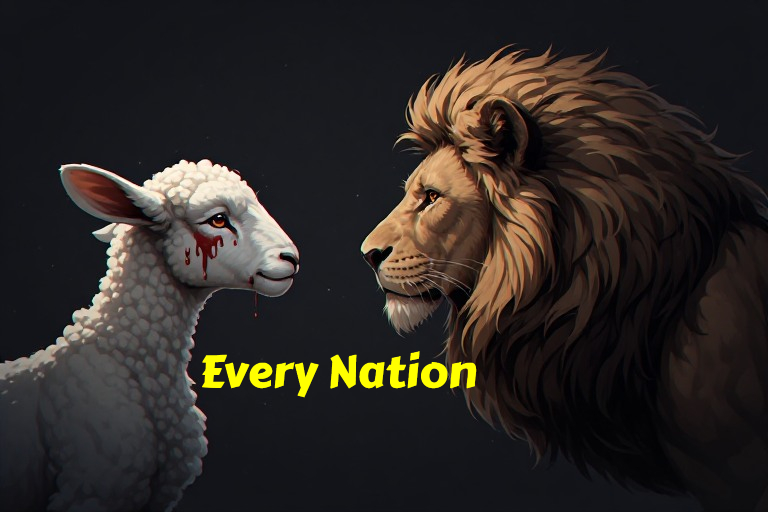
When we get a glimpse of this reality, the combined truth of the triumphant Lion and the sacrificed Lamb now standing again, we can grasp the uniqueness of our Saviour.  His blood has ransomed people for God from every tribe and language and people and nation (v. 9).  And His glorious rule has been shared with those people (v. 10).  The slain Lamb and the ruling Lion are two aspects of the wonder of Christ that both reflect God’s glorious love to us.

Indeed, the wonder of our Lion-Lamb-Lord is such that He alone is worthy of total worship.  And that is how the passage concludes.  John sees and hears everyone around the throne worshipping, including vast hosts of angelic voices (v. 11).  Together, they are all crying out that the slain Lamb is worthy of seven-fold praise (v. 12).  Then John hears every creature, in every dimension of creation, declaring He is worthy of praise for all time (v. 13).  And even the highest and closest ones to the throne agree, falling and worshipping.  This is total worship, because the Lamb is totally deserving of all praise.

We live in a world where bringing nations together in unity is increasingly out of reach.  No human power can achieve it.  But God’s King will, and does.  It is as we see our triumphant King, our humble and self-sacrificing King, our Lion-Lamb-Lord, that we can find hope for true unity and harmony.  That is why He alone is worthy of all the praise, both now and forever.

_____________________________________________________

God’s Great Story and You – Part 3…Why Does It Matter To Me That Jesus Rose?

God’s Great Story and You! is a 4-part series I wrote for LookForHope.org – a website for people looking for hope in the midst of this COVID-19 crisis.  Please take a look at the site and spread the word so that others can find it.  Click here for part 1, click here for part 2.  Here is part 3 of the series:

Why Does It Matter To Me That Jesus Rose?

In part 2 we saw how Jesus’ death on the cross achieved so much for us. But in order to see that his sacrifice had been accepted, that his victory had been won, that his mission had been accomplished…Jesus did not stay dead. The hero of the story walks out the tomb victorious and history has been completely changed by that fact.

After Jesus died on the cross, his followers did not assemble to plan the greatest ruse in history and spread a fake rumour about Jesus conquering death. They went into hiding as they mourned his death. They were shocked to meet him again. They didn’t see a ghost, or get a vague apparition. This was not the vain hope of Elvis fans that the king might still be alive somewhere. No, the risen Jesus purposefully met with them and rocked their worlds forever.

For instance, one of his followers, Mary Magdalene, met him on that Easter Sunday morning. She didn’t look up and recognise him until he spoke her name. That moment of recognition was powerful and deeply emotional. Then Jesus said something amazing, he told her that he would be going back to ‘‘my Father and your Father, to my God and your God.’ Jesus always spoke of God as his Father, but this is the first time he spoke of him as ‘your Father…your God.’ Jesus’ death on the cross had achieved what it was meant to achieve, and the resurrection confirmed it … God and humans could now enjoy a reconciled relationship! (See John 20:11-18)

That evening Jesus came to ten of his disciples and filled them with joy. He told them that he would be sending them out to continue his mission from his Father. But one disciple was missing. Thomas heard their report, but he was sceptical. He wanted proof. You probably should too. After all, claims of Jesus rising from the dead are nice, but we can’t live our lives and head into eternity based on fact-less claims. The next week Jesus came to them again, this time Thomas was there. Jesus didn’t rebuke Thomas for wanting proof. Instead, Jesus invited him to come forward and touch for himself. This was no ghost, no apparition, no vision. This was Jesus literally raised from the dead. We can’t touch him like that today, but we can investigate the evidence and test the fact of Jesus’ resurrection just like any other fact of history. In fact, if we do we will find the evidence is overwhelmingly in support of the fact that Jesus rose from the dead. (See John 20:19-29)

Because Jesus rose from the dead, this means that the claims of Jesus, and the teachings of Christianity, are built on the foundation of a fact that can be tested. We are not asked to blindly believe in fairy stories. The Christian faith is founded on fact.

Because Jesus rose from the dead, God has confirmed that all Jesus aimed to achieve on the cross was successful. He had paid for sin and satisfied the justice of God. He made a way for humans to come to God and defeated the enemy of our souls and death itself!

Because Jesus rose from the dead, death need no longer be the end of your story. Every other religious figure could teach his followers, but all of them ended up dead and buried. Jesus rose from the dead and so is in a category of his own. If he conquered death himself, then he can conquer death for his followers too.

Because Jesus rose from the dead, it means that this life is not all there is, but also that this life really matters. Christians have been willing to not only live for Jesus, but also to die for him, knowing that there is a life to come that gives great hope in this disease-ridden and violent world. No matter what happens, nothing can take away the hope of a Christian that reaches joyfully beyond suffering and death to the hope of being home with Jesus and more fully alive than ever.

At the same time, because Jesus rose physically, it means that human life is incredibly valuable. The world is not yet made right, but we can fight for what is right and good as we wait for God to purge sin and selfishness from this world and renew the wonderful creation again!