The Thirties – Part 5 (What About The Church?)

The question I brought into my reading of ACG’s book was more specific than society.  I wanted to know what was happening in the church during those years of transition to tyranny.  And is there anything we can learn for our tumultuous times?
The Catholic Church agreed a concordat with the Nazi party in 1933.  It gave the church a lot of freedom and protection.  But at a cost. “Catholic clergy were deprived of their civil rights. Political activity was forbidden.” (p205)  Ironically, they kept their position of influence in society, while relinquishing their ability to say anything constructive.  I have watched many wrestle with this tension in recent years.  Should we strive to keep our “voice” in society by following the rules imposed by the media, or do we speak out about concerns and thereby invite society’s opposition? 

“To oppose the encroachments by the Third Reich, the churches should have united and fought jointly the common danger, but here as in the political field, the spirit as well as the prerequisites to such unity were sadly lacking. As to the Protestant Church, the wealthy parishioners and the Protestant middle class were in favor of the Nazi regime. …Neither then nor later did the Protestant clergy show a common will and determination in defense of their rights.” (p206)  It is intriguing that those with some societal standing (in terms of their wealth status) are identified as supporting the regime.  Surely, if the benefits are to be weighed in terms of income and status, that should be a warning flag that the motives may be somewhat corrupted.

Is it possible to imagine a church in our time that goes along with a rogue government or popular narrative in order to keep its voice in society?  But what if it already has little to no voice?  What is it protecting?

“The Nazi aim in the field of religion is the establishment of a co-ordinated German church under party supervision. … Their publicly proclaimed thesis is “The word of Adolf Hitler is the word of God and has the authority of God.” (p206)  It was not just moral madness that should have been opposed, but also the religious heresy of the time.

Even within the 1930’s, there was a growing religious fervor in silent protests against the Nazi regime.  What if they had not capitulated initially to take the easy path and keep their influence?  What if the church had been willing to take a stand from the start?

There was a concerted effort to undermine the church’s influence in society.  The black-shirts, the elite guards, were forbidden to belong to any religion.  The Hitler Youth movement estranged a generation from churches. “Church services are held under observation of the Gestapo, the state secret police. Clergymen who have held services outside the church confines in order to escape police supervision have been arrested and sent to concentration camps.” (p208)

Church leaders and members were subjected to every possible charge and slander. “They are accused of immorality, corruption and violation of government regulations. . . . Occasional cases of law violations are blatantly generalized.” (p208)  It is hard to stand for what is right and true, but is that not what all believers are called to do in this fallen world?  We represent Jesus and the Gospel.  Always with grace and love, but sometimes with courage and a willingness to pay the ultimate price.  And when we capitulate in order to have a voice in society, what happens when society wakes up to the truth and then wonders why the church didn’t say anything? 

Is it better to have a voice, or to use it? 

I don’t want to condemn the church in the 1930s without acknowledging how easily cowed the church in the 2020s might prove to be.  As Dietrich Bonhoeffer famously wrote, “Silence in the face of evil is itself evil: God will not hold us guiltless. Not to speak is to speak. Not to act is to act.”


The Thirties – Part 3 (The Threats Identified)

In the last post, I noted a few parallels between the 1930s and our times.  But what about the threat itself?  The Nazi threat was totalitarian, oppressive, ideological and quasi-religious.  Since the fall of the Third Reich, the world has been more focused on Communism, supposedly coming from the opposite end of the political spectrum.  Also, on the expansion of militant religion, and latterly, activist agendas driven and funded by globalist ideologues.   While the media seems to scream “Nazi!” quite freely as an insult, there appears to be an eerie ignorance of where the threat lies for our society today.  What would be the cost in both freedom and lives if we continue to push in the direction of the utopian dreams being touted?

Interestingly, the ideologies swirling in the 1930s seem to come from both ends of the traditional political spectrum as people understand it. 

“Hardly had the republic been established, when the enemies started to attack in earnest.  From the left . . . the communists savagely pounded away at the people’s state and its institutions . . . fighting and belittling everything created by the republic. . . . Propelled by the insane belief in a world revolution, the communists caused millions of gold rubles to flow into Germany for the fight against the republic.” It is interesting to read how “time and again [the communists] joined forces with the Nationalists and Nazis in parliament.  They cast their vote against democratic government and, together with the Nazis, did immeasurable harm to the dignity of parliament by turning it into a place of political rowdyism and unheard-of brawls.” ACG was not surprised to see communists joining the brown-shirted storm troop army by the thousands, nor “the most radical communist districts . . . becoming strongholds of the National Socialist movement and its sluggers.” (p361) 

In another place, he notes how “Some SA formations had as many as thirty per cent communists in their ranks.  This was not at all surprising. Both the Nazi SA and the communists had much in common; above all, their hatred of democracy and especially of the social democracy.” (p252)

Wait, we are constantly told that the Nazis and the Communists represent opposite extremes on the political spectrum.  Instead of focusing all our attention on Left versus Right, we should instead contrast control and freedom.  Tyranny is tyranny, whatever uniform it wears.  And perhaps tyranny is the threat to liberal democracy and human freedom that lingers and re-asserts itself time and again.

Suppose the constitutional rights of the individual are not protected. In that case, any solution offered for any actual or imaginary crisis will prove to be a force of control.  In other words, self-proclaimed saviours tend to become tyrants.

 ACG finished his 1939 book with a prescient finale:

“National Socialism stands for the propagation of a system aimed at the destruction of individualism, the enslaving of other peoples, and barbarism. Civilization gives way to the law of the jungle. Wherever Hitler goes, the four horsemen of the Nazi Apocalypse follow. National Socialism is synonymous with war, devouring uncounted millions of lives, destroying culture and civilization. Hitler consciously or unconsciously is driving toward this goal. He is taking Germany and with her, all Europe and the whole world on the road to disaster.” (p367)

We would do well to understand what is meant by the political “left” and “right” but also to grasp that the real battle might be between control and freedom.  As preachers, our calling is not to preach a party political message.  The pulpit is not a soapbox; we have something much more important to proclaim.  But let us not bury our heads in the sand and live in ignorance of what is happening in the world around us. 

In the next post, I want to explore how the great shift happened so quickly and whether that may be helpful for our awareness today.

The Thirties – Part 2 (A Rapid Shift)

The shift from the German Republic founded in 1919 to the Nazi’s Third Reich in 1933 was colossal.  Clearly, it was possible for things to shift so rapidly in that society.  Are there any parallels between then and now?  As I read ACG’s Inside Germany, so many statements jumped out to me:

  • “The state, in my opinion, belongs to the people only if all the people take part in the exercise of government and public authority.” (p120)  Is there not an increasing feeling of disconnect between the population and the people with ultimate power in our day? 
  • “The best laws are of little value when carried out haphazardly or reluctantly.” (p120)  Confidence in a great legal system can drain away when it seems like there are different rules for different people.
  • “Knives, pistols and explosives are dangerous weapons. To those, however, who are guided by ideals and who, in the political struggle, have not lost sight of human dignity and integrity, the weapons of slander, abuse and insidious intrigues are far more dangerous.” (p122) ACG resigned as Minister of the Interior of Prussia in 1930following a targeted hate campaign by communist and national socialist agitators.  A politically motivated cancel culture is not a new phenomenon, but it is a concerning one.
  • We might assume that the people of Germany in the 1930s knew all too well the history of the war in the 1910s.  And yet, it doesn’t take long for a generation to rise who are ignorant or deliberately misinformed.  Those born during, or just before, the Great War became the youngsters who were so uninformed and so easily steered towards serving Hitler’s goals just two decades later. “What did those youngsters know of the struggles, miseries and sacrifices in the bitter war years?  Those youths from whom the truth was deliberately withheld had not the slightest inkling of the splendid response of the Social Democrats, the Jews and others to the war needs of the nation.  How many of the young men and women who swallow the lies and deceits of the National Socialist propaganda, hook, line and sinker know . . .” (p362) How confident can we be today that the younger generation is properly educated about the threats to our society from political, ideological or religious groups?  The evidence would suggest that too many know all too little.
  • In Mein Kampf, Hitler wrote that “A lie, if big enough, always has an excellent chance . . . . The masses with their primitive and one-sided minds are more susceptible to a big lie than a little one.” It is troubling to see how confident many are today that they are not the victim of any big lies.  They might acknowledge the possibility, or even the likelihood, of lies being the fare of politicians and the media.  But could they be the victim of a big lie?  Of course not, because they would know if they were.  It is a strange self-delusion, and our world is full of it.

There are so many parallels between then and now.  More will emerge in subsequent posts, but this is a starter list to ponder and prayerfully consider.  And the question that hangs over it all, like a Zeppelin, is what could and should the church pastors do in a society that is leaning in a dangerous direction?

Book Review: Pontius Pilate by Paul Maier

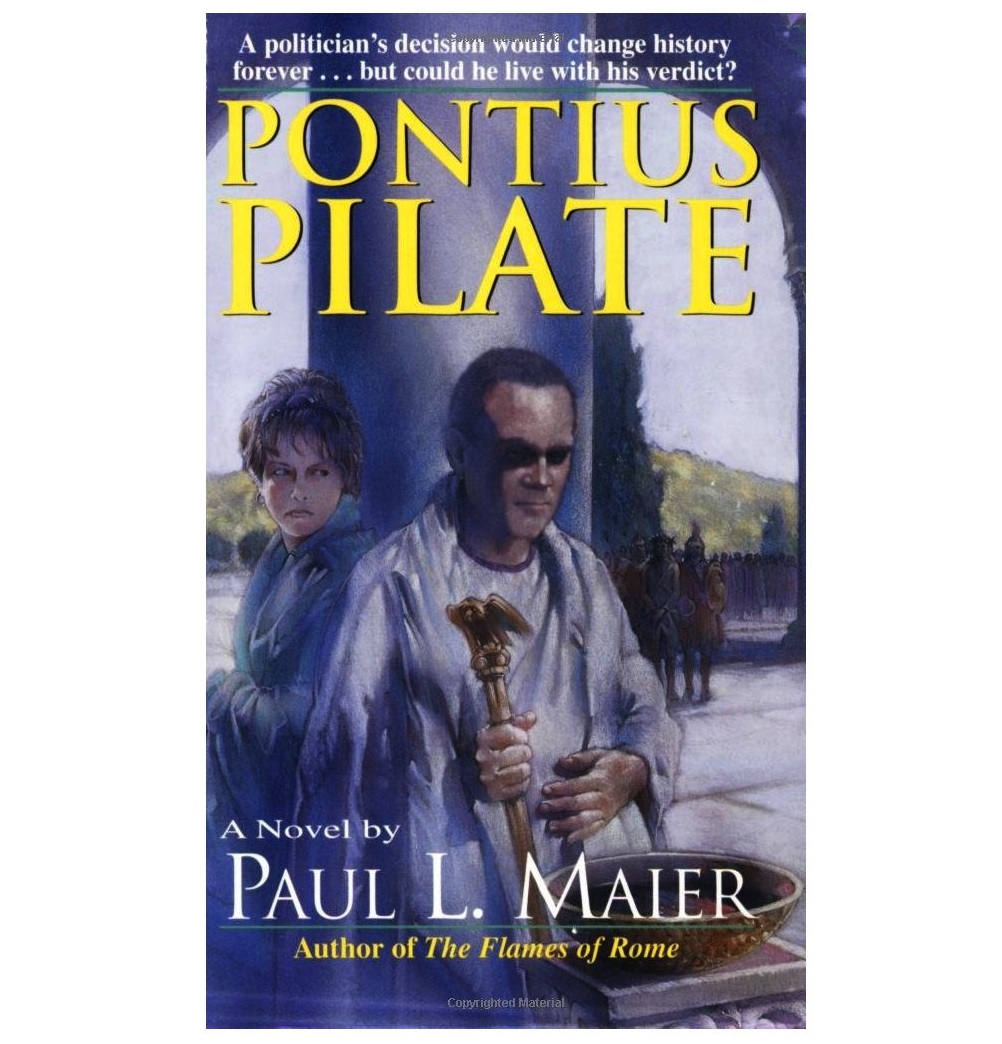
PilateI am just re-reading a book I devoured a couple of years ago.  It is historical fiction, but don’t let that put you off.  This historically annotated piece of work is a brilliant read.  It presents a biographical insight into the life and career of Pontius Pilate–his background in Rome, his prefecture in Judea, his confrontations with the Jewish authorities, his history shaping encounter with Jesus of Nazareth.

I suppose this review is a little late for this year, but if you ever preach around Easter, then you must read this book.  It was originally published in the 1960’s, but the timeless content means it could have been written last week.  Paul Maier is a pre-eminent historian of the first century and this makes his reconstruction of character and event particularly insightful.

Why did Pontius Pilate feel so trapped?  He was two strikes down with the Jewish populous when Jesus was presented to him.  This man was clearly innocent, but Pilate could not afford another disaster.  He could not face another report to the Emperor about his failure to manage the pesky Jewish religious affairs.  His ring declared him a friend of Caesar, with all the rights that went with that.  But the Sanhedrin turned the Jesus trial into an ultimatum for Pilate.  Was he really a friend of Caesar, or were these Jewish leaders more concerned with peace in Judea than he was?

Even if it is too late for this Easter, Christianity is an Easter faith and so I would strongly encourage you to get a copy of Pontius Pilate.  Don’t read it to your children, but grab a drink, get comfortable and step back into the first century.  Any preacher will benefit from doing so.