Saturday Short Thought: Glorious Gospel

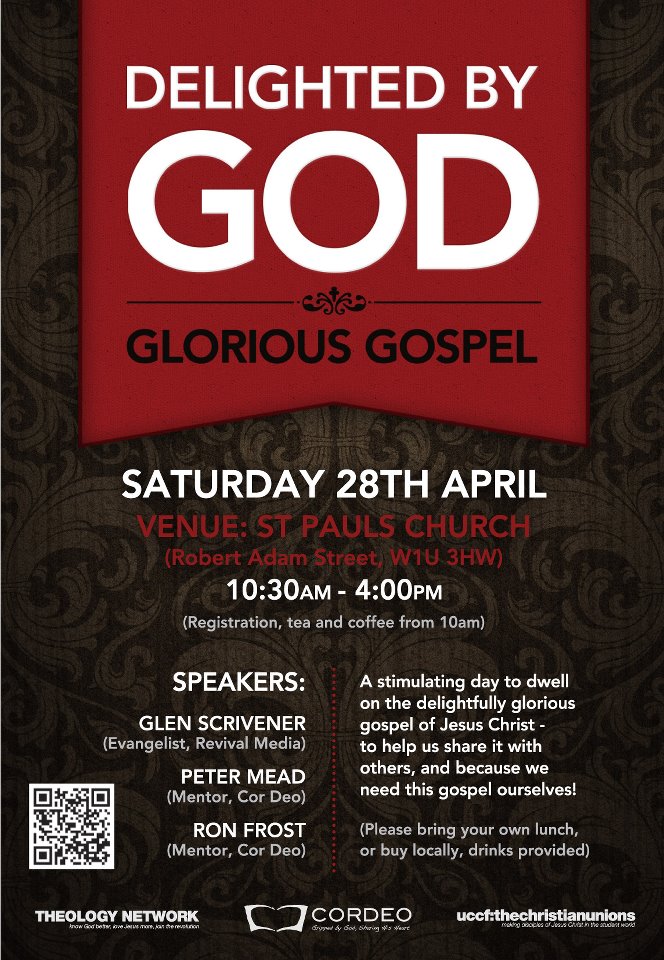
In a little while I’m heading to London to speak at a Cor Deo Delighted by God conference.  Our subtitle for the day is Glorious Gospel.  I am excited to hear the other sessions and to ponder together just how glorious the gospel really is.

What it comes down to, I suppose, is how glorious our God is, and what kind of gospel He has given us.  Too often the presentation of the gospel I hear is less than glorious.

It seems like a negotiation between a willing sinner and a reticent God.  The sinner is willing to say some words in order to gain a significant package of benefits.  And God is open to some sort of a contractual deal, but really is essentially resistant without the intervention of a kind lawyer working for us.

This is such a corruption of the truth.  God’s initiative is critical, and the extent to which He has gone to overcome the resistance of the human heart is stunning.  And as for the language of contracts, let’s dump that in the grip of His fatherly embrace!

The gospel is wondrously glorious, but it’s the kind of glory that involves His being high and lifted up, in absolute self-giving humiliation.

Let’s be sure we don’t preach a watered down, or petty, or negotiated gospel.

PS We’d really appreciate your prayers for today’s conference to go well!

_______________________

Next Week: The 10 Biggest Big Ideas

In the classroom Haddon Robinson said more than once that there are basically eight to ten big big ideas in the Bible.  He never gave us a list, but I’ll offer mine starting on Monday.  What would you include?

Beware the Power of Propagated Rumors

There are always troublesome trends around, even in the church. They may be ideas or vague concepts, but they creep in and stick around for a while. Perhaps books are written to support them, but something published is not something certain. Maybe it’s time to put your finger on the pulse of your church and see if there are any ideas drifting around. In some cases we don’t need to address them, but simply be careful not to propagate them in our preaching, either by attitude, inference or reference. In other cases we need to step in and overtly correct with direct Bible teaching.

The heretical understandings. For example, how many people in our churches have the idea that the Trinity can be explained by the illustration of water, ice and steam (a modalistic explanation) or three friends in one group (a tritheistic explanation). If there is heretical thinking, look for appropriate moments to clarify the truth.

The fashionable trends. Not everything we disagree with is outright heresy. Often they are theological fashions and trends. Perhaps an idea pushed in a book that is imbalanced or narrow. Perhaps an idea emanating from a certain “camp” in Christendom. Perhaps an idea pushed on us from pressure groups outside the church. Fashionable “trends” that I’ve heard lately would include the idea that eschatology is other-worldly, always “retreatist” in orientation and therefore irrelevant. The blanket statement that foreign missionaries are no longer needed in other countries. The notion that Paul hated women. Or that any social concern among Christians means they have given up on the gospel. Or the opposite idea that Christians concerned with evangelism have no concern for people. I want to be careful not to add weight to any of these ideas, no matter how popular they might be in some circles.

We don’t have to address every issue going on in broader Christianity. But we should be aware of any way in which a passing comment, or perceived attitude, might continue to propagate ideas we don’t support. And we should have our finger on the pulse enough to recognize when an idea is becoming imbalanced, or worse, when a heresy is becoming acceptable.