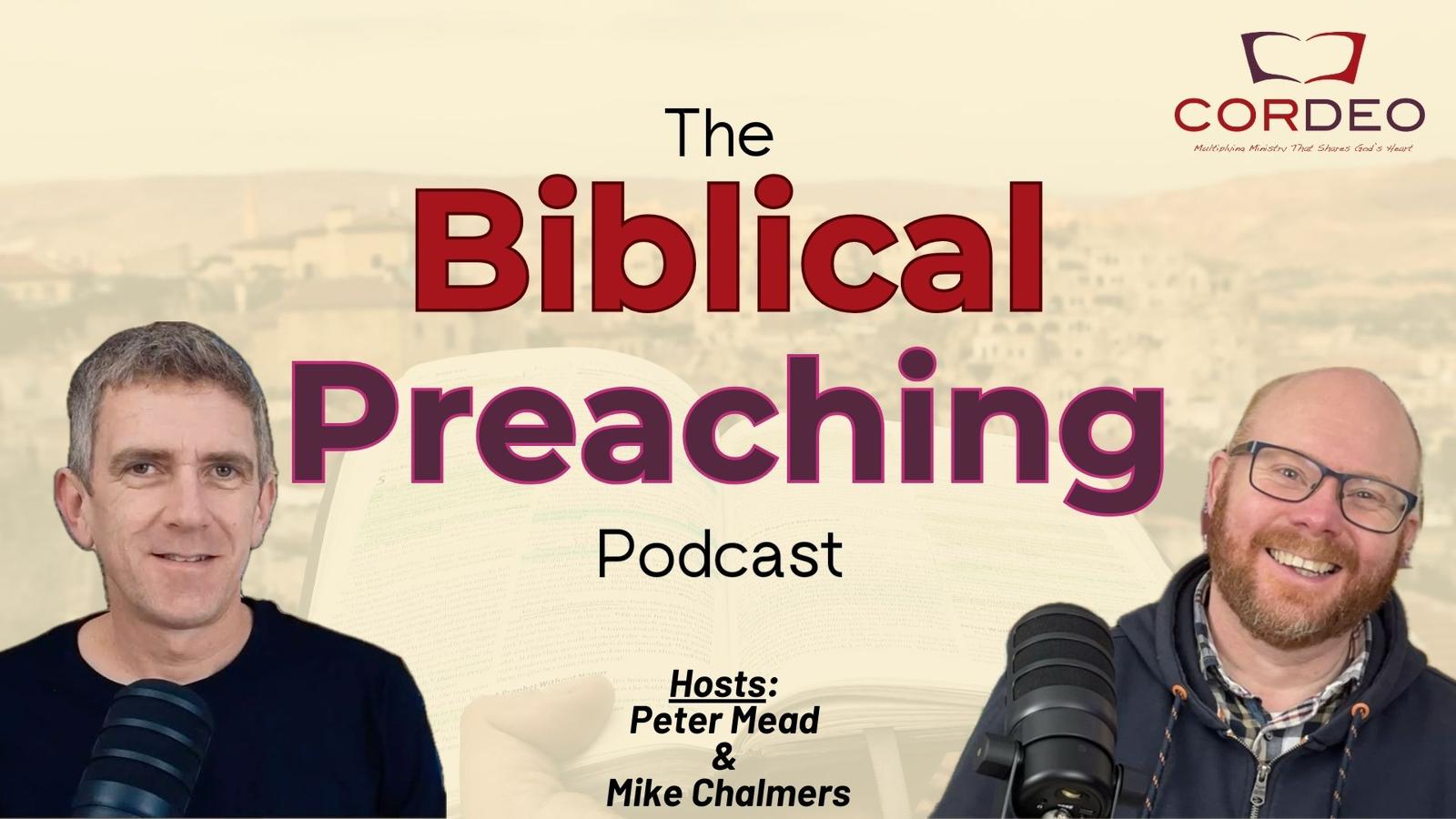
Introducing the Biblical Preaching Podcast!

I’m excited to announce the launch of our brand-new podcast: The Biblical Preaching Podcast! Unlike the many great sermon podcasts, this podcast is designed for those who preach, those who are learning to preach, and anyone who cares deeply about the ministry of preaching.

My Cor Deo colleague, Mike Chalmers, will join me as we discuss all things preaching. Together, we’ll explore this ministry’s joys, challenges, and complexities.

Here’s what you can expect:

  • Engaging Discussions: Insights into various aspects of biblical preaching.
  • Special Guests: We’ll feature some amazing voices from the world of preaching—our first guest joins us next week!
  • Encouragement for Preachers: Each full episode concludes with a segment designed to encourage those in preaching ministry.
  • Bitesize Episodes: Shorter episodes focusing on one specific aspect of preaching.
  • Related Blog Posts: From time to time, I’ll share blog posts that dive deeper into themes we discuss in an episode. These posts won’t be mere transcripts but will provide additional perspectives, practical tips, or reflections to help you take the conversation further.

Our hope and prayer for this podcast is simple: that it will strengthen and encourage biblical preaching in churches around the world. Where biblical preaching thrives, the church grows healthier, and healthy churches reach their communities.

We want this podcast to be a gathering point—a place where preachers can connect, reflect, and grow together. This is your conversation! We’ll celebrate the goodness of God, explore the transformative power of rightly handled Scripture, tackle the complex realities of ministry, and share the joy of seeing lives changed through the preached Word.


How to Listen & Connect:
🎙️ Listen to the Podcast on Your Favorite Platform:

📺 Watch Episodes on YouTube:
Subscribe to our channel for video versions of the podcast and exclusive content: YouTube Channel.

🖋️ Read the Blog
Continue to visit BiblicalPreaching.net for posts related to specific episodes, offering fresh insights and practical takeaways.


Can You Help Spread the Word?
We’d love your help in making this podcast a resource for as many people as possible! Here’s how you can support us:

  • Subscribe on your favorite podcast platform and/or to the YouTube channel.
  • Like and Comment to share your thoughts and join the conversation.
  • Follow Us for updates on new episodes and blog posts.
  • Share with your friends, fellow preachers, and anyone who might find this helpful.
  • Review the podcast on your favourite podcast platform – apparently, positive reviews are the most helpful thing!

Thank you for your prayers and support. We’re excited to see how God uses this podcast to encourage and equip preachers worldwide!

Are We Trying To Be Too Clever?

With 2024 now consigned to the history books, we are launching into 2025.  Inevitably, a new year tends to bring at least a small burst of new energy.  Externally, we may joke about others joining gyms and going through the standard routine of resolution and then inevitable failure.  However, we may still feel motivated internally to start the year well.  So, what is your approach to the new year?

I think we often look for sophisticated solutions to complicated problems.  Are we trying to be too clever?  In reality, the basics are usually the most fruitful focus.

For instance, we assume that taking a new and obscure supplement or getting a new piece of exercise equipment will help us achieve our health goals.  But we will probably accomplish a lot more by focusing on eating whole foods, moving more, and sleeping better.

Or, we can think that our ministry challenges will be unlocked by a key lesson we have never encountered before, so we hunt for the book or the seminar that will bring that critical insight.  But 2025 will be far more fruitful if we focus on hearing from God, praying, and investing in people.  These things are the basic stuff of ministry.

And what about on a personal level?  I think we would all benefit from a “back to basics” mindset as we launch into another new year:

Relationally – It is really about time.  Spend time with your spouse, children, and key friends (and there may be some other meaningful relationships, perhaps your parents).  The world is continuing to bombard us with time-saving technology that seems to suck all time away from meaningful relationships.  So make the deliberate and courageously counter-cultural step of going for a walk with your spouse, getting on the floor to have fun with your child, taking your teen out for lunch, or sharing some downtime with a friend.  If necessary, turn your phone off too – this “appointment” may be the most important in your day. 

Theologically – A few years ago, I wrote the book Foundations.  I looked at the apostles’ speeches in Acts.  I demonstrated how their first concerns were to answer foundational questions rather than to impress their listeners with sophisticated complexity.  I am more convinced than ever that our theological energy is best spent chasing four basic questions: what is God like?  What does it mean to be human?  What is our problem?  What is God’s solution to our problem?  As we prayerfully pursue better answers to these basic root questions, we will find abundant fruit all over the tree of our lives.

Spiritually – And if your spiritual health is critical for all aspects of your ministry in the home and beyond, what would a “back to basics” approach look like?  It isn’t complicated.  Surely it means hearing from God by being in the Word, speaking to God in prayer, responding to God in worship, and ensuring you invest in authentic and life-giving relationships with other believers, too.

Every year, in the UK, we have to take our cars for the annual “health check” required of every vehicle on the road.  We occasionally get a token physical “health check” from our medical system.  Why not take the New Year as an opportunity to take stock of the basics of life?  It may not seem very sophisticated or feel particularly clever.  Still, actually, it is the basic changes that bear the most fruit.

____________________________________________________________

Coming soon . . . a new podcast for all who preach or care about biblical preaching – watch this space!

New Book Released in the USA

I am very pleased to announce that my new book, The New Birth, has now also been released in the USA.

If you would like a copy of the book and will see me in person during January/February, please ask. (I will be in Oregon, St Louis and Chicago.) To order the book from my affiliate link in the USA – click here. (To order the book from my affiliate link in the UK/Europe – click here.)

Thanks so much! I hope you enjoy the book! (Please comment on this post if you’ve read the book already, but I would also greatly appreciate any positive reviews on 10ofthose, Amazon, GoodReads, etc.)

Endorsements

“Peter Mead presents this essential doctrine in a way that warm, clear, rich, and readable. The book is accessible and engaging, and the addition of stories and reflection questions at the end of each chapter enables us to consider and imagine the way that the truth of the gospel can and should shape our lives. This is a lovely and helpful book—a great introduction to those new to or exploring faith, and a refreshing encouragement to those who have been Christians for a while.”

Ellidh Cook, Student Worker at All Souls Langham Place, London

“This tiny book conveys a huge reality: that Jesus came to raise spiritually dead people into abundant life! Peter Mead’s insights into the new birth that Jesus offers are both pastorally wise and profoundly helpful.”

Philip Miller, Senior Pastor, The Moody Church, Chicago

“When I became a Christian, I didn’t really grasp what had happened. It was an infinitely bigger deal than I realised-it was (and is) beyond my wildest dreams. Peter has given us an excellent primer into this huge adventure. This lovely, heart-warming book opens up the foundational truth of the new birth. As with the rest of the Essentials series, it is short and simple, yet full of deep and delightful teaching.”

Jonathan Thomas, pastor, author & broadcaster

“I found Peter Mead’s The New Birth contribution to the Essentials’ series most helpful, because it weaves together our story with the big story of Scripture through the lens of the work of the Holy Spirit. Taking as its anchor point Jesus’ encounter with Nicodemus, it wonderfully explains the theology and the felt experience of Christian conversion, and all along there are thrilling stories of how the Spirit transformed the likes of Spurgeon, Whitefield, C.S. Lewis, and modern men and women.”

Rico Tice, Co-Founder of Christianity Explored

The Thirties – Part 8 (Points to Ponder)

In this series, I have considered ACG’s book, Inside Germany.  Published in 1939, it is a fascinating account of the Nazi takeover of Germany that brought the world to the brink of disaster.  In light of reading that book and reflecting on our own times, what are some takeaway points to consider as preachers?

1. Only one message can change hearts.  It is not a political message nor driven by headlines in the newspapers or social media.  It is the message of the Gospel, and it comes from the Bible.  We must preach the gospel as loud and clear as possible in tumultuous times.  It may be that the turbulent times stir previously comfortable hearts to a new level of openness.  When those moments come, we must offer Jesus to a needy world. 

2. Only saying one thing can be a sign of weakness.  I know that our ministry is to preach the Gospel.  However, we also have some clauses in our job description that relate to being people of the truth.  In an age of disinformation, misinformation, malinformation, etc., we must speak the truth.  In an age of censorship, controlled media narratives, and the silencing of independent thinking, we need to promote informed and free thought.  Suppose our default position in public speech is to hide behind what is culturally acceptable.  For now, we can quote Bible verses because it is still safe to do so.  Why do we think we will later become bold clarions of truth when the societal pressure to conform becomes so much greater once tyranny takes a tighter grip on our throats?

3. We need to grow in discernment.  Too many are proclaiming a media-shaped worldview with some Bible verses attached.  There is probably a church in your town that is already fully there – sounding like their pulpit is a marginally more religious version of a BBC TV presenter.  God has not called us to offer insipid commentary on society with the odd tip of the hat to contemporary ideology.  We were called to think and proclaim biblically.  So read the Bible, then read the culture through the lens of the Bible (and not vice versa). 

We wouldn’t only read theology books from one agenda-driven publishing house, so don’t read society simply through the lens of the mainstream media’s agreed narrative.  Neither should we only read society through just one or two social media voices.  Let’s look for trustworthy sources.  That doesn’t mean checking to see if they are on the BBC, even if it once did.  Censorship should be a red flag to any thinker.  Look for who is being paid and who is losing their livelihood.  Look for who stands to gain and who is being silenced.  Let’s look for multiple trustworthy sources of information and set an example of being informed, thoughtful, and biblical in our discernment.

4. Have the courage to speak when silence is easier.  Can I be candid?  There have been times during recent years when I have found that many Christian leaders seem to be hiding behind the mantra of only preaching the Gospel.  It is easy to quote John 3:16 on social media.  But how many churches have gone along with the media narrative every step of the way, only to wonder later why they didn’t question more?  The easy choice today can mean I have reduced my credibility in a year or two.

5. What is our territory?  We have to be careful with politicised issues.  But don’t fall for the simplistic idea that every political matter is off-limits to us.  Last week, I was in a room where some people were asked what it was like to live under Soviet rule.  One answered about how they could not trust anyone.  Another spoke about never showing gladness outwardly.  Then an older man said, “We can never explain to our children what it was like because it was a spirit.”  There was a spiritual reality behind Communist rule.  There was an evil spirituality in Nazi rule too.  And if there is a “spirit of the age” at work in the ideological agenda of our day, then we cannot say that preachers should stay quiet.  Politics may be largely off-limits, but speaking God’s truth in the midst of a spiritual battle certainly is our territory.

6. Having courage does not negate the need for gentleness.  Sometimes, people hear a call for courage as a call for bombastic shouting.  Not at all.  We represent Christ, and we need to convey the nature of his character, as well as truth, in society.  But we should not underestimate what can be achieved in this world with gentle forcefulness.  (See my post on Solzhenitsyn’s “Live Not By Lies” from January.)

7. Pray and pray boldly.  As well as saying little to challenge the media narrative, it is also easy to pray as if that media narrative dictates reality.  God can do immeasurably beyond all that we ask or imagine.  In our private and public prayers, let us boldly pray for God to bring down those who exalt themselves, for God to expose those whose plans are for evil rather than good, and for God to break open hearts that seem so solidified against him.  The Third Reich was supposedly going to last a thousand years, but it was done in twelve.  Many prayed for that.  The impregnable Iron Curtain was brought down in my younger years.  Many prayed for that too.  And so it is with every variation of Communism, globalism, or religious takeover. Let’s pray that God would bring it down so that more can be spared the suffering and freely come to know him.

7 Defining Moments in Your Sermon – Part Four

We have thought about two moments before the sermon starts, two in the introduction and two in the body of the sermon. 

What about the conclusion?  Let’s go there for the final defining moment:

7. The landing – We know the end of the message is important.  During preparation, we might have prayed and dreamed of a huge revival breaking out.  During delivery, we might just be desperate to be finished and away from the microphone.  But between those two extremes we can see that the conclusion does matter.  There is both the quality of the landing and the fact of the landing.  The quality is determined by both tone and content.  It is a chance to review the main points of the message, to restate the main idea again, and to bring a sense of conclusion to the whole.  The tone can be encouraging, upbeat, hopeful, and faith-stirring rather than critical, harsh and guilt-trippy.  As well as the quality, there is also the fact of landing.  Arrive.  Get there.  Stop talking.  Don’t elongate the message in the hope that your fourth attempted landing will prove to be better than the first three.  Robinson used to say that it is best to end a sentence or two before people expect you to end. Review, encourage, finish. 

So there we go, seven defining moments of the sermon.  But I need to add one more:

Bonus – Clearly stating the main idea.  Of course, no matter how hard I try to point away from the obvious moments to some that people may not be aware of, I still feel the need to underline the importance of a well-defined main idea in the message.  Too many preachers preach without it.  The main idea needs to be clarified by the preacher, otherwise it will be hastily cobbled together in the minds of your confused listeners.  It is your job to make sure the message is coherent.  Nothing holds a message together so well as an accurately defined main idea.

What would you add to this list?  What are the defining moments in a sermon?

7 Defining Moments in Your Sermon – Part Three

We have thought about the pre-sermon moments that impact the preaching event and considered a couple of aspects of the introduction.  Now, let’s consider a couple of moments that can define the impact of the message from within the body of the sermon.  Obviously, the points are important, the text’s explanation is critical, and so on, but that is what we tend to focus on.  Here are two surprisingly significant moments to consider:

5. Every transition – It could be argued that transitions separate good communicators from average ones.  It is natural to focus on the content of the points, but it is a step up to be aware of how you move from one to the next.  It is like having a passenger riding behind you on a motorcycle.  They will tend to stay with you in a straight line, unless you accelerate too fast.  But you really need to slow down through the turns.  The same is true when you preach.  A good transition can achieve so many good things: a review of what’s been said, an encouraging conclusion to a point, a reminder of progress in the message, a preview of what is to come, a chance to re-engage for the distracted listener, an opportunity to reinforce the main idea, a moment of pause for an overwhelmed listener, and so on.  Or you can clumsily jump into your next point and leave people confused as to what happened to the other point, why you are talking about this, how it relates, and so on.  Pay attention to every transition; your message will be more helpful for more people.

6. The Interruption or Surprise – We do not preach in a vacuum-sealed box that can be completely controlled.  It is an environment with many variables.  Let’s categorise them as either public or private.  The public ones interrupt everyone’s experience.  The phone ringing, the child crying, the jackhammer starting, the gunshot (hopefully not).  Some are minor, some are more significant.  You have to decide at the moment how to handle it.  Be careful not to draw attention to someone feeling awkward about their phone or baby or to press on through something worthy of a pause.  I’ve seen a preacher totally undermine his credibility and sermon by a harsh and unkind response to an accidental interruption.  I’ve also seen a preacher try to press on, oblivious to the passed-out person being carried out of the congregation.  The first should have been more gentle, the second would have done well to notice, pause and pray for the person.  I don’t remember either of the sermons, but years later, I remember the interruptions and the response from the preacher.

Then there are the private interruptions.  That is the thought that suddenly presents as you are preaching.  Maybe a new illustration.  Maybe a warning flag about using a planned illustration.  Perhaps an extra thought that could be added, or a new direction for the application.  A beginning preacher may not be able to imagine any internal dialogue while preaching because the whole experience is so consuming and overwhelming.  But actually, there can be quite a wrestle going on inside a preacher while the sermon continues to be preached.  Don’t automatically discount every thought and press on through the notes.  Neither should you take every thought as a Spirit-led and anointed change of direction.  You have to prayerfully and humbly process as you go.  You won’t always get it right, but you will do well to lean towards the love of God and others in every decision you make (and keep an eye on the clock, too, as an act of love for the children’s workers and people who brought a first-time guest!)

7 Defining Moments in Your Sermon

As you preach, there are numerous defining moments.  That is, pivotal decisions or moments that will multiply the impact of the sermon.  The whole sermon matters, of course.  You can’t expect one great line to do great work when it is packaged in fluff.  But while you work on the whole sermon, remember that there are some defining moments that could make or break it.

1. The unseen preparation (yours and theirs!) – Whatever happens during the sermon itself is really just the final part of a process.  There has been a whole lot of unseen preparation before the moment of delivery.  Of course, there have been the ups and downs of sermon preparation for you, the preacher.  The prayer, the study, the wrestling with word choices, the hunting for illustrative material, the interruptions, the storm, and the calm inside you and in your study.  The journey to the pulpit may have been arduous, or somehow serene, but hopefully God has been at work in you before he will work through you. And I am only describing the last few days, but God has been at work for years.  However, the sermon is not just about the preacher.  How has God been stirring the listeners?  Providential circumstances, carefully timed conversations, quiet questions inside, or overwhelming challenges without.  It is not unusual for a sermon to touch a nerve that was only sensitized in the preceding days.  “How did the preacher know that about me?”  Often, the preacher didn’t.  But someone did.  It is helpful to remember that a lifetime of preparation is brought into the sermon from all sides, and only God can be aware of that, let alone influential in it!

2. The first moments of the introduction – It is hard to overstate the importance of the first moments.  I don’t mean the introduction.  I mean the first impressions.  Do you seem comfortable, or nervous, or indifferent, or agitated?  Will listeners get the sense that you have something to say that is worth their focus and time to listen?  Will people who have never heard you before feel welcomed and engaged?  Will regular listeners sense that you are well prepared, or will they get the sense that you are somehow “off” this week?  Remember, humans are wired relationally.  When you sit at a table in a restaurant, you know whether you like the server before you have a chance to evaluate your first interaction.  Sometime, watch a video of yourself.  Watch up until your first word.  Prayerfully and conversationally evaluate (that is, ask God what he thinks, and ask someone else what they notice – don’t just trust your own perspective).  Then watch the first couple of sentences, and evaluate again. 

We will continue this list of defining moments in your sermon next time, but feel warmly invited to comment with any that are on your mind!

Nowhere, Now!

What is the greatest commitment we see in our world today?  Is it the commitment of a classical musician, or a sports professional?  They say it takes 10,000 hours of practice to really master any skill.  Apparently, it takes nine to twelve months of specialist training to be ready to attempt to climb Mt Everest. While the idea of commitment may be dismissed by so many in our society, there are still countless people dedicating themselves to various pursuits.

In Matthew 8:18-22, Jesus speaks about commitment at an extraordinary level.  After three chapters of the Sermon on the Mount (chapters 5-7), Matthew seems to be shifting to an all-action presentation of Jesus performing healing miracles.  He heals the leper, the centurion’s servant, and Peter’s mother-in-law.  It feels like we have left the teaching block behind and settled down for an action-adventure section of the Gospel.  But then we come to these few verses and two powerful sayings of Jesus about commitment.  

Essentially, Jesus declares that to follow him means to belong nowhere and the demand is to follow now.

Now when Jesus saw a crowd around him, he gave orders to go over to the other side. And a scribe came up and said to him, “Teacher, I will follow you wherever you go.” And Jesus said to him, “Foxes have holes, and birds of the air have nests, but the Son of Man has nowhere to lay his head.” 

Matthew 8:18-20

Belong Nowhere! – The scribe sounded so committed.  He would follow Jesus anywhere!  But Jesus pointed to the rhythm of creaturely life.  A fox?  It gets up and puts in a night shift touring its territory, marking the boundaries, catching a vole or two, enjoying some worms and bugs, even feasting on some berries if the opportunity arises.  Then, when its work is done, it returns to its hole and lays down its head to sleep.  Work done, it heads for home.

Just to reinforce the point, Jesus mentions birds too.  They wake up nice and early, some get in a singing practice before dawn, then head out and fly the skies looking for food.  Some catch flies mid-air, others swoop down for voles and mice, while others prefer seeds and worms.  Then, when their work is done, they return to their nest and lay down their heads to sleep.  Work done, they head for home.

Every creature is the same.  Including humans.  Wake up, work, head home, and sleep.  But not Jesus.  His work never seemed to be done.  When he finished healing Peter’s mother-in-law, then many more were brought to him late into the evening.  When he headed out early to a deserted place, he sometimes found crowds looking to get more from him there too.  And Jesus was not home.  We never read of him heading back to Nazareth for a home-cooked meal with mother Mary. 

To follow Jesus is not about a shift and then back to base for some relaxation and creaturely comforts.  To follow Jesus means to belong nowhere in this world.  It means we are not really at home in our home town, nor if we move to the other side of the world in missionary service.  If we follow Jesus, then our citizenship is in heaven, and our home town is still in the future (Philippians 3:18-21; Hebrews 11:13-16). 

These are challenging words, especially if we have grown too much at home in this world.

Another of the disciples said to him, “Lord, let me first go and bury my father.”  And Jesus said to him, “Follow me, and leave the dead to bury their own dead.”

Matthew 8:21-22

Follow Now! – The disciple’s request seems reasonable.  Surely, Jesus is not against family funerals, is he?  I don’t believe he is.  The point here is a striking one.  Nothing can come before following him.  Not a funeral that is scheduled for next week, nor a Jewish reburial in a few months, or even an anticipated death in order to collect an inheritance (all are explanations given for this cryptic moment in the text).  As Jesus said elsewhere, if we are to follow him, then we must first hate everything we hold dear.  Jesus wants his followers to honor their parents and so hatred seems extreme, but that is the point.  There can be nothing that comes first.

How often we can fall into the same problem?  Not so much with funerals, but with other things.  “I will be completely committed to Jesus, but first I . . . “  What?  What comes first?  Career first?  Promotion first?  Payrise and then folks will see my dedication to Jesus?  Or maybe family first?  Once married, once there are children, once they are grown, then the commitment will show?  Of what about fun first?  So many say they will live a little and be committed to Jesus when only a little life is left in this world.  Bucket lists get elevated to the level of an idol as Jesus is left to wait his turn.

No.  To follow Jesus at all means that we need to follow him now.  Not later.  Not after.  Now.

Reasonable Demand? – How can Jesus be so demanding and expect us to belong nowhere and follow now?  The demand is so extreme.  But the key is to look at who is saying the words.

Jesus had no home in this world.  He left his eternal home and entered into this world in the most humble of circumstances.  He was born in a peasant town and laid in a manger.  He was an infant refugee in Egypt, then grew up in Nazareth – a place with a rubbish reputation.  Nazareth was a rest stop on the way to somewhere better.  And then, once he launched into his ministry years, he had no home of his own in this world. 

Jesus’ work never seemed to be done.  He had nowhere to lay his head, not only because of a lack of address, but also because his work demanded so much.  There was always another person to heal, another demon to cast out, another crowd to feed, another dispute among the disciples to unpick, another conflicted conversation to navigate.  His work, his mission demanded so much.  Actually, it demanded everything.

As we read through the Gospels we find that Jesus did eventually lay down his head.  When was that?  It was in John 19:30, when his mission was accomplished, when he cried out “It is finished!” and then lay down his head and gave up his spirit.

The reason that we should take Jesus’ demand so seriously is because his mission cost him everything.  Since he gave his all for us, his call is for us to give everything in response.  Belong nowhere in this world, and follow now.  Nothing else would make sense in light of who said it.

Is Our View of Satan Too Small?

I have noticed something strange.  Many Christians will acknowledge the existence and the general agenda of Satan.  They will affirm that he is alive and active on planet Earth.  Yes, they recognize that he hates God and God’s people.  Yes, he hates truth and wants to steal, kill and destroy.  Yes, he wants to tempt us into rebellion, crush us under guilt, and destroy all that is good, beautiful and anything that has even the faintest reflection of God’s character. 

And yet, oddly, as quickly as those affirmations are made, that awareness seems to evaporate just as quickly.  For many Christians, the devil appears to be a very limited antagonist.  He might get some vague credit (for want of a better term) for any temptation we consciously notice. Still, he gets specific credit for very little activity. 

For example, suppose the subject of the occult is raised with the related concepts of devil worship, seances, fortune telling, etc. Many will shudder and point to the enemy’s works in that case.  But is that the whole story?  Is Satan just tempting us as individuals and running a relatively obscure dark religious operation? 

Let’s take a few moments to review some essential biblical background. 

Origins of Satan – The name Satan means adversary and came to be applied to the greatest adversary of all – the devil.  It is a well-earned label!

What we know of his origins is described primarily in Ezekiel 28:11-19, where it is clear that prideful arrogance was the key driver of his original fall from perfection.  Since his fall, his primary domain has been Earth and Sheol.  We see him cursed by God in Genesis 3 – the one whose goal was to be the most high became the most low, eating dirt close to the underworld.

Influence in the world – The big question in this post essentially relates to his influence.  According to 1 John 5:19, the whole world is under the control of the evil one.  He is called the ‘prince of this world’ on several occasions (John 12:31; 14:30; 16:11).  He influences through lies, especially the original lie that we humans can be like God, and he masquerades as an angel of light, deceiving people (John 8:44; 2 Corinthians 11:14).  There are plenty of people whose spiritual father is the devil, and it is possible to identify them by their actions and their lack of love (John 8:44; Matthew 13:36-40; Acts 13:10; Ephesians 2:2; 1 John 3:10)

Influence over nations – He rules the nations and tried to strike a deal with Jesus in exchange for Jesus bowing down to him. Still, Jesus did not affirm his ultimate ownership of the nations and did not bow down.  Jesus knew and trusted that, at the right time, the Father would give the nations to him.  (See Matthew 4:10.)  Jesus confronted the power of evil by casting out demons from people. It is evident that Satan commands the realms of darkness (see 1 John 3:8).  What Jesus began in his ministry, he is continuing – building his church and the “gates of hell” continue to be unable to resist the onslaught.  Satan is on the defensive. 

Influence in the Church – Paul wrote to the Romans, “The God of peace will soon crush Satan under your feet.” (Romans 16:20). Yet, it would be naïve to assume that Satan does not influence the church.  While our minds might go to Judas Iscariot, whom Satan influenced (John 13:2) and then entered (John 13:27), we do not need to live in fear of being taken over by the evil one.  We belong to God, who is greater than the one who is in the world (1 John 4:4).  However, we should recognize that discord, anger, unforgiveness and resentment can provide an opportunity to the devil, and we should actively resist him (James 4:7; 1 Peter 5:8-9).

Our hope as the spiritual war rages – Because of Jesus’ victory over the rulers and authorities on the cross (see Colossians 2:13-15), Satan’s power of death is now broken (see Hebrews 2:14-15).  We now know that death is swallowed up in victory (1 Corinthians 15:54).  And yet, the one who comes only to steal and kill and destroy does not give up easily (John 10:10).  His ultimate downfall is already determined; he will be thrown into the lake of fire (Revelation 20:10).  In the meantime, he fights on.  Indeed, as his time gets short, we might expect him to offer a big final push, but we know the end of the story.

The hole in our spiritual warfare – So, what is missing in our understanding of the spiritual battle that we are in?  Satan exists and is active on earth.  Yes, he does tempt us and would delight to see us derailed by sin and defiled by discord.  And yes, the occult does exist, and some people are drawn into religious acts of pure evil.  But at the start of this post, I suggested our view of Satan may be too small.  Is Satan just tempting us as individuals and running a relatively obscure dark religious operation? 

To be candid, I have been struck by how much we are inclined to bury our heads in the sand regarding evil in this world. “Oh yes,” people will affirm, “Satan is real, and we are in a spiritual battle.” But mention some specific aspects of society and watch the response change:

Could there be evil at work in news reporting designed to shape our thinking? “No way, we can trust the news media.” 

Might the enemy be shaping education to harm children?

Don’t be ridiculous!”

What about medical professionals who seem driven by something other than ‘first do no harm?’

“Of course not! The doctors I know are good people.”  

What about government decisions that seem to benefit them but harm people and cost lives?

Absolutely not!  They have our best interests at heart.” 

What about unelected and unaccountable groups of the hyper-rich and influential seeking to gain control over ordinary people?

If such groups exist, then I’m sure they mean well.”

What about influential people who have publicly declared the global population needs to be reduced by whatever means?

Of course not; they only want to help the poor!”

What about the entertainment industry that so fills our consciousness?

Oh, but I like him, she’s my favourite, etc.”

It does not mean much to acknowledge that Satan is real and active if we then immediately deny that he could be at work in almost every layer of human authority and influence.  And I would suggest we are utterly naïve if we don’t believe that the prevailing paradigm of our day, with its “lofty opinion raised against the knowledge of God”, is influenced by Satan.  (See 2 Corinthians 10:3-6) 

In the past, Christians seemed ready to recognize the malevolence of hedonism or materialism as it confronted our worldview in the so-called “Christian West” or the evils of totalitarian regimes in the East.  But today, too many Christians seem happy to play along with and believe the best about media-driven narratives concerning identity politics, critical theories, social justice, weather worship, globalist agendas, neo-communist ideologies, uncontrolled immigration and encroaching violent religion.  Are we sure that we should ‘believe the best’ and ‘affirm the good’ in all the ideas swirling around and in all the layers of authority setting themselves up over us?

Perhaps it is time for us to fix our eyes on Jesus and recognize that we are genuine outsiders in this world and that we will be hated by it. And yet we are here as ambassadors to represent God’s truth, to share the hope of Jesus, to stand for what is right and to not love our lives even unto death. Let’s stop smiling at the devil as if he is an insignificant foe.  Let us instead armour up, stand firm, be ready to speak, be prayerful as if we are in a war (for we are), and when we have done everything we can, to stand.

(HT – https://www.logos.com/grow/satan-in-the-bible/ )

The Least Resolution for 2024

January does not just bring a new page on the calendar but a whole new calendar.  And with the new year, we tend to generate renewed commitments.  Maybe you have already determined what 2024 will mean for you.  Perhaps your mind has already pondered daily step counts, gym visits, dietary changes, or other healthy habits.  Or maybe you are thinking about Bible reading, daily prayer routines, or other spiritual goals.  May your resolutions last and bear good fruit!  But perhaps the resolution we need for 2024 is more foundational than healthy habits and more straightforward than spiritual practices.

As I write this, I am in Budapest, where I have just visited a museum of the political terror of the twentieth century.  As you can imagine, it is a sobering experience to see the vast walls of victims, the displays focused on the political prisoners, a room commemorating the persecution of the religious leaders, the torture chambers, the prison cells, and the gallows.  But perhaps the lingering memory for me will be the final room.  With red walls and hundreds of pictures, it felt like yet another presentation of victims.  But it was not.  It was a room of “victimizers” – ordinary people who were merely doing their job, simply following orders, just playing along, and thereby facilitating the evil machine.  We can remember the victims, and we must.  Yet we must also face the uncomfortable reality that most cogs in the cruel machine of death were ordinary people.

Fifty years ago, in February 1974, Alexander Solzhenitsyn was arrested in the Soviet Union and exiled to the West.  There, he was welcomed as a hero.  On the day of his arrest, he released a document entitled “Live Not by Lies.”  He knew the power of an ideology that sought to reshape society.  He also knew the power of individuals who simply refuse to lie (and the even greater power of a crowd joining together in this conviction).  He knew that the ideological system would totter and collapse when it ran up against the brick wall of reality, exemplified by many individuals refusing to play along with the evil fantasy.

Fifty years later, perhaps it is time for us to revisit this document.  Are we living in times where some, on behalf of all, have determined what society should look like?  Do we see a mounting pressure to conform with what ‘they say’ is acceptable human thought and belief? Indeed, we should not be so naïve as to assume that the absence of marching military on our streets means we face no ideological threat. 

The pressure is growing for everyone quietly to conform.  More than that, the pressure is growing to affirm openly and celebrate what we know to be false.  Surely, it would be better to speak the truth now instead of growing our tendency to fit in and play it safe as the stakes mount.

Truth and Lies – Choosing not to lie was not an original idea for Solzhenitsyn.  Paul urged the Colossians not to lie to one another.  Not only had they put off their old self, but they had put on the new self to reflect their creator’s image (Colossians 3:9-10).  He told the Ephesian believers to speak the truth to one another since they were no longer defined by the lie (Ephesians 4:25).

In the Sermon on the Mount, Jesus addresses the anger underneath murder, the lust underneath adultery, and the daily consistency of speech beneath more flamboyant oaths (Matthew 5:21-37).  There is plenty of Old Testament support for the expectation that God’s people should be consistent speakers of truth (Exodus 20:16; Leviticus 19:11; Proverbs 14:5).  God does not lie, and his people represent him.

Fear and Lies – Solzhenitsyn knew the impact of fear on a population.  He wrote of the great threat facing humanity in his day, which was “about to flare up and engulf us.”  And he described the fear: “While we continue to smile sheepishly and babble; ‘But what can we do to stop it? We haven’t the strength.’”

God asked Isaiah’s listeners, “Whom did you dread and fear, so that you lied, and did not remember me, did not lay it to heart?” (Isaiah 57:11).  Their fear led to lies, as they forgot who was really in charge.

Our world seems to be changing at a frightening rate.  Trying to keep up with the latest adjustments to sense and morality can be tiring.  And it is increasingly revealing how much fear lies within most of us, who are so prone to play along with society’s expectations rather than speak what is true.  It is concerning how easily we fear and perhaps lie while forgetting who is really in charge. 

Some will capitulate completely and speak what is false.  Others hide behind a cloak of not wanting to “sound political” and speak out about the reducing set of acceptable Christian declarations.  Fear of being labelled and criticized leads many to hold back from speaking the simple truth.  After all, it is much easier to quote a Bible verse on social media or avoid the hot topics in conversation rather than offer the most minor form of resistance.

Solzhenitsyn wrote that the fear his people felt was not primarily a fear of nuclear death or a third world war.  The fear was of taking a “civic stance.”  He wrote, “We hope only not to stray from the herd, not to set out on our own, and risk suddenly having to make do without the white bread, the hot water heater, a Moscow residency permit.”  The penalty for a civic stance may have changed, but the fear of the herd has not.

History has never smiled on the timid, and yet each fearful choice always makes sense at the time.  How often do I justify timidity when society needs me to show courage and speak the truth?  We have almost constant opportunities to speak the truth about marriage, gender, sexuality, race, free speech, bodily autonomy, science, medical ethics, corruption, or whatever other prescribed view is being pushed at any given moment.

We cannot simply wait for an ideology to fall apart.  We must be part of the brick wall of reality into which it must crash.  And yet, it is always easier to “continue to acknowledge, glorify, and strengthen” that which we want to see collapse.  At the very least, we must not “recoil from its most vulnerable point.  From lies.”

Violence and Lies – Solzhenitsyn described how violence bursts into peaceful situations with great self-assurance.  “But violence ages swiftly, a few years pass—and it is no longer sure of itself.  To prop itself up, to appear decent, it will without fail call forth its ally—Lies.  For violence has nothing to cover itself with but lies.”

So, even under overt tyranny, people do not have to experience violence at all times.  The demand is only of a “daily participation in deceit” – the tribute paid to maintain one’s position under the power of the oppressive system.  Just play along, it is safer.

The connection between violence and lies is also not a discovery made under the rule of twentieth-century totalitarianism.  Micah wrote to the city in his day, “Your rich men are full of violence, your inhabitants speak lies and their tongue is deceitful in their mouth” (Micah 6:12).

We may not have to stand and fight against violence.  We may not even have to step out publicly and boldly declare the truth. “But let us at least refuse to say what we do not think!”

The Consequences of No Lies – In the Soviet Union, there was a cost to this most simple of stands.  It could cost your job and complicate life.  It could cost your success in education and impoverish your future.  But Solzhenitsyn was clear:

“And as for him who lacks the courage to defend even his own soul: Let him not brag of his progressive views, boast of his status as an academician or a recognized artist, a distinguished citizen or general.  Let him say to himself plainly: I am cattle, I am a coward, I seek only warmth and to eat my fill.”

To choose not to lie was not an easy choice in his day.  It will increasingly not be an easy choice for social standing, or even for physical wellbeing, in our day.  But the choice not to lie is “the only one for the soul.”

The implication of no lies is worthy of note. “The more of us set out together, the thicker our ranks, the easier and shorter will this path be for us all!  If we become thousands—they will not cope, they will be unable to touch us.  If we will grow to tens of thousands—we will not recognize our country!”

As we head into a new year, may we not simply play along with the world.  Instead, let us graciously, prayerfully, and wisely determine that whatever else may happen, we will not participate in the lies expected of us in society.  As representatives of God in this world, this is the least we must do!

(Source of AS quotes: https://www.solzhenitsyncenter.org/live-not-by-lies)