Christmas Podcast – week 1

My good friends at Fellowship of Wildwood in Missouri are giving away copies of Pleased to Dwell as part of their pre-Christmas outreach this year. Alongside the book, they have a weekly reading and a discussion about an aspect of it. Here is the first reading:

And here is the first discussion:

I will post the others on here, but feel free to subscribe to their channel and see them as soon as they come out. Thanks so much!

Podcast Catch-Up: Insights for Preachers

The last couple of months have been busy, to say the least. A conference with Josiah Venture in Czech Republic, the European Leadership Forum in Poland, two family weddings, two baptism services in the midst of a busy season at church – these all added up to not sharing much on this site. So, it is time for a catch-up on the podcast. What has been happening since the last post that was linked to an episode?

Mike and I discussed the various kinds of interruptions that can add some intricate dynamics to a preaching event. We also talked through the most basic sermon preparation process. While there is plenty of potential for complexity in the area of sermon preparation, we wanted to make sure the basic process is clear.

We have had quite a few bitesize episodes, including Peter on 5 Aspects of Natural Delivery, The Four Worlds of the Preacher, and Preaching Without Notes. (I will write another post on that subject soon!) Mike shared about the courage to confront yourself, and the potential poison of preaching ministry.

Along the way, we also had a couple of episodes hearing from Si Munsie of Life Church, Southampton. (Click here for part 1 on preaching to real people, and here for part 2 where we think about past employment and preaching.) And this week, we have part 1 of my interview with Andy Paterson, currently pastoring in Hong Kong – a fascinating conversation with a very experienced pastor-preacher! We have some great interviews lined up in the next months too.

So my apologies for being quieter on here and social media in recent weeks. We really do appreciate every encouraging comment, both in person and online. If you are able to subscribe on YouTube and in whatever podcast platform you use (eg Spotify or Apple), that really does help. Also, every like, comment, share, etc., is massively appreciated. Thank you for helping to get this podcast off the ground!

Biblical Ministry?

Most people in Christian ministry would like to think they have a biblical ministry.  But what does that mean?  Is it simply an evaluation of whether what they do is in the Bible?  Or maybe better, an assessment of whether their values and methodology reflect biblical qualities?  This would be a good question to ponder prayerfully.

Let’s take a few minutes and consider what role the Bible plays in your ministry.  I will start with some troubling ones I have observed, then move on to better options.  I have seen all of the troubling Bible roles over the years.  Perhaps one or two have crept into my ministry at times.  How about you?

5 Troubling Bible Roles:

1. Token Requirement – This is where a Christian ministry uses the Bible here and there because it is expected or required.  The driving energy for the ministry comes from the individual’s drive, the rhythm of habit and tradition, or the necessity of keeping their position.  But the Bible seems inert, a lifeless requirement quoted here and there to endorse what is happening in the ministry.

2. Quotes and Springboards – This is a slightly more specific version of number 1.  This is where the Bible gets used to either endorse the message or to launch the message.  Please understand me: the Bible is capable of both roles.  However, in this case, it feels more used than living.  The person makes their point, then adds a proof-text.  Or the preacher reads a bit of the Bible, then launches away from it to preach what is essentially their own set of thoughts (often leaving the Bible far behind in the process).

3. Magic Charm – This is where the Bible is used superstitiously to “guarantee” the effectiveness of the ministry.  The people of Judah treated the temple as a guarantee in the days of Jeremiah, but they didn’t know what God was doing in their day.  So, Christian ministries can hold up the Bible or quote a verse, thereby guaranteeing that their ministry should be successful.  Again, the Bible seems to be used rather than alive.

4. Blunt Weapon – This is where the Bible gets used without precision.  Instead of being the sharp scalpel wielded by a careful and kind surgeon, biblical words get plucked out of context and used for delivering blows to the poor recipients.  Without God’s grace, character or plan, and tangible reliance on the Holy Spirit’s work in the heart, the Bible gets used to beat people into behavioural submission.

5. Self-Support – Maybe you have come across this one too?  It is where the person doing the ministry uses the Bible to affirm their personal limitations and quirks.  Instead of being humble, teachable, and open to help, the minister quotes the Bible to self-affirm, self-support, and defend from criticism or concern. 

5 Better Bible Roles:

A. A Rule Book (An Instruction Manual) – I will start here because this could easily slip into the troubling list above.  It is good to recognise the authority the Bible has in life, ministry, etc.  We should be looking to see what God’s Word has to say about each issue we face and each difficulty we navigate.  At the same time, I hope you can also feel the awkwardness that can come when the Bible is seen as just a rule book, an instruction manual, or a guide for life.  It can so easily lose its vitality and begin to feel lifeless – one common factor in the list of troubling Bible roles.  So yes, the Bible does have authority, and we should submit to what it says, but let’s not be satisfied with that.  Let’s go on to the rest of this list!

B. An Inspiring Book – Again, this could be an inadequate label.  Sometimes, a work of art can inspire those beholding it, but the Bible is much more than a well-written collection of books.  It is inspired by God, meaning it uniquely comes from God, breathed out by him.  The writers were not just inspired by something divine, pulling out a pen to try to capture their feelings at that moment.  They wrote Scripture, carried along by the Holy Spirit, giving us the unique Word of God.  And if anything that has ever been written should stir our hearts and change our lives, it is God’s inspired and uniquely inspiring Word.

C. An Equipping Book – Whatever your ministry may be, the Bible has been given to you so that you may be “thoroughly equipped for every good work.” (2Tim.3:17)  Whatever your ministry may be, if it is biblical, there will be an element of helping equip others for life and ministry.  When the Bible is active in a ministry, both the one doing the ministry and the recipients of that ministry will be fashioned and formed for ministry in some way by the life-changing Word of God.

D. A Life-Giving Book – Because the Word of God is alive, it is also life-giving.  An encounter with biblical ministry can draw a dead heart to Christ, it can call back a drifting believer, it can motivate greater godliness, inspire Christlike sacrifice, launch cross-cultural missionaries, lift drooping hands, strengthen weak knees, and comfort the grieving believer.  When people encountered the Word of God incarnate (Jesus), their lives were changed.  In the Gospels, many people meet Jesus and leave more alive than when they came.  The same can and should be true of biblical ministry.  After all, the Word of God inspired (i.e. the Bible), is a life-giving book.  Biblical ministry should result in many leaving more alive than when they came.

E. A Him Book – Jesus rebuked the Jewish leaders for thinking they were so Scripture-saturated that they knew God and had life.  His rebuke?  They thought they would find life in diligent Scriptural study, but the Scriptures were “about me” (see John 5:37-40).  Above all else, the Bible’s role in life and ministry is to reveal God to us, ultimately in the person of Jesus Christ.  While we may treat the Bible as a me-book (what I need to learn for my life), actually, it is a Him book (whom I need to meet to know life).  As someone involved in ministry, I need to come to the Bible and look for Him. 

My God, I need you.  More than I need anything else, I need you.  As I open your Word on my own, show me your heart, your character, your plan, your Son.  Captivate my heart afresh with yours.  Then, by your grace, would you allow me to share that life with others in my ministry?  May they see you because they need you, just as I need you.  Amen!

Final thought – One time, a friend and supporter gave me a very generous gift.  I still remember his words close to three decades later: “When others speak, I can tell they are repeating their notes from when they went to seminary.  When you speak, I get the sense that you have been studying the Bible fresh.”  I pray that I will not grow stale but have a freshness to my preaching.  Let’s encourage one another in that!

_______________________________________________

Click here to listen to a recent episode of The Biblical Preaching Podcast. Please subscribe to the YouTube channel, or follow on Spotify, Apple, etc. We would love to stay connected as we think about preaching together:

James and the Greatest Gap

The book of James is a fascinatingly practical epistle. Some have called it the Sermon on the Mount in letter form. On the one hand, we shouldn’t expect anything less than practical from the son of a carpenter. On the other hand, we don’t want to miss the profound theological thrust of the letter.

After addressing issues of suffering, true religion, favouritism, the use of the tongue, and the right kind of wisdom, we arrive at James chapter 4. Now, James drills below the practical matters of the letter. Yes, there is a gap between conduct and confession, which seems to bother James. We could frame this as a gap between past habits and new identity, but James presents a more significant gap that we must face.

In James 4:1-3, he goes below the surface to explain what is going on and what is going wrong with his readers. Why do they have conflict? Very simply, it is because of the passions that bubble away inside them. Their conflict comes from their wants, like shoppers fighting to get bargains at the opening of a sale, like children fighting over the happy meals in McDonald’s, or even like chicks pushing to be in prime position to receive the worm from the mother that is bringing food into the nest . . . we clash, because we want.

It is encouraging to see James give a glimpse of the heart of our Father. We only need to ask since he is willing to feed us. So, the problem is inside each one of us – our selfish desires cause havoc in our lives.

What is the solution? Our world and Western tradition tend to tell us that self-control is the solution to our passions. Yes, we have an engine that moves us along, but we need to get a grip on the steering wheel and take control of ourselves. Interestingly, James does not instruct his readers to get a grip. Instead, he gives them a glimpse of what is happening inside God.

In James 4:4-6, we see inside God’s heart. What do we find? We see his jealousy over his people; he calls them “adulteresses.” James is not focusing on the women of the church; he is focusing on the people of the church, who are the bride of Christ. As the bride of Christ, we are flirting with the world. And God’s heart is grieved. It is jealously yearning for us to come back to him.

Here is the real gap that we need to face. Not just the gap between our conduct and our confession, nor even the gap between our past habits and our new identity. It is the growing gap between our hearts and his. Where there is unfaithfulness, God yearns for us to return. Where there is drift, God yearns for us to come close.

James 4 is like God has sat us down in a chair and confronted us with our drift. “What is going on?” We seem to be far from him. We seem to be motivated by other things. It may be overt unfaithfulness, or it may be signs of drift. It may be something that is not bad in itself, but it has become more important than him. Our career, bank balance, hobbies, favourite sports team. Just as we see in Hebrews 12:1-2, there is sin that entangles and everything that hinders—bad things, “good things,” but alternatives to him.

So, how do we respond when God lovingly confronts us for the drift in our spiritual marriage? If we stick out our chests and get defensive, claiming the right to define our spiritual health on our terms, then we reek of pride. God opposes the proud (James 4:6), but will we humbly admit the drift?

In James 4:7-10, we have the wonderful invitation. If we humble ourselves, submit to God, and resist the devil, we can draw near to God. We deserve his rejection, but that was also true before the cross. God loves us and gave Jesus to win our hearts to him. And as we drift, he continues to love us and waits with arms open to welcome us back to him. There may need to be mourning and grief over our unfaithfulness. Turning to our heavenly bridegroom should break our hearts as we see our waywardness and drift. But as we resist the devil and repent, turning back to our bridegroom, we will find that he also draws near to us.

The most critical gap in Christianity is the gap that can develop between our hearts and his. He may take James 4, sit us down in a chair, and confront us with our adulterous drift. But he does so lovingly, longingly yearning for our hearts to draw near to him. And as we do, he will draw near to us.

Hallelujah! What a saviour we have. 

___________________________________________________

Please check out the new Biblical Preaching Podcast – in this episode, Peter Mead and Mike Chalmers discuss the four most important questions for all in ministry:

Preaching to a Mixed Crowd – Part 3

So we have covered five principles for preaching to a mixed crowd in part 1, and in part 2.  Now, I’d like to share a starter guide to evaluating the mix that makes up your congregation.  Take this list and prayerfully think through it, making notes about the different groups in your church.  Consider which groups are bigger, and which are smaller but still present.  Then, perhaps share your thoughts with someone else involved in the leadership of your church.  Together, you will be able to pray for your church and preach more effectively to your church.

1. Believers and not-yet-believers – what is the mix?  How would you describe the believers?  How would you describe the not-yet-believers?

2. Bible literate and Bible unaware – what is the range of biblical awareness in your church?  Where do the majority currently stand on that continuum?

3. Churched and unchurched (guests/newcomers) – how often do you get visitors coming to the church?  Do people feel confident to bring guests along? 

4. Mix of ages in the church – what is the proportion of children, youth, students, young adults, established adults, older working-aged adults, retirees, and older seniors?

5. Lifestages in the church – as you consider the ages, how would you describe the life stages?  Are people out of work, jumping between jobs, established in their careers?  Are the empty nesters settled or struggling?  What is the nature of the life experience of the seniors in the church?

6. The gender mix in the church – there are two options, but what do you observe about numbers?  In couples where only one is a believer, which gender is typically a believer? 

7. Education and employment – what type and level of education do people have in the church?  How many had no higher education?  What about university educated?  What about vocationally trained?  Or higher degrees?  What type of employment do people have?  How financially stable and secure are the households in the congregation?

8. Family dynamics – consider the make-up of the church in terms of married and single.  Are the married couples doing well relationally?  And what about the single people?  How many are content long-term single, disappointed long-term single, young adults, newly single by divorce, etc.?  And what about parents?  Parents of young, of teens, of adults?  Broken marriages?  Blended families?  What about those with responsibilities for elderly parents?

9. Nationality and culture – how many of the church are local first language speakers?  What about non-local first-language speakers?  And non-local second language speakers?  Are internationals newly arrived or more settled? Are the internationals from various nations, or are there larger groups from specific countries? What are the dynamics within those groups and between the groups?

10. Is the congregation typical of the locality, or is the congregation “travelling in” to a central hub?  Do people live in the community the church is trying to reach?  Where do guests come from?  Are guests able to connect with church regulars?

11. What other factors come to mind as you evaluate your congregation?

If you haven’t seen it yet, please check out our discussion about preaching to a mixed crowd on The Biblical Preaching Podcast.

Preaching to a Mixed Crowd – Part 2

When we preach, we always have a mixed crowd, so we are thinking about five principles to help us preach effectively. Yesterday, we started by affirming that it is possible to preach effectively to a mixed crowd and by assuming that we have a greater mix than we can see. (Remember, for our discussion of different mixes at play, please check out the latest episode of The Biblical Preaching Podcast.)

So, continuing our list:

3. We need to learn about our listeners.  When it comes to our own church, we can consider several levels of analysis.  We can think about the culture in which our church exists and the specifics of the locality.  Is it urban, suburban, or rural?  Is it close to the cultural centre of society or at a distance from what is happening in the “big smoke?”  Then we can think about our congregation: What are the typical profiles of people?  Are there many people in a certain age and stage of life?  What about typical education levels or employment types?  There is a more specific analysis, too – pastorally, to get to know the individual people and families in the church.  (As a guest speaker, you may only be able to analyse the level of culture, locality, and a brief guess at typical profile, but your preaching will still be better for it!)

4. We need to preach sermons that aim to land in the lives of our listeners.  It is tempting to preach generic biblical truth and hope that listeners will grab hold of that truth for themselves.  Don’t settle for vague generalisations.  Our task is not only to be comfortable in the world of the biblical text but also to be targeted in our relevance to specific situations.  Listeners will translate and personalise specifics but allow generalisations to float on by. Authentic expository preaching is not only faithful to the biblical text, but it also requires effective communication from the preacher that emphasizes relevance to the listener.  True expository preaching also relies on God to be at work:

5. We need to pray for God to work in a profoundly personal way.  We know that God cares about congregations with an awareness of the groupings within that congregation.  Take, for instance, how God inspired Paul to give Titus specific instructions for each group in the church (Titus 2:1-10), or to help Timothy think about different groups in the Ephesian church (1 Timothy 5:1-2).  We know that God cares about individuals (for instance, see Psalm 17:6-8).  And we can be confident that God wants to continue his work in his people and complete what he has begun (Philippians 1:6).  So let’s be sure to pray that as we preach, God will land the message in very targeted and specific ways in those that hear us.

Please check out the conversation on the latest episode of the podcast. We really appreciate any help in getting the word out about this new resource. In the next post, I will offer a starter guide for evaluating the mix that makes up your congregation.

Preaching to a Mixed Crowd – Part 1

We always preach to a mixed crowd.  The mix may differ, but the one thing we can be sure of is that there will be a mix.  Older and younger, male and female, biblically aware, newcomers to the Bible, church regulars and guests, and so on.  In fact, in the latest episode of The Biblical Preaching Podcast, we work through six types of mix that we often have in our churches.

In this series of posts, I will share five principles to think through as preachers:

1. We must believe the Bible can be effectively presented to mixed groups simultaneously.  Traditionally, many churches have targeted their preaching at either believers or not-yet-believers.  So you might have an evangelistic event and a Bible study separately.  However, it is possible to preach the Bible to believers and non-believers simultaneously.  And if we do that, we might avoid some of the mistakes that come from assuming Christians have moved past the gospel (see Galatians 3:1-3 for a strong warning on this!)

2. We should assume a greater mix than we can see in a congregation.  There are two reasons for this.  First, because there is a greater mix than we can see.  People may look similar on the outside but be very different in reality.  And second, we should assume a greater mix because we want a greater mix than we can see.  For example, how will people in a small church that often has no guests present be confident to bring guests in?  One way will be for the preacher to consistently preach as if guests are present so that church members grow in confidence that they can bring a guest and it won’t feel awkward.  Preach to the mix you have, and preach for the mix you want.

Click here to see the episode on YouTube.  Come back tomorrow for the rest of the principles in this series.

Compelling Conclusions: 5 Ineffective Ingredients (Podcast Post – Episode 2)

A compelling conclusion contains three ingredients: a look back, a look forward, and a definite finish.  However, many sermon conclusions are harmed by extra ingredients.  Here are a few to watch out for and avoid when bringing your sermon down to its landing.

1. The conclusion is not the place for new information.  Do not go deeper into the text, nor bring in extra scholarship at this point in the sermon.  A helpful story or quote could be helpful, but remember that you are trying to finish, not trying to add more to the message.

2. The conclusion is not the place for emotional manipulation.  Do not try to ramp up the emotion at the end of the message.  Let the affective force of the text do its work in the body of the message.  While there is scope for enthusiasm and encouragement, listeners are rightly wary of added emotion designed only to stir response at the end of a message.  It feels manipulative, so don’t do it.

3. The conclusion is not the place for an untrusting final effort.  You have prayerfully prepared and presented God’s Word.  Trust the Word and trust the Spirit.  Do not think that if you just give one last push, then you will be able to push people into a response.  Sometimes a brief message review can become one last try to drive the truth home to the listeners.  This final and added push, often generated by the apparent lack of responsiveness in the listeners, is not faith-filled but is a fleshly effort to achieve a goal that is not ours to achieve.  The Lord brings the growth.

4. The conclusion is not the place for a discouraging, downbeat fade towards the finish.  A sea of apparently unresponsive faces can be pretty disheartening.  But the conclusion is not the time to show your discouragement.  If the listeners sense it in your tone, or see it in your face, then your conclusion will undo the good that may be present but invisible.  Again, trust God to change lives, even if it feels like a failure in this moment.

5. The conclusion is not the place for disconnected applications.  Some preachers feel the conclusion is a special moment to throw extra applications at their listeners.  Don’t do it.  After a message on prayer, don’t add in an extra “Oh, and also be sure to tell someone about Jesus this week and invite them to next Sunday’s special event.” 

For a fuller explanation of the three ingredients for compelling conclusions and Peter’s acronym to remember them, please watch the video or listen to the podcast.  We appreciate any help getting the word out about this new resource – thank you in advance for any likes, comments, reviews, follows, shares, and prayers!

To follow the Podcast, click here for Apple, or here for Spotify.

Why Biblical Preaching? (Podcast Post for Episode 1)

The Biblical Preaching Podcast is live!  My plan is to build on episodes with blog posts here so that you can get extra content on the blog, but also hopefully want to check out either the podcast or the related videos on YouTube.

In Episode 1, we discuss “Why Biblical Preaching?” 

People often raise the issue of a changing society.  The logic is simple – our world is changing at a rapid rate.  Technology is advancing faster than ever; people are bombarded with highly stimulating, rapidly moving content, and consumers access information differently than they did even a few years ago.  Therefore, many say that a verbal monologue delivered to a gathered congregation must be a mode of communication that should be consigned to history.  Spurgeon’s Victorian England may have needed preachers, and maybe Lloyd-Jones’ twentieth-century London required preachers, but surely we now live in a different world?

In the first part of the podcast, we discuss the question, “why preaching?”  We mention three reasons:

1. Because of the Biblical example – From Moses and Joshua, through the times of the Old Testament prophets, to the ministry of Jesus and the apostles in the early church, the consistent example is that of spoken messages pointing people to God’s person and purpose in this world.

Note: The world of the Bible is not monolithic.  There were vast shifts and changes between the preaching of Moses in Sinai, and the message of Joshua in the Promised Land, to the proclamation of Paul in Athens or Miletus.  And yet, through all the rising and falling of great empires, the shifting of cultures, the progression in God’s plan of history, still the pattern is consistent.  God’s messengers spoke a word that changed lives and shifted history.  It could be considered arrogant to think that our brief period of change should override millennia of shifting contexts in which preaching was a primary means of God working in the world.

2. Because of Biblical instruction – Paul’s final letter, written to Timothy, closes with the instruction to preach the Word.  It is fascinating that he does not focus on spectacular spiritual gifts or any other possible emphases for continuing ministry beyond his own time.  Instead, he urges Timothy to prioritize reading God’s Word and preaching it!  In other places, we can see instruction that would lead us to consider preaching as a critical component of gospel ministry.

3. Because of theological reality – What is God like?  He is a revealing, speaking and incarnational God.  In preaching, we see all persons of the Trinity in action – the Father’s loving initiative driving the whole mission of God in this world; the Son’s revealing of his Father and rescuing of humanity is the focus of both Scriptural and biblical preaching; and the Spirit woos, convicts and changes hearts through preaching.  In the podcast, I note how preaching (in this case, including spoken testimony), plays a key role in the story of salvation.  Where humanity fell into sin by doubting the word of an apparently absent God, so God wins a redeemed people back based not on a great show of power but based on the apparent weakness of words spoken in the kingdom of darkness.

In the second part of the podcast, we get into why we use the label “Biblical Preaching” and whether that is the same as “Expository Preaching.”  I will let you listen to the podcast to find out more!  Please check out the podcast, follow it on your podcast platform of choice, and thank you in advance for every interaction with the podcast or YouTube clip, as it helps the algorithm spread the content to more people.  Positive reviews are invaluable as we get the podcast going – thank you!

Click here to find the podcast on Apple Podcasts, and click here to find it on Spotify, or search for The Biblical Preaching Podcast on whatever app you use to find podcasts. And here is the YouTube video if you like to watch:

Introducing the Biblical Preaching Podcast!

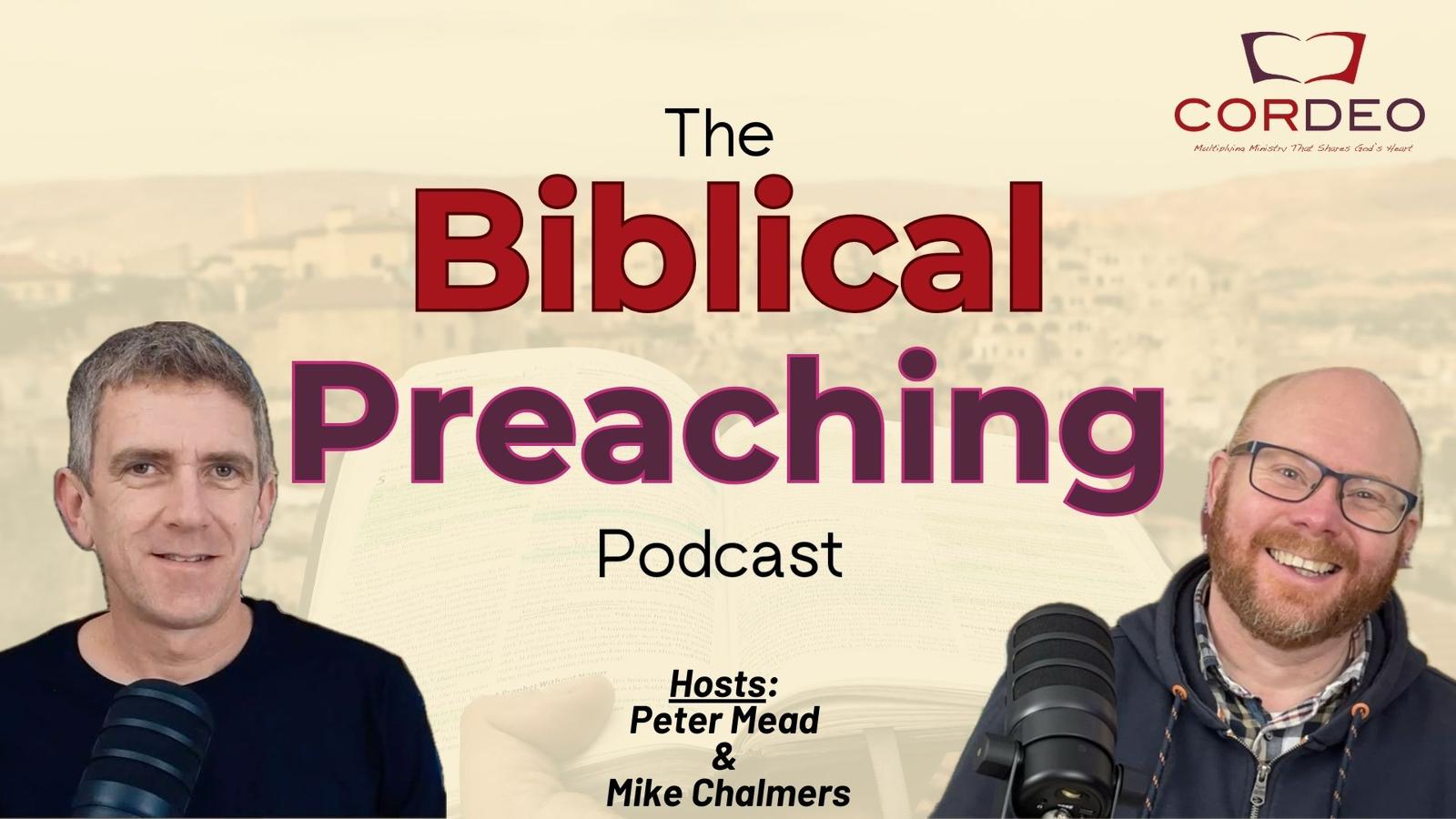
I’m excited to announce the launch of our brand-new podcast: The Biblical Preaching Podcast! Unlike the many great sermon podcasts, this podcast is designed for those who preach, those who are learning to preach, and anyone who cares deeply about the ministry of preaching.

My Cor Deo colleague, Mike Chalmers, will join me as we discuss all things preaching. Together, we’ll explore this ministry’s joys, challenges, and complexities.

Here’s what you can expect:

  • Engaging Discussions: Insights into various aspects of biblical preaching.
  • Special Guests: We’ll feature some amazing voices from the world of preaching—our first guest joins us next week!
  • Encouragement for Preachers: Each full episode concludes with a segment designed to encourage those in preaching ministry.
  • Bitesize Episodes: Shorter episodes focusing on one specific aspect of preaching.
  • Related Blog Posts: From time to time, I’ll share blog posts that dive deeper into themes we discuss in an episode. These posts won’t be mere transcripts but will provide additional perspectives, practical tips, or reflections to help you take the conversation further.

Our hope and prayer for this podcast is simple: that it will strengthen and encourage biblical preaching in churches around the world. Where biblical preaching thrives, the church grows healthier, and healthy churches reach their communities.

We want this podcast to be a gathering point—a place where preachers can connect, reflect, and grow together. This is your conversation! We’ll celebrate the goodness of God, explore the transformative power of rightly handled Scripture, tackle the complex realities of ministry, and share the joy of seeing lives changed through the preached Word.


How to Listen & Connect:
🎙️ Listen to the Podcast on Your Favorite Platform:

📺 Watch Episodes on YouTube:
Subscribe to our channel for video versions of the podcast and exclusive content: YouTube Channel.

🖋️ Read the Blog
Continue to visit BiblicalPreaching.net for posts related to specific episodes, offering fresh insights and practical takeaways.


Can You Help Spread the Word?
We’d love your help in making this podcast a resource for as many people as possible! Here’s how you can support us:

  • Subscribe on your favorite podcast platform and/or to the YouTube channel.
  • Like and Comment to share your thoughts and join the conversation.
  • Follow Us for updates on new episodes and blog posts.
  • Share with your friends, fellow preachers, and anyone who might find this helpful.
  • Review the podcast on your favourite podcast platform – apparently, positive reviews are the most helpful thing!

Thank you for your prayers and support. We’re excited to see how God uses this podcast to encourage and equip preachers worldwide!