As I mentioned before, my good friends at Fellowship of Wildwood in Missouri are giving away copies of Pleased to Dwell as part of their pre-Christmas outreach this year. Alongside the book, they have a weekly reading and a discussion. So here are the first three discussions.
Discussion 1: The Presence of the Promiser
Discussion 2: We Do Not Face Sin Alone
Discussion 3: The Birth of the Baby
I hope these are encouraging. There is one more coming in the next few days. Have a wonderful Christmas!
My good friends at Fellowship of Wildwood in Missouri are giving away copies of Pleased to Dwell as part of their pre-Christmas outreach this year. Alongside the book, they have a weekly reading and a discussion about an aspect of it. Here is the first reading:
And here is the first discussion:
I will post the others on here, but feel free to subscribe to their channel and see them as soon as they come out. Thanks so much!
Starting today, you would be very welcome to follow along with the Pleased to Dwell advent video playlist. It can work alongside the book, or you can just watch the videos. Here is the playlist, please do subscribe to the YouTube channel and use the playlist to work your way through these short videos as Christmas approaches!
The end of the year brings a strange combination of familiar traditions and genuine challenges. While we may be surrounded by bright lights and cheerful music, with parties and celebratory gatherings, we may also be struggling financially, wondering how we are supposed to get everything done and concerned about how we will handle looming difficulties. It could be navigating an awkward conversation with that difficult family member, or coping with the exuberant happiness when we are grieving a loved one, or facing particular challenges that would be hard enough at any time of the year, let alone during the “festive season.” Life can feel like too much, and Christmas sometimes makes it feel even worse.
As Christmas approaches, whether we are dealing with a particular challenge or not, we will all again be confronted with the challenge of seeing past the consumer festival and the nostalgic traditions to the reality of the incarnation. Finding the relevance of this critical doctrine is not achieved by simply revisiting familiar truths through nostalgic traditions. We also have a fresh need to explore how the old truth resonates with contemporary life – including all its challenges.
We are familiar with reviewing the great step taken by the Son of God from heaven to earth – the infinite taking on infancy, the glorious riches to abject poverty, etc. We are used to noting that He came with a purpose; He took on a human body and life so that He could experience death in that body for us. Indeed, Christmas is an arrow pointing to Easter, and it is right to think of that each year.
More than that, Christmas is an arrow pointing to a God who is revealing Himself in the ultimate way, and an invitation opened to rich and poor, local and global, Jew and Gentile. It is a story to stir our nostalgia and our worship, an inspiring example, and, if told well, a thriller with a villain, a deadly threat, and a perfectly-timed escape.
Actually, Christmas is a many-layered story, with intriguing characters, long-awaited prophecies, and profoundly moving themes woven together.
And yet, we so often end up repeating it as if it were merely a nostalgic children’s story to retell like an old family tale that gets trotted out once a year as we gather around a fire and nibble on seasonal treats.
How will you engage the Christmas story this year? How will it connect with your current experiences and concerns in a unique and fresh way in 2025?
Your life, your struggles, are very real. So was the first Christmas. It was not a pretty scene with snow falling peacefully. It contained real fear, real confusion, real hopelessness, real heartbreak. The bewilderment for Mary would have been so constant, the uncertainty for Joseph so vivid. The emptiness and despair of life for the shepherds would have been genuinely bleak. The intrigue of the wise men and all who came into contact with them must have been genuinely perplexing. The first Christmas was real.
As we come to another Christmas, let’s not just go through the motions of another ritual celebration. Let’s not think of it only in picture book scenes, nor apply its truth in nice generalities. Let’s be sure to bring the most real concerns of our time to the Christmas story and find in it a Saviour who has learned what it is to be human, what it is to enter into a world of political tensions, of the deadly inhumanity of men to one another, of the searing heartache of poverty. May we find a richer appreciation for our Lord because our 2025 Christmas realities meet with His first Christmas realities.
The reality of the incarnation is big enough to maintain its relevance and to shine forth its significance, no matter how difficult our current experience might be. May we honour God by bringing our real mess up close to the very real messiness of the first Christmas. There we will find a true Saviour, who is Christ our Lord, and that really is good news for all of humanity.
Peter’s book, Pleased to Dwell, is an ideal read in the Christmas season. To buy in the UK or Europe, click here, and to buy in North America, click here. Please do subscribe to the podcast, and let others know about it too:
As Christmas approaches, plans are coming together—not only for family gatherings but also for church events. Last year, our church put on a Christmas musical, which involved lots of cast, support crew, set building, costume making, songwriting, etc. This year, we are keeping it simple with just a couple of carol services. Whether we “go big” or “keep it simple,” there is one important ingredient that must not be forgotten.
It is so easy to have everyone frantically pulling together a Christmas production and then have nobody remembering to bring the baby for the manger. In the same way, it is easy to be busy with Christmas plans, even Christmas preaching, and fail to keep the focus on the baby at the centre of the story.
If Jesus is forgotten for a nativity scene, then someone will be quickly despatched to go and pick up a baby doll before anyone notices. But what happens if we lose Jesus from our Christmas, and even from our Christianity?
If the theme is Christmas, but Christ is missing, then there will be lots of peace on earth and goodwill to all men, but no basis for such a message of hope. And if the focus is more general, then a Christianity without Jesus will descend into moral tirades and an attempt to police either church or society. There can be no real Christianity without Christ.
And yet, it keeps on happening. How often is the gospel presented as a moral and legal logical presentation? “You have been bad, judgment is coming, God can help you get fixed, and there are some other benefits too…” It might involve some presentation of truth, but the heart of the message is missing.
John Piper wrote these words in God is the Gospel:
“The critical question for our generation – and for every generation – is this: If you could have Heaven, with no sickness, and with all the friends you ever had on earth, and all the food you ever liked, and all the leisure activities you ever enjoyed, and all the natural beauties you ever saw, all the physical pleasures you ever tasted, and no human conflict or any natural disasters, could you be satisfied with Heaven, if Christ was not there?”
We have briefly considered Christmas, and Christianity in general, as well as our evangelism. But what about on a personal level? When Jesus is missing, we will tend to see God as distant and become increasingly self-focused. This does not necessarily mean we will become rebellious and overtly sinful. We might just become religious and self-righteous. Whether in compliance or rebellion, we will become much more behavioural in our focus.
Without Jesus, we will start to see our Bibles as instruction manuals, more than God’s self-revelation. For instance, in John 5, Jesus is rebuking the religious leaders for diligently studying their Bibles and yet missing him completely. They would study and recite the Hebrew Scriptures, but they were blind to the self-revelation of God that should have had them excited at the arrival of Jesus. Sadly, their study spectacles only allowed them to see the dazzling lights of self-glorification, and they missed the main focus of the Scriptures who now stood in front of them.
When we let Jesus drift out of the spotlight in our Christianity, we will lose that vital sense of the relationship with God that Jesus came to establish. Instead of gazing on Jesus and being transformed (2 Corinthians 3:18), we will see only ourselves and drift toward self-glorifying, or self-loathing, or we will become self-appointed evaluators of others and start to inflict unhelpful pressure on others.
There is a world of difference between Christianity with Jesus at the centre, and religion with me at the centre. Actually, there is an eternity of difference.
As we come to another Christmas, let’s be sure to pause and allow our hearts to be wowed by the wonder of it all. Charles Wesley’s hymn says this: “In vain the first-born seraph tries, to sound the depths of love divine!” If angels are amazed, surely we should slow down and make sure we are too. Can we ever fully grasp the wonder of Christmas? Wesley’s words again, “Veiled in flesh, the godhead see, hail the incarnate deity, pleased as man with man to dwell, Jesus our Immanuel!”
Before the year is done, take a moment to stop and take stock. Jesus has to be the centre of everything, not only at Christmas, but in all of Christianity. He is much too precious to lose!
The genealogy in Matthew 1:1-17 points to the fulfilment of the promises to Abraham and David. It also gets the reader thinking about the troubled reputation of several women in earlier days. In Matthew 1:18-25, we see another couple troubled by apparent sexual sin.
Joseph’s Gracious Plan (vv18-19)
Couples married young, and this young couple had their lives before them. The young carpenter and his younger bride-to-be. But then the ultimate slap in the face: Joseph discovers that Mary is expecting a child. It is not hard to imagine the shattered dreams, repulsive images, and emotional turmoil that Joseph endured.
Not only did this crisis mean their forthcoming wedding was a sham, but Joseph also now faced the shame of suspicion. The obvious pathway forward was to save face for himself by publically disgracing her and distancing himself. If he could be sufficiently indignant and distance himself, then maybe his honour could be saved. But Joseph did not choose the obvious path.
Public disgrace for Mary might have meant some sort of public execution by stoning, but even without that, public disgrace is too painful to describe in a shame and honour society. Joseph chose an incredibly gracious option: he would divorce her, and he would do so quietly. What would people say about him? The cloud of suspicion would linger, but Joseph looked out for the best interests of the girl whom he thought had sinned. Joseph’s selflessness is worthy of reflection, not least because we know what he didn’t – the identity of the baby inside her!
God’s Greater Plan (vv20-21)
During the agonizing turmoil of Joseph’s deliberation, new information was introduced. Perhaps he tossed and turned on his bed. The thoughts, the images, the options, the consequences. But the troubled young man must have slept, for an angel of the Lord appeared in a dream.
He was told not to fear taking Mary into his home. He was told that the baby was in her from the Holy Spirit. He was told to name the boy Jesus. And he was told why.
Jesus. The Hebrew name Joshua. Yeshua in Aramaic. However we might pronounce it, this was a name of significance. Actually, it was not unusual. There were lots of little Jesuses running around the neighbourhood for it was one of the most common boys’ names in Palestine at that time. But the angel didn’t just give the name choice, he also gave the reason. This boy would live up to His name – He would save people from their sins.
God’s Great Plan Predicted (vv22-23)
Matthew adds some theological commentary for the sake of the reader. Going back to Isaiah 7:14, Matthew quotes the prophet’s anticipation of a virgin giving birth to a special child with a special name. Ahaz may have been a king with all sorts of issues, but God was not out of touch with his struggling people. In fact, an unmarried woman was soon to give birth to a son of significance, and the significance was God’s presence with the people.
What was true in Ahaz’s day proved to be infinitely truer still with Mary. She was a virgin, unmarried, but with child. This time it was not a matter of sequencing prediction and then fulfilment by normal means. This time she truly bore a miracle child, a child whose significance could not be greater. Immanuel – God with us!
So what would Joseph do? Seems obvious: obey the angel. But not so fast. So he had insider information concerning the child inside her. The boy Jesus was to save the people from their sins and He would be God with us, Immanuel. All very well and perhaps worthy of some Christmas carols, but what about Joseph and Mary?
You can imagine his thinking. Two men come into his carpenter’s shop and request a bid on a certain job. Joseph tells them a price. They look impressed but concerned. Joseph adds a comment about how they could trust his word. Little boy Jesus runs in and starts playing with some wood blocks. They look at the child and whisper to each other. Joseph hears a snippet of a comment about an angel in a dream. They laugh and press him further for assurance on whether he can follow through on his bid. Joseph knows what they are thinking. They leave and go looking for another carpenter, one they can trust.
The stigma of the sinful reputation would linger for years. It could cost them on so many levels. How would he provide for them? How would Mary cope with the dagger comments in the market? How long until the child sensed what everyone thought? It wasn’t that nobody sinned in Nazareth, that was all too common. But when a couple perceived to be different turns out to be the same as everyone else, well, they don’t get treated the same as everyone else. And what about family? What would they say? Family, friends, work, and just about every aspect of life would be stained by the reputation of sinful infidelity.
Joseph’s Immediate Obedience (vv24-25)
Matthew leaves us with no doubt what kind of man Joseph was. He had been kind to Mary, even when he thought she had been unfaithful. And now he proved faithful to God when the days ahead looked so uncertain.
He took Mary into his home, thereby offering the protection and security she needed. A quick wedding was the best thing for all involved. Then he had no marital union with her until after she had the boy. And Joseph named the boy Jesus.
Three times Matthew points to the name of the child. Indeed, the significance of the birth story here is wrapped up in that name. Everyone thought they saw just a normal couple getting married in a hurry for the ‘normal’ reason and later giving birth to a son with a common name. But this was not normal in any way.
How could they face the uncertainties, the knowing looks, the suspicious smiles from family members, or worse, the rejection that may come their way? They could face the stigma of sin because this child was Jesus, the One who would save His people from their sin. This child was Immanuel, God with us.
___________________
This post is adapted from chapter 9, Pleased to Dwell: A Biblical Introduction to the Incarnation (Christian Focus, 2014), 83-87.
Join us on a journey to Christmas this December. A new video every day walking through Pleased to Dwell (follow along with the book, or just the videos).
This December, Cor Deo will be releasing a series of short videos that walk through Pleased to Dwell: A Biblical Introduction to the Incarnation. The book was first released almost ten years ago, and quite a number of people have told me that they return to the book as a devotional reading during the month of December each year (there are, conveniently, 24 short chapters in the book!) So we decided to produce these short videos during December as a lead-up to Christmas, and potentially as a companion to the book (although reading the book is optional!) Join us each day for a brief highlight from the book, along with a Bible verse or two, as we prepare our hearts to celebrate the Incarnation this Christmas.
Please subscribe to the Cor Deo YouTube channel, and share this with others who may find this series helpful. It will work with or without following along in the book, but you are very welcome to order a copy of the book if you don’t have one!
If you would like to get a copy of the book in the UK or Europe, please check out 10ofthose.com or if you are in the USA/Canada, please use this link (these are affiliate links, so I will benefit very slightly).
We all say it every year. Where did this year go? Before we know it, the year has slid past, the temperatures have dropped, and the shops swell with Christmas sights, sounds, and shoppers. In church, we are busy preparing for the nativity play and dusting off the carols for their annual airing. We will hear the infancy narratives of Matthew and Luke, a briefer reading from Isaiah’s Immanuel section, or Micah chapter 5, and soon Christmas will be all over.
But the Incarnation is not just for Christmas.
The Incarnation is critical to the Christian faith. At some point during these weeks, someone will point out that Easter is the reason for the season. They are not wrong. Jesus had to be born to live the perfect life and then die in our place. But that is not the whole story. The Son of God became one of us for several reasons, including God’s great rescue mission.
I have introduced three more reasons that the Incarnation is not just for Christmas. To read the article, please click this link and then check out all the other great resources on the Union website!
It is almost time for Micah’s annual mention. For a seven-chapter book, Micah probably does not get as much attention as his book deserves. He was a contemporary of Isaiah and his writings overlap nicely with his more renowned prophetic colleague.
Micah’s seven chapters begin with a bang, end with a symphony of God’s goodness, and progress through three cycles of justice and hope. He spoke of justice because his society, and its leadership, were dangerously unjust. He spoke of hope because that is how God’s heart of kindness manifests itself to sinning humans. And throughout this little prophetic book, with a powerful prophetic punch, Micah keeps pointing to God’s good Shepherd-King.
The first cycle of justice and hope takes the reader through chapters 1 and 2. Micah begins with a powerful theophany to launch the book – a description of God stepping into the world and everything melting before him. The overwhelming impression is that we must take God seriously. This thought continues as Micah lays out how this awesome God judges sin. He judges the sin of not taking Him seriously, not taking His people seriously, and not taking His truth seriously. And after two chapters of divine justice, we are uplifted by two verses of divine hope. God will gather his people with the heart of a shepherd, and he will lead his people with the strength of a king (2:12-13).
The reference to God as the leader moves Micah into his second cycle of justice and hope in chapters 3-5. Again, he begins by condemning the injustices of his society, focusing now on the leadership who abuse their position, proclamation, and privilege. Micah was surrounded by corrupt speakers who spoke according to their paycheck. Micah, in contrast, was filled with the power of the Spirit of God to speak against the sins of his society (see Micah 3:8). Almost three millennia separate Micah’s culture from ours, but the similarities only demonstrate the consistency of human fallenness. We cannot expect human leaders to be all we need, and we should not be surprised when human leaders are profoundly corrupted. What we need is God’s good leadership.
This thought is developed in the hope section, now not just two verses, but rather two chapters long! Micah paints a glorious picture of a future golden age. Opinions differ as to when that age fits into the timeline of history and eternity. Still, it reveals God’s desire as He leads: He plans to unite peoples, to transform them by His teaching, to reconcile them to end their fighting and to love the weak and broken. While the immediate future looked bleak, with a prophecy of exile in Babylon to assure them of God’s longer-term trustworthiness, Micah then comes to chapter 5.
If what we need is God’s good leadership, then who will be God’s good leader? God promised His eternal ruler to the little town of Bethlehem. Micah 5:2 is quoted every Christmas as King Herod tries to work out where a new king would be born. But we should keep going beyond that one verse. A couple of verses later, we get some description of this coming King. He would be a strong shepherd, strengthened by God. He would bring global security (something never achieved in our world even up to today). And He would be their peace. Back in Micah 3:5, we read about false teachers offering a message of peace only if they are paid for it, but this coming Shepherd-King will bring genuine peace to the world!
Micah’s third and final cycle of justice and hope stretches through chapters 6 and 7. Again he returns to the corruption of the city and its leadership. God had only required that they do justice (in their dealings with one another), reflecting the loyal kindness of God’s heart, and do so in humble dependence upon God. (Micah 6:8 is the other verse that gets a mention now and then!) But the leaders, and the people, lived out a non-Micah 6:8 kind of lifestyle that was worthy of God’s discipline. The whole of that society seemed rotten to the core, but Micah, in contrast, looked to the Lord and waited for his saving God to hear him (see Micah 7:7).
Micah’s first cycle urges us to take God seriously. The second cycle encourages us to see our need for God’s good leadership. This final cycle underlines that our hope is in a God who is faithful to His promises. As justice yields the stage to hope, Micah calls for God to “Shepherd your people . . . as in the days of old.” He looks back to how God shepherded his people out of Egypt and in the wilderness (see Micah 7:14-17).
Micah began with a bang as the awesome God stepped in and mountains melted like wax. But now, he ends with a symphony celebrating God’s goodness. We live in cultures that are often as unjust as in Micah’s day. We live with national leadership that is often as corrupt as those that Micah renounced. We also live in a sinful world that deserves divine justice, so we need to look up for the divine hope – hope promised long ago, hope that broke in that first Christmas in the person of Jesus, and hope that can see us through whatever still lies ahead. So, as 2021 draws to a close, let’s allow Micah’s climactic symphony of God’s goodness to resonate in our hearts and lives:
18 Who is a God like you, pardoning iniquity
and passing over transgression
for the remnant of his inheritance?
He does not retain his anger forever,
because he delights in steadfast love.
19 He will again have compassion on us;
he will tread our iniquities underfoot.
You will cast all our sins
into the depths of the sea.
20 You will show faithfulness to Jacob
and steadfast love to Abraham,
as you have sworn to our fathers
from the days of old.
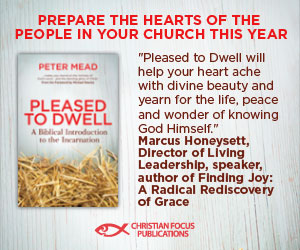
Pleased To Dwell: A Biblical Introduction to the Incarnation is a great read in the build-up to Christmas. 24 short chapters make for a healthy heart preparation during the days of Advent. To get your copy in Europe click here, or in the USA click here.
It is easy to preach Christmas in a Christmassy way. You know, quaint and familiar cliches that smell a lot like an other-worldly fairy tale. It will have beautiful scenes and an eclectic array of two-dimensional characters. And our listeners will guess where the message is going: kindness to others, unity amidst division, celestial sentiments of goodwill and a few references to eating too much.
The first Christmas was no fairy tale. So we should not preach Christmas to satisfy the nostalgic yearnings of a weary public. Nor should we sprint past the stable to get to a post-Christmas presentation of the Gospel in order to satisfy the more robust preaching critics from pew four.
The birth of Jesus occurred in a context of great confusion and tension. Jesus entered this world to change things. And if we can enter that world, we might better grasp the hope for our world today.
Just think of all that swirled for the characters that first Christmas:
The shepherds were social outcasts who received one of the greatest visions in human history. They were stunned. And they needed the angel to stir them to leave their sheep and dare to follow up on the heavenly announcement. If the angel hadn’t deliberately mentioned the manger, and therefore, the poor surroundings of the newborn king, they would have probably stayed in the fields impressed by their vision.
The Magi were trusting in obscure information passed down to them and what they saw in the night sky. Prophecies from foreign documents, long and dangerous travel, no guarantee of fruit from their journey. We can only imagine how bizarre it must have seemed to them (as well as how bizarre they felt as they arrived at their destination!)
Mary and Joseph got their life-changing information from Gabriel – it was truly momentous news, but so much was left unsaid. What would they say to others? How would they explain this? Would they even be able to live in their home town? How would family react? Who would trust Joseph’s word in business now? Lots of questions about the little stuff of real life.
But as they all lived that first Christmas, God did give them what they needed. They heard or discovered God’s kindness, God’s faithfulness, God’s timing, God’s plan to deliver people from their sins, even what God would look like if he came in human flesh to be with us!
As we preach Christmas this Christmas, let’s not sound too Christmassy. Instead, let’s invite people back into that world, so that they can discover how Jesus came into our world, for real people, with real issues, real fears, real doubts, and real questions. Let’s stand next to an unnamed shepherd or Joseph, not knowing what the next years will bring, but knowing that God has cared enough to do something about it! Life was complex before 2020. They didn’t used to live two-dimensional cartoon lives. Preach the real Christmas, and give real hope, this Christmas.




 Biblical Preaching