The Least Resolution for 2024

January does not just bring a new page on the calendar but a whole new calendar.  And with the new year, we tend to generate renewed commitments.  Maybe you have already determined what 2024 will mean for you.  Perhaps your mind has already pondered daily step counts, gym visits, dietary changes, or other healthy habits.  Or maybe you are thinking about Bible reading, daily prayer routines, or other spiritual goals.  May your resolutions last and bear good fruit!  But perhaps the resolution we need for 2024 is more foundational than healthy habits and more straightforward than spiritual practices.

As I write this, I am in Budapest, where I have just visited a museum of the political terror of the twentieth century.  As you can imagine, it is a sobering experience to see the vast walls of victims, the displays focused on the political prisoners, a room commemorating the persecution of the religious leaders, the torture chambers, the prison cells, and the gallows.  But perhaps the lingering memory for me will be the final room.  With red walls and hundreds of pictures, it felt like yet another presentation of victims.  But it was not.  It was a room of “victimizers” – ordinary people who were merely doing their job, simply following orders, just playing along, and thereby facilitating the evil machine.  We can remember the victims, and we must.  Yet we must also face the uncomfortable reality that most cogs in the cruel machine of death were ordinary people.

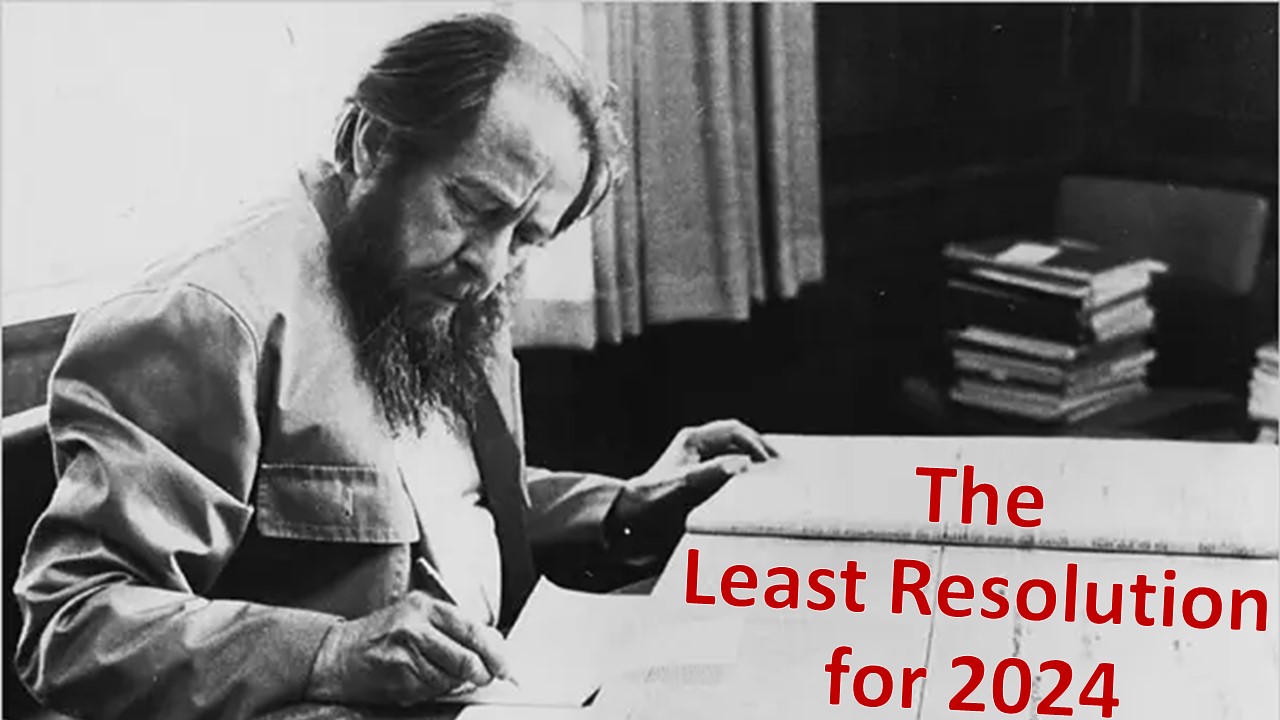
Fifty years ago, in February 1974, Alexander Solzhenitsyn was arrested in the Soviet Union and exiled to the West.  There, he was welcomed as a hero.  On the day of his arrest, he released a document entitled “Live Not by Lies.”  He knew the power of an ideology that sought to reshape society.  He also knew the power of individuals who simply refuse to lie (and the even greater power of a crowd joining together in this conviction).  He knew that the ideological system would totter and collapse when it ran up against the brick wall of reality, exemplified by many individuals refusing to play along with the evil fantasy.
Fifty years later, perhaps it is time for us to revisit this document.  Are we living in times where some, on behalf of all, have determined what society should look like?  Do we see a mounting pressure to conform with what ‘they say’ is acceptable human thought and belief? Indeed, we should not be so naïve as to assume that the absence of marching military on our streets means we face no ideological threat. 

The pressure is growing for everyone quietly to conform.  More than that, the pressure is growing to affirm openly and celebrate what we know to be false.  Surely, it would be better to speak the truth now instead of growing our tendency to fit in and play it safe as the stakes mount.

Truth and Lies – Choosing not to lie was not an original idea for Solzhenitsyn.  Paul urged the Colossians not to lie to one another.  Not only had they put off their old self, but they had put on the new self to reflect their creator’s image (Colossians 3:9-10).  He told the Ephesian believers to speak the truth to one another since they were no longer defined by the lie (Ephesians 4:25).

In the Sermon on the Mount, Jesus addresses the anger underneath murder, the lust underneath adultery, and the daily consistency of speech beneath more flamboyant oaths (Matthew 5:21-37).  There is plenty of Old Testament support for the expectation that God’s people should be consistent speakers of truth (Exodus 20:16; Leviticus 19:11; Proverbs 14:5).  God does not lie, and his people represent him.

Fear and Lies – Solzhenitsyn knew the impact of fear on a population.  He wrote of the great threat facing humanity in his day, which was “about to flare up and engulf us.”  And he described the fear: “While we continue to smile sheepishly and babble; ‘But what can we do to stop it? We haven’t the strength.’”

God asked Isaiah’s listeners, “Whom did you dread and fear, so that you lied, and did not remember me, did not lay it to heart?” (Isaiah 57:11).  Their fear led to lies, as they forgot who was really in charge.

Our world seems to be changing at a frightening rate.  Trying to keep up with the latest adjustments to sense and morality can be tiring.  And it is increasingly revealing how much fear lies within most of us, who are so prone to play along with society’s expectations rather than speak what is true.  It is concerning how easily we fear and perhaps lie while forgetting who is really in charge. 

Some will capitulate completely and speak what is false.  Others hide behind a cloak of not wanting to “sound political” and speak out about the reducing set of acceptable Christian declarations.  Fear of being labelled and criticized leads many to hold back from speaking the simple truth.  After all, it is much easier to quote a Bible verse on social media or avoid the hot topics in conversation rather than offer the most minor form of resistance.

Solzhenitsyn wrote that the fear his people felt was not primarily a fear of nuclear death or a third world war.  The fear was of taking a “civic stance.”  He wrote, “We hope only not to stray from the herd, not to set out on our own, and risk suddenly having to make do without the white bread, the hot water heater, a Moscow residency permit.”  The penalty for a civic stance may have changed, but the fear of the herd has not.

History has never smiled on the timid, and yet each fearful choice always makes sense at the time.  How often do I justify timidity when society needs me to show courage and speak the truth?  We have almost constant opportunities to speak the truth about marriage, gender, sexuality, race, free speech, bodily autonomy, science, medical ethics, corruption, or whatever other prescribed view is being pushed at any given moment.

We cannot simply wait for an ideology to fall apart.  We must be part of the brick wall of reality into which it must crash.  And yet, it is always easier to “continue to acknowledge, glorify, and strengthen” that which we want to see collapse.  At the very least, we must not “recoil from its most vulnerable point.  From lies.”

Violence and Lies – Solzhenitsyn described how violence bursts into peaceful situations with great self-assurance.  “But violence ages swiftly, a few years pass—and it is no longer sure of itself.  To prop itself up, to appear decent, it will without fail call forth its ally—Lies.  For violence has nothing to cover itself with but lies.”

So, even under overt tyranny, people do not have to experience violence at all times.  The demand is only of a “daily participation in deceit” – the tribute paid to maintain one’s position under the power of the oppressive system.  Just play along, it is safer.

The connection between violence and lies is also not a discovery made under the rule of twentieth-century totalitarianism.  Micah wrote to the city in his day, “Your rich men are full of violence, your inhabitants speak lies and their tongue is deceitful in their mouth” (Micah 6:12).

We may not have to stand and fight against violence.  We may not even have to step out publicly and boldly declare the truth. “But let us at least refuse to say what we do not think!”

The Consequences of No Lies – In the Soviet Union, there was a cost to this most simple of stands.  It could cost your job and complicate life.  It could cost your success in education and impoverish your future.  But Solzhenitsyn was clear:

“And as for him who lacks the courage to defend even his own soul: Let him not brag of his progressive views, boast of his status as an academician or a recognized artist, a distinguished citizen or general.  Let him say to himself plainly: I am cattle, I am a coward, I seek only warmth and to eat my fill.”

To choose not to lie was not an easy choice in his day.  It will increasingly not be an easy choice for social standing, or even for physical wellbeing, in our day.  But the choice not to lie is “the only one for the soul.”

The implication of no lies is worthy of note. “The more of us set out together, the thicker our ranks, the easier and shorter will this path be for us all!  If we become thousands—they will not cope, they will be unable to touch us.  If we will grow to tens of thousands—we will not recognize our country!”

As we head into a new year, may we not simply play along with the world.  Instead, let us graciously, prayerfully, and wisely determine that whatever else may happen, we will not participate in the lies expected of us in society.  As representatives of God in this world, this is the least we must do!

(Source of AS quotes: https://www.solzhenitsyncenter.org/live-not-by-lies)

What’s the Big Deal with Worship?

What does gathered worship do?  Sometimes it can make our souls soar.  Other times not so much.  It is easy to understand why non-believers scratch their heads at Christian worship.  If I saw a small group of people awkwardly singing, listening to someone talk about an old book, and sharing a tiny amount of bread and wine, I’d scratch my head too.

As I anticipate returning to Poland for the European Leadership Forum, I am reminded of the sacrifices made by so many during the Communist era.  Russian Baptist pastor, Yuri Sipko, remembers Christians who were sent to prison camps or lost their jobs or their children. “Without being willing to suffer, even die for Christ, it’s just hypocrisy.  It’s just a search for comfort.”  Challenging words, but ponder this thought: “You need to confess him and worship him in such a way that people can see this world is a lie.”

What does gathered worship do?  It declares that this world is a lie.

At the end of Revelation 3, we find that famous verse about Jesus standing at the door and knocking.  He was knocking on the door of the church at Laodicea, but would they open the door and let him in?  They thought they had everything they needed, but actually, they desperately needed Jesus.  As we turn to chapter 4 and John’s great vision from Jesus continues, we find the heavenly door is open for John to come up and participate in the ultimate worship gathering.

In Revelation chapters 4-5, we get to glimpse the ultimate worship gathering, and it reminds us what gathered worship does.  Here are five things that gathered worship does:

1. Worship centres us around God’s throne. (4:1-2)  In worship, we are invited, by Jesus, to gather at the throne of God.  In Eugene Peterson’s Reversed Thunder, he points out how we live in a world that feels like a storm-tossed sea.  We are thrown all over the place by every wind, every wave, every advert, every news story, every problem, and every threat.  But as Christians, we have an anchor that holds us firm, gives us a circumference, and centres us.  God is on the throne, so there can be a constant source of stability in my heart and life. Gathering with God’s people to sing his praise is an anchor point in the frenetic chaos of life.

2. Worship gathers God’s people around his throne. (4:3-11)  In this glorious vision, there is layer upon layer of rich meaning.  The vibrant colours seem to reflect God’s holiness and justice, as well as his life-giving nature as the Creator.  The 24 elders probably represent the twelve tribes of Israel and the twelve apostles of the Church (there is debate on all these details, of course).  Perhaps they represent God’s great work through the centuries to reveal his plan and rescue people for himself.  Then there are the four living creatures – a picture of God’s creation (noble, strong, wise, and swift), and some have seen here four glimpses into the person of Jesus Christ.  God’s people, God’s creation, all falling down and worshipping God on the throne.  In worship, we are united together, not only with one another but also with God himself, in the uniquely trinitarian worship we find in the Bible.

3. Worship points us to Christ and his payment. (5:1-7) At the start of chapter 5, John is struck by the disconnect between God’s greatness and the need of humanity.  The sealed scroll, Earth’s title deed, God’s plan of judgment – its existence underlines that no human is worthy to open the seals.  Even apart from the judgment context of Revelation, our gathered worship cannot be satisfied with just lauding God the Creator for his power and majesty.  Christian worship always points us to Christ and his payment.  John turned to see the Lion of the Tribe of Judah and was confronted by the slain Lamb.

4. The Lion/Lamb Redeemer stirs greater songs of worship. (5:8-13)  When God’s people encounter God’s goodness and grace, they sing.  Moses, Miriam, Deborah, David, Mary, Angels, Jesus and the Disciples, Paul and Silas – they all sang.  When we become aware of who he is and what he has done, then we will sing too.  In chapter four, there were two songs to the Creator (4:8, 4:11).  Now the singing swells as more voices join in and more richness is reflected in two songs to the Redeemer (5:9-10, 5:12).  Finally, there is one song to both the Creator and the Redeemer combined (5:13).

5. Worship finishes with a great Amen! – the ultimate reality of God’s person and plan is definitively affirmed!  (5:14)  If you think about it, we humans have a history of saying no to God.  We are all quite adept at saying no.  But Revelation 4-5 underlines that in the end God’s great yes will overcome every one of our noes.  In worship, we are confronted by the reality of God the Creator King on his throne, and of God the Redeeming Lion/Lamb, and we cry out, “Yes!”  When we worship together, we get a pre-taste of what is to come.  “Your kingdom come, your will be done, on earth as it is in heaven.”  Gathered worship is like an anchor to both the future, when all our questions will be answered, and to the ultimate reality in the present – that God is on the throne and he has redeemed us.

So what does gathered worship do?  It declares that this world is a lie.  More than that, it centres us around the throne of God – for God is on the throne whatever we may be facing down here.  It gathers God’s people around his throne – for God is worthy of every note of praise that can be uttered by any part of his creation.  It points us to Christ and his payment – for we worship not only in response to the majesty on the throne but also to the scars on that Lamb.  It stirs us to sing greater songs of worship – for God the Creator and our Lion/Lamb Redeemer.  It definitively affirms the ultimate reality of God’s person and plan – for in the end we will cry out our great “Yes!” and “Amen!” to God.

Whether we are gathering in a great crowd at a Christian event, or with a handful of dear saints on a Sunday, let us appreciate the privilege of gathered worship and declare with joy that this world is a lie.

_________________________________

Sipko quote from Live Not By Lies, by Rod Dreher, p185-6.

______________________________________________

A Perplexing Silence – part 3

We are living in momentous times when the ethical foundations and nature of western society is being radically reshaped.  In part one, I briefly surveyed the situationIn part two, I offered three possible reasons for our relative silence as Christians – some are unaware, some are strangely unconcerned, and some are understandably overwhelmed. 

Let’s continue that list with two very important additions:

4.  Some are afraid.  There is a lot of fear in Christian ministry.  Let me put it out on the table.  It is probably better to discuss it rather than pretend it is not there:

  1. Fear of upsetting people in our church.  Every church will have people across a spectrum of political or cultural views.  Our society controls contrarian perspectives by its reaction. This mechanism is evident with gender, sexuality, race, public health, climate crisis, military conflict, etc.  Some people sit primed to be upset if we touch the wrong nerve.  It always feels safer to play it safe.
  2. Fear of upsetting Christians beyond our church.  Maybe your local church is not as diverse as the wider church.  Perhaps you can speak freely in your local pulpit without concern.  But we live in an age of online recordings.  Spurgeon used to have his sermons typed and published in newspapers. At the same time, thousands of other pastors could preach anything, and only their smaller congregation would hear them.  Today the pastor of an obscure church can be heard by someone on the other side of the world. That person might disagree vehemently and take to their keyboard.
  3. Fear of upsetting people in our society.  A decade ago, church leaders were concerned about being forced into a complicated legal situation. “What if someone asks me to perform a wedding I can’t offer in good conscience?  If that happens, then I could get in trouble.” Today, we are already in trouble with many people because of our beliefs.  We don’t have to do anything wrong; we are already wrong.  We are already guilty of wrong-think.  We hold dangerous views.  When some agent in society requires us to affirm certain things, we will already be in trouble.  This dynamic can lead not only to silence but also to participation so as not to stand out.  When Daniel’s three friends did not bow down, they stood out.  They were heroes then, but it is genuinely challenging to know when to stand out in the complexities of today. 
  4. Fear of the backlash.  Nobody wants to be in the sights of the mob.  The destruction meted out by today’s cancel culture can be ruthless and unforgiving.  The antagonistic othering of people who do not conform to society’s expectations has already become quite sinister.  In the last couple of years, I’ve seen people wishing on me imprisonment, the withholding of medical treatment, the restriction of movement, and even death.  Thankfully they did not name me specifically, but I happened to be in a class of people that were overtly “othered.” Nobody wants to face the force of that anger on any of the triggering issues.

Solzhenitsyn’s stunning warning in 1978 at the Commencement of Harvard University still rings out today.  Does it apply to us? “A decline in courage may be the most striking feature that an outside observer notices in the West today.  The Western world has lost its civic courage, both as a whole and separately, in each country, in each government, in each political party, and, of course, in the United Nations.  Such a decline in courage is particularly noticeable among the ruling and intellectual elites, causing an impression of a loss of courage by the entire society.  There are many courageous individuals, but they have no determining influence on public life.”

5.  The category I have not mentioned.  You may have read through these points and said, “yes, but there is another perspective.” I know.  Let me raise the common one that I anticipate.  I agree that the hope of society, indeed the hope of humanity, is the gospel.  Absolutely.  Signing petitions, participating in protests, writing to our representatives, voting one way or another, or any other political action are not the ultimate answer.  I agree.  The gospel is the answer, and we must rest in it ourselves.  Then we must also broadcast it and share it from person to person.  

But can I be candid?  I feel like sometimes we might be hiding behind a gospel-only approach.  To do so allows us to say nothing about what is going on, human rights, moral evils, etc., and thereby not face much in the way of antagonistic response.  I know exactly how to say the right Christian things to avoid criticism or backlash. I’m sure you do too.  We still have the freedom to speak Christian truths to each other, so long as we do not trip the growing number of hyper-sensitivities in our culture.  Gradually the freedom to quote Bible verses will grow ever more restrictive.  When referencing the Bible at all becomes culturally unacceptable, will we then quietly comply with that expectation too?

As Solzhenitsyn provocatively wrote in Live Not By Lies, “And as for him who lacks the courage to defend even his own soul: Let him not brag of his progressive views, boast of his status as an academician or a recognized artist, a distinguished citizen or general. Let him say to himself plainly: I am cattle, I am a coward, I seek only warmth and to eat my fill.”

I do not quote that to point only at others.  I fear that I can too quickly be part of the herd too.

In closing, my mind goes to two scenes:

  1. The best burger I can remember.  I sat with another pastor enjoying both the burger and the conversation.  We were both expressing the same thought.  It isn’t easy to prepare people for what seems to be coming in our society when we are not allowed to mention what is coming.  In my preaching and social media, I can make every public statement both gospel-centred and relatively safe.  But the gospel has always been radically counter-cultural. And as culture pivots away from a Judeo-Christian ethical basis, the gospel will only become more radical. Many people in the church are not prepared for a world that is overtly antagonistic and institutionally persecuting them for their beliefs.
  2. That congress.  The film, Tortured for Christ, begins with the “Congress of Cults” that brought together religious leaders in Romania in 1945.  Richard Wurmbrand, a Lutheran pastor, sits with his wife listening to the leaders praising the “progress” brought by the new Stalinist regime. Then he spoke out. We could just as easily go back to the example of Dietrich Bonhoeffer in Germany a few years earlier. It is hard to speak out when almost nobody else does. I know some Christian leaders are taking a stand today and speaking out on various issues. I am thankful for them. But I also see that many are already choosing to play it safe. We aren’t in the 1930s or 1940s, but we are in the 2020s. How can we be so sure this decade will not prove equally significant?

As we come to the end of the year, we also may be coming to the end of an era.  One last quote from Solzhenitsyn, “If the world has not approached its end, it has reached a major watershed in history, equal in importance to the turn from the Middle Ages to the Renaissance. It will demand from us a spiritual blaze; we shall have to rise to a new height of vision, to a new level of life, where our physical nature will not be cursed, as in the Middle Ages, but even more importantly, our spiritual being will not be trampled upon, as in the Modern Era.” If we were not at a major historic watershed in his day, it feels like we are now.  So, let’s all pray for wisdom, insight, courage, and strength as we head into 2023. Let’s not take part in the lie. We need a spiritual blaze.  God has put us all here for such a time as this.

8 Pulses to Check this December

As we come to the end of another year, the finish line is in sight.  Christmas plans are in place, and all those events will soon be over.  Before you know it, we will be into 2023 with all the familiarity of a New Year and the uncertainties of a new year.  We know people will join the gym and try to read through their Bible, but we never know what is about to happen.

Between the Christmas events finishing and the launch of 2023, let’s take a moment to take the pulse, actually, several pulses.  If you are involved in church ministry, then here are some pulses you need to be checking:

1.  God.  How does God feel about your church?  How does God’s heart beat for all that matters to you?  God’s heart is your ultimate concern.  Knowing God’s heart doesn’t require mystical guesswork.  It requires time in the Bible and time in prayer.  We should prayerfully prepare every sermon we preach, and I think it is wise to seek God’s heart for each passage and how it should land in the hearts of your listeners.  But why not take the year-end as an opportunity to seek God’s heart about your church, your ministry, and your part in His plans? 

2.  Society.  Are you aware of what is going on in society?  There is a whole edifice presented by the media, the news, and the current catalogue of acceptable issues and concerns.  We need to have our finger on the pulse of society, whether we agree with all of it or not.  That sense of what is normal will throb in the veins of the people you encounter daily.

3.  Reality.  Are you in touch with what you are not supposed to think?  There will usually be significant parts of society that are not convenient for reality as presented in the media.  It is good to have a sense of what people are thinking but not saying.  Or what they are saying but you are not allowed to hear.  It is good to know what is happening, and sometimes others will need you to point beyond the cultural narrative they are constantly hearing.

4.  Congregation.  Your congregation is not a perfect representation of your society.  The culture is pushed along by sophisticated ideas and/or unsophisticated entertainment.  Still, your congregation is a specific group in a particular location.  The country could be thriving while your part of town is economically depressed, or vice versa.  The nation could be gripped by avant-garde notions, while your congregation may seem to be living a generation behind.  Who is in your church?  What are their concerns?  How are they doing?  The culture may be focused on saving the planet, but your people may be more worried about staying warm and paying their bills this winter.

5.  Future Congregation.  It is understandable that we tend to focus on the flock God gave us.  But it is also wise to ponder what the future may look like for your church.  If you have a very established congregation, you still need to preach to people new to the church.  They may not even be coming yet, but preach to them anyway.  Your congregation will not feel comfortable bringing them along if you don’t make it a suitable environment.  So, what kind of people might God want to add to your church in the coming years?  Why not prayerfully think about preaching as if they are already attending so the church is ready to receive them when they do?

6. Co-Workers.  If your church program gives you room to breathe, be sure to prayerfully consider the health of your coworkers.  You know that your church is not your church.  You cannot do everything yourself and your church would be in dire straits if all your coworkers were to quit or burnout.  Whether they are paid staff members, or busy volunteers who give sacrificially of their “spare” time, how are they doing?  Pray for them.  Reach out to them.  Write them a note to thank them.  Make sure that you do not head into 2023 unaware of warning signs from those around you.

7.  Me.  Ministry can take its toll.  How are you doing?  Are you in a good place with God?  How much has your ministry depleted your energy reserves?  Are any situations weighing heavily on you and setting off warning lights?  Are you letting yourself slide in any areas, succumbing to temptation, or developing unhealthy habits?  The end of the year is an excellent time to take your pulse before launching into another year.  Take your pulse spiritually, physically, mentally, and emotionally.  How is your walk with Christ?  Are you looking after yourself properly?  Do you have the relationships you need to thrive?  Is someone mentoring you?  Are you mentoring someone?  Who can you be open with as a peer?  Who is looking out for your heart?  Are you proactively meeting people outside of church circles?  Oh, and don’t trust yourself to self-evaluate.  Ask God to search you and try you, and ask those close to you for their perspective as well.

8.  Family.  Ministry can take its toll.  How is your family?  It is easy to sacrifice your family on the altar of ministry, but is God honoured when you do that?  Suppose you have a child who is not thriving spiritually. Would it make sense to devote more time to your primary responsibility of parenting?  You might even do well to consider a sabbatical or taking a step back to pursue their heart for a season.  I know it is complicated if you depend on ministry for your income, but many readers are not receiving a salary.  And whether you are or not, it could be a significant example to others to see you put family first and seek to win the hearts closest to home.  It is not a simple decision.  Nevertheless, I raise it because too many of us would not even consider stepping back from the ministry that gives us too much of our identity to care for the people God has most entrusted to us.  Nobody else can be your spouse’s spouse, and you only get a limited window with that child still under your roof.  Of course, you may find such drastic changes are not needed.  But perhaps you need to tweak some things at home so that your church ministry can flow out of greater strength at the family level?

I know we are taking a deep breath before the chaos of Christmas.  I pray that your Christmas events will proclaim the peace that only Christ can bring into this desperately needy world.  And I also pray that we will all get the opportunity to take a deep breath after it is all over.  May we all take the opportunity to check the pulse in these areas and head into the New Year looking to Christ for each of the needs we discover!

________________________________

This year’s video quest through the Psalms will soon reach the finish line. Here is Psalm 139:

Different (1 Thessalonians – part 5)

Paul’s first letter to the Thessalonians is like a training manual for a young church. He has taught about the impact of the gospel in chapter 1, giving ourselves to build up the body of Christ in chapter 2, and praying for each other to thrive spiritually in chapter 3. Then in chapter 4, he offered some truths that would make a difference in their lives. So now, in chapter 5, he lands the letter underlining some differences that the gospel makes for believers. In a sense, he has come full circle.

How is the church you preach to supposed to be different?

1. Not naïve, but alert & hopeful. How easily we can lose our bearings as believers. Especially as relatively comfortable believers. It is so easy to get caught up in the hype of our society and fall into the naïve trap of thinking, “there is peace and security.”  After all, our country has been free and secure for generations. And the everyday stuff of life is carrying on as it has for as long as we can remember: the sports calendar, the TV series, the progression of seasons, the endless cycle of monotonous news, etc. Yes, our world is declaring certain destruction of the planet and will pat itself on the back for every effort to rescue our future from its terrible fate. Meanwhile, some of the loudest voices continue to buy their beachfront properties while proclaiming the scientific certainty of destructively rising sea levels. And so we must all play along with their panic. But despite all the shouts, most people still have a naïve confidence that nothing will actually change. The news is just noise. There is no credible threat to my safety and sense of peace.

And yet, 1 Thessalonians 5:1-11 seems to expect Christians to be different. Christians are supposed to be marked by alertness, discernment, sobriety, readiness and hope. Our faith, hope and love are not typical of humanity in any age. We do not stand apart by pretending all is well or spouting nice Christian platitudes. This world is heading for sudden destruction and wrath. And amid a society that tinkers as the empire heats up, we know our salvation is in Christ, so we encourage and build one another up.

2. Not self-absorbed, but purposeful. How easily we can reflect the relational dynamics of our fallen world. When selfish materialism gripped society, it was easy for Christians to play that game with a smug sense of sanctification (God is blessing me!)  What if society is now becoming enchanted by a new, but still self-serving, moral ideology? Well, it will also be easy for Christians to play that game. Many already are. We only need to learn hypersensitivity to certain moral trigger concepts and remember to celebrate brand-new self-defined and unquestionable identities. The morality of intersectional identity politics is replacing the ethics of liberal democracy. However, Christians will still simply add a Bible verse to their version of it and fit right in. 

And yet, 1 Thessalonians 5:12-14 seems to expect Christians to be different. Like many in the New Testament, this passage describes a community gripped by a counter-cultural perspective that shapes a more purposeful and selfless set of relational dynamics. Instead of a subtle rebellion against leadership, there is to be respect, esteem and love. Instead of interpersonal squabbling, whether the garden fence gossiping of yesteryear or the proactive and unfiltered taking of offence and wholesale interpersonal condemnation of today, Paul’s language of living at peace is radically different. And instead of using the community for my selfish goals (think classic networking in strategic gatherings or contemporary social narcissism on the media platform of your choice), the Christian community differentiates need among people so it can selflessly address each need. A loving Christian community should feel radically different.

3. Not worldly, but distinctly His.  How easily we can lose our distinctness as followers of Jesus. We are like fish swimming in a spiritually fallen fish tank and still assume what we experience is normal. And since our experience defines normality, our conduct will tend to reflect it. We compete. We get our own back. We moan. We can be prayerless, thankless, and unspiritual. We can live only by what we see. We can indulge.

And yet, 1 Thessalonians 5:15-28 seems to be urging us to be different. There are instructions that counter the list of normal behaviours listed above. And there is the closing benediction, where Paul prays that the God of peace will sanctify, set apart, make holy, transform, and distinguish. How much? Completely.  How blameless? Every aspect of our being. And is that transformation down to us? No, God is faithful and will surely do it. The Christian church should be radically and progressively more different because we are not called to fix ourselves, but we are called by the One who can bring about the necessary change in us. 

___________________

Running on Fumes

When a car has very little fuel in the tank, we say it is running on fumes.  It is moving forward, but warning signs indicate the vehicle is in trouble.  It won’t go very far unless something changes.  And the something is simple – it needs fuel.

The same thing happens with Christians too.  They give the impression of keeping on spiritually, engaging with the church, and so on.  But there are warning signs, and they won’t go very far unless something changes.  Again, the something that needs to change is relatively simple – they need fuel. Simply being around Christians and using Christian language is not enough. Without a vital personal relationship with Christ, they are merely running on the fumes of Christianity.

Warning Signs – In a car, you have warning lights on the dashboard to alert you to an issue before it becomes a problem.  If you proceed far enough, the engine will start to sputter and make unusual noises.  What are the warning signs when a Christian is running on the fumes of Christianity?

  1. Loss of Joy – There are many reasons for a loss of joy, so do not assume that the spiritual tank is always empty when joy fades.  However, any warning light is a reason to investigate.  Indeed, when someone’s tank lacks the fuel needed, delight in the things of God and church life will only come in fits and starts.  The classic biblical example is Martha in Luke 10:38-42 – she was doing the right thing, but the joy was gone.
  2. Alternate Fuels – Is work or a hobby suddenly becoming more significant?  Are they starting to find motivation and purpose in something other than Christ in a way that was not true earlier in their Christian journey?  Alternative fuels are attractive because someone struggling will see the alternative as more readily accessible and the goals more attainable.
  3. Blaming the Church – It is very rare to hear someone drifting from church life and being honest, “Oh, I am staying away because I am not fuelling my soul, and so I feel awkward being around other Christians right now.”  It is much easier to talk about how the church does not meet their needs, and they don’t fit, the programs are not helpful, the other people don’t like them, etc.  Not every person being critical of the church is in a bad place personally, but many are.
  4. Verbal Paper Cuts – Sometimes it is not the full force explosions that hurt, but the subtle paper cuts.  Someone in a low place spiritually will often make little paper cuts with their words.  Little bits of gossip.  Little criticisms.  Little digs.  Maybe nothing significant enough to confront or challenge, but enough to leave you feeling that sting of an open wound when they walk away.
  5. Emotional Outbursts – Sometimes, things do come out in full force explosions.  And, like a cornered animal, someone feeling spiritually empty can lash out and attack rather than admit their need and open themselves up to help from others.

Emergency Measures – What do you do when someone is running on empty and about to run out of fuel and grind to a halt? 

  1. Re-Fuel – To be blunt, they need to be in the Word of God and allow Him to minister to them.  But they may struggle to feed themselves if they have let their tank get too low.  Perhaps a friend can help them get into the Word and start back into a healthy pattern. 
  2. Recognize the Emergency – How often do we pridefully persist on our path, ignoring all the warning signs?  Many a stranded motorist thought they could go a little farther before stopping for fuel.  Part of solving the problem will be humbly admitting the problem.  As long as pride continues to stir excuses and explanations, the fuel cap remains in place.  They must humbly acknowledge how they have allowed themselves to drift, how they have arrogantly felt they did not need to be in the Word personally, or how another sin has built a blockage between them and God.  Whether that is a giant skeleton in the closet or the “respectable” sin of personal pride, confession will be like a doorway to help for the struggling believer.
  3. Reach out for Help – These are in the reverse order.  We need to be fuelled again, but often that won’t happen until the nature of the problem is recognized, and often that is hard to achieve without first calling out for help from another.  If you see the warning signs in a friend, encourage them to face the reality of their situation.  If you are desperate, you could point them to this post and ask if it resonates with them because you are concerned.  If you see warning signs in yourself, then get a friend immediately.  We tend to think that a renewed effort in my quiet times, or perhaps some alternative, will fix the issue.  A thimble of fuel won’t get you too far.  Call a friend and walk through it with someone. 

_________________________________________________________

Check out a Psalm from this week for your encouragement:

7 Ways Church Helps Healthy Thinking

The last couple of years has created a whole set of experiences that were new to most of us.  Lockdowns, social distancing, virus testing, online church, and so much more.  Whatever we may think of the measures that have been taken by our governments, it is always good to evaluate the impact of circumstances on the health of the church congregation.

Last week I listened to a discussion between two scientists and a clinical psychologist.  One of them raised the issue of churches and “faith communities.”  In a society marked by social isolation, a widespread lack of meaning, lots of anxiety, increasing aggression and polarized society, he noted the potential benefit that participation in a church might have for the thinking of the congregation.     

Without getting “too psychological” – here are seven ways that church participation can help people to think well and live life in a healthy way:

1. Preaching: The Anchor – Preaching is not merely an educational exercise, although good preaching will help people learn, of course.  Regular Biblical preaching also functions as an anchor in the storms of life.  People are bombarded with intense messaging all week, but when the Word of God is preached, they are reminded of ultimate realities.  Everything else may seem upside-down, but that only reinforces the value of preaching as reminding.  God is still God.  God is still good.

2. Singing: The Crowd – After the disruption to congregations meeting, or being able to sing together, I hope that we have all recognized just how significant corporate worship is in the life of a healthy believer.  Whether the “crowd” is twenty people or a thousand people, it does us good to stand together and sing out our worshipful response to God’s goodness.  When that is taken away, believers suffer in numerous ways.

3. Fellowship: The Family – So many in society suffer from having no meaningful relationships.  The statistics are staggering.  Being part of a local church family is incredibly significant with respect to our sense of sanity.  The regular interactions, the sense of belonging, the familiarity of weekly connections, even the warmth of a handshake or hug . . . it all makes a difference.  During the first half of 2021, churches here were allowed to meet.  While others chose not to do so, our church continued to meet. I am sure this made the negative impact of lockdown far less significant for our church family, even if there were numerous inconveniences along the way.  Who can measure the negative impact of isolation psychologically, relationally, emotionally, physically, and spiritually?

4. Service: The Role – Healthy thinking does not simply flow from good teaching input.  Serving refreshments every third Sunday, greeting people on the welcome team, participating in church set up, hosting a homegroup, teaching the 3–6-year-olds, etc., all these specific roles in the life of the church make a difference in the life of those serving too.  When that is taken away for a season, some will struggle with a reduction in their sense of meaning.  It is personally healthy to be contributing to the life of the community.

5. Unity: The Conversation – When people are forced apart, they will tend to lose a sense of conversation and perspective.  Some may lose touch with anything outside their family unit.  Others will keep the TV news on for constant company.  Still, others will select a small set of voices to hear, or distractions to enjoy.  But the church is not a social club uniting like-minded people.  God has a way of bringing different races, different interests, different political views, etc., into one gathering of people.  We need to be engaging with and hearing from each other to help us have a healthy perspective.  Solitude is not God’s design for the primary context in which we should think.

6. Pastors: The Shepherds – Christians need each other’s gifts to stay healthy and to grow spiritually.  And churches also need the feeding, leading, caring, protecting and mentoring of the shepherds too.  The example, the teaching, the perspective, the courage, the gentleness, and the faith of the pastors all have a tangible impact on the members of the flock.  Sometimes this may be felt in a direct and personal challenge, but week by week exposure and encounter is also highly beneficial.

7. Weekly: The Rhythm – How many churches are struggling because the normal schedule was disrupted for too long?  Maybe for some people, the rhythm of life has shifted and they now need to reconsider how healthy it is to try and do life without meaningful church involvement.  Maybe for others, the fear of Covid is still keeping them away from the many healthy benefits of church participation.  After significant disruption, it might take some deliberate effort to re-establish healthy habits as far as the priority of church involvement.

I am making no comment here on what churches should do regarding safety in these Covid-sensitive times – that is another discussion for another day.  I am making a big comment that the church itself is incredibly important for believers to be healthy in every regard. 

The discussion I was listening to was focused on human thinking.  I hope that as we take stock after two years of Covid-19 disruption, we will see how local church involvement is critical for all aspects of a healthy life: mental, psychological, emotional, social, relational, even physical, and of course, spiritual.

What have the last two years taught you about the value of the local church?

_______________________________

Join me for a journey through the Psalms! One detail to help us read the Psalms Today, and one detail to help us apply the Psalms Today. Hopefully, you will want to then read the Psalm and share your highlights with someone else!

Back to Basics

Happy New Year!  As we head into 2022, I imagine we are more aware than ever that we don’t know what these next months might bring.  We may face worldwide challenges and global concerns.  We may face changes closer to home that we did not anticipate.  We may thrive, or we may struggle.  How should we head into the unknown?  It is always a good idea to check our foundations and get back to basics.

In 1173, they laid the foundations for the bell tower of Pisa Cathedral, Italy.  This freestanding structure took quite a while to complete.  Within five years, the building was up to the second level, and it was already leaning.  The foundation was the problem. Construction was delayed for most of the next century, but by the 1270s, the builders were up to the higher levels and were trying to fix the noticeable tilt by building one side higher than the other.  The tower was finally completed in 1372.  It has survived four earthquakes, and scientists believe it may stand for another two centuries.  But the issue remains – the building is tilted, and the foundation is the problem.

The same is true for us in our Christian life.  We tend to make tweaks at higher levels of our spiritual life.  Perhaps a sophisticated theological nuance, or maybe a clever new personal discipline will fix the issue?  The reality is that whether we have been a Christian for decades or for only a short time, the foundation is the place to make adjustments.  Whether our struggle is overtly spiritual or seems to be disconnected from our personal spirituality – I am thinking about marital issues, relational struggles, emotional stress, etc. – whatever the problem, we always do well to take a look at our foundations.

So what are the foundations of our faith?  We need to evaluate how we answer four basic, foundational questions:

1. Who is God?  The God revealed in the Bible, the Trinity, is different to and better than any other god that humanity has ever imagined.  And yet, how easily our view of God shifts from the biblical revelation of the unique glory-giving, relational, Triune God to a more generic power-God or a more mystical experiential-God.  Too often, we fall into inadequate views of God that diminish the impact of knowing Him in our daily lives.

Thankfully, we can remember that if we want to know what God is like, we need only to look at Jesus.  Jesus came to reveal God to sinners and to rescue sinners for God.  Our struggles in life should push us back to the fundamental reality of spending time growing deeper in our relationship with Jesus.  Making tweaks at level 7 or 8 of our life will not help us anywhere near as much as time spent with Jesus as he reveals God’s heart to us.

2. What is a human?  The Bible reveals to us the wondrous complexity of humanity.  From the beginning, it points to our image-bearing relationality, creativity, and diverse abilities.  It goes on to emphasize our inherent value and worth.  It also underlines our fallenness, as we will see in the next question.  One of our significant problems is that the cultural “water” we swim in every day seeks to blind us to the relational dynamic hard-wired into our very core.

Our world bombards us with the message that our value and worth come from accumulating wealth, knowledge, achievements, capacity, or influence.  So we play the game by the world’s rules and wonder why we struggle and burn out.  Yet deep down we resonate with the idea that our greatest joys and our greatest struggles all happen in the context of our relationships.  Don’t pursue a sophisticated solution to life’s struggles when getting back to basics often helps so much: invest in your walk with the Lord, love your spouse, play with your children, laugh and pray with your friends.

3. What is our problem?  We live after Genesis 3.  The world as we know it is a fallen world.  There is no single moment of our day that is not pulled down by the gravity of fallenness.  And yet, so often, we live and think as if the Fall didn’t make that much difference.  We spot sin in others but believe ourselves to be untouched by so much of it.  Sometimes we become experts at acting like the older brother in Luke 15, condemning the sins of our younger brother while not recognizing how deeply infected we are, too.

How easily we blame circumstances for our struggles.  If only my spouse would change, or the government, or the media, or my church.  If only, if only . . . and yes, there certainly are problems in all of these people and institutions.  But are we dreaming of changes at a higher level of the tower while missing the most profound issue of all?  Sin is the problem, and I am not immune to it!  When we stop to remember how desperate our need is, it drives us back to the foot of the cross, broken and needy.  That is actually a great place to be.

4. What is the solution?  If the ultimate issue in this world is sin, and it is far worse than we have ever grasped, then that means the solution must be far better than we tend to think.  Our problem is not only our guilt and shame but also a hard, stony heart that rebels against God, and the total absence of the life of God through the Holy Spirit.  In the Gospel, we have a complete solution!  By God’s grace and through the death of God’s Son on the cross, we have sins forgiven, a new heart bursting with love for Him, and the Spirit of God pouring out God’s love into our hearts.

May we never think ourselves too sophisticated to celebrate the good news of God’s love for us in Christ.  May we never lose the wonder of the cross.  And as we live the Christian life, may we continue to live it by faith in the Son of God who loved us and gave himself for us.  So make sure that you allow the Bible to be a relational nudge that leads you towards a deeper relationship with God.  Make sure that you allow church fellowship to be that relational nudge, too.

Whether we have been following Jesus for eight weeks or eighty years, it does us good to get back to the basics.  Instead of adjusting the building project at level 7 or 8, let’s get down to the foundations and make sure our view of God, ourselves, sin, and living in response to God’s grace is all as biblical as it can be.  We naturally drift away in all of these areas, so let’s be sure to invest in the foundations of our faith for greater spiritual health and ministry fruitfulness this year.

________________________________________________

Christian Living Reoriented

There is a well-worn path in evangelical Christianity.  It begins with the presentation of wonderful news – that God has done everything necessary, in Christ’s death on the cross, to make it possible for us to receive salvation.  All we have to do is trust in Christ and we are saved.  To put it another way, we don’t have to do anything, because Christ has done it for us. 

The path then makes a surprising turn.  Having trusted in Christ for salvation, we soon find the path turning steeply uphill as we discover that living the Christian life is another matter entirely.  Living as a Christian is presented as a list of disciplines, activities, new habits to start and old habits to kick.  The sunny days of gospel invitation give way to storm clouds of pressure and obligation.

A superficial reading of the Bible only seems to reinforce this idea.  After all, there is plenty of instruction and lots of commands directed at believers. 

But a more careful reading of our Bibles will yield a more helpful set of directions.

The gospel is by faith from first to last (Romans 1:17).  That faith is both pioneered and perfected by Jesus (Hebrews 12:2).  And as Paul puts it in Galatians 2:20, “the life I now live in the body, I live by faith in the Son of God, who loved me and gave himself for me.”

The Christian life begins by faith, and is to continue by faith.  The way we “get on” is the same as the way we “got in” – by faith in Jesus.  (See Galatians 3:1-3 for Paul’s critical evaluation of the idea that we are to grow to maturity by our own flesh effort instead of by faith!)

I would like to illustrate what this means and then suggest three areas where we may need a reorientation of our perspective.

Illustration – An actively engaged faith. Imagine a couple dancing at their wedding.  We are the bride of Christ, he has won our hearts and we are his.  And now we are invited to live by faith, with our gaze fixed on him and our every move lived in response to his loving leadership.  Just as in a dance, there are three options and two of them are bad.  We can imagine that living by faith means being uninvolved – hanging like a dead weight as he leads the dance.  That will never be a pretty sight.  Or we might assume that we must play our part and fight to express our own leadership on perhaps 50% of the steps.  Again, not pretty.  The beautiful way to engage the dance is 100% active, but 100% responsive.  We fix the gaze of our hearts on him and follow his every lead.  Fully involved, but completely responsive.  That makes for a beautiful married dance.

With that image in mind, let me suggest three wonderful gifts that God has given us for living the Christian life.  These are three gifts that perhaps we need in order to reorient our perspectives and enjoy them to the maximum:

Gift 1 – The Bible.  The Bible is a relational prompt, given to us by God, to continually point our hearts toward Christ.  But we tend to view the Bible as a book about us.  We read it looking for the instruction or the encouragement that we need to live our lives.  We settle for the idea that it is an instruction manual for life and then read through it looking for something that will help us.  Our unspoken feeling is often that it is not a very well-organized manual for twenty-first century living.  Our disappointment can lead to us neglecting this wonderful gift from God.

In reality, the Bible is so much more than a manual for life.  It is primarily and ultimately a revelation of the heart of God, culminating in the mission of Christ. (See John 5:39, for example, where Jesus rebuked the Jewish leaders for daily Bible time spent pursuing life for themselves, but neglecting the revelation of God’s Son.)  When we sit down with a cup of coffee to read the Bible, or listen to it on the way to work, or take a few minutes at lunch time to ponder a few verses, we should come to it with a simple prayer, “Lord, please show me your heart as I read this now. I need to know you. Please show me you.”  Coming to the Bible looking for God’s heart and character, looking for God’s plan that leads to Christ, looking for Christ himself – this is the best way to engage with this relational prompt given to us by God.  As a believer, I need to look to Jesus today.  The Bible is a fantastic gift from God to help me do exactly that.

Gift 2 – The Holy Spirit.  The Holy Spirit is a relational prompt, given to us by God, to continually point our hearts toward Christ.  We tend to view the Holy Spirit as being there for us.  We might focus on the Spirit as a means to experience excitement and miracles for our own sake, or we might reduce the Spirit to a mere source of power as we strive to live as we are supposed to live.  Again, our disappointment with either the miraculous or the empowering work of the Spirit may remain unspoken, but may also lead us to neglecting this wonderful gift from God.

In reality, the Holy Spirit is able to work miracles when he chooses, and he is gloriously empowering.  But the primary passion of the Spirit is to point our hearts to Christ (see John 14:26, John 15:26, John 16:14, Romans 5:5.)  When we wake up in the morning, why not begin the day by greeting the God who has not slept, but has been keeping watch over us, “Good morning, Father – thank you for your good heart and your love for me.  Good morning, Lord Jesus – thank you again for all you did for me on the cross, that you are alive today interceding for me.  And Holy Spirit, make me sensitive to all the ways you point me to trust in God’s good heart today, help me to keep my eyes on Jesus today.”  As a believer, I need to look to Jesus today.  The Holy Spirit is a glorious gift from God to help me continue to do exactly that.

Gift 3 – The Body of Christ.  The Church is a relational prompt, given by God, to continually point our hearts toward Christ.  We tend to view the church as being there for us.  What can I get out of it?  Is it serving my needs?  How easily we become consumers of services offered by the church, reducing our participation to that of a critic posting our negative reviews for others to browse.  Our disappointment with the church is often not kept hidden, and too easily we can neglect this gift from God.

In reality, the local church is a God-given gift, a community where believers can love and be loved in a way that is different from the world around us (see John 13:34-35).  Instead of looking to church as a consumer, ready to evaluate and offer a negative review, let’s see church for what it is.  Who can I love, encourage, and pray for today?  Who can I serve in practical ways?  What responsibility can I take on that will give me the opportunity to point people to Jesus?  When I preach, how can I point listeners to the goodness of God in Christ (instead of pointing them to their own failure and their need to try harder)?  When I teach the children’s class, how can I point them to Jesus so that they might find life to the full?  Who can I send an encouraging text message to today?  Who can I love, and serve, and encourage?  As a believer, I need to look to Jesus today.  The local church is a community of faith strugglers like me, encouraging each other to look to Jesus day by day. “The life I now live, I live by faith in the Son of God who loved me and gave himself for me.”

We Need Each Other

Some years ago, I was chatting with my future in-laws about their experiences on the mission field.  They mentioned a couple that they were close to during a challenging season of missionary work.  I asked if their very different denominational backgrounds were an issue.  The response was so helpful: “Secondary things do not matter when you are in the trenches.”

Back in the first century, the Apostle Peter wrote a letter to some believers in the trenches.  They had probably been kicked out of Rome by Emperor Claudius and transplanted to five regions in what we would now call Turkey.  These people had been unwanted back in Rome (troublemakers or guilty by association with others), and they were now unwanted in their new locations.  So Peter wrote his epistle to help them.

Today we live in cultures that are increasingly hostile to Christians.  We can certainly take on board the instruction Peter gave to those first-century believers.  In chapter 4, after the main body of his argument, Peter urges believers to live in light of their situation. God’s great redemption plan is in its final stage; they need to live with disciplined thinking for the sake of their attentive prayerfulness.  But then he gives a not-to-be-missed “above all” point:

“Above all, love one another earnestly.” (1 Peter 4:8)

He is not referring to casual and comfortable fellowship.  The word Peter uses here, “earnestly,” implies a full and sustained effort.  Think of the muscles of a thoroughbred horse working at full capacity as the horse gallops.  Or think of the strenuous and sustained efforts of an athlete in competition.  Peter is not just asking Christians to be pleasant to one another; he is speaking of how much we need each other.

In this paragraph, Peter gives us three “one another” instructions to help us understand how much we need each other:

1. We need each other’s grace. In verse 8, he urges them to “love one another earnestly, since love covers a multitude of sins.” Of course, some sins should not simply be covered over.  Sometimes the most loving thing to do is to graciously confront the sin of a fellow believer.  Sometimes a sin is so significant that you should inform the authorities.  But here, Peter is speaking about ongoing, every day, frequent annoyances. 

Think about a group of children gathering in a minibus for a day at the seaside.  They will be full of energy and excitement.  They will probably tolerate annoying pokes and name calling from their friends in this state – every comment will be met with laughter and joy.  But fast forward to the evening when they all clamber back into the minibus, exhausted and emotionally fraught.  Now the slightest poke in the ribs, a crossed word from a friend, or another tiny thing might provoke tears and tension.  As adults, we are often more drained by life than delighted.  How easily Christians can aggravate one another.  That is why we need one another’s grace.

Eugene Peterson translated the underlying thought in Proverbs 10:12 like this: “Hatred starts fights, but love pulls a quilt over the bickering.”

 2. We need each other’s generosity.  In verse 9, Peter goes on, “Show hospitality to one another without grumbling.” We tend to think of hospitality in the New Testament as an essential support to the church’s missionary work.  Travel inns were expensive and dangerous, so finding a place to stay with fellow believers was a vital feature of the Gospel’s spread.  However, in this verse, Peter is speaking of hospitality to “one another.” Maybe this is less about helping travelling missionaries and more about supporting one another in the local community of believers.

After more than a year of restrictions and lockdowns, some of us are appreciating the blessing of being in each other’s homes more than ever.  Let us never take for granted the gift that it is to share a meal with fellow believers.  It is not about the performance of the chef or the presentation of a picture-perfect house.  We are not auditioning for a magazine.  We are a family that needs each other.

Sometimes, the gift of time, practical support, and fellowship can make the difference between making it through a challenging season and not making it through.  We need each other’s generosity.

3. We need each other’s gifting.  In verse 10, Peter adds one more “one another” to the paragraph: “As each has received a gift, use it to serve one another, as good stewards of God’s varied grace.” God designed the body of Christ to be interdependent.  We need the gifts that others have.  Some gifts are more visible and up-front, while others are more behind-the-scenes and play a support role.  We need each other.

The gifting may be different for one who preaches and one who sets up the facility, but both are intimately connected to God.  The speaker speaks the words of God.  The server works with the strength God supplies.  And whatever type of gift we have, God is at work amongst us as we benefit from one another’s spiritual gifts.

Whether we are living in a time of relative comfort and ease or a time of growing antagonism and complexity, the reality is that we all need each other.  It is an incredible blessing to be part of a local family of believers.  As we love one another earnestly, we will benefit from each other’s grace, generosity and gifting.  And the impact of all this will be a blessing for us, a powerful witness to a fragmented watching world, and glory to God.

What would it look like if you earnestly loved the people in your church family this week?