Preaching to a Mixed Crowd – Part 2

When we preach, we always have a mixed crowd, so we are thinking about five principles to help us preach effectively. Yesterday, we started by affirming that it is possible to preach effectively to a mixed crowd and by assuming that we have a greater mix than we can see. (Remember, for our discussion of different mixes at play, please check out the latest episode of The Biblical Preaching Podcast.)

So, continuing our list:

3. We need to learn about our listeners.  When it comes to our own church, we can consider several levels of analysis.  We can think about the culture in which our church exists and the specifics of the locality.  Is it urban, suburban, or rural?  Is it close to the cultural centre of society or at a distance from what is happening in the “big smoke?”  Then we can think about our congregation: What are the typical profiles of people?  Are there many people in a certain age and stage of life?  What about typical education levels or employment types?  There is a more specific analysis, too – pastorally, to get to know the individual people and families in the church.  (As a guest speaker, you may only be able to analyse the level of culture, locality, and a brief guess at typical profile, but your preaching will still be better for it!)

4. We need to preach sermons that aim to land in the lives of our listeners.  It is tempting to preach generic biblical truth and hope that listeners will grab hold of that truth for themselves.  Don’t settle for vague generalisations.  Our task is not only to be comfortable in the world of the biblical text but also to be targeted in our relevance to specific situations.  Listeners will translate and personalise specifics but allow generalisations to float on by. Authentic expository preaching is not only faithful to the biblical text, but it also requires effective communication from the preacher that emphasizes relevance to the listener.  True expository preaching also relies on God to be at work:

5. We need to pray for God to work in a profoundly personal way.  We know that God cares about congregations with an awareness of the groupings within that congregation.  Take, for instance, how God inspired Paul to give Titus specific instructions for each group in the church (Titus 2:1-10), or to help Timothy think about different groups in the Ephesian church (1 Timothy 5:1-2).  We know that God cares about individuals (for instance, see Psalm 17:6-8).  And we can be confident that God wants to continue his work in his people and complete what he has begun (Philippians 1:6).  So let’s be sure to pray that as we preach, God will land the message in very targeted and specific ways in those that hear us.

Please check out the conversation on the latest episode of the podcast. We really appreciate any help in getting the word out about this new resource. In the next post, I will offer a starter guide for evaluating the mix that makes up your congregation.

Preaching to a Mixed Crowd – Part 1

We always preach to a mixed crowd.  The mix may differ, but the one thing we can be sure of is that there will be a mix.  Older and younger, male and female, biblically aware, newcomers to the Bible, church regulars and guests, and so on.  In fact, in the latest episode of The Biblical Preaching Podcast, we work through six types of mix that we often have in our churches.

In this series of posts, I will share five principles to think through as preachers:

1. We must believe the Bible can be effectively presented to mixed groups simultaneously.  Traditionally, many churches have targeted their preaching at either believers or not-yet-believers.  So you might have an evangelistic event and a Bible study separately.  However, it is possible to preach the Bible to believers and non-believers simultaneously.  And if we do that, we might avoid some of the mistakes that come from assuming Christians have moved past the gospel (see Galatians 3:1-3 for a strong warning on this!)

2. We should assume a greater mix than we can see in a congregation.  There are two reasons for this.  First, because there is a greater mix than we can see.  People may look similar on the outside but be very different in reality.  And second, we should assume a greater mix because we want a greater mix than we can see.  For example, how will people in a small church that often has no guests present be confident to bring guests in?  One way will be for the preacher to consistently preach as if guests are present so that church members grow in confidence that they can bring a guest and it won’t feel awkward.  Preach to the mix you have, and preach for the mix you want.

Click here to see the episode on YouTube.  Come back tomorrow for the rest of the principles in this series.

Exchange

The essential nature of all trade is that of an exchange.  I will give my ten sheep in exchange for your one donkey.  Or, in more recent history, I will provide a certain number of currency units for the service you are offering.  Life is full of exchanges.

One of the most potent images of the gospel is known as the great exchange.  Martin Luther described the wonder of our salvation using the biblical image of a great marriage.  Jesus is the great King, full of life, grace, and salvation.  We are at the opposite extreme: full of death, sins, and damnation.  But when faith comes between us, a most glorious marriage occurs.  He takes all that is ours on himself, and we get all that is his as if it were our own.  What an exchange!

The most foundational exchange in Christianity is Christ’s life for ours.  He is the God-given substitute, taking our place and facing the just punishment for sin.  His death gives us life.  His life replaces our death.  In John 3, for instance, we see Jesus helping the impressive Nicodemus to see that all his achievements and standing meant nothing before God.  As remarkable as he was in human terms, he was still spiritually dead and needed to be born from above.  How could that happen?  Just like the Israelites needed to look at the brass serpent in Numbers 21:6-9, so would the Son of Man be lifted up in death, and those who believed in him, who looked to him, would live. 

But there are more exchanges to be found in the Gospel of John.  Consider the ongoing transformation that occurs as someone follows Jesus and serves him.  For instance, John the Baptist knew who Jesus was, pointed others to him, and served him faithfully.  At the end of John 3, we see some of John’s disciples bemoaning that the crowds had shifted from John to Jesus. Indeed, for a life defined by the ministry of baptizing, it must have been disappointing to see the flood of people dwindle to a trickle.  Not for John.  He knew that his role was that of best man at a wedding, but the groom was Jesus. The bride going to Jesus only made John immensely happy (see John 3:29).  So John uttered the beautiful words: “He must increase, but I must decrease.” (John 3:30)  This is the gradual exchange of self for Christ that happens as we follow our Saviour.

We can see the self-for-Christ exchange contrasted at the start of John 12.  There, Mary is so captivated by Jesus that she pours an immensely valuable perfume onto his feet.  Meanwhile, Judas Iscariot, captured not by Christ but by his greed, can only express his dismay at the missed opportunity for further theft.  (See John 12:1-8.)  Mary was the picture of a disciple who knew Jesus’ giving and worshipped Jesus by selflessly giving everything in return.  Judas was the picture of someone exposed to Jesus but still gripped by the magnetic pull of self.  Following Jesus should shift us increasingly from the lure of self to the wonder of Christ.

And then we see Jesus with his disciples in the upper room.  In a world filled with hate, Jesus demonstrates a better way.  The radical way of selfless love stands in sharp contrast to the way of our world.  Today, as then, selfless love is repulsive to a world gripped by sin (Judas must have been struggling in that upper room until he left), but it is also strikingly attractive.  People in a culture of hate need to see true love.  How will they see it?  Only if the faithful followers of Jesus are marked with his defining characteristic.  (See John 13:35.)

Having exchanged death for life, self for Christ, and hate for love, the followers of Jesus are invited to also exchange comfort for calling.  In John 21, we see Jesus gently remind his disciples that he called them to fish for men, to feed the sheep, and to follow him even to their death – whatever that would involve. 

To be a disciple of Jesus asks much of us, but we cannot fully describe how much we receive in the process.  Giving up death, self, hate, and comfort is not easy.  But receiving life, Christ, love, and a calling is truly other-worldly and glorious.  Praise God that he is the God of exchange – an exchange that cost him everything, that gives us everything, and that changes everything!

_________________________________________________________

The new Biblical Preaching Podcast is here for you. Check out Jonathan Thomas talking about revival, and please subscribe to Cor Deo on YouTube so that you can see each new episode as it is released. (You can also follow the podcast on Apple, Spotify, etc.)

Why Biblical Preaching? (Podcast Post for Episode 1)

The Biblical Preaching Podcast is live!  My plan is to build on episodes with blog posts here so that you can get extra content on the blog, but also hopefully want to check out either the podcast or the related videos on YouTube.

In Episode 1, we discuss “Why Biblical Preaching?” 

People often raise the issue of a changing society.  The logic is simple – our world is changing at a rapid rate.  Technology is advancing faster than ever; people are bombarded with highly stimulating, rapidly moving content, and consumers access information differently than they did even a few years ago.  Therefore, many say that a verbal monologue delivered to a gathered congregation must be a mode of communication that should be consigned to history.  Spurgeon’s Victorian England may have needed preachers, and maybe Lloyd-Jones’ twentieth-century London required preachers, but surely we now live in a different world?

In the first part of the podcast, we discuss the question, “why preaching?”  We mention three reasons:

1. Because of the Biblical example – From Moses and Joshua, through the times of the Old Testament prophets, to the ministry of Jesus and the apostles in the early church, the consistent example is that of spoken messages pointing people to God’s person and purpose in this world.

Note: The world of the Bible is not monolithic.  There were vast shifts and changes between the preaching of Moses in Sinai, and the message of Joshua in the Promised Land, to the proclamation of Paul in Athens or Miletus.  And yet, through all the rising and falling of great empires, the shifting of cultures, the progression in God’s plan of history, still the pattern is consistent.  God’s messengers spoke a word that changed lives and shifted history.  It could be considered arrogant to think that our brief period of change should override millennia of shifting contexts in which preaching was a primary means of God working in the world.

2. Because of Biblical instruction – Paul’s final letter, written to Timothy, closes with the instruction to preach the Word.  It is fascinating that he does not focus on spectacular spiritual gifts or any other possible emphases for continuing ministry beyond his own time.  Instead, he urges Timothy to prioritize reading God’s Word and preaching it!  In other places, we can see instruction that would lead us to consider preaching as a critical component of gospel ministry.

3. Because of theological reality – What is God like?  He is a revealing, speaking and incarnational God.  In preaching, we see all persons of the Trinity in action – the Father’s loving initiative driving the whole mission of God in this world; the Son’s revealing of his Father and rescuing of humanity is the focus of both Scriptural and biblical preaching; and the Spirit woos, convicts and changes hearts through preaching.  In the podcast, I note how preaching (in this case, including spoken testimony), plays a key role in the story of salvation.  Where humanity fell into sin by doubting the word of an apparently absent God, so God wins a redeemed people back based not on a great show of power but based on the apparent weakness of words spoken in the kingdom of darkness.

In the second part of the podcast, we get into why we use the label “Biblical Preaching” and whether that is the same as “Expository Preaching.”  I will let you listen to the podcast to find out more!  Please check out the podcast, follow it on your podcast platform of choice, and thank you in advance for every interaction with the podcast or YouTube clip, as it helps the algorithm spread the content to more people.  Positive reviews are invaluable as we get the podcast going – thank you!

Click here to find the podcast on Apple Podcasts, and click here to find it on Spotify, or search for The Biblical Preaching Podcast on whatever app you use to find podcasts. And here is the YouTube video if you like to watch:

Introducing the Biblical Preaching Podcast!

I’m excited to announce the launch of our brand-new podcast: The Biblical Preaching Podcast! Unlike the many great sermon podcasts, this podcast is designed for those who preach, those who are learning to preach, and anyone who cares deeply about the ministry of preaching.

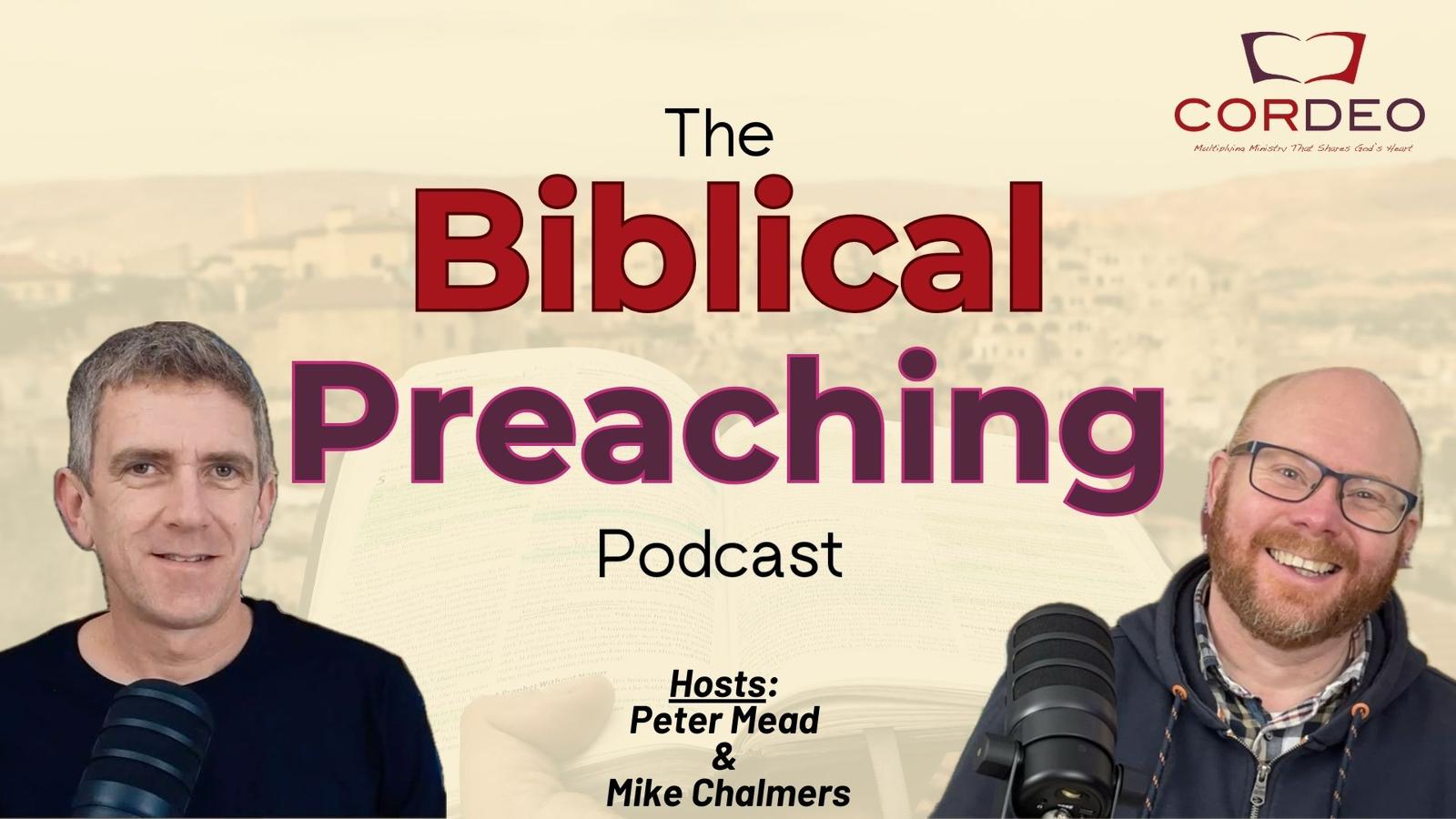
My Cor Deo colleague, Mike Chalmers, will join me as we discuss all things preaching. Together, we’ll explore this ministry’s joys, challenges, and complexities.

Here’s what you can expect:

  • Engaging Discussions: Insights into various aspects of biblical preaching.
  • Special Guests: We’ll feature some amazing voices from the world of preaching—our first guest joins us next week!
  • Encouragement for Preachers: Each full episode concludes with a segment designed to encourage those in preaching ministry.
  • Bitesize Episodes: Shorter episodes focusing on one specific aspect of preaching.
  • Related Blog Posts: From time to time, I’ll share blog posts that dive deeper into themes we discuss in an episode. These posts won’t be mere transcripts but will provide additional perspectives, practical tips, or reflections to help you take the conversation further.

Our hope and prayer for this podcast is simple: that it will strengthen and encourage biblical preaching in churches around the world. Where biblical preaching thrives, the church grows healthier, and healthy churches reach their communities.

We want this podcast to be a gathering point—a place where preachers can connect, reflect, and grow together. This is your conversation! We’ll celebrate the goodness of God, explore the transformative power of rightly handled Scripture, tackle the complex realities of ministry, and share the joy of seeing lives changed through the preached Word.


How to Listen & Connect:
🎙️ Listen to the Podcast on Your Favorite Platform:

📺 Watch Episodes on YouTube:
Subscribe to our channel for video versions of the podcast and exclusive content: YouTube Channel.

🖋️ Read the Blog
Continue to visit BiblicalPreaching.net for posts related to specific episodes, offering fresh insights and practical takeaways.


Can You Help Spread the Word?
We’d love your help in making this podcast a resource for as many people as possible! Here’s how you can support us:

  • Subscribe on your favorite podcast platform and/or to the YouTube channel.
  • Like and Comment to share your thoughts and join the conversation.
  • Follow Us for updates on new episodes and blog posts.
  • Share with your friends, fellow preachers, and anyone who might find this helpful.
  • Review the podcast on your favourite podcast platform – apparently, positive reviews are the most helpful thing!

Thank you for your prayers and support. We’re excited to see how God uses this podcast to encourage and equip preachers worldwide!

New Book Released in the USA

I am very pleased to announce that my new book, The New Birth, has now also been released in the USA.

If you would like a copy of the book and will see me in person during January/February, please ask. (I will be in Oregon, St Louis and Chicago.) To order the book from my affiliate link in the USA – click here. (To order the book from my affiliate link in the UK/Europe – click here.)

Thanks so much! I hope you enjoy the book! (Please comment on this post if you’ve read the book already, but I would also greatly appreciate any positive reviews on 10ofthose, Amazon, GoodReads, etc.)

Endorsements

“Peter Mead presents this essential doctrine in a way that warm, clear, rich, and readable. The book is accessible and engaging, and the addition of stories and reflection questions at the end of each chapter enables us to consider and imagine the way that the truth of the gospel can and should shape our lives. This is a lovely and helpful book—a great introduction to those new to or exploring faith, and a refreshing encouragement to those who have been Christians for a while.”

Ellidh Cook, Student Worker at All Souls Langham Place, London

“This tiny book conveys a huge reality: that Jesus came to raise spiritually dead people into abundant life! Peter Mead’s insights into the new birth that Jesus offers are both pastorally wise and profoundly helpful.”

Philip Miller, Senior Pastor, The Moody Church, Chicago

“When I became a Christian, I didn’t really grasp what had happened. It was an infinitely bigger deal than I realised-it was (and is) beyond my wildest dreams. Peter has given us an excellent primer into this huge adventure. This lovely, heart-warming book opens up the foundational truth of the new birth. As with the rest of the Essentials series, it is short and simple, yet full of deep and delightful teaching.”

Jonathan Thomas, pastor, author & broadcaster

“I found Peter Mead’s The New Birth contribution to the Essentials’ series most helpful, because it weaves together our story with the big story of Scripture through the lens of the work of the Holy Spirit. Taking as its anchor point Jesus’ encounter with Nicodemus, it wonderfully explains the theology and the felt experience of Christian conversion, and all along there are thrilling stories of how the Spirit transformed the likes of Spurgeon, Whitefield, C.S. Lewis, and modern men and women.”

Rico Tice, Co-Founder of Christianity Explored

We Must Not Lose Christ at Christmas

As Christmas approaches, plans are coming together—not only for family gatherings but also for church events.  Last year, our church put on a Christmas musical, which involved lots of cast, support crew, set building, costume making, songwriting, etc.  This year, we are keeping it simple with just a couple of carol services.  Whether we “go big” or “keep it simple,” there is one important ingredient that must not be forgotten.

It is so easy to have everyone frantically pulling together a Christmas production and then have nobody remembering to bring the baby for the manger.  In the same way, it is easy to be busy with Christmas plans, even Christmas preaching, and fail to keep the focus on the baby at the centre of the story.

If Jesus is forgotten for a nativity scene, then someone will be quickly despatched to go and pick up a baby doll before anyone notices.  But what happens if we lose Jesus from our Christmas, and even from our Christianity?

If the theme is Christmas, but Christ is missing, then there will be lots of peace on earth and goodwill to all men, but no basis for such a message of hope.  And if the focus is more general, then a Christianity without Jesus will descend into moral tirades and an attempt to police either church or society.  There can be no real Christianity without Christ.

And yet, it keeps on happening.  How often is the gospel presented as a moral and legal logical presentation?  “You have been bad, judgment is coming, God can help you get fixed, and there are some other benefits too…”  It might involve some presentation of truth, but the heart of the message is missing.

John Piper wrote these words in God is the Gospel:

“The critical question for our generation – and for every generation – is this: If you could have Heaven, with no sickness, and with all the friends you ever had on earth, and all the food you ever liked, and all the leisure activities you ever enjoyed, and all the natural beauties you ever saw, all the physical pleasures you ever tasted, and no human conflict or any natural disasters, could you be satisfied with Heaven, if Christ was not there?”

We have briefly considered Christmas, and Christianity in general, as well as our evangelism.  But what about on a personal level?  When Jesus is missing, we will tend to see God as distant and become increasingly self-focused.  This does not necessarily mean we will become rebellious and overtly sinful.  We might just become religious and self-righteous.  Whether in compliance or rebellion, we will become much more behavioural in our focus.

Without Jesus, we will start to see our Bibles as instruction manuals, more than God’s self-revelation.  For instance, in John 5, Jesus is rebuking the religious leaders for diligently studying their Bibles and yet missing him completely.  They would study and recite the Hebrew Scriptures, but they were blind to the self-revelation of God that should have had them excited at the arrival of Jesus.  Sadly, their study spectacles only allowed them to see the dazzling lights of self-glorification, and they missed the main focus of the Scriptures who now stood in front of them.

When we let Jesus drift out of the spotlight in our Christianity, we will lose that vital sense of the relationship with God that Jesus came to establish.  Instead of gazing on Jesus and being transformed (2 Corinthians 3:18), we will see only ourselves and drift toward self-glorifying, or self-loathing, or we will become self-appointed evaluators of others and start to inflict unhelpful pressure on others. 

There is a world of difference between Christianity with Jesus at the centre, and religion with me at the centre.  Actually, there is an eternity of difference.

As we come to another Christmas, let’s be sure to pause and allow our hearts to be wowed by the wonder of it all.  Charles Wesley’s hymn says this: “In vain the first-born seraph tries, to sound the depths of love divine!”  If angels are amazed, surely we should slow down and make sure we are too.  Can we ever fully grasp the wonder of Christmas?  Wesley’s words again, “Veiled in flesh, the godhead see, hail the incarnate deity, pleased as man with man to dwell, Jesus our Immanuel!”

Before the year is done, take a moment to stop and take stock.  Jesus has to be the centre of everything, not only at Christmas, but in all of Christianity.  He is much too precious to lose!

______________________________________________________

As we enter the month of December, click below for the advent series of videos in Pleased to Dwell – Peter’s book about the Incarnation . . .

The Echo of Easter

I recently imagined a global tour that could be called the “tour of the tombs.”  That might not sound too exciting, but it would include great cities in Europe, the Middle East, Africa, Asia, and North America!  Were we to travel that itinerary, we would see the burial sites of philosophers and Pharaohs, Kings and Emperors, religious leaders and mass murderers.  It would be quite the tour!  And along the way, we would get an inadvertent “tour of the troubles.”  After all, Europe, Asia, the Middle East, etc., are all marked by political protests, persecution, death, wars, and terrorism.  The world of today is not so different from the world of our history books.

In the first century, the events of one Sunday led to one of the greatest books ever written.  Imagine being John, possibly the youngest of Jesus’ disciples.  For three years, being with Jesus had transformed his life.  He was there when Jesus taught, healed, and shook the world.  John was there when Jesus was arrested and crucified.  He was there the day Jesus rose from the dead and met with his disciples.  John was there when Jesus met the group by the Sea of Galilee, when he uttered the Great Commission, and when he ascended into heaven.

The three years were over, but for the next six decades, John served his beloved Jesus.  He saw the gospel spreading in Jerusalem and the persecution that arose.  He saw his brother and the other disciples systematically slaughtered over the following decades.  He lived beyond the destruction of Jerusalem, the dispersion of the Jewish people, and the rise of nasty Emperor Domitian.  John lived for six decades serving Jesus.  And it was for preaching Jesus that John was sent to the penal colony of Patmos in his old age.

Then, one Sunday morning towards the end of the first century, John heard the voice of the risen Jesus (see Revelation 1:9-11).  The voice commissioned him to write everything he saw so that the Revelation of Jesus might be sent to the seven churches John cared about in Asia Minor.

If you look at the introduction to that book, the book of Revelation (1:1-8), you will find that John believed it to be a uniquely special book.  In a dark and troubling world, it offered grace and peace from the eternal God, especially the risen and victorious Son, Jesus Christ.  John underlined how Jesus revealed the Father, has risen from the dead, rules over the kings of the Earth, has rescued sinners from this world, and, in the future, will return.  The Revelation of Jesus Christ was exactly what the aged John needed.  It is what we need, too.

So what was it that John saw?  When we read through Revelation 1:12-20, how Jesus is portrayed is striking. 

The risen Jesus is impressively powerful.  He is impressively dressed, with a God-like description of his features.  There is the eternal wisdom seen in the white hair, the penetrating eyes, the judging feet and mouth, the thundering voice, and the brighter-than-the-sun face.  It might be really obvious, but this is no description of a corpse.  Jesus is very much alive and impressively powerful.  If we think of the tour of the troubles in this world, what hope do we find in the many tombs of emperors and kings?  None.  But one tomb is empty, and death has been defeated – Jesus holds the keys of death and Hades!  We all need to be gripped by the wondrous vision of Revelation 1.  But don’t skim through the description too quickly.  Jesus is not only impressively powerful, but he also explains the cryptic imagery of lampstands and stars that appear in that vision, leading us to reconsider all those powerful features.

The risen Jesus is intimately present. I wonder how many times John had remembered Jesus’ words, “I am with you always, to the end of the age.” (Matthew 28:20)  Surely, those words had meant a lot during the difficult days when the apostles were being killed, when the Middle East was being rearranged, when John’s ministry in Asia was being opposed, when persecution was rising, and when John suffered on the prison island, kept away from the people he loved.  Jesus had promised to be present, and he was.  And now, this entire book was pointed in the direction of those seven churches.  When John turned, he saw Jesus walking in the midst of the lampstands, that is, the churches.  Jesus was present with John and with the churches.

Specifically, Jesus wore the clothing of a high priest (Rev. 1:13).  We can surmise that he was praying for the churches.  His features point to the purifying work of this high priest (Rev. 1:14-15) – the penetrating eyes, the feet ready to stamp out sin, etc.  And his thunderous voice proclaims boldly to the church (Rev. 1:15-16).  It is interesting that this is no whisper, but like the sound of many waters pounding on the shore – it makes me wonder how many of those churches had closed their ears to the words of Christ by closing their Bibles.  How many churches today are doing the same?

Jesus is risen; he is alive.  The Easter truth transforms our experience of this troubled world.  And the vision described in Revelation 1 declares a vital message.  The risen Jesus is both impressively powerful, and intimately present in the church today.  We need not despair at what we see around us.  We can look back to the empty tomb.  We can look forward to the return of Christ.  And we can look up, knowing that our great High Priest is praying for us, purifying his church, and proclaiming his word to this day.  Easter echoes down through the years. He is risen.  He is alive.  He is powerful and present.

The Least Resolution for 2024

January does not just bring a new page on the calendar but a whole new calendar.  And with the new year, we tend to generate renewed commitments.  Maybe you have already determined what 2024 will mean for you.  Perhaps your mind has already pondered daily step counts, gym visits, dietary changes, or other healthy habits.  Or maybe you are thinking about Bible reading, daily prayer routines, or other spiritual goals.  May your resolutions last and bear good fruit!  But perhaps the resolution we need for 2024 is more foundational than healthy habits and more straightforward than spiritual practices.

As I write this, I am in Budapest, where I have just visited a museum of the political terror of the twentieth century.  As you can imagine, it is a sobering experience to see the vast walls of victims, the displays focused on the political prisoners, a room commemorating the persecution of the religious leaders, the torture chambers, the prison cells, and the gallows.  But perhaps the lingering memory for me will be the final room.  With red walls and hundreds of pictures, it felt like yet another presentation of victims.  But it was not.  It was a room of “victimizers” – ordinary people who were merely doing their job, simply following orders, just playing along, and thereby facilitating the evil machine.  We can remember the victims, and we must.  Yet we must also face the uncomfortable reality that most cogs in the cruel machine of death were ordinary people.

Fifty years ago, in February 1974, Alexander Solzhenitsyn was arrested in the Soviet Union and exiled to the West.  There, he was welcomed as a hero.  On the day of his arrest, he released a document entitled “Live Not by Lies.”  He knew the power of an ideology that sought to reshape society.  He also knew the power of individuals who simply refuse to lie (and the even greater power of a crowd joining together in this conviction).  He knew that the ideological system would totter and collapse when it ran up against the brick wall of reality, exemplified by many individuals refusing to play along with the evil fantasy.

Fifty years later, perhaps it is time for us to revisit this document.  Are we living in times where some, on behalf of all, have determined what society should look like?  Do we see a mounting pressure to conform with what ‘they say’ is acceptable human thought and belief? Indeed, we should not be so naïve as to assume that the absence of marching military on our streets means we face no ideological threat. 

The pressure is growing for everyone quietly to conform.  More than that, the pressure is growing to affirm openly and celebrate what we know to be false.  Surely, it would be better to speak the truth now instead of growing our tendency to fit in and play it safe as the stakes mount.

Truth and Lies – Choosing not to lie was not an original idea for Solzhenitsyn.  Paul urged the Colossians not to lie to one another.  Not only had they put off their old self, but they had put on the new self to reflect their creator’s image (Colossians 3:9-10).  He told the Ephesian believers to speak the truth to one another since they were no longer defined by the lie (Ephesians 4:25).

In the Sermon on the Mount, Jesus addresses the anger underneath murder, the lust underneath adultery, and the daily consistency of speech beneath more flamboyant oaths (Matthew 5:21-37).  There is plenty of Old Testament support for the expectation that God’s people should be consistent speakers of truth (Exodus 20:16; Leviticus 19:11; Proverbs 14:5).  God does not lie, and his people represent him.

Fear and Lies – Solzhenitsyn knew the impact of fear on a population.  He wrote of the great threat facing humanity in his day, which was “about to flare up and engulf us.”  And he described the fear: “While we continue to smile sheepishly and babble; ‘But what can we do to stop it? We haven’t the strength.’”

God asked Isaiah’s listeners, “Whom did you dread and fear, so that you lied, and did not remember me, did not lay it to heart?” (Isaiah 57:11).  Their fear led to lies, as they forgot who was really in charge.

Our world seems to be changing at a frightening rate.  Trying to keep up with the latest adjustments to sense and morality can be tiring.  And it is increasingly revealing how much fear lies within most of us, who are so prone to play along with society’s expectations rather than speak what is true.  It is concerning how easily we fear and perhaps lie while forgetting who is really in charge. 

Some will capitulate completely and speak what is false.  Others hide behind a cloak of not wanting to “sound political” and speak out about the reducing set of acceptable Christian declarations.  Fear of being labelled and criticized leads many to hold back from speaking the simple truth.  After all, it is much easier to quote a Bible verse on social media or avoid the hot topics in conversation rather than offer the most minor form of resistance.

Solzhenitsyn wrote that the fear his people felt was not primarily a fear of nuclear death or a third world war.  The fear was of taking a “civic stance.”  He wrote, “We hope only not to stray from the herd, not to set out on our own, and risk suddenly having to make do without the white bread, the hot water heater, a Moscow residency permit.”  The penalty for a civic stance may have changed, but the fear of the herd has not.

History has never smiled on the timid, and yet each fearful choice always makes sense at the time.  How often do I justify timidity when society needs me to show courage and speak the truth?  We have almost constant opportunities to speak the truth about marriage, gender, sexuality, race, free speech, bodily autonomy, science, medical ethics, corruption, or whatever other prescribed view is being pushed at any given moment.

We cannot simply wait for an ideology to fall apart.  We must be part of the brick wall of reality into which it must crash.  And yet, it is always easier to “continue to acknowledge, glorify, and strengthen” that which we want to see collapse.  At the very least, we must not “recoil from its most vulnerable point.  From lies.”

Violence and Lies – Solzhenitsyn described how violence bursts into peaceful situations with great self-assurance.  “But violence ages swiftly, a few years pass—and it is no longer sure of itself.  To prop itself up, to appear decent, it will without fail call forth its ally—Lies.  For violence has nothing to cover itself with but lies.”

So, even under overt tyranny, people do not have to experience violence at all times.  The demand is only of a “daily participation in deceit” – the tribute paid to maintain one’s position under the power of the oppressive system.  Just play along, it is safer.

The connection between violence and lies is also not a discovery made under the rule of twentieth-century totalitarianism.  Micah wrote to the city in his day, “Your rich men are full of violence, your inhabitants speak lies and their tongue is deceitful in their mouth” (Micah 6:12).

We may not have to stand and fight against violence.  We may not even have to step out publicly and boldly declare the truth. “But let us at least refuse to say what we do not think!”

The Consequences of No Lies – In the Soviet Union, there was a cost to this most simple of stands.  It could cost your job and complicate life.  It could cost your success in education and impoverish your future.  But Solzhenitsyn was clear:

“And as for him who lacks the courage to defend even his own soul: Let him not brag of his progressive views, boast of his status as an academician or a recognized artist, a distinguished citizen or general.  Let him say to himself plainly: I am cattle, I am a coward, I seek only warmth and to eat my fill.”

To choose not to lie was not an easy choice in his day.  It will increasingly not be an easy choice for social standing, or even for physical wellbeing, in our day.  But the choice not to lie is “the only one for the soul.”

The implication of no lies is worthy of note. “The more of us set out together, the thicker our ranks, the easier and shorter will this path be for us all!  If we become thousands—they will not cope, they will be unable to touch us.  If we will grow to tens of thousands—we will not recognize our country!”

As we head into a new year, may we not simply play along with the world.  Instead, let us graciously, prayerfully, and wisely determine that whatever else may happen, we will not participate in the lies expected of us in society.  As representatives of God in this world, this is the least we must do!

(Source of AS quotes: https://www.solzhenitsyncenter.org/live-not-by-lies)

What’s the Big Deal with Worship?

What does gathered worship do?  Sometimes it can make our souls soar.  Other times not so much.  It is easy to understand why non-believers scratch their heads at Christian worship.  If I saw a small group of people awkwardly singing, listening to someone talk about an old book, and sharing a tiny amount of bread and wine, I’d scratch my head too.

As I anticipate returning to Poland for the European Leadership Forum, I am reminded of the sacrifices made by so many during the Communist era.  Russian Baptist pastor, Yuri Sipko, remembers Christians who were sent to prison camps or lost their jobs or their children. “Without being willing to suffer, even die for Christ, it’s just hypocrisy.  It’s just a search for comfort.”  Challenging words, but ponder this thought: “You need to confess him and worship him in such a way that people can see this world is a lie.”

What does gathered worship do?  It declares that this world is a lie.

At the end of Revelation 3, we find that famous verse about Jesus standing at the door and knocking.  He was knocking on the door of the church at Laodicea, but would they open the door and let him in?  They thought they had everything they needed, but actually, they desperately needed Jesus.  As we turn to chapter 4 and John’s great vision from Jesus continues, we find the heavenly door is open for John to come up and participate in the ultimate worship gathering.

In Revelation chapters 4-5, we get to glimpse the ultimate worship gathering, and it reminds us what gathered worship does.  Here are five things that gathered worship does:

1. Worship centres us around God’s throne. (4:1-2)  In worship, we are invited, by Jesus, to gather at the throne of God.  In Eugene Peterson’s Reversed Thunder, he points out how we live in a world that feels like a storm-tossed sea.  We are thrown all over the place by every wind, every wave, every advert, every news story, every problem, and every threat.  But as Christians, we have an anchor that holds us firm, gives us a circumference, and centres us.  God is on the throne, so there can be a constant source of stability in my heart and life. Gathering with God’s people to sing his praise is an anchor point in the frenetic chaos of life.

2. Worship gathers God’s people around his throne. (4:3-11)  In this glorious vision, there is layer upon layer of rich meaning.  The vibrant colours seem to reflect God’s holiness and justice, as well as his life-giving nature as the Creator.  The 24 elders probably represent the twelve tribes of Israel and the twelve apostles of the Church (there is debate on all these details, of course).  Perhaps they represent God’s great work through the centuries to reveal his plan and rescue people for himself.  Then there are the four living creatures – a picture of God’s creation (noble, strong, wise, and swift), and some have seen here four glimpses into the person of Jesus Christ.  God’s people, God’s creation, all falling down and worshipping God on the throne.  In worship, we are united together, not only with one another but also with God himself, in the uniquely trinitarian worship we find in the Bible.

3. Worship points us to Christ and his payment. (5:1-7) At the start of chapter 5, John is struck by the disconnect between God’s greatness and the need of humanity.  The sealed scroll, Earth’s title deed, God’s plan of judgment – its existence underlines that no human is worthy to open the seals.  Even apart from the judgment context of Revelation, our gathered worship cannot be satisfied with just lauding God the Creator for his power and majesty.  Christian worship always points us to Christ and his payment.  John turned to see the Lion of the Tribe of Judah and was confronted by the slain Lamb.

4. The Lion/Lamb Redeemer stirs greater songs of worship. (5:8-13)  When God’s people encounter God’s goodness and grace, they sing.  Moses, Miriam, Deborah, David, Mary, Angels, Jesus and the Disciples, Paul and Silas – they all sang.  When we become aware of who he is and what he has done, then we will sing too.  In chapter four, there were two songs to the Creator (4:8, 4:11).  Now the singing swells as more voices join in and more richness is reflected in two songs to the Redeemer (5:9-10, 5:12).  Finally, there is one song to both the Creator and the Redeemer combined (5:13).

5. Worship finishes with a great Amen! – the ultimate reality of God’s person and plan is definitively affirmed!  (5:14)  If you think about it, we humans have a history of saying no to God.  We are all quite adept at saying no.  But Revelation 4-5 underlines that in the end God’s great yes will overcome every one of our noes.  In worship, we are confronted by the reality of God the Creator King on his throne, and of God the Redeeming Lion/Lamb, and we cry out, “Yes!”  When we worship together, we get a pre-taste of what is to come.  “Your kingdom come, your will be done, on earth as it is in heaven.”  Gathered worship is like an anchor to both the future, when all our questions will be answered, and to the ultimate reality in the present – that God is on the throne and he has redeemed us.

So what does gathered worship do?  It declares that this world is a lie.  More than that, it centres us around the throne of God – for God is on the throne whatever we may be facing down here.  It gathers God’s people around his throne – for God is worthy of every note of praise that can be uttered by any part of his creation.  It points us to Christ and his payment – for we worship not only in response to the majesty on the throne but also to the scars on that Lamb.  It stirs us to sing greater songs of worship – for God the Creator and our Lion/Lamb Redeemer.  It definitively affirms the ultimate reality of God’s person and plan – for in the end we will cry out our great “Yes!” and “Amen!” to God.

Whether we are gathering in a great crowd at a Christian event, or with a handful of dear saints on a Sunday, let us appreciate the privilege of gathered worship and declare with joy that this world is a lie.

_________________________________

Sipko quote from Live Not By Lies, by Rod Dreher, p185-6.

______________________________________________