Confidence for the Storms (Psalm 27)

During a storm in life, people often look back to the calm moments before everything turned chaotic.  It is strange to look back on a moment of tranquility when you had no idea what was about to take place.  Psalm 27 reflects that experience.  In the first half of the Psalm, David appears to be filled with faith and peace.  Then, in the second half, there is more than a hint of fear in his words.  Where other psalms begin with fear and end with faith, this psalm seems to reverse that pattern.

However, it may be helpful to see the psalm differently, not as part 1 followed by part 2, but as an outer layer and an inner layer.  In the outer layer, David seems gripped by the reality of God’s greatness.  He knows that God is greater than any enemy.  He has seen it in the past, and he has confidence for the future.  “The LORD is my light and my salvation; whom shall I fear?” (v 1)

He begins the psalm stating that God is the refuge of his heart (translated “life”), and his heart will not fear, even in the face of enemies, armies, and wars!  (Psalm 27:1-3)  Then at the conclusion of the psalm, he declares confidence in his future experience of the goodness of God and calls on others to strengthen their hearts by waiting for the LORD.  (Psalm 27:13-14)

We live in tumultuous times.  Whether we are in an active war zone or not, it seems that most of us are living in countries where tensions are running high.  How can we have confidence in the Lord, strengthening our hearts as we wait for Him?  Perhaps it is not enough to know that our God is bigger than our enemies, although that is undoubtedly true. Perhaps we should examine what happens in the inner layer of this psalm.

In verse 4, David describes his devotional determination to dwell in the house of the LORD and gaze upon the beauty of the LORD.  It is in the security of God’s presence that he can get to know God for who He is.  To be close to God is to be hidden in God’s shelter, concealed in His tent, lifted on a rock.  The word translated as “shelter” carries the sense of a lion’s lair.  Is there anywhere safer, presuming the Lion is good and is for you?

The secret to confidence in God is to meet God in the secret place.  To gaze upon Him.  To know Him.  Jonathan Edwards wrote of Christ that He “has infinite loveliness to win and draw our love.”  He went on to say that the angels in heaven, who can look on His face all the time, have never run out of reason to praise Him, even to this day.  How lovely He must be!  And so it is that we too can draw near to God in the person of Christ, and day after day, gaze upon the face of our God. 

In fact, in troubled and tumultuous times, our people need us to do just that.  If we are going to lead our families, our ministries, our churches, then we need to be spending time hiding in God’s presence, gazing on and getting to know the “light of the knowledge of the glory of God in the face of Jesus Christ.” (2 Corinthians 4:6)

Not only does David declare that he will seek God’s face, but God invites him to do so.  It is a bit like playing hide and seek with a small child.  Hide and seek is a classic children’s game.  One person counts to 100, while the other players hide.  Then the seeker goes hunting for the hidden.  It can be frustrating if the players are too creative.  But when you play the game with a toddler, it can be so much fun.  They want to be found!  All you need to do is say out loud what you are thinking, “I am thinking she might be behind the armchair?”  And a little voice will giggle behind the curtain.  “Is she behind the television?”  And a little voice will say, “No!”  It is all about the moment of discovery, the unbridled joy when two faces meet.

“Seek my face,” God says.  And as leaders of God’s people, may the cry of our hearts be, “Your face, O LORD, do I seek.”  We need to gaze on the beauty of His character to have confidence in His strength.  The greatest one is for us, so let’s not hold back.  Draw near, gaze, and grow in confidence.  Fearful times will come, but faith-filled leaders will emerge from God’s presence confident and ready.

_______________________________________________________________________

Imitate Who?

There are some strange stories of people imitating other people.  For instance, in 1951, the Canadian Naval Ship the Cayuga was engaged in the Korean War.  It took onboard three Korean fighters who needed immediate surgery.  The ship’s surgeon, Dr Joseph Cyr, went ahead and removed a bullet from the chest of one man, amputated the foot of another, etc.  He performed sixteen operations onboard and surgeries on shore in Korea.  But that man was not Dr Joseph Cyr.  With no training in surgery, Fred Demara had “borrowed” Cyr’s credentials to get into the Canadian Navy.  He had also imitated his way into being a Psychology Professor, a university administrator, a prison warden, and a Trappist monk.  It truly is a bizarre story.

And yet, perhaps it is even more bizarre that the Apostle Paul instructed the Ephesian believers to “be imitators of God” (See Ephesians 5:1).  There are a handful of places where believers are urged to imitate Paul or even to imitate Christ (e.g. 1 Corinthians 11:1).  Still, the instruction to “imitate God” is unique to this verse.  Let’s probe Paul’s point.

What is Paul’s instruction?  “Therefore, be imitators of God” (Ephesians 5:1).  Paul is not suggesting that we pretend to be God or that we in any way usurp God’s position.  For humans to invite worship, to function as if they are the central character in the universe, or to give the impression of being all-knowing, and so on, would be spiritual treason.  God is God, and I am not. 

On the other hand, we are very much expected to reflect the good character of God in every area of life.  For instance, in the verses before and after Ephesians 5:1, we see instruction as honest, gracious, self-controlled, generous, kind, forgiving, loving, self-sacrificing, holy, and pure – all beautiful aspects of God’s perfections.  (See Ephesians 4:25-5:4).

It would be fair to say that whatever is good about God’s character would be good to emulate and imitate, as long as we never blur the Creator and creature distinction.  It would also be fair to notice that since the Fall of Genesis 3, humans have been much more inclined to get these categories reversed.  How many people act as if they are the centre of the universe, worthy of worship, all-knowing, and in control, but lack the kind of goodness we have just described?  The Fall absolutely messed us up!

Why should we imitate God?  Because we are “children” (Ephesians 5:1).  Whether it is fair or not, people observe children and evaluate the parents.  Sometimes, a critical evaluation may be justified; other times, an outsider will have no idea of how much the parent is achieving considering the child’s circumstances.  For those of us who are parents, we know how much we feel the watching eyes of others, so we hope our children will behave well in public situations. 

As unfair as it may feel to us to have people evaluating us based on our children, how much more unfair is that for God?  Imagine having your reputation and perception determined by representatives like you and me.  After all, we are all flawed and broken people.  Image bearers of God, of course, but so far from divine perfection!

And yet, the watching continues.  People who never think about theological matters are watching you and me and assuming things about our God.  This watching is not only from those outside the church but also from inside.  Believers watch and learn from one another.  I can think of people I have watched and from whom I learned something of God’s forgiveness, or God’s generosity, or God’s humility, or God’s redemptive power.  The church is a living theological case study!

But how can we imitate God?  The idea that we can and should imitate God’s character can feel overwhelming.  How is it possible?  Are we supposed to self-generate a super-human effort and achieve the impossible by sheer willpower?  Notice the other word in the verse: “as beloved children” (Ephesians 5:1).  This imitation instruction is not based on the burden of striving effort.  Instead, it is to be fueled by the joy of a loving relationship.  Being saved and brought into God’s family means we are beloved children.

The word “beloved” makes it clear that we are not “tolerated” children, or “technically” children, or even “one of millions of children.”  The word “beloved” gives a sense of the lavishing of all the parental love poured out on a uniquely favoured, even an only, child.   More significantly, it is the same idea used of God’s unique Son, Jesus.  Remember the baptism declaration, “This is my beloved Son, with whom I am well pleased!” (Matthew 3:17).

There are multiple layers in the idea of being a child of God.  Just as we have three types of paternity tests used among humans, the same idea works for us as believers.  There is the legal reality of being lovingly adopted into God’s family (e.g. Ephesians 1:5-6).  An adopted child has the paper evidence of the adoption certificate.  Then there is the DNA test proving something of a parent in a child.  For believers, we have the Spirit of God living within us (e.g. Ephesians 1:13-14).  And thirdly, there is the resemblance test.  When we see a baby, some people will immediately pronounce that the baby has his father’s nose, eyes, or whatever.  That is the DNA showing through immediately.  But Ephesians 5:1 is calling us to a more developed character likeness.  Just as a child in a loving relationship will grow to resemble the character of the loving parent, so it can be with us.

As we seek to lead other believers into greater God-likeness, we would do well to pause and reflect on this one word.  Do I believe I am “beloved” of God?  It is easy to say it, but then live as if I am merely tolerated.  And yet, what rocket fuel for transformation there is in being loved by God, even as He loves the Son (see John 17:23, for instance). 

In response to Ephesians 5:1, let us pray a simple prayer that has massive implications in our lives and those we influence.  “My loving Father, what do you want to work on in me so I may look more like you?”

___________________________________________________

The Biblical Preaching Podcast is your conversation about preaching that shares God’s heart! Please find us on Spotify, Apple Podcasts, other podcast directories, and on YouTube. We would love to have your help in spreading the word – thank you in advance for every like, comment, share, follow and positive review!

Is Our View of Satan Too Small?

I have noticed something strange.  Many Christians will acknowledge the existence and the general agenda of Satan.  They will affirm that he is alive and active on planet Earth.  Yes, they recognize that he hates God and God’s people.  Yes, he hates truth and wants to steal, kill and destroy.  Yes, he wants to tempt us into rebellion, crush us under guilt, and destroy all that is good, beautiful and anything that has even the faintest reflection of God’s character. 

And yet, oddly, as quickly as those affirmations are made, that awareness seems to evaporate just as quickly.  For many Christians, the devil appears to be a very limited antagonist.  He might get some vague credit (for want of a better term) for any temptation we consciously notice. Still, he gets specific credit for very little activity. 

For example, suppose the subject of the occult is raised with the related concepts of devil worship, seances, fortune telling, etc. Many will shudder and point to the enemy’s works in that case.  But is that the whole story?  Is Satan just tempting us as individuals and running a relatively obscure dark religious operation? 

Let’s take a few moments to review some essential biblical background. 

Origins of Satan – The name Satan means adversary and came to be applied to the greatest adversary of all – the devil.  It is a well-earned label!

What we know of his origins is described primarily in Ezekiel 28:11-19, where it is clear that prideful arrogance was the key driver of his original fall from perfection.  Since his fall, his primary domain has been Earth and Sheol.  We see him cursed by God in Genesis 3 – the one whose goal was to be the most high became the most low, eating dirt close to the underworld.

Influence in the world – The big question in this post essentially relates to his influence.  According to 1 John 5:19, the whole world is under the control of the evil one.  He is called the ‘prince of this world’ on several occasions (John 12:31; 14:30; 16:11).  He influences through lies, especially the original lie that we humans can be like God, and he masquerades as an angel of light, deceiving people (John 8:44; 2 Corinthians 11:14).  There are plenty of people whose spiritual father is the devil, and it is possible to identify them by their actions and their lack of love (John 8:44; Matthew 13:36-40; Acts 13:10; Ephesians 2:2; 1 John 3:10)

Influence over nations – He rules the nations and tried to strike a deal with Jesus in exchange for Jesus bowing down to him. Still, Jesus did not affirm his ultimate ownership of the nations and did not bow down.  Jesus knew and trusted that, at the right time, the Father would give the nations to him.  (See Matthew 4:10.)  Jesus confronted the power of evil by casting out demons from people. It is evident that Satan commands the realms of darkness (see 1 John 3:8).  What Jesus began in his ministry, he is continuing – building his church and the “gates of hell” continue to be unable to resist the onslaught.  Satan is on the defensive. 

Influence in the Church – Paul wrote to the Romans, “The God of peace will soon crush Satan under your feet.” (Romans 16:20). Yet, it would be naïve to assume that Satan does not influence the church.  While our minds might go to Judas Iscariot, whom Satan influenced (John 13:2) and then entered (John 13:27), we do not need to live in fear of being taken over by the evil one.  We belong to God, who is greater than the one who is in the world (1 John 4:4).  However, we should recognize that discord, anger, unforgiveness and resentment can provide an opportunity to the devil, and we should actively resist him (James 4:7; 1 Peter 5:8-9).

Our hope as the spiritual war rages – Because of Jesus’ victory over the rulers and authorities on the cross (see Colossians 2:13-15), Satan’s power of death is now broken (see Hebrews 2:14-15).  We now know that death is swallowed up in victory (1 Corinthians 15:54).  And yet, the one who comes only to steal and kill and destroy does not give up easily (John 10:10).  His ultimate downfall is already determined; he will be thrown into the lake of fire (Revelation 20:10).  In the meantime, he fights on.  Indeed, as his time gets short, we might expect him to offer a big final push, but we know the end of the story.

The hole in our spiritual warfare – So, what is missing in our understanding of the spiritual battle that we are in?  Satan exists and is active on earth.  Yes, he does tempt us and would delight to see us derailed by sin and defiled by discord.  And yes, the occult does exist, and some people are drawn into religious acts of pure evil.  But at the start of this post, I suggested our view of Satan may be too small.  Is Satan just tempting us as individuals and running a relatively obscure dark religious operation? 

To be candid, I have been struck by how much we are inclined to bury our heads in the sand regarding evil in this world. “Oh yes,” people will affirm, “Satan is real, and we are in a spiritual battle.” But mention some specific aspects of society and watch the response change:

Could there be evil at work in news reporting designed to shape our thinking? “No way, we can trust the news media.” 

Might the enemy be shaping education to harm children?

Don’t be ridiculous!”

What about medical professionals who seem driven by something other than ‘first do no harm?’

“Of course not! The doctors I know are good people.”  

What about government decisions that seem to benefit them but harm people and cost lives?

Absolutely not!  They have our best interests at heart.” 

What about unelected and unaccountable groups of the hyper-rich and influential seeking to gain control over ordinary people?

If such groups exist, then I’m sure they mean well.”

What about influential people who have publicly declared the global population needs to be reduced by whatever means?

Of course not; they only want to help the poor!”

What about the entertainment industry that so fills our consciousness?

Oh, but I like him, she’s my favourite, etc.”

It does not mean much to acknowledge that Satan is real and active if we then immediately deny that he could be at work in almost every layer of human authority and influence.  And I would suggest we are utterly naïve if we don’t believe that the prevailing paradigm of our day, with its “lofty opinion raised against the knowledge of God”, is influenced by Satan.  (See 2 Corinthians 10:3-6) 

In the past, Christians seemed ready to recognize the malevolence of hedonism or materialism as it confronted our worldview in the so-called “Christian West” or the evils of totalitarian regimes in the East.  But today, too many Christians seem happy to play along with and believe the best about media-driven narratives concerning identity politics, critical theories, social justice, weather worship, globalist agendas, neo-communist ideologies, uncontrolled immigration and encroaching violent religion.  Are we sure that we should ‘believe the best’ and ‘affirm the good’ in all the ideas swirling around and in all the layers of authority setting themselves up over us?

Perhaps it is time for us to fix our eyes on Jesus and recognize that we are genuine outsiders in this world and that we will be hated by it. And yet we are here as ambassadors to represent God’s truth, to share the hope of Jesus, to stand for what is right and to not love our lives even unto death. Let’s stop smiling at the devil as if he is an insignificant foe.  Let us instead armour up, stand firm, be ready to speak, be prayerful as if we are in a war (for we are), and when we have done everything we can, to stand.

(HT – https://www.logos.com/grow/satan-in-the-bible/ )

The Least Resolution for 2024

January does not just bring a new page on the calendar but a whole new calendar.  And with the new year, we tend to generate renewed commitments.  Maybe you have already determined what 2024 will mean for you.  Perhaps your mind has already pondered daily step counts, gym visits, dietary changes, or other healthy habits.  Or maybe you are thinking about Bible reading, daily prayer routines, or other spiritual goals.  May your resolutions last and bear good fruit!  But perhaps the resolution we need for 2024 is more foundational than healthy habits and more straightforward than spiritual practices.

As I write this, I am in Budapest, where I have just visited a museum of the political terror of the twentieth century.  As you can imagine, it is a sobering experience to see the vast walls of victims, the displays focused on the political prisoners, a room commemorating the persecution of the religious leaders, the torture chambers, the prison cells, and the gallows.  But perhaps the lingering memory for me will be the final room.  With red walls and hundreds of pictures, it felt like yet another presentation of victims.  But it was not.  It was a room of “victimizers” – ordinary people who were merely doing their job, simply following orders, just playing along, and thereby facilitating the evil machine.  We can remember the victims, and we must.  Yet we must also face the uncomfortable reality that most cogs in the cruel machine of death were ordinary people.

Fifty years ago, in February 1974, Alexander Solzhenitsyn was arrested in the Soviet Union and exiled to the West.  There, he was welcomed as a hero.  On the day of his arrest, he released a document entitled “Live Not by Lies.”  He knew the power of an ideology that sought to reshape society.  He also knew the power of individuals who simply refuse to lie (and the even greater power of a crowd joining together in this conviction).  He knew that the ideological system would totter and collapse when it ran up against the brick wall of reality, exemplified by many individuals refusing to play along with the evil fantasy.
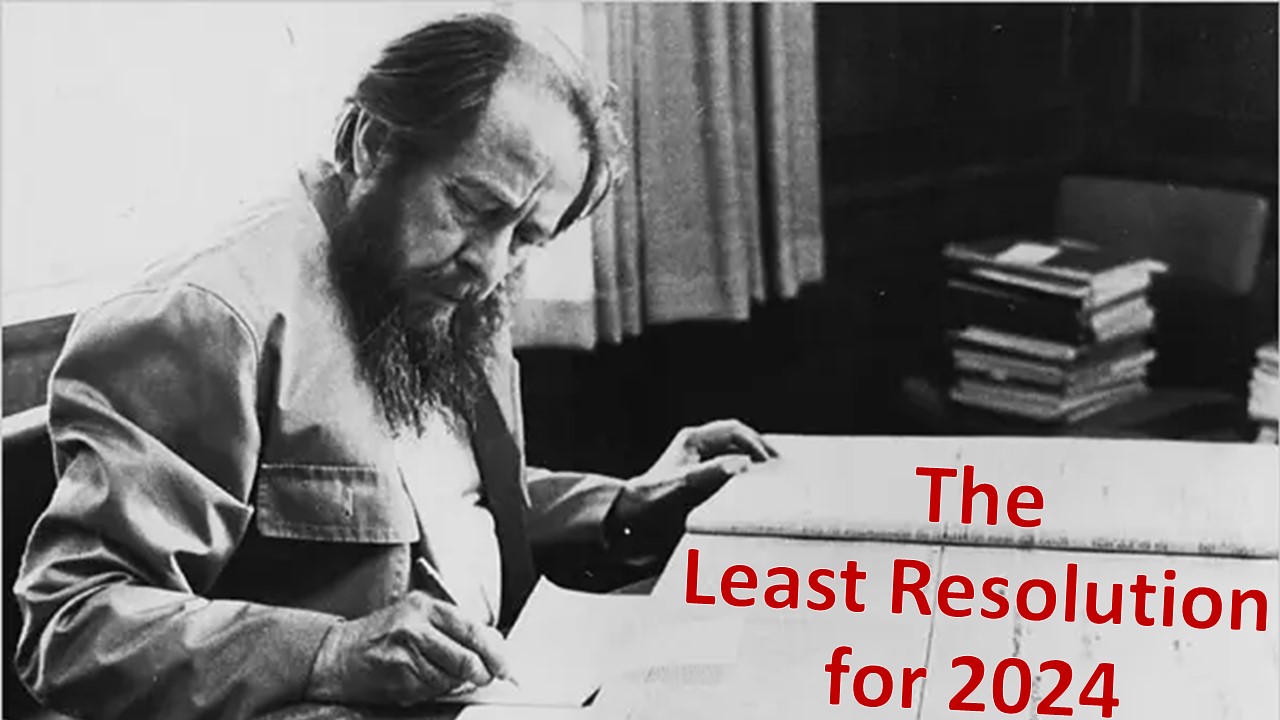
Fifty years later, perhaps it is time for us to revisit this document.  Are we living in times where some, on behalf of all, have determined what society should look like?  Do we see a mounting pressure to conform with what ‘they say’ is acceptable human thought and belief? Indeed, we should not be so naïve as to assume that the absence of marching military on our streets means we face no ideological threat. 

The pressure is growing for everyone quietly to conform.  More than that, the pressure is growing to affirm openly and celebrate what we know to be false.  Surely, it would be better to speak the truth now instead of growing our tendency to fit in and play it safe as the stakes mount.

Truth and Lies – Choosing not to lie was not an original idea for Solzhenitsyn.  Paul urged the Colossians not to lie to one another.  Not only had they put off their old self, but they had put on the new self to reflect their creator’s image (Colossians 3:9-10).  He told the Ephesian believers to speak the truth to one another since they were no longer defined by the lie (Ephesians 4:25).

In the Sermon on the Mount, Jesus addresses the anger underneath murder, the lust underneath adultery, and the daily consistency of speech beneath more flamboyant oaths (Matthew 5:21-37).  There is plenty of Old Testament support for the expectation that God’s people should be consistent speakers of truth (Exodus 20:16; Leviticus 19:11; Proverbs 14:5).  God does not lie, and his people represent him.

Fear and Lies – Solzhenitsyn knew the impact of fear on a population.  He wrote of the great threat facing humanity in his day, which was “about to flare up and engulf us.”  And he described the fear: “While we continue to smile sheepishly and babble; ‘But what can we do to stop it? We haven’t the strength.’”

God asked Isaiah’s listeners, “Whom did you dread and fear, so that you lied, and did not remember me, did not lay it to heart?” (Isaiah 57:11).  Their fear led to lies, as they forgot who was really in charge.

Our world seems to be changing at a frightening rate.  Trying to keep up with the latest adjustments to sense and morality can be tiring.  And it is increasingly revealing how much fear lies within most of us, who are so prone to play along with society’s expectations rather than speak what is true.  It is concerning how easily we fear and perhaps lie while forgetting who is really in charge. 

Some will capitulate completely and speak what is false.  Others hide behind a cloak of not wanting to “sound political” and speak out about the reducing set of acceptable Christian declarations.  Fear of being labelled and criticized leads many to hold back from speaking the simple truth.  After all, it is much easier to quote a Bible verse on social media or avoid the hot topics in conversation rather than offer the most minor form of resistance.

Solzhenitsyn wrote that the fear his people felt was not primarily a fear of nuclear death or a third world war.  The fear was of taking a “civic stance.”  He wrote, “We hope only not to stray from the herd, not to set out on our own, and risk suddenly having to make do without the white bread, the hot water heater, a Moscow residency permit.”  The penalty for a civic stance may have changed, but the fear of the herd has not.

History has never smiled on the timid, and yet each fearful choice always makes sense at the time.  How often do I justify timidity when society needs me to show courage and speak the truth?  We have almost constant opportunities to speak the truth about marriage, gender, sexuality, race, free speech, bodily autonomy, science, medical ethics, corruption, or whatever other prescribed view is being pushed at any given moment.

We cannot simply wait for an ideology to fall apart.  We must be part of the brick wall of reality into which it must crash.  And yet, it is always easier to “continue to acknowledge, glorify, and strengthen” that which we want to see collapse.  At the very least, we must not “recoil from its most vulnerable point.  From lies.”

Violence and Lies – Solzhenitsyn described how violence bursts into peaceful situations with great self-assurance.  “But violence ages swiftly, a few years pass—and it is no longer sure of itself.  To prop itself up, to appear decent, it will without fail call forth its ally—Lies.  For violence has nothing to cover itself with but lies.”

So, even under overt tyranny, people do not have to experience violence at all times.  The demand is only of a “daily participation in deceit” – the tribute paid to maintain one’s position under the power of the oppressive system.  Just play along, it is safer.

The connection between violence and lies is also not a discovery made under the rule of twentieth-century totalitarianism.  Micah wrote to the city in his day, “Your rich men are full of violence, your inhabitants speak lies and their tongue is deceitful in their mouth” (Micah 6:12).

We may not have to stand and fight against violence.  We may not even have to step out publicly and boldly declare the truth. “But let us at least refuse to say what we do not think!”

The Consequences of No Lies – In the Soviet Union, there was a cost to this most simple of stands.  It could cost your job and complicate life.  It could cost your success in education and impoverish your future.  But Solzhenitsyn was clear:

“And as for him who lacks the courage to defend even his own soul: Let him not brag of his progressive views, boast of his status as an academician or a recognized artist, a distinguished citizen or general.  Let him say to himself plainly: I am cattle, I am a coward, I seek only warmth and to eat my fill.”

To choose not to lie was not an easy choice in his day.  It will increasingly not be an easy choice for social standing, or even for physical wellbeing, in our day.  But the choice not to lie is “the only one for the soul.”

The implication of no lies is worthy of note. “The more of us set out together, the thicker our ranks, the easier and shorter will this path be for us all!  If we become thousands—they will not cope, they will be unable to touch us.  If we will grow to tens of thousands—we will not recognize our country!”

As we head into a new year, may we not simply play along with the world.  Instead, let us graciously, prayerfully, and wisely determine that whatever else may happen, we will not participate in the lies expected of us in society.  As representatives of God in this world, this is the least we must do!

(Source of AS quotes: https://www.solzhenitsyncenter.org/live-not-by-lies)
Enjoying the Word – Introduction

New year and new project! Last year I enjoyed working through the book of Psalms on YouTube.  I hope those videos will be useful to more people this year as people choose to use them as companions in a journey through the Psalms.  And now we are into a new year and a new project: Enjoying the Word.

Enjoying the Word will be a growing collection of videos that will hopefully help people to enjoy reading and studying the Bible.  The first part of the sermon preparation process is the privilege of every believer – to spend time in God’s Word so that it gets into us and changes us.

The plan is to release short videos related to Bible reading and Bible study.  I will share a simple process to think through the Bible study journey.  I plan to release more mini-series called Pursuing God’s Heart Yourself. These short series use a single Bible book or section to illustrate important principles of biblical interpretation.  And I may work through a Bible book or two from start to finish to show the workings of healthy Bible study. 

I hope this will be helpful to you and to others you know.  Please do let me know if you have questions or ideas for videos.  And please share the resources with others too!  As videos are liked and shared, and as more people subscribe to the channel, so these videos will get in front of more people. (You can click here to subscribe to the YouTube channel.)

I am also planning to write companion posts on this blog to point to individual videos or mini-series of videos.  The subjects we will cover in the videos perfectly fit this blog, so why not?

The introductory video includes a quick look at a fantastic biblical truth!

Feeling Flat?

When the Covid-19 crisis rolled across Europe in March, everything changed.  Maybe you found the experience overwhelming, or challenging, or perhaps even invigorating.  Somehow, when crisis hits and our adrenaline surges, we tend to lean on the Lord and find ways through the situation.  But after adrenaline there is always a settling period, when it is the most normal thing in the world to feel emotionally flat.  Maybe by now you have arrived there too?

Two Types of Feeling Flat

When we feel flat we tend to have lowered motivation and energy.  We may be doing less, but somehow feeling more tired.  We feel a loss of creativity and initiative.  Flatness is not a new feeling, but having so many of us experience it at the same time is slightly unusual.

“I’m feeling flat” is something I’ve heard a lot recently.  But there is another type of flatness that is perhaps more concerning.  It is the unconscious flatness that we don’t tend to recognize in ourselves – we don’t spot it in the mirror.

Unconscious flatness could be called spiritual coasting.  Coasting is where you disengage the motor of the car you are driving and allow past momentum and present circumstances to roll the car forwards.  This kind of driving is dangerous.  It changes the braking and steering in the car, but perhaps most concerning is that it can give a false sense of security.  After all, the engine noise reduces and the car keeps moving forwards.

We need to respond when we are feeling flat, especially when we become aware of this unconscious flatness, or spiritual coasting.

Responding to Feeling Flat

The typical human response to feeling flat will not be spiritually healthy.  We may default to distraction, to self-recrimination, or to laziness.  That is, we can fill the void with busy work, new pursuits, or entertainment.  We can beat ourselves up with the “I need to try harder!” kind of self-coaching.  Or we can settle into our flat state and get comfortable.  Typical human responses will tend to be self-oriented and spiritually unhealthy.

What should we do when we understandably feel flat or discover we have drifted into a state of flatness?  Our emotions are great indicators of deeper realities in our hearts, and they should be prompts to connect relationally – with others, and with God.

When we feel flat, we tend to pull back from others.  Living through a pandemic only reinforces that possibility – it is a government-mandated withdrawal!  But spiritually we need to connect and fellowship with our brothers and sisters in whatever way we can (even if that means using Zoom!)

Most of all, we need to re-connect with Christ.  We need to spend time with Him, because only Christ can invigorate our hearts and stir life in us.  And yet our default fleshly response will be to pull in the opposite direction.

Let me share one thing about Christ that may encourage you to bring your tired and emotionally flat heart to Him in these days.  I want to point to two passages and focus particularly on what they teach about how Christ cares for the weak and vulnerable.  Does going to Christ mean accessing the ultimate personal trainer who can shout the loudest?  Not at all.

Motivation for Connection

Isaiah 42:1-4 is the first of Isaiah’s famous “Servant songs.”  At first glance it could look intimidating.  After all, three times it declares that this servant of the LORD will establish justice on the earth.  Surely one who is tough on crime will be overwhelmingly powerful and intimidating?  But not so.  Verse 2 tells us that he is not full of himself, nor does he demand everyone’s attention.  And verse 3 describes his way of dealing with the weak:

                         “a bruised reed he will not break,

                                         And a faintly burning wick he will not quench.”

That is the kind of God that motivates me to lift a bruised and tired heart up toward him.  Feeling flat?  Connect with the only one who can be fully trusted with your heart.

That truth is painted in narrative colour in John 21.  The adrenaline of the first Easter has faded and seven of the disciples are back in Galilee, heading out to fish for the night.  Whatever their motivation, I am sure that part of the issue was that they felt flat.  Read the chapter and watch Jesus care for them.  He could have criticized, shouted, corrected, berated, or chastised them.  He didn’t.

Instead, Jesus gently reminds them of their calling to ministry by miraculously filling their nets with fish, again.  He gently reminds them that he will continue to provide for them by lovingly preparing a barbecued breakfast, a God-given meal of fish and bread, again.  He gently re-established Peter’s position within the group by re-affirming his shepherding role.  In this chapter he reminds them of their calling to evangelism and edification ministries, he reminds them of his ability to continue to provide for them, and he even grants Peter his desire to die for Jesus – only this time with a 30+ year warning.  The content of his teaching is powerful and challenging, but his manner is gentle and tender.

This is the kind of God that can motivate us to lift our flattened hearts up toward him.  Dare to connect with the only one who can be fully trusted with your heart.

_________________________________________________________

I have recently been adding highlights from John’s Gospel to my YouTube channel:

God’s Great Story and You – Part 4 … What is a Christian?

God’s Great Story and You! is a 4-part series I wrote for LookForHope.org – a website for people looking for hope in the midst of this COVID-19 crisis.  Please take a look at the site and spread the word so that others can find it.  Click here for part 1, click here for part 2,  click here for part 3.  And here is the final part:

What is a Christian?

The name was originally an insult – a “mini-Christ.” But today the word gets used in so many ways. To really understand what a Christian is, we need to be clear what Jesus invites people to be and what he offers to people.

A follower of Jesus. Jesus invited people to become his followers. That is, to become like apprentices, following him, learning from him, copying him, becoming like him. A Christian is a follower of Jesus.

The problem is that naturally nobody really wants to give up their lives and live for Jesus. Take the example of Nicodemus in John 3. Nic was at the top of the religious, social, economic and cultural totem pole, as it were. He was highly educated, influential, wealthy and successful. But when he came to Jesus to talk about the kingdom of God, Jesus told him that they couldn’t have that conversation until Nic was born again. He literally told the teacher of Israel that he hadn’t even started living as far as God was concerned. In the same passage Jesus says that where the Spirit of God is, you can see the effects (but the implication is that Jesus saw no effects in Nicodemus!)

The bad news for every human is that we have sinned, which means we are guilty and need forgiveness. More than that, we don’t have the Spirit of God uniting us to God in the way we were designed to be connected. And there is more, our hearts are hard, cold and dead toward God.

The good news is that Jesus came to die on the cross, to rise from the dead, and to offer us the solution to these, our deepest problems. Because Jesus died and rose, we can have our sins forgiven, we can have the Spirit of God come to live within us, and we can have our hearts transformed so that we start to love God and want to live for him. When we accept the offer of forgiveness and new life from Jesus, this is called salvation, or being born again.

In light of this amazing offer, what is a Christian?

A Child of God. The Bible speaks about this new life in terms of both birth and adoption. A Christian is someone who has been both born into and adopted into God’s family. We have the Spirit of God within us, meaning that we gradually grow to resemble the character of God and look more and more like Jesus. (But we are also desperately flawed and while we may look nothing like our God at times, our status is secure with him!)

Part of the Bride of Christ. The Bible speaks of Christians as the bride of Christ. This is an amazing image in that it speaks of the closest union possible between Jesus and his followers. The millions of people who have trusted Christ and accepted his offer of forgiveness and life are not just an army of servants, but actually constitute his bride. We are united to him by his Spirit, and we are his most treasured beloved.

A Christian is someone who knows they are not good enough and that they deserve the righteous judgment of God. A Christian is someone who believes that Jesus was who he claimed to be and believes that Jesus fulfilled the mission his Father gave him when he died on the cross and rose from the dead. A Christian is a forgiven sinner, more than that, they are a child of God, part of the bride of Christ, brought into a close and personal relationship with God through Jesus.

A Christian is a follower of Jesus – someone who is both transformed and in the process of being transformed. Christians are works in progress, but works in progress with absolute confidence – not in themselves, but in what Jesus did for them that first Easter, and confident that whatever this life may throw at them, the embrace of Jesus is waiting at the end of this chapter of our story!

Dane Ortlund – Life As It Was Meant To Be?

OrtlundDane Ortlund is Senior Vice President at Crossway.  He is the author of several books, most recently Edwards on the Christian Life: Alive to the Beauty of God (August, 2014).  I really appreciated Dane’s A New Inner Relish and so am eagerly awaiting my copy of his new book.  In this Incarnation Series guest post, Dane prompts us to re-think Jesus’ miracles in light of the incarnation.  (Dane’s books are available via 10ofthose.com (UK) & christianbook.com (US) as well as all other good book retailers!)

_________________________________

In his essay “Is Theology Poetry?” C. S. Lewis spoke of the incarnation as ‘the humiliation of myth into fact.’ He wrote that

what is everywhere and always, imageless and ineffable, only to be glimpsed in dream and symbol and the acted poetry of ritual becomes small, solid—no bigger than a man who can lie asleep in a rowing boat on the Lake of Galilee.

The Word, the Logos, the central meaning of the universe, the integrative center to reality, the climax and culmination of all of human history, that which summoned solar systems into instant existence—at just the right time (Gal. 4:4)—became a baby. The night Christ was born in Bethlehem, Chesterton wrote, “the hands that had made the sun and stars were too small to reach the huge heads of the cattle.”

He became a man. The one true man. All that you and I experience Jesus experienced, with the exception of sin. Therefore to question whether Jesus led a normal life as we do is to put the whole point backward. His was the only normal life the world has ever seen. We are the abnormal ones.

When Jesus performed miracles he was not doing violence to the natural order. He was restoring the natural order to the way it was meant to be. People were not supposed to be blind but to see. People were not made to be lame but to walk. Legs are supposed to work.

In this sense Jesus’ healing miracles were not supernatural. They were miracles, to be sure—but they were re-naturalizing miracles. This fallen world is sub-natural. Jesus is the one truly human being who ever lived. The incarnation does not give us a hypothetical picture of how we would be able to live if only we were divine. It gives us an actual picture of how we are meant to live, and one day will, when we are once again fully human.