Say It

CH Spurgeon’s conversion is one of the great conversion stories in church history. Feeling under heavy conviction and longing to find out how to be saved, he set off for church one January Sunday morning (172 years ago tomorrow, in fact). The weather was atrocious and he couldn’t make it to his intended destination, and instead slipped into a small chapel where about a dozen people were attending. Their preacher had also been thwarted by the weather, so eventually, a thin man stood up to preach. Some have said it was the wrong preacher, in the wrong church, in the wrong weather, with the wrong congregation. Whatever, God is still God!
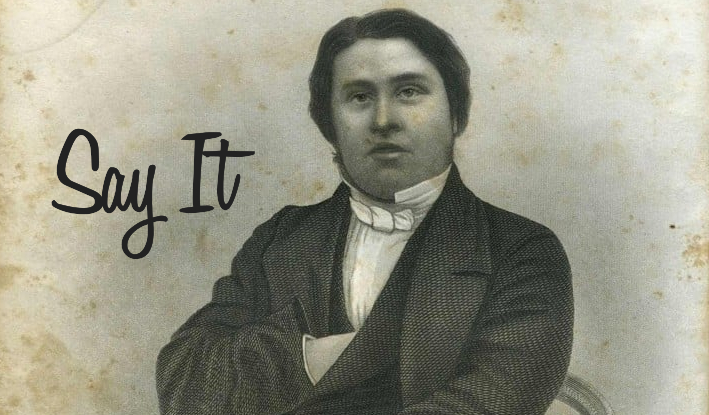
Spurgeon himself said, “Now, it is well that preachers should be instructed, but this man was really stupid. He was obliged to stick to his text, for the simple reason that he had little else to say.”

Of course, the story continues. The text was from Isaiah. “Look unto Me, and be ye saved, all the ends of the earth.” And the message was on target for young and troubled Spurgeon, “there was a glimpse of hope for me in that text.” So the thin-looking preacher restated the text every way he could manage for about ten minutes, and then told the young guest at the back that he looked miserable and needed to look to Jesus to be saved. And Spurgeon was born again. Spurgeon often told the story and it is well worth reading.

But let’s just ponder that earlier point. “He was obliged to stick to his text, for the simple reason that he had little else to say.”

Three points to ponder:

1. Our job as a preacher is to say what the text says.

2. Our education does not give us something better to say than what the text says.

3. God once spoke through a donkey, so humbly say what the text says.

Looking back on that moment, Spurgeon quoted words you may have sung:

E’er since by faith I saw the stream
Thy flowing wounds supply,
Redeeming love has been my theme,
And shall be till I die.

To read a slightly fuller version of the story, click here. (And if you want to sing the song, I enjoyed this!)

How is Your Preaching Toolbox?

So I started into Spurgeon’s Lectures and got about, well, more or less, about a page in before I was “arrested” by his helpful thinking.  Here’s a taster
We are, in a certain sense, our own tools, and therefore must keep ourselves in order. If I want to preach the gospel, I can only use my own voice; therefore I must train my vocal powers. I can only think with my own brains, and feel with my own heart, and therefore I must educate my intellectual and emotional faculties. I can only weep and agonise for souls in my own renewed nature, therefore must I watchfully maintain the tenderness which was in Christ Jesus. It will be in vain for me to stock my library, or organise societies, or project schemes, if I neglect the culture of myself; for books, and agencies, and systems, are only remotely the instruments of my holy calling; my own spirit, soul, and body, are my nearest machinery for sacred service; my spiritual faculties, and my inner life, are my battle axe and weapons of war.

Your library, your laptop, your office, your desk, your starbucks tab are all secondary.  The real tools of the trade for a preacher are their heart and their head, their own inner life and spiritual walk.

Share

Out of Our Depth

Charles Haddon Spurgeon once made this very true statement, “The best man here, if he knows what he is, knows that he is out of his depth in his sacred calling.”  How true that is.  Only with a keen awareness of that reality will we avoid a ministry empowered by the flesh.  Let me probe this issue briefly with some rhetorical questions:

Do I feel confident in my ministry based on previous experience, ministerial training or affirmation received? This is a dangerous confidence to lean on.  We need to lean on Him only when we step up to preach.

Do I feel stirred to worship, to confess, to pray, to focus on the Lord as I prepare to preach? If these responses and similar are missing in preparation, something is missing for the preaching too.

Do I concern myself more with what people will think of my message, than what God will think of it? Surely we preach to our listeners, but we ultimately answer only to One (consider 2Tim.4:1 in light of verse 2).

Let’s never allow ourselves to forget the simple fact that we are out of our depth when we stand to preach God’s Word.