Review: Preaching, by Michael Reeves

Subtitled, A God-Centred Vision, this is a little gem of a book from Union Publishing.  It is not about preparation techniques.  Reeves writes, “I want to press deeper. For a rich, biblical theological understanding of preaching dramatically enhances preaching far more powerfully than any practical tip. . . . I want to cast a vision for preaching that is nourished by the very being of God, the glory of his Word, and the power of the gospel.” (p17-18)

As you can imagine, Reeves builds his book on both a theological and historical footing.  There are clear trinitarian foundations: “This is what the living God is like: not silent or speechless, but a God who speaks.” (p21)  And there are also historical insights worthy of note: “Preaching was the real engine room of the Reformation. . . . the Reformation demonstrated the astonishing, transformative power of the regular and clear preaching of God’s Word.  It stands as historical evidence that there is nothing inevitable about church decline.  The spiritual darkness of our day can indeed be checked and turned back.” (p24-25)  

The goal of preaching, theologically, is not just to learn about God, but to encounter him, to enjoy him, and be united to him.  And biblically?  True preaching must be expository, “in that it exposes the Word of God and makes that the food on which the church grows.” (p30)  Reeves is clear, true preaching must point us to the person of Christ.  While this is not a book of the mechanics of sermon construction, Reeves offers some critical advice.  “Preach Christ, not an abstraction.”  “Proclaim the reality, not a mere idea.”  “Show, don’t tell.” (p52-57)

While many preaching books will encourage preaching to the heart, and not just the head, this book explains what that actually means.  The preacher must convey more than mere information or emotion.  “(Preaching) is a heart-shaking assault on darkness and the very gates of hell, trumpeted forth so that sinners tremble and saints quake in wonder.” (p62)  And true preaching must lead to heartfelt worship, for “the triune God, who is love, is not truly known where he is not truly loved.” (p64)

We all know that preaching can tick many boxes, yet remain essentially shallow.  Reeves offers a simple cure for shallow preaching: get to the root of the issue.  We are not simply needing exhortation to better conduct.  We need heart transformation.  The affections are the key target in ministry– “Affections are deeper and more constant (than emotions): they make up the very grain of the heart and its inclinations.” (p73)

When the gospel is truly preached, “It is that gospel that will melt and renew hearts of stone.  It is that sight of the Son of Man, lifted up on the cross, proving the love of his Father, that realigns affections. . . . The sin that pleased us becomes odious. The God we flinched from becomes entrancing.” (p78-79)

This book really is a gem.  A book to read and read again for your ministry, and a book small enough to distribute to other preachers in your circle.   
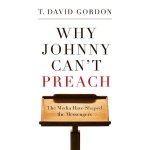
Review: Why Johnny Can’t Preach, by T.David Gordon

It’s a short book,108 pages, but it packs quite a punch.  T.David Gordon wrote Why Johnny Can’t Preach during a year of treatment for cancer.  Given only a 25% chance of survival, he found his focus clear and the desire to compromise his message absent.  The book is hard-hitting, but I found the tone entirely appropriate and not harsh despite the subject matter.

The writer is a media ecologist – that is, one who studies the effects of the change of media forms on the culture.  Taking his title from two books in the 1960’s on the growing inability of students to read and write, this book focuses on why the present state of preaching is so dire.

The first part of the book sets out his evidence for his claim that preaching is ordinarily poor.  While admitting freely that his first line of evidence is merely anecdotal, I found the presentation of evidence hard to argue with (not that I’m inclined to argue since my experience largely reflects the author’s).  Yet Gordon’s evidence is not merely subjective.  He goes to some pains to make clear that there are some objective measures of sermon quality that can be used to identify problem preaching.  It is too common to hear “that is just your opinion” if a sermon is ever questioned or critiqued.

The author’s argument culminates with the almost total absence of the annual review, not missing in any other profession, but indicative that all sides know there is an issue.  Gordon doesn’t blame seminaries for this state of affairs.  In his perspective they haven’t changed, but the calibre of incoming student certainly has.  What has changed?  Because of the change in media forms, Johnny is no longer able to read, nor write, nor discern the significant, and hence he can’t preach either.

True preaching requires close examination and study of a quality text, something non-readers have no experience of today.  People don’t study classical languages.  They don’t read literature.  They aren’t equipped to really study a text.   People read for content, but don’t learn to look at how a text communicates.

True preaching requires careful composition.  But people don’t write letters anymore.  They talk on the phone. Instead of careful composition, we live in a day of easy and cheap talk.

True preaching requires a sensibility of the significant.  But the only way to watch hours of television is to turn off such sensibility, so most do.

A once-common sensibility (close reading of texts) is now uncommon, and a once-common activity (composition) is now comparatively rare.  A once-common daily occurrence (face-to-face communication allowing us to “read” the unstated feelings of another) has been replaced by telephone conversation in which visual feedback is absent.  A once-common sensibility, the capacity to distinguish the significant from the insignificant, is becoming rare.  For a minister today to preach a basic average sermon by early-twentieth-century standards would require a lifestyle that is significantly countercultural.

The book is not solely concerned with capacity to study and compose.  The fourth chapter looks at the content of sermons and gives a fine rebuttal of four contemporary approaches – moralism, how-to, introspection and “so-called culture wars” . . . helpful content that I will come back to in other posts.

At certain points I would suggest that the author’s view of Christian preaching is a little narrow.  There is more to an inherently relational faith than merely submitting our will to God’s will.  Perhaps the Bible text, if read carefully, might present the heart of God such that our hearts might be changed in response.

Nevertheless, even taken on the author’s terms, the book’s message is important and needs to be considered.  All of us live in a fast-paced world that simply doesn’t allow for careful reading of God’s heart in His Word.  Perhaps it is time we were more counter-cultural in order to be able to read the text well.

Thankfully, T. David Gordon is still alive and serving the church through his teaching and writing.  We should be grateful for this little gem of a book.  Buy this book, perhaps even pass on a copy to someone else!

(If you are in the UK, click here to buy.)

Add to FacebookAdd to DiggAdd to Del.icio.usAdd to StumbleuponAdd to RedditAdd to BlinklistAdd to TwitterAdd to TechnoratiAdd to Yahoo BuzzAdd to Newsvine