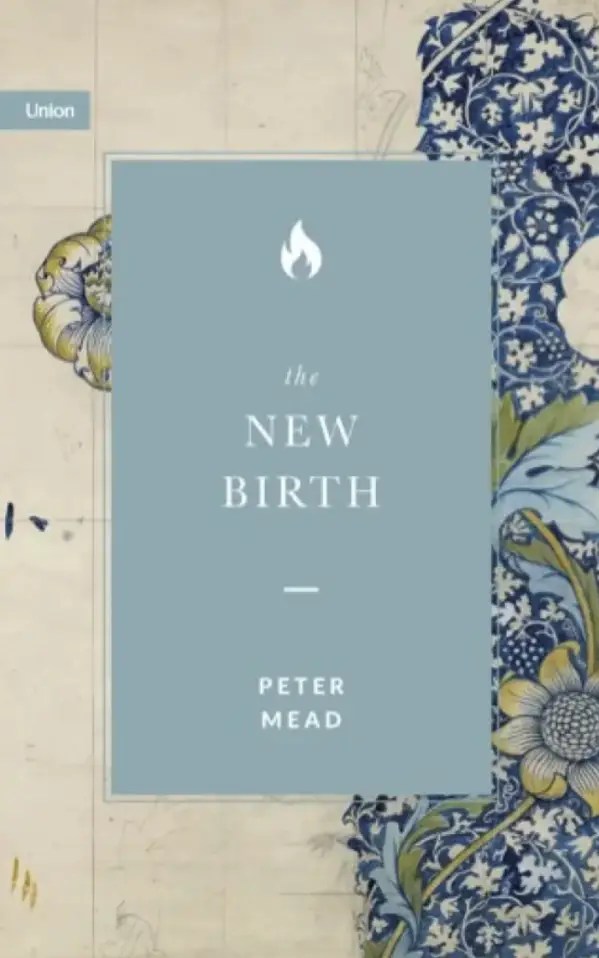
New Book Released in the USA

I am very pleased to announce that my new book, The New Birth, has now also been released in the USA.

If you would like a copy of the book and will see me in person during January/February, please ask. (I will be in Oregon, St Louis and Chicago.) To order the book from my affiliate link in the USA – click here. (To order the book from my affiliate link in the UK/Europe – click here.)

Thanks so much! I hope you enjoy the book! (Please comment on this post if you’ve read the book already, but I would also greatly appreciate any positive reviews on 10ofthose, Amazon, GoodReads, etc.)

Endorsements

“Peter Mead presents this essential doctrine in a way that warm, clear, rich, and readable. The book is accessible and engaging, and the addition of stories and reflection questions at the end of each chapter enables us to consider and imagine the way that the truth of the gospel can and should shape our lives. This is a lovely and helpful book—a great introduction to those new to or exploring faith, and a refreshing encouragement to those who have been Christians for a while.”

Ellidh Cook, Student Worker at All Souls Langham Place, London

“This tiny book conveys a huge reality: that Jesus came to raise spiritually dead people into abundant life! Peter Mead’s insights into the new birth that Jesus offers are both pastorally wise and profoundly helpful.”

Philip Miller, Senior Pastor, The Moody Church, Chicago

“When I became a Christian, I didn’t really grasp what had happened. It was an infinitely bigger deal than I realised-it was (and is) beyond my wildest dreams. Peter has given us an excellent primer into this huge adventure. This lovely, heart-warming book opens up the foundational truth of the new birth. As with the rest of the Essentials series, it is short and simple, yet full of deep and delightful teaching.”

Jonathan Thomas, pastor, author & broadcaster

“I found Peter Mead’s The New Birth contribution to the Essentials’ series most helpful, because it weaves together our story with the big story of Scripture through the lens of the work of the Holy Spirit. Taking as its anchor point Jesus’ encounter with Nicodemus, it wonderfully explains the theology and the felt experience of Christian conversion, and all along there are thrilling stories of how the Spirit transformed the likes of Spurgeon, Whitefield, C.S. Lewis, and modern men and women.”

Rico Tice, Co-Founder of Christianity Explored

Food and Following (Matthew 9:9-17)

It seems like food is significant in every culture.  Whether a culture is known internationally for its food or not, something about sitting down together to eat carries more significance than the mere fuelling of the body or renting restaurant space for a meeting.  In Jesus’ time, it is evident that table fellowship mattered greatly.

In Matthew 9:9, Jesus called Matthew from the tax booth to a new life as a follower of Jesus.  That may seem like a familiar idea to us, but having such despised sinners as followers was a radical act by Jesus.  Who deserves to be his follower?  Who deserves to be his apprentice, learn from him, become like him, relate to him, and be launched into a life of ministry representing him?  Did Matthew deserve it?  Do you or I deserve it?  May we never lose the wonder of the call to be his followers!

Immediately, we read of Jesus reclining at the table with many tax collectors and sinners.  Luke’s account points out that Matthew laid out a “great feast,” although Matthew was too humble to mention that detail.  (Luke 5:29)

The Fellowship Question (Matthew 9:10-13) – The meal sparked a fairly obvious food-related question – who should Jesus eat with?  To the religious evaluators, it was obvious that Jesus should not be eating with tax collectors and sinners. Indeed, they were the ones who’d earned the invite to the special meal.

I was recently with a pastor whose church seeks to reach out to the marginalized and the maligned of society.  He took my family to dinner, and we enjoyed a wonderful meal together at his favourite restaurant.  He told us how, when his church had started, they hired this restaurant and filled it with people who may never have eaten in a restaurant before.  The feast was a gift.  The gift was not just the food; it was a fantastic way to get to know a Jesus who would sit and eat with societal nobodies like Matthew’s friends.

It is interesting how Jesus responded to the question.  He differentiated between those who are healthy and those who are sick.  It is the sick who know they need the help of the physician.  After all, whoever says, “Let me allow my broken ankle to heal, and then I will head for the hospital,” or “Let me wait for this abdominal pain to pass before I go and get checked out?”  It makes no sense to hold back when you know you need help.

Jesus called the religious to soften their hearts toward those who knew their spiritual need.

The Fasting Question (Matthew 9:14-17) – Matthew follows up with another food-related question.  Why do Jesus’ followers eat?  Some of John the Baptist’s disciples wanted to know about fasting.  After all, the Pharisees were promoters of the Old Testament Law and promoted fasting.  Then, they were followers of the final Old Testament prophet and were into fasting, too.  So, indeed, if Jesus were a step forward religiously, he would promote fasting even more.  The Law, the Prophets, and now came Jesus; therefore, his followers should be fasting extra!  But they missed something: Jesus was not just another step forward. He was the goal of it all!

Jesus spoke in wedding terms.  A wedding day is not a normal day.  You never walk into a wedding reception and expect to find people fasting.  It is a day of feasting!  It cannot be a typical day when the bridegroom is present! 

Jesus went on to give two everyday examples to make a point.  Nobody would put a piece of unshrunk cloth onto an old garment because it would self-destruct when it got wet and dried again.  Everyone knew that.  Likewise, nobody would put new wine into old, hard, shrunk, leathery wineskins.  Again, it would self-destruct when the wine fermented and expanded.  Everyone knew that, too.  So, to Jesus’ point – his work was not just another step forward in the Old Testament line of promise.  It was the launch of something profoundly new that could not be contained in the old framework.

We may not be from a Jewish background and tempted to try to squeeze the radically new gift of New Covenant life into the framework of the Old Covenant.  But actually, we are all tempted to try to add the new life Jesus offers into the old way of religious effort that always characterizes humanity.  It is so easy to think that becoming a Christian adds a few more responsibilities onto my to-do list of moral efforts for respectable living.  However, that is not how it works.  It is a radically new life.

Jesus came to transform our lives by his presence.  He calls us to live a radically new life as his followers.  We are called to be with him, enjoy time together, learn from him, and be transformed from inside to out.  We are called to feast in joy because he has come.  We are called to fast in earnest because he is currently away.  Jesus is not asking you to become more religious; he is offering something far more radical than that.

As our thoughts are drawn to the first Easter, remember the radical nature of all that Jesus has done for us.  And then don’t settle for a modified version of religious living.  We get to follow the risen Christ through the year ahead.  Jesus offers a radically new life to really needy folks like you and me.

At Work in His Word

As we enter February, there will be many new year Bible reading plans that are fading away.  Perhaps the challenge of a full work schedule, combined with dark mornings, drains the motivation to be in God’s Word.  Or maybe the second half of Exodus and Leviticus is proving too great a challenge.  Whatever the reason, many will settle into a rhythm marked more by guilt than regular enjoyment of the Bible.

It is hard to relate to a God we cannot see, hear, or touch.  And while we know that the Bible is his glorious gift of communication to us, it can often feel distant and disconnected from our everyday lives.  How can we find motivation for a relationship with God that has the Bible at the centre?

The critical issue is right in the question itself.  Do we experience the Bible in the context of a relationship?  Or have we let the relational aspect drain away, leaving the Bible as an optional tool or merely an interesting document for our fascination with religious history?

In 2 Timothy 3:14-17, Paul gives us a critical passage on the nature of Scripture.  In these verses, Paul points to the role of Scripture in our salvation and our growth to maturity.  In these verses, Paul clarifies what Scripture is and how it works in us.  Let’s look again at these verses and remind ourselves that God lovingly works in us as we are in his Word.  To put it differently, the Bible is not just a “past tense” book for our studies.  It is a “present tense” gift for our relationship with God.  God lovingly works (present tense) in us as we are in his Word and as his Word gets into us.

Entering into a relationship with God, 2 Tim. 3:14-15.  As Paul wrote to Timothy to encourage him in the challenges he would face, he wanted him to remember where his ministry all started.  It started by coming to know salvation in the first place.  Timothy had learned and came to believe in the sacred writings of Scripture from his grandmother, his mother, and Paul himself.  His Bible exposure taught him about the wonder of salvation through faith in Christ Jesus.  Without the Bible, we would only be guessing about God, and our guesswork would never have led us into a relationship with him.  God has taken the initiative in our salvation, revealing his character, plans, and great gift.  There is no relationship with God if there were no Bible.  But since there is, let us not lose the relational nature of our connection to him!

So, what is Scripture? 2 Tim. 3:16a.  “All Scripture is God-breathed.”  What a way to describe it!  It comes from the very core of God’s being.  He made sure that the authors wrote exactly what God wanted to be written.  All Scripture, every last Word, was as he intended.  On a human level, the Bible is astonishing – so many authors, different languages, different types of literature, and yet an incredibly coherent and consistent collection of documents.  But the Bible is not written just on a human level – it is “God-breathed!”  That means it is unique – no other book is in the same category.  It also means it is a loving gift – God wanted it written for his people.  It is a purposeful gift – God intended it to achieve something in us.

Based on what we know of God, what might we assume his Scriptures would do?  Would God give us a mindless distraction to pass some time?  I don’t think so.  That does not fit what we know of his character. Indeed, he would want to work in our hearts since that is the core of who we are and the heart of all our problems.  Surely, he would want to instruct our minds since God made us incredible thinking beings.  And he would want to guide us in how to live since God had a good plan and we have so profoundly rebelled against him.  Is it a living communication designed to work in our hearts, heads, and hands?  That seems about right.

How does God work in us through Scripture? 2 Tim. 3:16b. Regarding our beliefs, the Bible is profitable for teaching and rebuking.  We need instruction to understand God, the world, and ourselves.  And since we don’t always think well, we must be rebuked, lest we persist in error and come to harm.  How many newcomers to Christianity put information together and end up with errant thinking, only to be corrected as they read the Bible?  For example, many think they have solved the complexity of the Trinity by assuming there must be one God who dresses up in three different outfits to suit the occasion.  Sometimes, he is a father, but other times, he shows up as a man, and sometimes, what we need is a more empowering Holy Spirit.  But then they might read about the baptism of Jesus, and suddenly, they are confronted by all three persons involved distinctly and simultaneously.  Oh dear.  Rebuked by Scripture.  Taught the truth.  This correcting rebuke might happen with logical ideas about salvation, eternal judgment, or whatever.  If we want “to overcome error and grow in truth … we must turn to the Scriptures!” (John Stott)

Regarding our actions, the Bible is profitable for correcting and training in righteousness.  We need to be set straight at times.  Perhaps we have drifted into an area of compromise and the Scriptures confront us as a mirror.  Or perhaps we have drifted from God and run up against Jesus’ letter to the church at Ephesus.  Maybe you have already been corrected by that passage?  So much about that church is so impressive, but “this I have against you: that you have left your first love!”  It can stop you dead in your tracks.  And then, it instructs you to repent and do the things you did at first.  A way back to the healthy reality of a real relationship with God.  The Scriptures train us in righteousness – growing us up in all areas of character, endurance, maturity, etc.  Do we hope “to overcome evil and grow in holiness?  Then it is to Scripture we must turn, for it is profitable for these things.” (John Stott).

What is God’s goal as he works in us through the Scriptures? 2 Tim. 3:17.  The goal is clear: you will be complete or mature, thoroughly equipped for every good work.  We know that God has good works for us in every stage of life.  But how can we be ready for them?  The answer is easy.  Get your nose in the Bible and get the Bible into you, relationally, so that God’s work will be done in your life.

Two Errors to Avoid.  Some Christians will come from a background that might be labelled “text-optional” – it is a divine-hotline approach to living, with an eager expectation that God will speak through my thoughts, feelings, and circumstances.  The Bible may be sitting there, but so is the red flashing phone that offers direct encouragement along the way.  If this is your background, then be sure to recognize that along with all the perceived blessings comes a tendency to leave the Bible sitting there.  But the Bible Ais not optional.  For a healthy relationship with God, we need to be soaking and swimming in his Word, enjoying the wonder of God at work in us passage by passage, day by day.

Other Christians will come from a background that might be labelled “text-only” – it is the intellectual curiosity approach to living with a Bible.  There may be an eagerness to study the Bible and a hunger to learn more and more, but often, there is too little expectation that God will speak to me as I read and study.  The Bible is open, and the study is focused, but somehow God is not expected to be at work.  If this is your background, then be sure to recognize that along with the blessing of study, there is also a tendency to stop studying before fully responding to God’s Word.  We should look at the text and learn what it says and means and consider how it is stirring us to love God and live for God in this world.  Engaging relationally is not optional. Again, for a healthy relationship with God, we need to be soaking and swimming in his Word, enjoying the wonder of God at work in us passage by passage, day by day.

Let’s move beyond “what is God saying to me through my thoughts and feelings” and “what is this text saying” to the relational reality of “what is God saying to me as I read or study this text?” 

God is at work in us as we are in his Word.  What a privilege.  A present tense, today, privilege.

______________________________________

Is Our View of Satan Too Small?

I have noticed something strange.  Many Christians will acknowledge the existence and the general agenda of Satan.  They will affirm that he is alive and active on planet Earth.  Yes, they recognize that he hates God and God’s people.  Yes, he hates truth and wants to steal, kill and destroy.  Yes, he wants to tempt us into rebellion, crush us under guilt, and destroy all that is good, beautiful and anything that has even the faintest reflection of God’s character. 

And yet, oddly, as quickly as those affirmations are made, that awareness seems to evaporate just as quickly.  For many Christians, the devil appears to be a very limited antagonist.  He might get some vague credit (for want of a better term) for any temptation we consciously notice. Still, he gets specific credit for very little activity. 

For example, suppose the subject of the occult is raised with the related concepts of devil worship, seances, fortune telling, etc. Many will shudder and point to the enemy’s works in that case.  But is that the whole story?  Is Satan just tempting us as individuals and running a relatively obscure dark religious operation? 

Let’s take a few moments to review some essential biblical background. 

Origins of Satan – The name Satan means adversary and came to be applied to the greatest adversary of all – the devil.  It is a well-earned label!

What we know of his origins is described primarily in Ezekiel 28:11-19, where it is clear that prideful arrogance was the key driver of his original fall from perfection.  Since his fall, his primary domain has been Earth and Sheol.  We see him cursed by God in Genesis 3 – the one whose goal was to be the most high became the most low, eating dirt close to the underworld.

Influence in the world – The big question in this post essentially relates to his influence.  According to 1 John 5:19, the whole world is under the control of the evil one.  He is called the ‘prince of this world’ on several occasions (John 12:31; 14:30; 16:11).  He influences through lies, especially the original lie that we humans can be like God, and he masquerades as an angel of light, deceiving people (John 8:44; 2 Corinthians 11:14).  There are plenty of people whose spiritual father is the devil, and it is possible to identify them by their actions and their lack of love (John 8:44; Matthew 13:36-40; Acts 13:10; Ephesians 2:2; 1 John 3:10)

Influence over nations – He rules the nations and tried to strike a deal with Jesus in exchange for Jesus bowing down to him. Still, Jesus did not affirm his ultimate ownership of the nations and did not bow down.  Jesus knew and trusted that, at the right time, the Father would give the nations to him.  (See Matthew 4:10.)  Jesus confronted the power of evil by casting out demons from people. It is evident that Satan commands the realms of darkness (see 1 John 3:8).  What Jesus began in his ministry, he is continuing – building his church and the “gates of hell” continue to be unable to resist the onslaught.  Satan is on the defensive. 

Influence in the Church – Paul wrote to the Romans, “The God of peace will soon crush Satan under your feet.” (Romans 16:20). Yet, it would be naïve to assume that Satan does not influence the church.  While our minds might go to Judas Iscariot, whom Satan influenced (John 13:2) and then entered (John 13:27), we do not need to live in fear of being taken over by the evil one.  We belong to God, who is greater than the one who is in the world (1 John 4:4).  However, we should recognize that discord, anger, unforgiveness and resentment can provide an opportunity to the devil, and we should actively resist him (James 4:7; 1 Peter 5:8-9).

Our hope as the spiritual war rages – Because of Jesus’ victory over the rulers and authorities on the cross (see Colossians 2:13-15), Satan’s power of death is now broken (see Hebrews 2:14-15).  We now know that death is swallowed up in victory (1 Corinthians 15:54).  And yet, the one who comes only to steal and kill and destroy does not give up easily (John 10:10).  His ultimate downfall is already determined; he will be thrown into the lake of fire (Revelation 20:10).  In the meantime, he fights on.  Indeed, as his time gets short, we might expect him to offer a big final push, but we know the end of the story.

The hole in our spiritual warfare – So, what is missing in our understanding of the spiritual battle that we are in?  Satan exists and is active on earth.  Yes, he does tempt us and would delight to see us derailed by sin and defiled by discord.  And yes, the occult does exist, and some people are drawn into religious acts of pure evil.  But at the start of this post, I suggested our view of Satan may be too small.  Is Satan just tempting us as individuals and running a relatively obscure dark religious operation? 

To be candid, I have been struck by how much we are inclined to bury our heads in the sand regarding evil in this world. “Oh yes,” people will affirm, “Satan is real, and we are in a spiritual battle.” But mention some specific aspects of society and watch the response change:

Could there be evil at work in news reporting designed to shape our thinking? “No way, we can trust the news media.” 

Might the enemy be shaping education to harm children?

Don’t be ridiculous!”

What about medical professionals who seem driven by something other than ‘first do no harm?’

“Of course not! The doctors I know are good people.”  

What about government decisions that seem to benefit them but harm people and cost lives?

Absolutely not!  They have our best interests at heart.” 

What about unelected and unaccountable groups of the hyper-rich and influential seeking to gain control over ordinary people?

If such groups exist, then I’m sure they mean well.”

What about influential people who have publicly declared the global population needs to be reduced by whatever means?

Of course not; they only want to help the poor!”

What about the entertainment industry that so fills our consciousness?

Oh, but I like him, she’s my favourite, etc.”

It does not mean much to acknowledge that Satan is real and active if we then immediately deny that he could be at work in almost every layer of human authority and influence.  And I would suggest we are utterly naïve if we don’t believe that the prevailing paradigm of our day, with its “lofty opinion raised against the knowledge of God”, is influenced by Satan.  (See 2 Corinthians 10:3-6) 

In the past, Christians seemed ready to recognize the malevolence of hedonism or materialism as it confronted our worldview in the so-called “Christian West” or the evils of totalitarian regimes in the East.  But today, too many Christians seem happy to play along with and believe the best about media-driven narratives concerning identity politics, critical theories, social justice, weather worship, globalist agendas, neo-communist ideologies, uncontrolled immigration and encroaching violent religion.  Are we sure that we should ‘believe the best’ and ‘affirm the good’ in all the ideas swirling around and in all the layers of authority setting themselves up over us?

Perhaps it is time for us to fix our eyes on Jesus and recognize that we are genuine outsiders in this world and that we will be hated by it. And yet we are here as ambassadors to represent God’s truth, to share the hope of Jesus, to stand for what is right and to not love our lives even unto death. Let’s stop smiling at the devil as if he is an insignificant foe.  Let us instead armour up, stand firm, be ready to speak, be prayerful as if we are in a war (for we are), and when we have done everything we can, to stand.

(HT – https://www.logos.com/grow/satan-in-the-bible/ )
Join Us For An Advent Journey!

This December, Cor Deo will be releasing a series of short videos that walk through Pleased to Dwell: A Biblical Introduction to the Incarnation. The book was first released almost ten years ago, and quite a number of people have told me that they return to the book as a devotional reading during the month of December each year (there are, conveniently, 24 short chapters in the book!) So we decided to produce these short videos during December as a lead-up to Christmas, and potentially as a companion to the book (although reading the book is optional!) Join us each day for a brief highlight from the book, along with a Bible verse or two, as we prepare our hearts to celebrate the Incarnation this Christmas.

Please subscribe to the Cor Deo YouTube channel, and share this with others who may find this series helpful. It will work with or without following along in the book, but you are very welcome to order a copy of the book if you don’t have one!

If you would like to get a copy of the book in the UK or Europe, please check out 10ofthose.com or if you are in the USA/Canada, please use this link (these are affiliate links, so I will benefit very slightly).

The Best Place to Hide in Evil Times

This world can be a sinister place.  I was recently on a missions team serving abroad, and we heard testimonies from several local believers.  One told of his times in prison – a place ordered more by the structure of the dangerous mafia than by any attempt at protecting human rights from the authorities.  Another told of his religious family – a home where this eleven-year-old boy was beaten up by his older brother every time he dared to go back to church, and that at the instruction of his parents.  Another told of his time in the military, where he discovered just how evil a totalitarian communist ideology can be in reality.

Whether it is by crime, religion, or ideology, the evil of this world is evident all around us.  If we scratch the surface of society, we will find all of this lurking today.  No country is free of crime, and the level of organization often goes way beyond what we can imagine.  Billions live under the threat of their religion, a threat that uses family members to beat any hint of turning, and ideologies that require everyone to think the same replace God with government and treat people as collateral damage in an ideological march towards utopia.  Well, they did not die out in 1990 – the same old ideas keep coming back dressed in new garb.

In Psalm 17, we find three cries to God from David’s mouth (see v1, v6, v13).  His cry was essentially: I am innocent, they are attacking me, but I am confident in God (see v1-5, v6-12, v13-15).  Let’s look at these three sections and see if this Psalm might stir us to cry out similarly.  After all, the same God is still the best refuge from wherever the threat comes!

Introduction (v1-5).  In the first verses of the Psalm, David’s cry is based on asserting his innocence.  We know from many other places that he knew of his guilt.  His cry was not for protection because he deserved it.  No, his vindication came from God’s presence, not from his own perfection.  Nevertheless, there is a place for recognizing that we may be innocent with respect to a specific threat, and it is right to cry out to God in the face of injustice.  Whether that be criminal activity, religious persecution, or ideological threats, we can and should cry out to God for his protection.

God protect me from the evil people (v6-12).  The description of the malicious threat is very vivid.  David doesn’t just say they are violent and threatening (v9); he goes on to give four descriptions.  Three descriptions use human body references; the fourth is from the animal kingdom.  Their heart lacks compassion, their mouth speaks with pride (v10), and their eyes are set on sinister plans (v11).  These verses could describe the mafia bosses running a prison, the religious family members intent on guarding family reputation, or a totalitarian regime marching towards its ideological utopia.  Whatever way evil dresses up, underneath lurks the same sinister roar – the lion.  David described his chief antagonist as a lion eager to tear.  Peter used the same imagery of Satan in 1 Peter 5:8.  There is great evil in this world, so we need a great God in whom to find refuge.

In Psalm 17, David described God in the preceding three verses.  He also uses three human body descriptions, followed by one from the animal kingdom.  Notice the description: your ear, right hand, and eye (v6-8).  As we draw near to our great God on the throne, we find him to be a wonderfully good God.  His ear inclines to hear even the weakest of whimpers.  His loving right hand has all the authority needed to protect us from every evil this world offers.  His eye is on us.  The phrase “apple of your eye” is an English figure of speech, but the original language refers to “the little person of your eye” – that tiny reflection in the pupil that reveals the whole focus of the eye.  What a gloriously intimate description – an inclined ear, the loving and full authority of the right hand, the attentive and affectionate eye.  Then the animal image?  We are hidden in the shadow of his wings!

Conclusion (v13-15).  David finishes the Psalm with one last call for God to act.  He desires deliverance.  Those who are against him are living for this world.  They want to gain power and wealth, to have something to pass on to the next generation.

In contrast, what matters to David?  His ultimate goal is not just victory but God’s visage (face).  It is not just about getting a response but about enjoying a relationship with God.  It is not about protecting his inheritance but about having intimacy with God.

God’s goodness can be celebrated in each of the three situations mentioned at the start of this article.  The prisoner may have lost the protection of the mafia leader he was close to. Still, he met a church pastor who came into the prison and told him about Jesus.  Today, he follows Jesus and visits two prisons he once occupied to tell others about Jesus too. 

The eleven-year-old boy never saw most of his family follow Jesus as he does.  Still, he pastors a church that reaches out to the marginalized of society.  He also enjoys telling others that the brother who beat him up for attending church is a believer and a missionary in a foreign land. 

The soldier serving in a communist military realized after three years just how evil the totalitarian regime was in reality.  But God allowed him to be tasked with listening to foreign radio stations to discover any plans to invade his country.  Instead, he heard the good news of Jesus broadcast in his language.  Today, he pastors a church and delights in telling others about the goodness of God!

Whatever evil is evident in your context or working away behind the scenes, seek refuge next to our good God’s throne.  When we see how good he is, we will want nothing else!

5 Easter Lessons from the Trials of Jesus

As we come to another Easter, our minds and hearts will be drawn back to the cross and the empty tomb.  This is the central hinge of human history, and ground zero of our faith.  As followers of Christ, we should never stray too far from his passion if we are going to follow him well, do good theology, or seek to offer hope in this world.  We are a people birthed, marked, shaped, and transformed by the cross and the empty tomb.

God gave us four Gospels, and all four essentially offer a preparatory retelling of the ministry years of Jesus, followed by a slower and more detailed account of the Passion Week.  That means we have many column inches given to other aspects of that first Easter.  As well as the crucifixion and the resurrection, we also have a lot of details about Jesus’ clashes with the authorities, the Last Supper and Upper Room, Gethsemane, and the arrest and trials of Jesus.  Let’s take just the trials, in particular.  What might we notice as we move towards another Easter?

1. The trials did not all happen in one night.  There are six trial hearings that occur between the arrest of Jesus and his crucifixion.  However, the Jewish authorities had long determined that he was guilty and deserved to die.  As we read through the Gospels we find their growing animus, their utter rejection of his authority, and their determination to put him to death.  This final night of trials was the end of a process, it was not the beginning.

2. The trials are divided between the religious and the Roman.  Jesus was arrested by a group of temple guards, with some Roman soldiers added to the posse.  He was taken first to Annas for what is effectively a pre-trial hearing, then to Caiaphas and the Sanhedrin during the night, and then for a brief ratification of their decision at first light.  The focus of these religious trials was Jesus’ teaching and identity.  Then the Jewish leaders took him to Pontius Pilate, the governor of Judea, for the Roman trial.  Here the focus was his threat to Roman rule, and the emphasis had to shift to political concerns.  Pilate offered a political peace offering to King Herod, a Roman-installed Tetrarch who had previously sent a complaint about Pilate to Caesar.  Herod had wanted to meet Jesus but soon sent him back to Pilate for the sixth and final trial of that night/morning.  Three religious trials.  Three Roman trials.

3. The trials feel rushed and disorganized.  The Jewish authorities had planned to arrest Jesus and deal with him before he could slip away from Jerusalem, but not during the feast.  And then, during the Last Supper, Jesus revealed to Judas that he knew about the planned betrayal.  Their secret was out, and so they rushed a plan into action.  The rush resulted in them struggling to find two witnesses that would agree in front of the defendant during the night trial, and then coming to Pilate without a clearly defined charge in the morning.  It all seems so chaotic and rushed – because it was.  They were not planning to execute Jesus on that particular day.  We can see that God’s plan for the timing required crucifixion on that particular day.  The authorities were not in control.

4. The trials helpfully point us to other key characters.  As we read through the trial accounts, we come across a number of incidental characters.  There are soldiers mistreating Jesus (quite likely to have been Samaritan conscripts, since the Jews would not have joined the Roman ranks).  There are the members of the Sanhedrin gathering in the shadows.  There is Pilate’s wife, whose dream only increases Pilate’s superstitious nervousness around this decision.  And there are some major characters too – Pilate was the most powerful man in the region.  He was used to criminals cowering and begging for mercy but was amazed at the silent strength of Jesus.  Peter had promised to die for Jesus, tried to kill for him in the garden, and then found himself in a series of mini-trials by the fire in the courtyard.  Peter wept bitterly at his failure, but Judas’ grief was different.  He was confronted by the deathly darkness of despair and plunged to his death that night.  As you read the trial accounts, notice everyone who is mentioned.

5. The trials shine a glorious light on Jesus.  And as you read the trial accounts, be sure to focus particularly on Jesus himself.  The arresting party wasn’t in control.  The mafia don of Jerusalem, Annas, was not in control.  The High Priest was not in control.  Nor Pilate the governor.  Certainly not Herod the visiting King.  No, the only one showing control, dignity, clarity of purpose, and strength of character, was Jesus himself.  Watch for when he remains silent.  Take note of what he says when he speaks.  See how he supplies the Old Testament quotes that the High Priest needed to seal the decision.  Recognize his gravitas before Pilate.  Just as Jesus’ words from the cross help to shape our theology, so should his words in these trials.  Jesus came to rescue us at such a great cost.  And Jesus came to reveal the heart of his Father with such great clarity. 

As we head into another Easter, let’s be sure to watch Jesus closely in the biblical text.  He is our humble and regal Redeemer, rescuing us and revealing God to us.  Thank God for Jesus, and thank God for the beautiful way he navigated those last hours before the cross.

_______________________________________

Join us for a mini-series that show how to study the Bible:

Christian Living Reoriented

There is a well-worn path in evangelical Christianity.  It begins with the presentation of wonderful news – that God has done everything necessary, in Christ’s death on the cross, to make it possible for us to receive salvation.  All we have to do is trust in Christ and we are saved.  To put it another way, we don’t have to do anything, because Christ has done it for us. 

The path then makes a surprising turn.  Having trusted in Christ for salvation, we soon find the path turning steeply uphill as we discover that living the Christian life is another matter entirely.  Living as a Christian is presented as a list of disciplines, activities, new habits to start and old habits to kick.  The sunny days of gospel invitation give way to storm clouds of pressure and obligation.

A superficial reading of the Bible only seems to reinforce this idea.  After all, there is plenty of instruction and lots of commands directed at believers. 

But a more careful reading of our Bibles will yield a more helpful set of directions.

The gospel is by faith from first to last (Romans 1:17).  That faith is both pioneered and perfected by Jesus (Hebrews 12:2).  And as Paul puts it in Galatians 2:20, “the life I now live in the body, I live by faith in the Son of God, who loved me and gave himself for me.”

The Christian life begins by faith, and is to continue by faith.  The way we “get on” is the same as the way we “got in” – by faith in Jesus.  (See Galatians 3:1-3 for Paul’s critical evaluation of the idea that we are to grow to maturity by our own flesh effort instead of by faith!)

I would like to illustrate what this means and then suggest three areas where we may need a reorientation of our perspective.

Illustration – An actively engaged faith. Imagine a couple dancing at their wedding.  We are the bride of Christ, he has won our hearts and we are his.  And now we are invited to live by faith, with our gaze fixed on him and our every move lived in response to his loving leadership.  Just as in a dance, there are three options and two of them are bad.  We can imagine that living by faith means being uninvolved – hanging like a dead weight as he leads the dance.  That will never be a pretty sight.  Or we might assume that we must play our part and fight to express our own leadership on perhaps 50% of the steps.  Again, not pretty.  The beautiful way to engage the dance is 100% active, but 100% responsive.  We fix the gaze of our hearts on him and follow his every lead.  Fully involved, but completely responsive.  That makes for a beautiful married dance.

With that image in mind, let me suggest three wonderful gifts that God has given us for living the Christian life.  These are three gifts that perhaps we need in order to reorient our perspectives and enjoy them to the maximum:

Gift 1 – The Bible.  The Bible is a relational prompt, given to us by God, to continually point our hearts toward Christ.  But we tend to view the Bible as a book about us.  We read it looking for the instruction or the encouragement that we need to live our lives.  We settle for the idea that it is an instruction manual for life and then read through it looking for something that will help us.  Our unspoken feeling is often that it is not a very well-organized manual for twenty-first century living.  Our disappointment can lead to us neglecting this wonderful gift from God.

In reality, the Bible is so much more than a manual for life.  It is primarily and ultimately a revelation of the heart of God, culminating in the mission of Christ. (See John 5:39, for example, where Jesus rebuked the Jewish leaders for daily Bible time spent pursuing life for themselves, but neglecting the revelation of God’s Son.)  When we sit down with a cup of coffee to read the Bible, or listen to it on the way to work, or take a few minutes at lunch time to ponder a few verses, we should come to it with a simple prayer, “Lord, please show me your heart as I read this now. I need to know you. Please show me you.”  Coming to the Bible looking for God’s heart and character, looking for God’s plan that leads to Christ, looking for Christ himself – this is the best way to engage with this relational prompt given to us by God.  As a believer, I need to look to Jesus today.  The Bible is a fantastic gift from God to help me do exactly that.

Gift 2 – The Holy Spirit.  The Holy Spirit is a relational prompt, given to us by God, to continually point our hearts toward Christ.  We tend to view the Holy Spirit as being there for us.  We might focus on the Spirit as a means to experience excitement and miracles for our own sake, or we might reduce the Spirit to a mere source of power as we strive to live as we are supposed to live.  Again, our disappointment with either the miraculous or the empowering work of the Spirit may remain unspoken, but may also lead us to neglecting this wonderful gift from God.

In reality, the Holy Spirit is able to work miracles when he chooses, and he is gloriously empowering.  But the primary passion of the Spirit is to point our hearts to Christ (see John 14:26, John 15:26, John 16:14, Romans 5:5.)  When we wake up in the morning, why not begin the day by greeting the God who has not slept, but has been keeping watch over us, “Good morning, Father – thank you for your good heart and your love for me.  Good morning, Lord Jesus – thank you again for all you did for me on the cross, that you are alive today interceding for me.  And Holy Spirit, make me sensitive to all the ways you point me to trust in God’s good heart today, help me to keep my eyes on Jesus today.”  As a believer, I need to look to Jesus today.  The Holy Spirit is a glorious gift from God to help me continue to do exactly that.

Gift 3 – The Body of Christ.  The Church is a relational prompt, given by God, to continually point our hearts toward Christ.  We tend to view the church as being there for us.  What can I get out of it?  Is it serving my needs?  How easily we become consumers of services offered by the church, reducing our participation to that of a critic posting our negative reviews for others to browse.  Our disappointment with the church is often not kept hidden, and too easily we can neglect this gift from God.

In reality, the local church is a God-given gift, a community where believers can love and be loved in a way that is different from the world around us (see John 13:34-35).  Instead of looking to church as a consumer, ready to evaluate and offer a negative review, let’s see church for what it is.  Who can I love, encourage, and pray for today?  Who can I serve in practical ways?  What responsibility can I take on that will give me the opportunity to point people to Jesus?  When I preach, how can I point listeners to the goodness of God in Christ (instead of pointing them to their own failure and their need to try harder)?  When I teach the children’s class, how can I point them to Jesus so that they might find life to the full?  Who can I send an encouraging text message to today?  Who can I love, and serve, and encourage?  As a believer, I need to look to Jesus today.  The local church is a community of faith strugglers like me, encouraging each other to look to Jesus day by day. “The life I now live, I live by faith in the Son of God who loved me and gave himself for me.”

Before The Sermon

One of the challenges of the pandemic has been preaching to a camera without people present. Thankfully we are currently able to meet, but there have been many Sundays of just preaching to a camera. When there is an actual gathering of people, and you are preaching, there are lots of things to be aware of between the beginning of the service and the sermon itself.

1. The Time – this is number one for a reason. Sometimes delays happen. End of service still needs to arrive on time. Maybe the announcements take too long, song introductions become mini-sermons, a technical hitch slows things down. What is the result? Well, you need to preach shorter. Be aware of where you can trim time from your message (an illustration that can go, a shortcut through the introduction, removing the review of the series so far), and be careful not to edit out important elements (the major points, the key transitions, etc.) Pray that you will not be annoyed by the adjustment. People can read people and at least some of your listeners will sense it.

2. The Pre-Message Messages – between the announcements, any interviews, prayers, songs, etc., there is usually quite a bit said before you get to preach. Listen to it and maybe you can integrate elements into the message. Especially if someone has done something nerve-wracking like a testimony, be sure to acknowledge and thank them. However, you have a sermon to preach, so make sure an engaging opening (or a terrible one) doesn’t distract you and weaken the message. (And if you are like me, there are sometimes quite amusing comments that come to mind in relation to what has happened earlier in the service. These are often better left behind when it comes time to preach!)

3. The Speaker Introduction – especially if you are a guest speaker, you don’t know what they are going to say about you right before you preach. Generally just say thank you and get on with it. Clever retorts made without time to evaluate can really backfire. (A note to those introducing a speaker. Please only say what is helpful. Too much praise, too much humour, or too much time all make it harder to preach effectively!)

4. The Service Mood – sometimes a congregation is laughing after you’ve been introduced, sometimes they are in a deep and sombre moment. Perhaps they have been bored to death already, or maybe they are distracted by the crying infant. It is helpful to read the congregation and launch accordingly. Adapt your introductory comments as appropriate.

5. The Congregation – as well as evaluating the mood of the congregation, it doesn’t hurt to be aware of the people. If you are not in a position where observing would be awkward, observe and pray for your congregation. This sermon is not about you preaching it, it is about them hearing it. Pray for their hearts to be open and for yours to be beating with Christ’s heart for them.

6. The Journey – minor detail, until you make a mistake. Be sure to check your journey from where you are sat to where you will preach. Any steps? Any microphone cables? I remember one church where I had to climb a literal staircase to get to the pulpit. I was thankful for those extra moments when my introduction came far earlier than expected (and my end time was pre-determined by being a live radio broadcast – I did a lot of thinking and praying on my way up those stairs!)

7. The Focus of the Preacher – it is good to be aware of all these things and probably other things too. At the same time you are thinking about the message. In the midst of it all, remember to pray. You want to preach focused rather than distracted or distressed.

Anything else you would add to this list?

________________________________________________

6 Questions About Illustrations

Good preachers make illustration look effortless, but for most of us it can be a real struggle. Here are a few questions that I find helpful:

1. What’s the purpose of your illustration? Too many preachers default to simply adding in illustrations because there hasn’t been one for a few paragraphs, or because they think they should. It works much better to define your purpose. At this point in the message will your listeners be needing explanation to clarify the point you are making? Or will they need support to prove the point? Or perhaps application to picture themselves applying the point? Generally it is better to identify what you are trying to achieve and you will probably achieve it more successfully. Explain, prove, apply . . . or perhaps give a break in the intensity to allow them to re-group. Decide what is needed and then you are more likely to find it.

2. Are you relying on their knowledge, or does it touch their experience? People will always connect more with what they have experienced than what they know. People are more likely to remember cross-country running at school than have experience of running in the Olympics. They know what it feels like to get stuck in traffic, but probably not what it feels like to step out of a spacecraft. Instead of going for the more exotic, consider if more mundane might connect better.

3.  Have they experienced it, or are they simply having to hear about yours? The best illustrative material tends to be experienced by both speaker and listener. It is easy for you to describe and easy for them to imagine. If this isn’t possible, then consider whether you can do the learning and speak of what they know personally, rather than always asking them to imagine what you have experienced personally. It won’t always be possible, but worth the effort when you can.

4. Are you falling into the laziest and weakest forms of illustration? There are plenty of illustrations that fall outside your experience and knowledge, and their experience and knowledge. The illustration anthologies are full of them. Obscure anecdotes and clever quotes from yesteryear. Wartime speeches, heroic moments, distant pithy quotes. Generally speaking these will seem far more effective on paper than they do in actual preaching. At the very least, can I suggest that if you love this kind of illustration then at least try to balance these with something more immediate and normal? (You may love your 1950’s football stories, or WWI trench poetry, but your listeners may not be so enthused.)

It takes work to illustrate well. Sometimes we have to go with something weaker than we’d prefer. That is preaching. But let’s try to do the best we can. (And tomorrow I will share the final two questions…)