With Easter fast approaching, today’s post is called “Crucifixion Billboard“
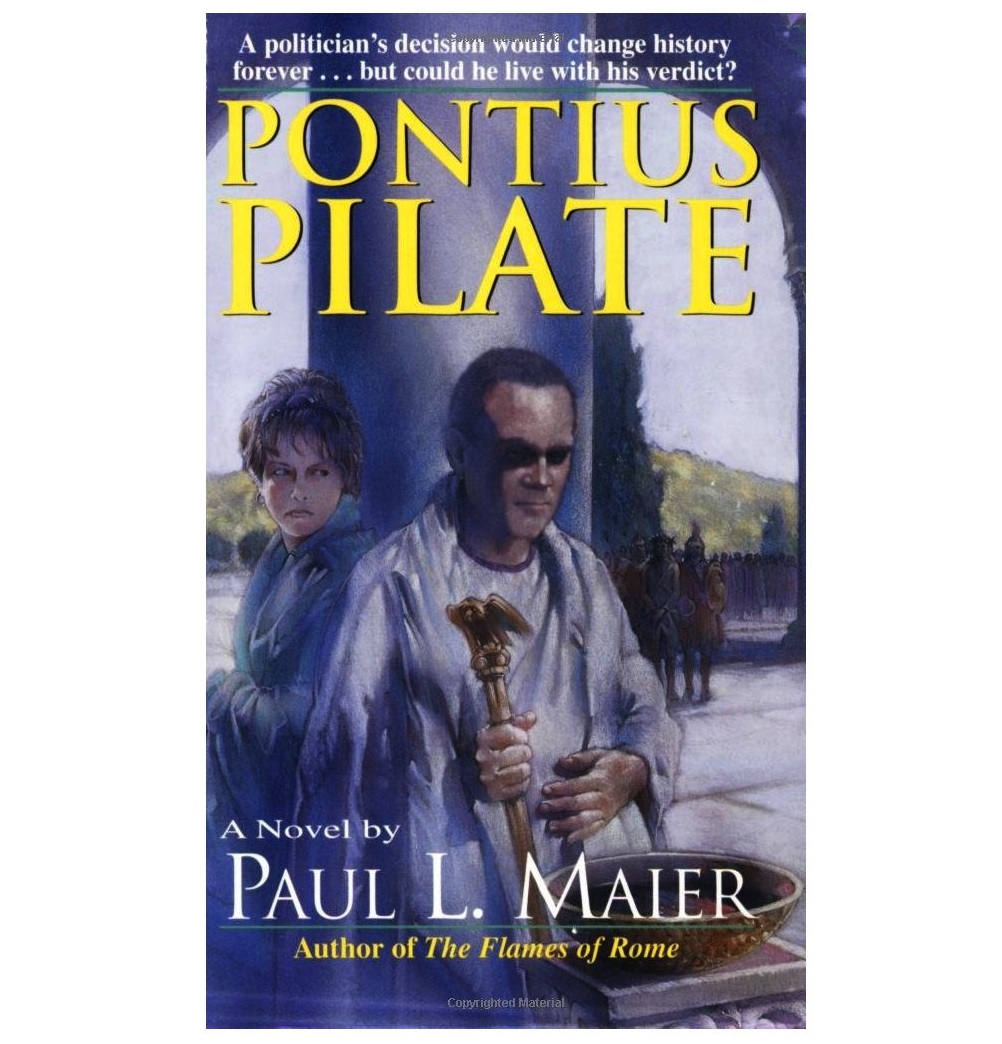
Book Review: Pontius Pilate by Paul Maier
I am just re-reading a book I devoured a couple of years ago. It is historical fiction, but don’t let that put you off. This historically annotated piece of work is a brilliant read. It presents a biographical insight into the life and career of Pontius Pilate–his background in Rome, his prefecture in Judea, his confrontations with the Jewish authorities, his history shaping encounter with Jesus of Nazareth.
I suppose this review is a little late for this year, but if you ever preach around Easter, then you must read this book. It was originally published in the 1960’s, but the timeless content means it could have been written last week. Paul Maier is a pre-eminent historian of the first century and this makes his reconstruction of character and event particularly insightful.
Why did Pontius Pilate feel so trapped? He was two strikes down with the Jewish populous when Jesus was presented to him. This man was clearly innocent, but Pilate could not afford another disaster. He could not face another report to the Emperor about his failure to manage the pesky Jewish religious affairs. His ring declared him a friend of Caesar, with all the rights that went with that. But the Sanhedrin turned the Jesus trial into an ultimatum for Pilate. Was he really a friend of Caesar, or were these Jewish leaders more concerned with peace in Judea than he was?
Even if it is too late for this Easter, Christianity is an Easter faith and so I would strongly encourage you to get a copy of Pontius Pilate. Don’t read it to your children, but grab a drink, get comfortable and step back into the first century. Any preacher will benefit from doing so.
Three Possibilities Preaching Psalms
As I am reading through the Bible I am currently in the Psalms – what a great book! Sadly, for some, Psalms seems to be preached only as filler material in the summer holidays. There is so much potential for preaching in the book of Psalms. Let me offer three possibilities opened up by preaching from this book:
1. You can introduce new treasure to people. People tend to be familiar with some Psalms. Probably 23. Perhaps 24, 1, 110, 121, 127, 51, 8, 73, 37, 27. But what about Psalm 36? Or 33? There is a whole host of Psalms that tend to get ignored in the annual audition for three filler sermons. And don’t just stick to the filler sermon approach. Why not preach Psalm 34 at the start of a series on 1Peter? It certainly was in the mind of the apostle as he wrote his epistle. Why not preach Psalm 118 in connection with Easter? It might add a new set of thoughts to the Easter considerations since Jesus would very likely have sung that with his disciples at the last supper.
2. You can connect with a different group of people. It may be a stereotype, but some have suggested that engineers enjoy epistles. They like the truth statements, logical flow, direct discourse. So if that is the case, who might appreciate the Psalms? Artists? Sure, and there are more of them than we tend to realise in every congregation. How about the suffering? Certainly. Psalms connects with different people at different times in the complexities of each personal biography.
3. You can offer a more vulnerable sermon. When David wrestles with spiritual realities, why not be more open that we do too? Personal sin struggles, doubting God’s goodness, tendency to trust in ourselves, feelings of extreme fatigue, etc. We don’t preach to preach ourselves, but we ourselves do preach. The Psalms opens up the possibility of greater vulnerability from the preacher, and hopefully stirs vulnerability in the congregation. The Psalm writers didn’t treat God as delicate or fragile, they blasted their prayers at Him. Perhaps we can stir greater prayer in churches that tend to pray religiously, and Psalms would be a worthwhile workshop for that kind of goal.
Popcorn?
This week I may be a bit quieter than usual on the site. I am working on notes for the European Leadership Forum that is coming up in May. It is a privilege to be involved in the Bible Teachers Network there and your prayers are appreciated as I finish off the teaching notes for that event. Meanwhile, here’s this week’s Cor Deo post, simply titled Popcorn?
Dangerous Immunization 2
Yesterday we were thinking about the danger of having non-Bible lovers teaching children and youth. But there are other Bible ministry opportunities in the church:
Surely the home Bible study is a safe place for different folks to try their hand at leading? Absolutely, it can be a very safe and loving environment as far as the trainee leader is concerned. People will be reasonably forgiving toward them. But turn it around. What effect will their leadership have on others present? I am not talking about polish and skill . . . this can be learned and people will be patient. I am talking about core motivation for the Bible. Out of the group who meet on that evening each week, don’t invite someone to try leading unless they have an evident personal appetite for the Word. You might have a Bible college trained, capable presenter, experienced school teacher, well dressed and even charismatic person in the group who is showing motivation to lead the group. But if that person lacks an evident hunger for God’s Word, don’t let them near the reins. There may be another person who ticks far fewer boxes, but if they are not an immunizer, they might be the next Bible study leader to train up and launch.
There may be other venues that include “sharing a biblical thought.” Perhaps a prayer gathering or a social event or whatever. Make sure that every potential biblical communicator is a potent biblical communicator. Having a wider group of people speak, even in a “safe” venue, is not worth it. A good shepherd will not let some of the sheep be immunized so as to lose their appetite for healthy grass, no matter how small a group of sheep are involved, or how brief the immunization exposure might be.
Then there is the pulpit ministry of the church. How many Sundays should a church knowingly tolerate pulpit ministry from people without a personal hunger for the Bible and the God of the Bible? How many Sundays in a year is it ok to have dull, unhelpful, weak preaching? I think once a year is too often. For the visitor that comes that week, the effect could be lifelong. Better to have a local with a passion for God and His Word than a visiting “expert” who dulls the hearts of the listeners.
I feel for the churches where there doesn’t seem to be anyone who can teach the children, the youth, the adults, with a delight in God and His Word. But if that is your church, perhaps you are the key player. Invite people to read through the Bible with you, pray for someone to get infected with the real disease. Seek to infect someone and then see them grow into being a biblically infectious Bible study leader/teacher/preacher. And at the same time do whatever you can to never let a non-Bible lover teach the Bible. The cost is too high.
Dangerous Immunization
Something is not always better than nothing. My wife and I went to a local restaurant and she decided to try something different: pheasant. We’ve never had it before. We’ll never choose it again. The one we were served was poor: chewy, funny tasting, and a piece of shot included as a bonus. Others may say how great Pheasant can be, but we tasted enough of the bad version to probably never choose it again.
There is too much Bible immunization going on in churches. That is where the administration of weakened or dead pathogens are introduced to healthy persons so that immunity is developed against lively forms of the same “disease.” Take the life out of the Bible and give it to people, but don’t be surprised when they develop a distaste for the Bible.
Take Sunday School, for instance. Since the church has always had four classes, it must always have four classes, even if that means pressuring people to teach who lack any personal delight in God’s Word. The children taste a “nothing there” version of the Bible that feels like ancient fables with predictable moral lessons from dull non-infectious teachers. Better to have two or even one classes with a good Bible teacher than more classes where any of them are offering an immunizing effect.
Then the children move up to youth ministry. Here’s a safe place for people to “cut their teeth” on Bible teaching in a safe environment. Perhaps, but only let people teach who have a personal appetite for and delight in God’s Word. It is dangerous to open the door to immunizers. The young folks are at a key stage in life. They are preparing for university, for adulthood, for living out their own faith. And if they have been dulled to the Word of God, then the damage done by such bad leadership choices will be impossible to calculate.
I learn a lot by teaching, but I don’t think it is wise to give people the opportunity to teach in order to generate an appetite within them. It may work for them. But the cost for the listeners is too high. Tomorrow we’ll follow this through into the home group and pulpit ministries of the church.