 Here is a post looking at a key word in the book of Acts – repent/repentance. We have to be so careful not to import our meanings to a word, but to instead be diligent to see what the author intended to communicate by using the term as he did. Click here to go to the post.

Responsiveness 2
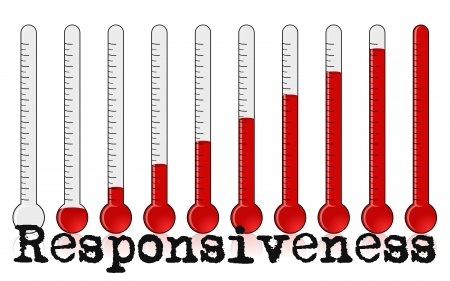 Continuing the list of factors that influence the responsiveness of a congregation. Some you can influence, some you just live with. Actually, today they are all things to influence:
5. Subject – Some subjects will be more engaging than others. If the subject seems less engaging, don’t settle for low engagement . . . what can you do to engage the listeners? Is there a way to bring a narrative aspect to the message, either in organisation, in setting of biblical scene (i.e. preach the narrative setting of an epistle section), or at least in illustrative content. A good preacher can make a dull subject engaging. In fact, a good preacher will do so without hesitation, since only listening listeners will typically be touched by a message.
6. Level – Engaging content preached over the heads of listeners, or patronisingly offered, will not actually engage. Too heady and people feel intimated and drift. Too patronizing and people get frustrated and feel like their time is being stolen. Make sure you pitch things at an appropriate level. Just because you have read technical material in your preparation does not mean that people need to know that. Aim to communicate, not to impress.
7. Proxemics – Are you elevated above the listeners, are you on the same level, or are they looking down at you? How far away are they? Is there furniture separating you from them? These things can all make a huge difference. Sometimes something as small as standing beside the lectern instead of behind it can make a huge difference.
8. Spiritual Maturity – Perhaps this is the overall goal, but if you are preaching to a church over a period of time, then hopefully this will increase. As maturity increases, people should be leaning in more to biblical preaching that offers Christ and engages hearts. (Bear in mind that when temperatures increased in some, the New Testament always seems to show others that became harder . . . response will not be universally positive!)
What other factors would you add to the list?
Responsiveness
Every congregation is unique. If you have ever preached in a different church, you will know what I mean. What are some of the factors that influence how responsive a congregation will be? Let me list a few. Some of these will just reassure you that you are not going mad. Some may suggest things that you might be able to change.
1. Culture – Different national groups respond in different ways. I remember preaching in a country that had just come out of a brutal civil war. The listeners seemed so hard to me, as if nothing could move them. Actually they were not as internally hard as they were externally, but it took some getting used to for me as the preacher. At the same time, it isn’t fair, or even possible, to simply use broad brush strokes for describing responsiveness. There may be a more typically British congregation, but each British congregation is still unique. The same is true for American, or Italian, or Kenyan, etc.
2. Church Culture – Each church is different. Different personalities will affect the tone of a church congregation. It could be a person with a hearty laugh, or it could be an immature person with showy spirituality. The leadership will affect the tone of a church: corporate culture is their responsibility, whether they recognize it or not. A church with clear vision and momentum will react to a preacher differently than a church without direction left to personal preferences and a social club mentality. Everyone makes a difference to a church culture, especially those in official or unofficial leadership.
3. Age – If there is a typical age in a group, it will influence responsiveness. Compare and contrast talking to children, to teens, to young adults, to middle-aged folk, and to the elderly. For one thing, if they don’t catch what you are saying, they won’t respond as you might expect them to respond. Seems obvious, but be sure to preach appropriately to the ages present.
4. Speaker – Just in case we are starting to think that it is all about the congregation, here’s a big factor in their responsiveness – the speaker! Is the speaker engaging? Warm? Flippant? Friendly? Upset? Easy to listen to? Distant? Is there lots of eye contact? What about a smile? Is the body language suggestive of an approachable person, or one who is aloof and disengaged? Do the listeners get the sense that the speaker likes them, that the speaker cares about what is being preached, that the speaker wants to be there? The same congregation can be warm and responsive, then with another speaker seem cold and uninterested. They aren’t being fickle!
Preaching Paul in Acts
 Recently I preached what was essentially a topical series. I wanted to look at a set of basic theological issues, but wanted to root the messages in a biblical text. I ended up using Paul’s journeys in Acts. There are some real advantages to working with that section of the Bible and it reminded me again of some real benefits to preaching from Acts:
1. You are preaching exciting narrative. The journeys were not dull! Whether it is people being saved, or preachers being beaten, it makes for exciting preaching content if you can tell a story engagingly.
2. You are preaching obviously relevant narrative. Spreading the gospel into pagan Europe is probably more relevant to most of us than fighting local armies or dealing with excessively tall enemies (although preaching OT narrative is awesome in other ways, of course).
3. The focus of the narrative is gospel proclamation. This means that the excitement and advance in the action is actual preaching, or at least, summaries of preaching. As you compare Paul’s preaching in Lystra and Athens, you can see patterns in how he addressed the biblically illiterate. As you compare Pisidian Antioch to the Ephesian elders at Miletus, you can see the difference between gospel presentation to a Jewish audience and a gospel application to Christians.
4. Patterns emerge in a book like Acts. For instance, how striking to see the gospel stir response followed by antagonistic reaction. Do a word study of repent and turn in Acts and you will be struck by how the terms are so consistently used (11x & 8x respectively) as a relational move, rather than a behavioural one. Notice God’s deliberate paralleling of blessing to Jewish converts and to Gentile converts.
5. Other Scripture is supportive and significant. The informing theology in Acts is stirring as you can trace the quotes, the allusions, the background themes, etc. As a preacher this opens up windows of opportunity!
So much more could be said, but I’ll leave it there. If you haven’t preached from Acts for a while, maybe it is time to return?
How to Preach Less Than Christian – Part 4
 Preacher, Bible, sermon, sorted. Christian preaching. Perhaps. In this series I have been nudging us to consider whether our preaching is genuinely and fully Christian. We have considered issues of which God we preach, what it means to be made in His image, the full extent and nature of sin, and let’s finish with one more area of focus – God’s solution to the sin problem.
4. Fail to recognize the relational and transformative nature of God’s grace.
Grace is a tricky word. To read of sin and grace was standard fare in the past, but today there is often a push back against the notion of grace. I think this comes from a misrepresentation of God’s grace that goes soft on sin in some circles. This is so unfortunate. Grace is not just a reference to God’s goodness toward us in all the biblical dimensions, it is also used as a theological label to stand for God’s provision to overcome the sin problem. Here are a couple of thoughts on the solution to our sin problem:
A. God’s solution to our problem fully addresses our problem. We are sinners who stand condemned legally. Grace has to take care of that, and it does as we are justified and not under condemnation, it is by grace we are saved. And we are also sinners relationally – our hearts are dead toward God and we lack God’s Spirit as we are separated from the life of God. God’s solution to our sin problem is not merely to offer legal status change, wonderful and foundational as that is, He also transforms the heart and gives the Spirit (regeneration and reconciliation as well as justification!)
B. God’s solution to our problem results in genuine life change. When people focus only on the legal change brought about by God’s grace in justification, there is a tendency to fear the potential for that grace being abused. With good reason! If salvation were only status change, but no heart transformation, then the flesh would still rule in every situation. But the gospel brings change to the very motives and values of the heart. If people are inclined to abuse grace, the solution is not balancing grace with some sort of burden and coercion, but to do a better job of presenting grace in all its fullness (and clarifying that grace does not equate to nice-ness or lax-ness – God’s love and grace are written in the crimson red of Jesus’ blood).
C. God’s solution to our problem is not merely the plan for initiating the Christian life. Grace upon grace. By faith from first to last. Gaze fixed on Jesus. The Christian life is not about turning our focus back onto our own efforts, but about growing in our love for and response to the God who loved us first.
Preaching the gospel is a wonderful privilege. Let’s be sure to preach it both simply, and in all its fullness, with relevance to both the lost and to believers.
Anticipating 2 out of 3
 Why are we thrilled by what we read in the Bible, but less than thrilled by what we experience every day? To go to this post, click here.
How To Preach Less Than Christian – Part 3
Preacher in a pulpit with a Bible and some thoughts . . . Christian preaching? Maybe. Here is another warning sign that our preaching may be offering something less than the gospel.
3. Fail to recognize the gravity of sin.
To much Christian theology and evangelistic preaching assumes that everyone knows what sin is. Sin is sins, right? Stealing, lying, murder, adultery, etc. So obvious that there is no need to probe the issue, just be sure to make lots of noise about it. But what if our view of sin is altogether too shallow?
A. It is easy to make a lot of noise about half of sin. Everyone is inclined to hand pick which sins are their personal target and then make noise about such things. But the list of sins is typically truncated. It tends to be the ones that I don’t struggle with. But what about the deep sin coming to the surface in other ways? More on the root versus the fruit in a moment, but at the fruit level, what about the acceptable sins? Why don’t we hear so much on the sins that tend to be an issue within the church? Too easily we aim our guns at people who haven’t even engaged us in our dialogue.
B. It is easy to rage against society, but what does that achieve? I know that theologically the world is clearly in opposition to God and His values. But at the same time, simple raging against people not present doesn’t achieve much. For one thing, if a non-church person happens to visit, they might feel like the church is a place for complaining and arguing with straw-man enemy figures. For instance, I wonder if people would be so bold in statements about outspoken opponents of religion if they were present? So someone might hear and that might actually paint an unhelpful picture of the church. Furthermore, church folk might hear and grow in their fleshly inclination to compare with others, thereby losing sight of the sin that is their own greatest problem. Fanning the flames of fleshly pride is not helpful.
C. In our noisy preaching about half of sin, we may be understating the issue altogether. Even if we add older brother behaviours to younger brother behaviours and make our sin lists more complete, we are still addressing the issue at the level of fruit rather than root and sap. When we treat sin as what comes out, we make it sound behavioural by definition. But the Bible treats sin as a heart-level issue. The heart of the human problem is the human heart. Out of the heart spews all types of sin: the drunken orgy rebellion type, and the prideful religious churchy type . . . both from a heart dead toward God. The behaviours weren’t the ultimate issue with those two sons, it was their hearts – despising relationship with father and loving self. The manifestation was different, but the hearts were equally lost.
Sin is to important to treat as a given. We have to diagnose the depths of the human problem if our gospel preaching is to offer an appropriately radical cure.
How to Preach Less Than Christian – Part 2
Christian preaching is easy to spot: preacher with Bible in a church. But maybe it is not so easy? Continuing this series on warning signs that your preaching may be slightly less than Christian.
2. Fail to hear the hiss of serpent-like independence in the way you view people.
We live in a culture that esteems and values and assumes the independence of individuals. Parents are pressured to raise independent children. Counselors seek to get people to a state of “healthy” independence. Advertisers promise us the fulfillment of wealthy independence. We are individuals and we will fight for our independence. The language of freedom and inalienable rights sounds as solid as biblical truth itself.
In the sixth century a certain Boethius defined a person essentially as a “thinking-choosing individual” . . . all three elements may be true of us, but is this the sum of personhood? Ever since Genesis 3, it has seemed to be, but it is not the original design. What is more, the original design is still in operation, albeit broken on so many levels. Let me explain.
A. We experience life as thinker-choosers. I am presented with three options (three cookies or three jobs, whatever), and I think and I choose. Simple. But why do I think what I think? Why do I choose what I choose? Where are the values coming from that enable me to prefer chocolate chip over peanut butter . . . many people would argue that my preference for the former is irrational, but that just shows they have differing values. Where do they come from? And I do make choices, but why is it that I always choose what I want to choose? Why is it, as sales people know, that we actually seem to buy based on what we love and then rationalize and justify our preferences?
B. We experience life as individuals. I have my own private thoughts and desires and dreams. I have my own private thought processes and struggles and difficulties. I make my own choices. There is a disconnect between me and others. Yet I also experience that my life is not really truly independent. My choices make a mark on family and friends. And often in my private independence, there is a loneliness and apparent lack. A beautiful sunset does little for me if I feel genuinely alone in that moment.
C. We were created as heart-driven relational responders. Our thinking is informed by our heart values. Our choices are driven by our wants. Our inherent design is profoundly relational. We will choose what we want, but we cannot choose what it is that we want. Our wants are free to roam around the gravity centre of our heart-orientation, and in our sinful dead state, we are dead toward God as an alternative gravity centre to our self-world.
Implication for preaching? If we are treating people as thinking-choosing individuals, we may be saying Bible truth to them, but our preaching will be less than Christian. We cannot simply educate people or pressure people into social conformity and call that gospel ministry. The gospel works not from the outside-in, but from the inside-out – it brings heart change that leads to life change. Boethius didn’t get that, let’s be sure we do.
 Biblical Preaching